

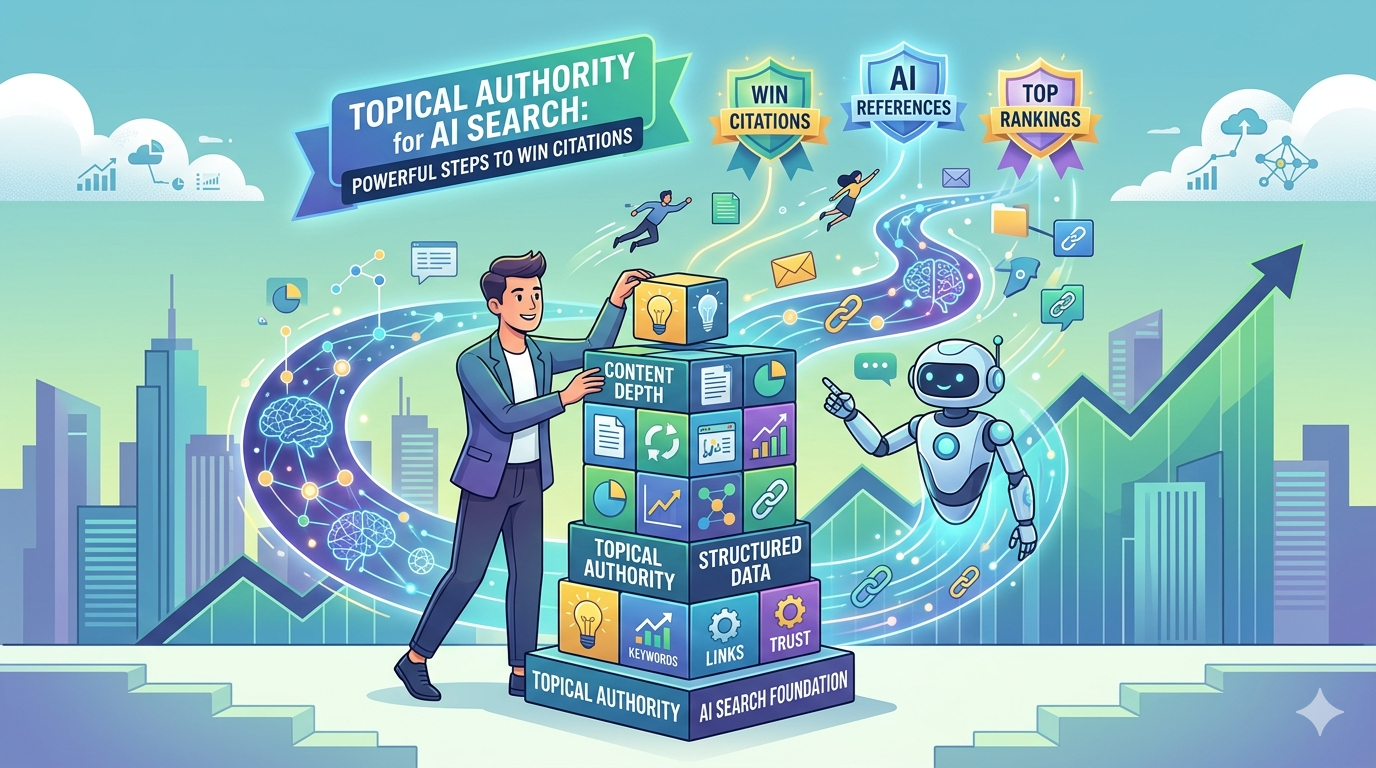
Search didn’t just change, it flipped. Ranking #1 on Google used to be the finish line. Now the finish line is being quoted by an AI engine before a single blue link ever loads. When someone asks ChatGPT, Gemini, Perplexity, or Google’s AI Overviews a question, those systems don’t reward the page with the most keywords. They reward the source they trust most on the subject. That trust is what Topical Authority for AI Search is all about, and it has quietly become the difference between brands that get cited everywhere and brands that vanish.
This guide breaks down exactly what topical authority means in the age of generative search, why AI engines weigh it more heavily than traditional search ever did, and the nine practical steps you can use to build it, backed by current data, not guesswork.
TL;DR
- Topical Authority for AI Search is the recognition that your site is the expert on a subject, earned through deep, interconnected, trustworthy coverage, not keyword stuffing.
- AI engines use Retrieval-Augmented Generation (RAG): they retrieve trusted sources, then synthesize an answer. Authority decides who gets retrieved and cited.
- Princeton’s landmark GEO study found that adding statistics lifts AI visibility by 41% and citing sources can lift it 115% for lower-ranked pages (Aggarwal et al., KDD 2024).
- Brand mentions correlate far more strongly with AI citations (0.664) than backlinks (0.218), according to Ahrefs’ Brand Radar analysis of 76 million AI Overviews.
- Build authority with topic clusters, entity clarity, answer-first formatting, internal links, structured data, and consistent off-site mentions.
- Keyword stuffing actively hurts you in AI search, it performs worse than no optimization at all.
- Expect a 4–8 week lag before GEO changes show measurable citation gains.
What Is Topical Authority for AI Search?
Topical authority is the degree to which search engines and AI systems recognize your website as a credible, comprehensive expert on a specific subject. In classic SEO, it helped you rank a cluster of related pages. In AI search, it does something bigger: it determines whether a generative engine considers you safe enough to cite without misleading its user.
That’s the real shift. When an AI assistant assembles an answer, it’s silently asking, “Who is the genuine expert here?” rather than “Who optimized best for this keyword?” Building this kind of authority means giving these systems an unmistakable answer, through depth, structure, and consistency they can verify across the web.
It helps to separate two ideas people often confuse: domain authority and topical authority. A news site with sky-high domain authority may have zero credibility on, say, sustainable fashion. Meanwhile a focused niche blog that publishes 20 interlinked articles on that exact topic can out-rank, and out-cite, the giant. AI engines need the most credible subject-matter expert, and broad popularity doesn’t guarantee that.
Topical Authority vs. Domain Authority
| Factor | Domain Authority | Topical Authority |
| What it measures | Overall backlink strength across all topics | Subject-matter expertise on one topic |
| Primary signal | Referring domains, link equity | Depth, coverage, entity relationships, consistency |
| Scope | Site-wide, generic | Niche-specific, focused |
| AI search weight | Moderate (a supporting signal) | Very high (a primary citation signal) |
| Who wins | Big, established sites broadly | Focused experts within a category |
Why Topical Authority Matters More in AI Search
The economics of search are being rewritten. Gartner projects that traditional search volume will decline 25% by 2026 as queries migrate to conversational AI interfaces. At the same time, organic click-through rates have collapsed by as much as 61% on Google queries where an AI Overview appears (Seer Interactive, 2025). When AI answers the question on the page, the click never happens, unless your brand is the cited source inside that answer.
Here’s why authority is the lever that matters most:
- AI engines extract, they don’t just rank. They pull passages, summarize them, cross-reference claims, and decide whom to credit. Shallow content gives them nothing reliable to extract.
- Citation overlap with old rankings has cratered. The overlap between Google’s top-10 organic results and AI citations dropped from roughly 75% in mid-2025 to as low as 17–38% in early 2026 (BrightEdge/Demand Local). Ranking high no longer guarantees you’ll be cited.
- AI traffic converts. Visitors arriving from AI engines convert dramatically better than organic search, often 10–16% versus around 1.76% for Google organic (Seer Interactive). Being cited isn’t a vanity metric; it’s high-intent traffic.
In short, topical authority isn’t a “nice to have.” It’s the framework that decides whether AI systems treat your brand as the reference point for your niche or skip you entirely.
Traditional SEO vs. Generative Engine Optimization (GEO)
GEO – Generative Engine Optimization, is the practice of structuring content so AI engines cite it. It overlaps with SEO but rewards different signals. The strongest performers treat them as partners, not rivals.
| Dimension | Traditional SEO | Generative Engine Optimization (GEO) |
| Goal | Rank in the list of links | Get cited inside the AI answer |
| Success metric | Rankings, clicks, organic CTR | AI citation share, brand mentions, overview visibility |
| Core unit | The page | The extractable passage |
| Top signals | Backlinks, keywords, on-page SEO | Entity clarity, statistics, source citations, consistency |
| Keyword stuffing | Risky but historically tolerated | Actively harmful, performs below baseline |
| Tone | Often promotional | Non-promotional, factual (promo tone hurts citations) |
The Princeton-led study behind GEO, conducted by researchers from Princeton, Georgia Tech, IIT Delhi, and the Allen Institute for AI tested nine content strategies across 10,000 queries. The standouts were adding statistics, citing sources, and adding quotations, each producing 30–40% improvements in AI visibility, while keyword stuffing performed about 10% worse than doing nothing at all (Aggarwal et al., KDD 2024). That finding alone should retire the old playbook.
How to Build Topical Authority for AI Search: 9 Steps
1. Map the Entire Topic Before You Write a Word
Authority comes from owning a conversation, not publishing a post. Start with a pillar, the broad subject you want to be known for, then map every sub-entity, process, comparison, FAQ, and case study around it. The goal is semantic completeness: if a user could ask 50 questions about your niche, your content ecosystem should answer all 50 well.
2. Build Interconnected Topic Clusters
A pillar page anchors the topic; cluster articles cover each facet in depth and link back to the pillar and to one another. This structure does double duty. It tells Google your site has real depth, and it tells AI systems your content is organized, connected, and trustworthy. Clusters that don’t interlink are effectively invisible to AI platforms, they read as scattered, low-confidence sources.
3. Optimize for Entities, Not Just Keywords
AI search runs on entity relationships, not keyword repetition. Entity-based optimization is reportedly about three times more effective than keyword-based SEO in generative engines (SEO Sandwich, 2026). Be explicit about who you are, what you do, and which topics you own. Use clear, consistent naming, and define key terms so an AI can categorize and retrieve you correctly.
4. Lead With the Answer (Make Content Extractable)
If your ideas are easy to extract, they’re easy to cite. Put a direct, self-contained answer in the first 40–60 words beneath each H2 or H3, what practitioners call an “answer capsule” or BLUF (Bottom Line Up Front) structure. Phrase headings as the questions real users ask, then answer them immediately. AI engines lift these passages verbatim.
5. Add Statistics, Sources, and Quotations
This is the single highest-leverage GEO tactic. Specific, verifiable data is a citation magnet. Compare “AI marketing improves results” with “AI-driven campaigns deliver 20–30% higher ROI”, the second gets cited, the first gets ignored. Princeton’s data confirms it: statistics addition improved AI visibility by 41% and citing external sources lifted visibility 115% for lower-ranked content (Aggarwal et al., KDD 2024). Cite credible third parties generously; doing so signals thoroughness and, paradoxically, makes you more likely to be cited, Semrush (2025) similarly found that non-promotional, source-backed content earns markedly more AI citations.
6. Wire Everything Together With Internal Links
Descriptive, contextual internal links turn isolated posts into a navigable knowledge system. They distribute authority across the cluster and give crawlers and AI retrievers a clear map of how your content connects. Use meaningful anchor text that describes the destination, not “click here.”
7. Build Consistent Off-Site Entity Signals
AI engines assess authority holistically, across the whole web. Every mention of your brand on industry publications, review sites, directories, Reddit, and Wikipedia reinforces your topical associations. Brand mentions correlate with AI citation probability at 0.664, roughly three times stronger than backlinks at 0.218, based on Ahrefs’ Brand Radar study of 76 million AI Overviews. Consistency matters too: AI citations can fluctuate 40–60% month over month, so a steady signal across sources is as important as the initial optimization.
8. Implement Structured Data and Clean Technical Foundations
Schema markup- Article, FAQPage, HowTo, and Author, helps machines understand your content and feed clean answers into generative systems. Equally important: make sure your site is crawlable, your canonicals are correct, and your sitemap is submitted to Bing Webmaster Tools, since ChatGPT Search retrieves heavily through Bing’s index. Structured data won’t manufacture authority, but it removes friction that can hide it.
9. Strengthen E-E-A-T and Publish Consistently
Demonstrate experience, expertise, authoritativeness, and trust. Add real author bios with credentials, cite your methodology, and write in a non-promotional voice, Semrush found promotional language reduces AI citation rates by about 26%. Then keep going. Sporadic publishing signals fading expertise; steady, thoughtful output on the same subject over time signals ongoing authority that both training data and live crawls reward.
How AI Engines Decide What to Cite
Most AI search experiences use Retrieval-Augmented Generation (RAG). The engine first retrieves relevant documents from its index or a live crawl, then generates an answer that cites a handful of selected sources. The factors that influence whether you make that shortlist are remarkably aligned with topical authority: comprehensiveness, structural clarity, factual specificity with verifiable data, source credibility, and consistency across platforms.
This is also why first-mover advantage is real. Citation authority compounds much like domain authority did before it. Brands that earn citation share early in a category make it harder for later entrants to displace them, the AI keeps returning to the source it already trusts.
Measuring AI Search Visibility
You can’t improve what you don’t track. As GEO matured, a new set of KPIs emerged that sit alongside traditional SEO metrics:
| Metric | What It Tracks | Why It Matters |
| AI citation share | How often you’re cited vs. competitors | Direct measure of authority in AI answers |
| Overview visibility | Presence in AI Overviews/AI answers | Reach within the generative layer |
| Brand mention frequency | Unlinked and linked mentions across the web | Top correlate of AI citation probability |
| Zero-click displacement | Lost clicks to AI answers | Quantifies risk and pivot urgency |
| AI-referred conversions | Conversions from AI traffic (via GA4) | Ties citations to revenue |
Set a realistic timeline. Most brands see measurable improvements in citation frequency within four to eight weeks of deploying proper GEO infrastructure, since open-world engines like Perplexity and Google AI Overviews pull live data and respond to structural changes relatively quickly.
Common Mistakes That Sabotage Topical Authority
- Random blogging. Jumping between unrelated topics dilutes your signal so badly that neither Google nor AI can tell what you actually stand for.
- Volume over depth. Five thin posts lose to one genuinely complete article every time. AI prefers one source that covers a topic fully over ten that skim it.
- Orphaned cluster pages. Articles that don’t link to a pillar or to each other read as low-confidence and get overlooked.
- Keyword stuffing. It’s not just outdated, it measurably lowers AI visibility below baseline.
- Promotional tone. Sales-y language suppresses citations. Write like a reference, not a brochure.
When to Bring in Specialists
Building topical authority in-house is entirely doable, but it’s a long game that compounds, and many teams accelerate it by partnering with specialists who live in this space daily. If you’re evaluating outside help, it’s worth reviewing curated comparisons of the best generative engine optimization agencies to understand who’s doing serious GEO work, and the top answer engine optimization agencies for teams focused specifically on getting cited inside AI answers. The right partner can compress months of trial-and-error into a focused roadmap.
Frequently Asked Questions
Is keyword clustering enough for AI search?
No. AI search prioritizes entity relationships and demonstrated expertise over keyword repetition. Clusters help, but only when they’re deep, interlinked, and entity-rich.
Can small websites build topical authority?
Yes, and niche dominance is often easier than broad authority. A focused site that thoroughly owns one subject can out-cite a far larger generalist within that category.
Does GEO replace SEO?
No. They work together. AI systems still lean on traditional search indices and authority signals, so a strong SEO foundation makes GEO far more effective.
How long until I see results?
Typically four to eight weeks for live-retrieval engines once solid GEO infrastructure is in place, though citation share continues to compound over months.
What’s the fastest single improvement I can make?
Add verifiable statistics with source citations and lead each section with a direct 40–60 word answer. Both are proven, high-leverage moves.
Final Thoughts
The rules of visibility have moved from ranking to reference. In this new landscape, Topical Authority for AI Search is the most durable asset you can build, it compounds over time and pays off in both traditional search and AI citations. Map your topic completely, publish interconnected and extractable content, anchor every claim in verifiable data, and keep your signals consistent across the web. Do that, and when AI systems summarize your niche, your brand becomes the answer they reach for first.
The competitive window is open because most brands haven’t started. The ones that build citation authority now are the ones AI will be quoting for years to come.