

Introduction
For two decades, the link-building playbook was simple: collect as many backlinks as possible and watch your rankings climb. That era is over. As ChatGPT, Google AI Overviews, Gemini, and Perplexity reshape how people find answers, the machines deciding which sites to trust have grown far more discerning. They no longer count links, they interpret them.
This shift has put AI backlink evaluation at the center of modern search strategy. Instead of treating every inbound link as a vote, AI systems now weigh authority, relevance, context, and credibility before deciding whether a source deserves to be cited or surfaced. Understanding how this assessment works is the difference between getting referenced in AI answers and disappearing from them entirely.
TL;DR
- AI backlink evaluation is the process by which AI-powered search engines analyze the quality, relevance, and authority of a site’s links to decide whether to trust and cite it.
- Quality and authority now outweigh raw link volume, a few authoritative links beat hundreds of weak ones.
- A Semrush study of 1,000 domains found Authority Score correlated strongly (Pearson 0.65) with how often a domain was mentioned in AI answers.
- Nofollow links carry nearly the same weight as follow links in AI search, and image links can perform even better than text links.
- Authority gains follow a threshold effect, small link wins barely move the needle until a site crosses higher authority tiers.
- Google’s SpamBrain uses machine learning to cluster and neutralize manipulative links, making low-quality tactics counterproductive.
- Winning at AI link building means earning relevant, editorial links from trusted sources and building genuine brand presence.
What Is AI Backlink Evaluation?
AI backlink evaluation is the method AI-powered search engines and large language models use to judge the value of the links pointing to a website. Rather than tallying a numeric score, these systems analyze the meaning behind each link, who is linking, how relevant they are to the topic, the context surrounding the link, and whether the pattern of links looks earned or manufactured.
In practical terms, when an AI search engine decides which sources to pull into a generated answer, it leans heavily on signals of trust. Backlinks remain one of the strongest of those signals. The Semrush and Kevin Indig study put it plainly in its conclusion: backlinks still matter in AI search, but quality and authority matter far more than quantity. That single insight reframes the entire discipline of AI link building.
How AI Evaluates Backlinks Differently From Traditional Search
Traditional Google ranking treated links largely through PageRank, a model where authority flowed from page to page and more links generally meant more equity. AI systems borrow from that foundation but add layers of semantic understanding. They read the content around a link, map entity relationships, and assess whether the linking source is genuinely authoritative on the subject.
The table below summarizes how the two approaches differ.
| Factor | Traditional Search | AI Backlink Evaluation |
| Primary unit | Link volume and PageRank flow | Authority, relevance, and trust signals |
| Anchor text | Heavily weighted for keywords | Read in context; over-optimization penalized |
| Nofollow links | Largely discounted | Nearly equal weight to follow links |
| Relevance | Helpful but secondary | Critical, topical fit drives citations |
| Brand mentions | Minor indirect signal | Reinforce authority even without a link |
| Evaluation logic | Rule and pattern based | Machine learning + semantic context |
This is why how AI evaluates backlinks feels less like accounting and more like editorial judgment. The relationship between AI and backlinks is built on credibility, not arithmetic.
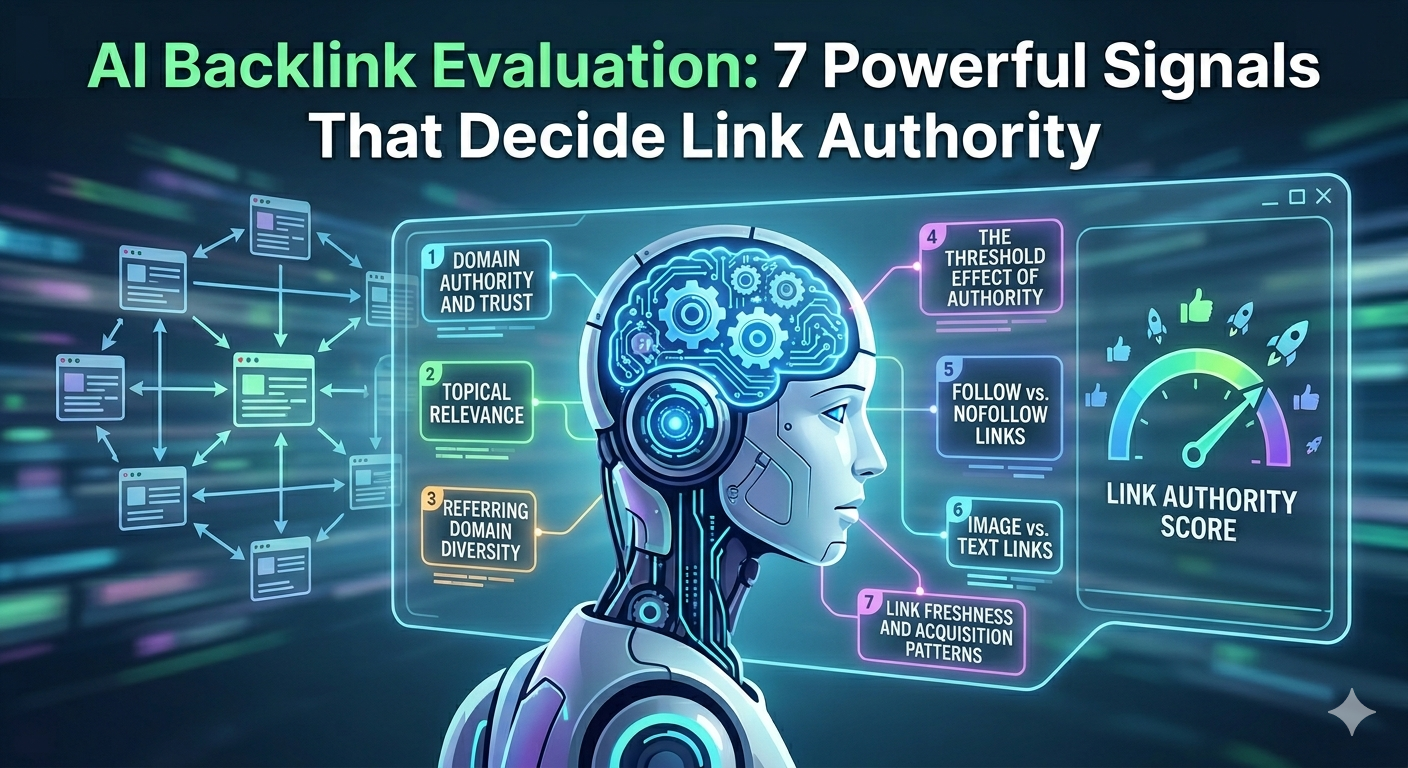
The 7 Core Backlink Quality Signals AI Systems Assess
Effective AI backlink analysis comes down to a handful of signals that AI search ranking factors consistently reward. These are the backlink quality signals that determine whether your links build authority or quietly drag it down.
1. Domain Authority and Trust
The single most influential signal is the overall authority of the linking domain. In the Semrush study of 1,000 domains across five AI platforms, Authority Score showed a strong 0.65 Pearson correlation with how often a site appeared in AI-generated answers (Semrush, 2025). Links from established, trusted publishers transfer meaningful credibility; links from obscure, traffic-less sites transfer almost none.
2. Topical Relevance
A backlink from a website deeply aligned with your subject carries far more weight than one from an unrelated high-metric domain. AI systems analyze co-citations and the semantic relationship between the linking content and your page. A health publication linking to a dental practice is far more valuable than a generic directory link.
3. Referring Domain Diversity
AI rewards links spread across many independent sources rather than repeated links from the same few sites. Backlinko’s analysis of 11.8 million search results found that the number of referring domains had the strongest correlation with rankings of any factor studied, with the #1 result averaging 3.8x more backlinks than positions 2–10 (Backlinko). Diversity signals organic, distributed trust.
4. The Threshold Effect of Authority
One of the study’s most important findings is that authority gains are not linear. Small, incremental link wins barely register until a domain crosses into a higher authority tier. As Kevin Indig summarized, you need a minimum investment before AI backlink evaluation rewards your effort, gradual link growth alone won’t move the needle.
5. Follow vs. Nofollow Links
In a surprise that overturns classic SEO advice, nofollow links carry almost the same weight as follow links in AI search. The Semrush data showed follow links at 0.334 Pearson and nofollow links at 0.340, virtually identical. AI models treat both as legitimate references when they come from authoritative sources like Reddit, Wikipedia, or Quora.
6. Image vs. Text Links
Image-based links performed as well as, and sometimes better than, text links. Image links registered a 0.415 Pearson correlation versus 0.334 for text links. Original charts, infographics, and data visuals that others embed and credit have become a genuine AI link building asset.
7. Link Freshness and Acquisition Patterns
AI systems evaluate links over time. Natural, steady acquisition signals trust; sudden spikes from low-quality sources flag manipulation. Keeping existing placements current, refreshing stats and visuals on pages that already link to you, sustains their value over time.
The table below shows how these signals translate into AI visibility based on the Semrush correlation data.
| Backlink Signal | Pearson Correlation | Spearman Correlation | Takeaway |
| Authority Score (quality) | 0.65 | 0.57 | Strongest single predictor |
| Image links | 0.415 | 0.538 | Outperform text links |
| Nofollow links | 0.340 | 0.509 | Nearly equal to follow |
| Follow links | 0.334 | 0.504 | Reliable but not dominant |
| Text links | 0.334 | 0.472 | Solid baseline signal |
What the Data Says About Backlinks for AI Search
The evidence that backlinks for AI search still matter is overwhelming. Across separate Semrush research tracking citations in 11 industries, AI visibility and AI mentions correlated at 0.87, and backlink scale showed its strongest coupling with AI visibility in sectors like finance, automotive, and technology. Authoritative, community-edited sources such as Wikipedia and Reddit dominated citations, with Reddit alone earning roughly 66,000 AI mentions across all 11 sectors.
Traditional search data reinforces the pattern. Ahrefs research has repeatedly found that the vast majority of web pages, around 95%, have zero backlinks and receive almost no organic traffic, while pages with even a single quality backlink perform dramatically better. The conclusion is consistent across both ecosystems: links remain a foundational trust signal, but the bar for what counts as a quality link has risen sharply.
How AI Search Engines Detect Low-Quality Links
The flip side of this assessment is detection. Google’s SpamBrain, a machine-learning system that has powered link spam enforcement since its 2018 launch, no longer relies on simple rules. It clusters links by shared characteristics like anchor text, timing, placement, and source type, then neutralizes entire networks when a pattern looks coordinated.
This is why manipulative tactics now backfire. SpamBrain and similar systems flag:
- Over-optimized anchor text – identical exact-match commercial keywords repeated across many domains.
- Irrelevant niches – links from sites with no topical connection to yours.
- Private blog networks (PBNs) – interlinked sites built primarily to sell or trade links.
- Velocity spikes – unnatural surges of links from low-quality sources.
- Thin or spun content – links buried in auto-generated pages with no editorial oversight.
The practical lesson: low-quality links at scale create detectable footprints that can discount your entire profile. In an AI-driven environment, one manipulative cluster can outweigh dozens of legitimate links.
AI Link Building: How to Earn Links AI Rewards
Winning at AI link building isn’t about gaming a formula, it’s about earning the kind of trust AI systems are designed to recognize. The most reliable strategies map directly to the signals above.
| Strategy | Why It Works for AI Search |
| Digital PR and expert commentary | Earns authoritative, editorial links that cross authority thresholds |
| Original research and data | Generates image and citation links that AI weighs heavily |
| Topically relevant guest contributions | Builds co-citations and semantic relevance |
| Brand mentions and unlinked citations | Reinforce authority even without a hyperlink |
| Community presence (Reddit, Quora) | Captures the nofollow links AI treats as trust signals |
Because earning high-authority links is slow and competitive, many teams accelerate the process with vetted partners. If you’re comparing providers, this roundup of the best backlink services is a useful starting point for finding relevance-first link building rather than volume-based packages that AI systems now discount.
The strategic priority is clear: pursue meaningful authority gains over incremental wins, never dismiss nofollow links from trusted sites, invest in shareable visual assets, and earn references for content that genuinely adds value.
AI Backlink Analysis Tools
Modern AI backlink analysis tools have evolved to surface the quality signals that matter. Platforms like Semrush combine massive link databases with AI-driven scoring to evaluate brand visibility on ChatGPT and AI Overviews, identify toxic links, and recommend high-relevance opportunities. The goal of any such tool is the same: separate the links that build durable authority from those that quietly create risk.
When auditing your profile, focus on three questions: Are my links topically relevant? Are they diverse across independent domains? And do any clusters show signs of manipulation? Answering those honestly is the foundation of a profile that AI-powered search engines will trust.
Frequently Asked Questions
Do backlinks still matter for AI search engines?
Yes. Multiple 2025 studies confirm backlinks remain a core trust signal, but AI systems prioritize authority and relevance over volume.
Does AI backlink evaluation treat nofollow links as valuable?
It does. Research shows nofollow links carry nearly identical weight to follow links in AI-generated answers, especially from high-authority sources.
How many backlinks do I need to appear in AI answers?
There’s no fixed number. Because of the threshold effect, what matters is reaching a higher overall authority tier through quality links, not hitting a specific count.
The Bottom Line
AI backlink evaluation has rewritten the rules of link building. The systems deciding which sites to trust now read context, weigh relevance, reward diversity, and punish manipulation with machine-learning precision. Volume is no longer a strategy, sustained authority is. Brands that earn credible, relevant links and maintain genuine presence across the web will keep showing up in AI answers. Those still chasing cheap links at scale will watch their visibility quietly fade. The path forward is to build the kind of authority AI systems are designed to recognize, one trustworthy link at a time.