

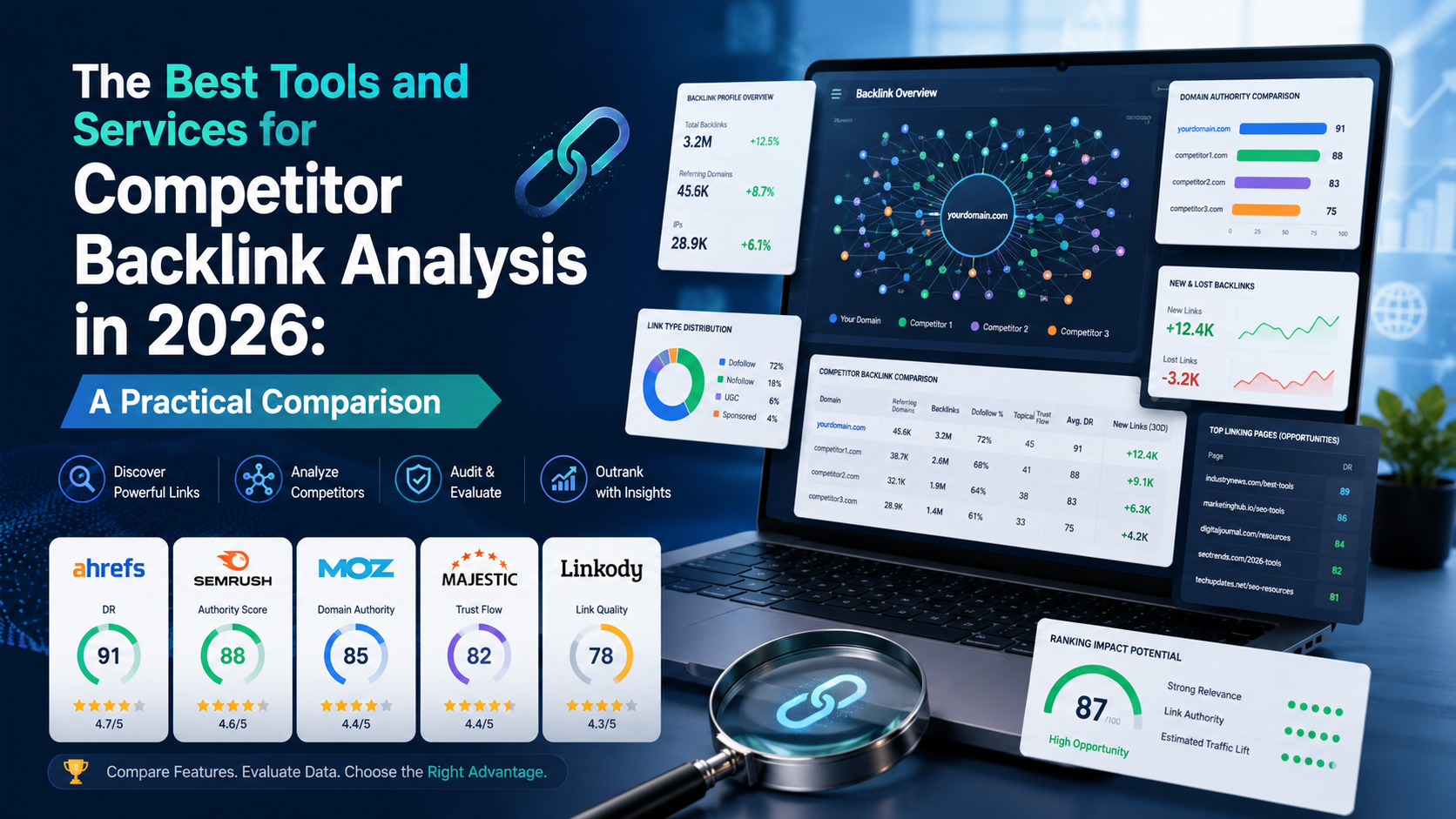
TL;DR: Ahrefs leads for raw backlink data freshness and depth. Semrush wins as the all-in-one suite with a powerful Backlink Gap tool. Moz is the budget-friendly option for beginners. Majestic is the specialist choice for link auditors. SE Ranking suits agencies that need white-label reporting on a tighter budget. If you want someone else to execute the link building after your analysis, OutreachZ offers a fully managed alternative.
If you have ever wondered why your competitor ranks on page one while you are stuck on page three despite publishing similar content, the answer is almost certainly sitting inside their backlink profile. Understanding where they earn their links, who vouches for them, and how aggressively they have been building authority is one of the highest-leverage moves in modern SEO.
That process has a name: competitor backlink analysis. And in 2026, the tools available to execute it have never been more sophisticated or, frankly, more confusing to choose between.
This guide cuts through the noise. It is built for SEO professionals, in-house marketers, agency strategists, and founders who want a straight answer about which tools actually deliver and for whom. We cover the leading platforms side by side, break down pricing, highlight what each does well, and tell you where each one falls short. We also discuss when it makes more sense to hand the execution to a specialized link building service instead of going it alone.
No affiliate spin. No inflated star ratings. Just the kind of honest breakdown you would get from a colleague who has been in the trenches.
Why Competitor Backlink Analysis Still Matters in 2026
Google’s algorithm has evolved considerably over the past few years, but the fundamental role of backlinks has not disappeared. High-quality links from authoritative, relevant domains remain one of the clearest signals that a piece of content deserves to rank. The strategic shift in 2026 is that link quality now matters far more than quantity, and search engines have grown remarkably good at detecting manipulative patterns.
This is exactly where competitor backlink analysis becomes a strategic advantage rather than just a diagnostic exercise. When you map where your competitors earn their best links, you are not just identifying targets for your own outreach. You are learning which publishers, editors, and website owners in your space have already demonstrated they care about your topic, and by extension, which relationships are worth pursuing.
Beyond opportunity discovery, running a thorough analysis helps you understand your competitive gap. If your top-ranking rival has 4,200 referring domains and you have 800, no amount of on-page optimization is going to close that gap on its own. The analysis quantifies the challenge and turns a vague feeling that “my competitors are doing something right” into a concrete number you can actually work toward.
There is also a defensive dimension to this. Monitoring competitor link velocity, meaning how quickly they are building links, lets you anticipate ranking shifts before they happen. If a competitor suddenly acquires 300 new referring domains in a month, that is worth paying attention to before it shows up as a rankings drop for you.
What to Look for in a Backlink Analysis Tool
Before jumping into the tool comparisons, it is worth establishing the criteria that actually matter. Not all backlink tools are built the same, and the differences extend well beyond marketing copy.
• Index size and freshness: A larger index means more data, but freshness matters equally. A link that went live yesterday but only shows up in your tool next week is potentially useful information you are acting on too late.
• Competitor gap analysis: The ability to compare multiple competitor domains simultaneously and flag link sources that point to them but not to you is arguably the most actionable feature any backlink tool can offer.
• Link quality metrics: Domain Rating (Ahrefs), Domain Authority (Moz), Trust Flow (Majestic), and toxicity/spam scores all attempt to answer the same question: is this link worth having? Understanding how each tool calculates these helps you interpret the data accurately.
• Anchor text distribution: Analyzing what anchor text competitors are using reveals their keyword strategy and can help you spot over-optimization patterns that may eventually trigger a penalty.
• Historical data access: Seeing how a backlink profile evolved over time is invaluable for understanding whether a site’s authority was built slowly and naturally or was artificially inflated.
• Reporting and workflow: For agencies and consultants, white-label reporting, client dashboards, and automated alerts are not nice-to-haves; they are operational necessities.
The Tools: An Honest Comparison
Table 1: Quick-Reference Overview
| Tool | Index Size | Update Freq. | Starting Price | Best For | Backlink Gap? | Free Tier? |
| Ahrefs | 35T links / 500M domains | Every 15–30 min | $129/mo | Backlink depth & accuracy | Yes | Limited |
| Semrush | 43T links / 390M domains | Every 15 min | $139/mo | All-in-one SEO suite | Yes (5 competitors) | 7-day trial |
| Moz Pro | 44.8T links | Weekly | $49/mo | Budget & beginners | Yes | 30-day trial |
| Majestic | Large historic index | Daily (Fresh) | $49.99/mo | Specialist link intel | No | No |
| SE Ranking | ~2T links | Regular | $52/mo | Agencies / affordability | Yes | 14-day trial |
| OutreachZ | Managed publisher network | N/A (managed) | Custom | Done-for-you link building | Strategy call | Demo |
1. Ahrefs – The Gold Standard for Backlink Data
TL;DR: Ahrefs is the most trusted tool for serious competitor backlink analysis. Its crawler is second only to Googlebot in activity, meaning new links typically appear in its index within hours of going live.
Ahrefs built its entire reputation on backlink data, and in 2026 that reputation remains well earned. The platform indexes 35 trillion known links across 500 million domains, and its web crawler operates continuously, updating link data every 15 to 30 minutes. For practitioners who care about catching competitor link moves quickly, that responsiveness is genuinely hard to match.
The Site Explorer feature is the workhorse of competitor backlink analysis on Ahrefs. You can drop in any competitor domain and immediately see a breakdown of referring domains, the strength of those domains, anchor text distribution, link velocity over time, and the specific pages attracting the most links. The Backlink Gap tool lets you compare your own profile against up to 10 competitors simultaneously and surfaces domains that link to your rivals but not to you, creating a ready-made outreach prospect list.
Ahrefs also allows batch analysis of up to 200 URLs at once, which is a significant time saver when vetting a large outreach list or auditing a niche’s link landscape quickly.
The downsides are real. Ahrefs eliminated its trial period, so you are committing to a paid subscription before testing the full product. Entry-level pricing starts at $129 per month. And while the interface is clean and fast, some users report that Ahrefs’ keyword research tools are slightly less comprehensive than Semrush’s on the content-marketing side.
Best for: SEO specialists, link builders, and agencies for whom backlink intelligence is the primary use case.
2. Semrush – The All-in-One Suite with Serious Gap Analysis
TL;DR: Semrush’s Backlink Gap tool is arguably the most actionable feature in this space for marketers who want link opportunities served up on a platter. Its 43 trillion-link index is the largest by raw count.
Semrush has evolved significantly from its roots as a keyword research tool. Today it is a full-stack digital marketing platform, and its backlink analysis capabilities are genuinely competitive with Ahrefs at the top level. The platform indexes 43 trillion links across 390 million domains, with new links refreshed every 15 minutes.
Where Semrush distinguishes itself for competitor backlink analysis is the Backlink Gap report. Enter up to five competitor domains alongside your own, and the tool instantly highlights publishers that link to multiple competitors but have never linked to you. In practice, this feature turns what could be a manual hours-long research exercise into a 15-minute session with a clear action list.
Semrush also integrates backlink analysis directly with its outreach management tools, which is an advantage over Ahrefs for teams that want to prospect and reach out within a single platform. The toxic backlink audit, which connects with Google Search Console, makes it straightforward to identify and disavow potentially harmful links before they cause damage.
The main friction point is pricing. The Pro plan at $139 per month is reasonable, but meaningful competitor analysis really benefits from the Guru tier at $249 per month. Per-seat costs also add up quickly for growing teams. Some advanced features like AI visibility tracking require the higher-tier Semrush One plans rather than the standard SEO plans.
Best for: In-house SEO teams and agencies that want a single platform covering keyword research, content marketing, competitive intelligence, and backlink analysis.
3. Moz Pro – The Budget-Friendly Option with Brand Recognition
TL;DR: Moz’s Domain Authority (DA) metric is still the most widely recognized link quality signal in the industry. If budget is your primary constraint, Moz Pro’s Starter plan at $49 per month is a legitimate entry point.
Moz occupies an interesting position in this space. On paper, its backlink database is larger than Semrush’s at 44.8 trillion links, yet most practitioners would rank it third behind Ahrefs and Semrush for practical link research. The discrepancy comes down to update frequency: Moz refreshes its index weekly, meaning you may not see a competitor’s newest links until days after they were acquired.
That said, Moz has earned its place in the conversation. The Domain Authority metric, while not a direct Google ranking factor, has become the industry shorthand for evaluating a website’s link authority. Virtually every SEO professional, writer, and publisher knows what a DA 60 domain means. This shared vocabulary makes Moz data useful for client communication even if Ahrefs provides richer data for internal analysis.
Link Explorer, Moz’s backlink analysis module, provides referring domain data, anchor text distribution, spam score detection, and competitor link comparisons. The Link Intersect tool surfaces domains linking to competitors but not to your site, similar to what Ahrefs and Semrush offer. The interface is genuinely beginner-friendly, which matters for smaller teams or founders running their own SEO without a dedicated specialist.
Moz’s 30-day free trial is the most generous among the major platforms. For anyone not ready to commit, this makes it an easy first step for evaluating backlink research tools with real data.
Best for: Small businesses, content marketers, and SEO beginners who need reliable backlink data without the complexity or cost of Ahrefs or Semrush.
4. Majestic – The Specialist’s Choice for Deep Link Forensics
TL;DR: Majestic does one thing and does it better than almost anyone: backlink analysis. Its Trust Flow and Citation Flow metrics and its historic index going back years make it a uniquely powerful tool for serious link auditors.
Majestic is the outlier on this list. It is not trying to compete as an all-in-one SEO suite. There is no keyword research tool, no rank tracker, no site audit. The entire platform exists to tell you about backlinks, and it does so with a level of depth that specialists genuinely value.
The proprietary metrics are the key differentiator. Trust Flow measures the quality of links pointing to a site based on their proximity to a set of trusted seed sites. Citation Flow measures the sheer volume of links. The ratio between the two, sometimes called the Trust Ratio, is a fast heuristic for spotting sites that have artificially inflated their authority with low-quality links. Topical Trust Flow goes further, categorizing backlinks by topic area to show how relevant a site’s link profile actually is to its stated niche.
Majestic also maintains two distinct indexes: the Fresh Index, updated daily, and the Historic Index, which contains link data going back years. The Historic Index is uniquely valuable for understanding how a site’s authority was built over time, which is information that most tools either lack or make difficult to access.
The platform starts at $49.99 per month for the Lite plan, which is accessible, but the lack of supplementary SEO tools means most practitioners use Majestic alongside another platform rather than as a standalone solution.
Best for: Link auditors, penalty recovery specialists, and advanced SEOs who want the deepest possible view into link quality and want a platform that exclusively focuses on backlink intelligence.
5. SE Ranking – The Agency-Friendly Alternative at a Lower Price Point
TL;DR: SE Ranking is one of the most capable mid-range SEO platforms available in 2026. At $52 per month for the Essential plan, it delivers white-label reporting and competitor backlink analysis at a price point that larger tools cannot match.
SE Ranking has quietly become one of the more compelling options for agencies and freelancers who need solid competitor backlink analysis without paying Ahrefs or Semrush prices. Its backlink index is smaller than the top three tools, but for the majority of backlink gap analysis tasks, the data is comprehensive enough to drive real decisions.
The platform includes a Competitor Backlink Checker that lets you compare your link profile directly against competitors, filter by link type, anchor text, and domain authority, and export data for client reports. White-label reporting is available across plans, which is a significant differentiator for agencies that want to brand their deliverables without paying premium rates for enterprise-tier features.
SE Ranking also includes a robust rank tracking module and on-page audit tools, making it a genuine all-in-one platform for practitioners on a budget. The learning curve is manageable, and the interface has improved considerably in recent iterations.
Best for: Freelance SEOs, smaller agencies, and businesses that need reliable competitor backlink analysis along with rank tracking and site auditing without the cost of the enterprise-tier tools.
6. OutreachZ – When You Want to Skip the Research and Just Build Links
TL;DR: OutreachZ is not an analysis tool in the traditional sense. It is a managed link building service that handles the entire workflow from competitor strategy through to live placements. If you have done your competitor backlink analysis and need someone to execute the outreach, this is worth evaluating.
There is a natural tension in the competitor backlink analysis workflow: you can spend hours in Ahrefs identifying the perfect outreach targets, but identifying them and actually earning the links are two very different challenges. This is the gap that services like OutreachZ are designed to fill.
OutreachZ operates as a full-service link building agency with a network of vetted publishers organized by niche, domain authority, and organic traffic. Their process begins with an onboarding strategy call that covers your current backlink profile, competitor analysis findings, and link velocity goals. From there, they match your project with appropriate publishers, create or review the content, manage editorial placement, and deliver a verified placement report with live URLs.
What distinguishes OutreachZ in a market crowded with link vendors is the emphasis on quality control. Every link is reviewed before delivery, and the publisher network is maintained based on actual organic traffic rather than just domain rating. Custom anchor text strategy is built in to avoid over-optimization patterns that can trigger algorithmic penalties. For businesses that have done their research and know which types of sites they need links from, OutreachZ provides a streamlined execution layer.
This is not the right solution for everyone. Businesses with in-house SEO teams and the bandwidth to run their own outreach campaigns may prefer to keep the process internal. But for organizations that have identified a clear competitor backlink gap and want to close it quickly without building an outreach infrastructure from scratch, OutreachZ is a credible option that multiple industry reviews have ranked at or near the top of managed link building services in 2026.
Best for: Businesses and agencies that have completed their competitor analysis and need a trusted partner to execute the actual link acquisition at scale, with full transparency and quality assurance.
Table 2: Feature-by-Feature Comparison
| Feature | Ahrefs | Semrush | Moz Pro | Majestic | SE Ranking |
| Competitor Backlink Gap | Yes | Yes | Yes | Limited | Yes |
| Broken Link Detection | Yes | Yes | Yes | No | Yes |
| Toxic / Spam Score | Yes | Yes (Toxic Score) | Yes (Spam Score) | No | Yes |
| Anchor Text Analysis | Yes | Yes | Yes | Yes | Yes |
| Historical Data | Yes (since 2010) | Yes (15 min–weekly) | Yes | Yes (Fresh + Historic) | Yes |
| White-Label Reporting | Limited | Yes (higher tiers) | No | No | Yes |
| API Access | Yes | Yes | Yes | Yes | Yes |
| AI Visibility Tracking | Add-on (Brand Radar) | Semrush One plans | No | No | Limited |
| Outreach Management | No (separate tool) | Yes (Link Building Tool) | No | No | Basic |
| Batch URL Analysis | Yes (200 URLs) | No | No | Yes (1000 URLs) | Limited |
How to Actually Run a Competitor Backlink Analysis: A Practical Workflow
TL;DR: A practical competitor backlink analysis follows six steps: identify competitors, pull their backlink profiles, filter for quality, run a gap analysis, qualify prospects, and build an outreach list. The tool you choose matters less than the consistency with which you execute the process.
Having the best tool is only half the equation. Knowing how to use it to produce actionable intelligence is the other half. Here is a repeatable workflow that works regardless of which platform you use.
1. Identify your true SEO competitors. These are not always the businesses you think of as commercial competitors. Use your target keywords in the tool’s organic research feature to find the domains that actually occupy the rankings you want. Three to five competitors is the right number for a focused analysis.
2. Pull each competitor’s referring domains report. Focus on referring domains rather than raw backlink count. A site with 500 high-quality referring domains is more authoritative than one with 50,000 low-quality backlinks.
3. Filter for quality. Set a minimum domain traffic threshold to remove spam sites. Filter by link type to focus on dofollow links unless you are auditing for diversity. Sort by domain authority or trust flow to identify the highest-leverage link sources first.
4. Run the gap analysis. Use Backlink Gap (Semrush), Link Intersect (Moz), or the equivalent feature in your tool to isolate domains linking to two or more of your competitors but not to you. These are your most validated prospects because publishers have already shown they link to content in your space.
5. Qualify each prospect. Visit the sites manually. Confirm they are topically relevant, have real organic traffic, and publish content your audience would actually read. This step prevents wasting outreach effort on domains that look good on paper but serve no real audience.
6. Build a tiered outreach list. Rank prospects by authority, relevance, and how many competitors they link to. Prioritize the top tier for personal outreach. Use the second tier for guest posting or resource page pitches. Archive the third tier for future campaigns.
Run this analysis quarterly. Competitors are not static, and neither are link opportunities. Setting up automated alerts in Ahrefs or Semrush to notify you of significant new competitor link gains provides continuous intelligence between full analyses without requiring manual effort.
Which Tool Is Right for You? A Use-Case Guide
Table 3: Tool Recommendations by Use Case
| Scenario | Best Tool(s) | Why |
| Solo blogger / startup | Moz Pro (Starter) | Affordable entry, DA metric widely recognized |
| In-house SEO team | Ahrefs + Semrush combo | Best-of-both-worlds for data depth + marketing suite |
| Link building agency | Ahrefs or SE Ranking | Batch analysis, white-label reporting, multi-client |
| Specialized link auditor | Majestic + Ahrefs | Trust Flow + freshest index for deep forensics |
| Done-for-you link building | OutreachZ | Skip the tools; managed outreach with vetted publishers |
| Competitor gap analysis | Semrush Backlink Gap | 5-competitor side-by-side in one click |
| Monitoring new competitor links | Ahrefs Alerts | Real-time notifications within hours of link going live |
One note on combining tools: many serious SEO professionals run both Ahrefs and Semrush simultaneously, using Ahrefs for its fresher backlink index and Semrush for its keyword research depth and content marketing tools. The combined cost runs between $270 and $400 per month depending on plan tiers, which is not trivial, but for agencies or in-house teams managing multiple competitive campaigns, the complementary strengths justify the spend.
Majestic as a third tool alongside one of the two majors makes sense only for practitioners doing intensive link auditing work or penalty recovery, where its historic index and Trust Flow metrics provide information the other tools simply do not surface in the same way.
Common Mistakes When Analyzing Competitor Backlinks
Even with excellent tools, competitor backlink analysis produces bad outcomes when the underlying approach is flawed. These are the mistakes that show up repeatedly.
• Chasing raw link count instead of referring domains: A competitor with 100,000 backlinks from 12 domains is not nearly as authoritative as one with 4,000 backlinks from 1,500 unique domains. Total backlinks is a metric that misleads at scale.
• Copying competitor links without qualifying them: Just because a site links to your competitor does not mean it is worth pursuing. Filter aggressively by traffic and relevance before putting any domain on your outreach list.
• Ignoring anchor text patterns: If a competitor has 80% of their backlinks anchored with exact-match keywords, their profile is a liability, not a blueprint. Build diverse, natural anchor text from the beginning.
• Running the analysis once: Competitor backlink landscapes change continuously. A quarterly cadence for full analyses, supplemented by automated alerts for significant competitor link gains, keeps your strategy current.
• Focusing only on the highest-authority domains: The DA 80 sites on your competitor’s profile are exactly what everyone else is chasing too. Mid-authority sites in the DA 40 to 65 range often have higher response rates and are just as valuable for building a diverse, natural-looking link profile.
• Skipping the manual qualification step: Automated exports produce long lists. Not every item on that list is worth pursuing. Spending 30 seconds reviewing each prospect before sending an outreach email saves significant time and protects your sender reputation.
The Bigger Picture: Analysis Without Execution Is Just a Spreadsheet
This is a point that deserves direct attention: competitor backlink analysis is only as valuable as what you do with it. The gap between knowing your competitors have links from 200 industry publications and actually earning similar links from those publications is not a research problem. It is an execution problem.
For teams with the bandwidth to run outreach campaigns, the workflow is clear. Use your analysis tool to identify prospects, qualify them manually, develop a pitch that provides genuine value to the publisher, and follow up consistently. Results do not come overnight, but they compound over months.
For teams that are resource-constrained or that simply want to compress the timeline, managed link building services represent a legitimate alternative. The critical thing to understand is that the quality variance among these services is enormous. The commoditized end of the market produces the kind of links that look fine on a report but produce zero ranking lift because search engines have long since devalued them.
Evaluating a link building service requires asking the same questions you would ask about any backlink in your own analysis: are the publishers real, do they have organic traffic, does the editorial content serve a genuine audience, and would the link placement pass a manual review? Services that can answer those questions transparently, with verified placement reports and real publisher lists, are worth considering. Those that cannot should be avoided regardless of price.
Frequently Asked Questions
How many competitors should I analyze?
Three to five competitors is the optimal range for a practical analysis. More than five produces diminishing returns because the link opportunities you identify from the fifth competitor rarely differ meaningfully from those you found in the first three. If you are in a highly competitive niche, run a broader scan quarterly to check for emerging rivals, but keep your active analysis focused on your core competitive set.
How often should I run a competitor backlink analysis?
A full analysis should be conducted quarterly. This cadence captures meaningful shifts in competitor link profiles without producing data that has not changed significantly between reviews. Between quarterly analyses, set up automated alerts in your tool of choice to notify you when a competitor gains significant new referring domains. This provides continuous intelligence without manual effort.
Is Ahrefs or Semrush better for competitor backlink analysis?
For pure backlink analysis, Ahrefs leads in data freshness and database depth. Its crawler picks up new links within hours, and its Site Explorer interface is faster and more intuitive for backlink-specific research. For teams that also need robust keyword research, content tools, and PPC competitive intelligence in a single platform, Semrush provides better overall value. Many practitioners use both simultaneously, with Semrush for keyword strategy and Ahrefs for link research.
Can I do a useful analysis with a free tool?
Free tools and free tiers can give you a directional sense of a competitor’s link profile, but they are not reliable enough for strategic decisions. Most free tiers cap results at 100 to 200 backlinks and refresh infrequently. Google Search Console shows your own link data but nothing about competitors. For any meaningful competitor backlink analysis, a paid subscription to at least one of the major platforms is necessary. Moz’s 30-day trial and Semrush’s 14-day trial are the most accessible starting points for evaluating which platform fits your workflow before committing.
What is a backlink gap analysis?
A backlink gap analysis identifies domains that link to one or more of your competitors but have never linked to your site. These represent your most qualified outreach prospects because the publishers have already demonstrated willingness to link to content in your space. Most major tools offer this feature under various names: Backlink Gap (Semrush), Link Intersect (Moz), or via manual export comparison in Ahrefs. Running a gap analysis against your top three competitors typically surfaces dozens to hundreds of actionable prospects in a single session.
Final Verdict: Matching the Tool to the Task
There is no single best tool for competitor backlink analysis in 2026. The right choice depends on your budget, team size, workflow preferences, and how much of your SEO strategy revolves specifically around link research versus the broader digital marketing picture.
If you are a dedicated SEO professional or agency where backlink data is the lifeblood of your work, Ahrefs is the platform to anchor your research. Its data is fresher, its interface is faster, and its backlink-specific features are deeper than any other tool on this list.
If you want one platform to cover SEO, content, PPC intelligence, and competitor analysis without managing multiple subscriptions, Semrush provides the best breadth. Its Backlink Gap tool is particularly strong for actionable competitor analysis.
If budget is the primary constraint, Moz Pro’s Starter plan at $49 per month gives you a legitimate entry point with a recognized authority metric and a generous free trial to evaluate the fit.
For specialized backlink forensics, penalty recovery, or deep historical link analysis, Majestic earns its place in the toolkit even as a complement to a primary platform.
And if you have completed your competitor analysis, identified the gap, and need execution rather than more research, services like OutreachZ offer a managed path to closing that gap without building an in-house outreach operation from scratch.
The analysis is not the end goal. Rankings are. Use the tool that gets you to actionable intelligence fastest, and then actually act on it.