

Introduction: Guest Posting Has a New Engine
Guest posting never died. It evolved, and in 2026, it has evolved faster than at any other point in its history, driven almost entirely by artificial intelligence.
For years, the guest posting playbook was straightforward: identify blogs in your niche, send a pitch, write an article, earn a backlink. Volume was king. Domain Authority was the currency. Most SEO teams running high-output campaigns didn’t much care whether the content was genuinely useful, or whether the sites it appeared on had real audiences as long as the DA number looked good in a report.
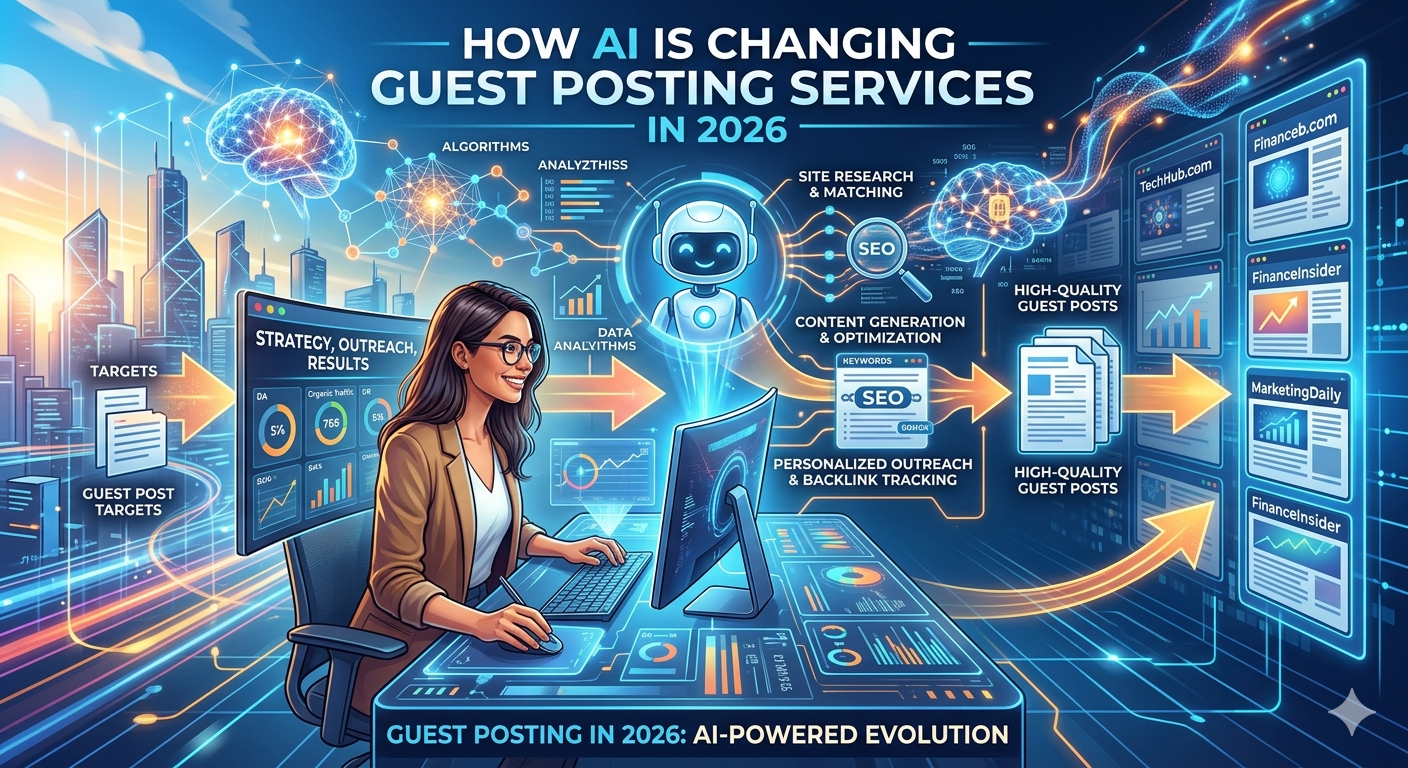
That era is definitively over. A new generation of AI guest posting services has arrived, and the shift isn’t cosmetic. AI is now embedded into every stage of the guest posting pipeline – prospect discovery, quality vetting, content creation, outreach personalization, and post-placement performance analysis. For brands and agencies that understand how these tools work and how to use them strategically, the opportunity is significant. For those still relying on bulk outreach to “write for us” directories, the risks are mounting quickly.
If you want a practical, reviewed breakdown of the providers leading this shift, this roundup of the best AI guest posting services in 2026 is an excellent starting point. But understanding why the landscape has changed and how AI is specifically reshaping each component of guest posting is what separates smart investment from expensive guesswork.
This article goes deep on all of it.
TL;DR
- AI is now embedded across every stage of guest posting: prospecting, vetting, outreach, content, and analysis.
- Google’s AI-powered detection systems have made mass, low-quality placements actively dangerous.
- The best AI guest posting services in 2026 combine automation with human editorial oversight, not AI alone.
- Guest posts now serve dual purposes: traditional Google rankings and citations in AI search engines like Perplexity, ChatGPT Search, and Google AI Overviews.
- Quality, topical relevance, and E-E-A-T alignment are the non-negotiables for any guest posting strategy that will hold up through 2026 and beyond.
Part 1: Why the Guest Posting Landscape Shifted So Dramatically
The Volume-to-Quality Pivot
Between 2020 and 2023, volume-based guest posting dominated the link building industry. Teams chased Domain Authority scores, bulk link packages were commonplace, and the market was flooded with “write for us” farms that existed purely to sell backlinks dressed up as editorial content.
Google’s Helpful Content Updates and Spam Algorithm refinements from 2024 onward fundamentally disrupted this model. AI-powered detection systems were deployed at scale to evaluate content authenticity, topical relevance, and genuine user engagement, not just surface-level signals like word count or keyword density. Sites that had accumulated thousands of low-quality placements saw rankings crater almost overnight.
The lesson was clear: the guest posting model built on shortcuts didn’t just become less effective. It became a liability.
The Rise of AI Search: A Second Reason Everything Changed
The second major force reshaping guest posting services in 2026 has nothing to do with penalties. It’s opportunity – specifically, the emergence of AI-generated search responses as a primary discovery channel.
Google’s AI Overviews, ChatGPT Search, Perplexity, and Gemini are now actively citing sources in their answers. When a user asks a complex question, these systems don’t just return a list of blue links, they synthesize an answer and attribute it to specific sources. Brands that appear consistently in high-authority, topically relevant content are being cited. Those that don’t aren’t visible in these answers at all, regardless of how they rank in traditional SERPs.
This has given guest posting a second purpose entirely. In addition to building backlinks for Google ranking signals, editorial placements on authoritative sites now function as citation signals for AI engines. The same link that improves your domain authority can also make your brand the source a language model reaches for when constructing an answer in your niche.
That dual function, traditional SEO and Generative Engine Optimization (GEO), is why top guest posting services 2026 are restructuring their entire approach around content quality and publisher authority rather than placement volume.
Part 2: How AI Is Being Used Inside Guest Posting Services
1. AI-Powered Publisher Vetting and Discovery
Finding quality publishers has historically been one of the most time-consuming parts of any guest posting campaign. Teams would manually evaluate dozens of sites, checking Domain Rating, monthly traffic, niche relevance, spam scores, and whether editorial standards were genuine or performative.
AI has dramatically accelerated this process. Modern platforms including tools like Respona, Pitchbox, and Linkee now use machine learning to automatically scan and score publisher prospects against multi-dimensional quality criteria. These aren’t just DA thresholds. AI vetting systems in 2026 evaluate:
- Traffic pattern authenticity: whether site traffic is organic and consistent or artificially inflated
- Content quality signals: average engagement, depth of editorial coverage, presence of real authors
- Topical alignment: how closely a publisher’s content cluster matches the campaign’s niche
- Link neighborhood health: the quality of other sites linking to and from the publisher
- PBN detection: identifying private blog networks through footprint analysis that would take human reviewers hours to replicate
Platforms like Linkee, for example, now scan databases of 12 million websites to vet prospects for relevancy and quality, delivering curated shortlists in minutes rather than days. The human editor’s role shifts from manual prospecting to final approval, a significantly more efficient use of expertise.
2. AI-Driven Outreach Personalization at Scale
Mass cold email outreach has always produced diminishing returns. Response rates for generic, templated pitches hover around 2–5% in most niches, and in 2026, many editors have become increasingly allergic to obvious automation.
The solution AI outreach SEO platforms have developed is personalization at scale. Tools like Respona use AI to read each prospect’s most recent published content and automatically generate customized opening lines that reference specific articles, insights, or positions the editor has taken. The result is an outreach email that reads as if it was personally crafted, because the personalization engine has actually consumed and synthesized the prospect’s content, not just inserted a name into a template.
Pitchbox takes this further by integrating directly with Ahrefs, Moz, and Semrush APIs, automatically filtering prospects by quality thresholds before the outreach sequence even begins. Teams running 100+ guest post campaigns monthly report that this layer of AI-assisted quality filtering, combined with personalized email sequences and automated follow-ups, has improved reply rates from the industry’s typical 2–5% baseline to 10–20% for well-run campaigns.
The benchmark is clear: a 10–20% reply rate signals strong targeting and personalization; anything below 5% indicates a list or messaging problem that no amount of volume will fix.
3. AI Content Generation: The Double-Edged Sword
This is where the conversation gets nuanced. AI content generation is now genuinely useful in the guest posting process but the way top services use it has very little in common with the “generate and publish” approach that tanked rankings for so many sites between 2023 and 2025.
The best AI guest posting services in 2026 use AI to produce first drafts and structural frameworks, then layer in rigorous human editing, subject-matter expertise, and original experience signals. Content that reaches publication has been substantively reworked by a human who can add the kind of first-person authority, specific examples, and genuine insight that AI alone cannot produce.
Google’s E-E-A-T framework – Experience, Expertise, Authoritativeness, Trustworthiness – is now directly evaluating whether the humans credited with published content have verifiable credentials and genuine experience in the topic. AI systems are sophisticated enough to detect shallow, templated AI content even when it passes traditional plagiarism checks. The signal they’re looking for is substance, not just surface structure.
Industry consensus has coalesced around a clear rule: AI can accelerate content creation, but it cannot replace the human expertise layer that makes content credible.
4. AI-Assisted Anchor Text Strategy and Link Profile Management
One of AI’s quietest but most impactful contributions to automated guest posting is in anchor text optimization. The days of exact-match keyword anchors are long gone, modern link building strategies in 2026 prioritize natural language anchors, branded references, and contextually relevant phrases that serve readers rather than fulfilling an SEO checklist.
AI tools like Linkio analyze existing backlink profiles and traffic data to recommend optimal anchor distributions, alerting campaign managers when a profile is drifting toward over-optimization before it becomes a ranking risk. This kind of predictive monitoring, using AI to flag problems before they materialize, is now considered a baseline capability for serious link building operations, not a premium feature.
5. Performance Analytics and GEO Tracking
Traditional guest posting analytics measured two things: whether the link went live, and what the referring domain’s authority score was. In 2026, top platforms track substantially more:
- AI citation tracking: whether content from a placement is being cited in Google AI Overviews, Perplexity, or ChatGPT Search responses
- Traffic verification: actual referral traffic from placements, not just domain metrics
- Entity signal monitoring: whether consistent brand mentions across placements are strengthening how AI models identify and characterize the brand
- Link decay detection: alerting teams when placed links are removed, noindexed, or changed
This shift in measurement reflects the dual-purpose nature of guest posting in the AI search era. Backlinks that generate no AI citations and drive no referral traffic are being deprioritized in favor of placements that contribute to both traditional ranking signals and AI visibility.
Part 3: What the Best AI Guest Posting Services in 2026 Actually Do Differently
The services separating themselves from the pack in 2026 share a common set of characteristics that go beyond AI tooling. They reflect a fundamentally different philosophy about what guest posting is for.
Transparent publisher marketplaces have become the gold standard for quality-conscious buyers. Rather than delivering placements from opaque, undisclosed networks, leading platforms now let buyers browse and filter publisher sites before committing, seeing actual traffic data, audience demographics, content standards, and pricing in one place. This transparency isn’t just a user experience improvement. It’s an alignment with Google’s E-E-A-T standards, which extend to the credibility of link sources themselves.
Manual outreach as the foundation, AI as the accelerant is the operational model that’s delivering results. Services running fully automated outreach from end to end are finding that editors increasingly filter these pitches at the inbox level. The most effective operations use AI for research, personalization suggestions, and follow-up timing but keep a human voice in the actual relationship development.
Niche specialist content teams have replaced generalist writers in top-tier services. When content is being published on a healthcare blog, a SaaS industry publication, or a legal resource site, the authorial expertise needs to match the audience’s sophistication. Platforms that match writers to assignments based on actual domain knowledge, not just keyword research ability are producing content that editors accept and readers engage with.
GEO optimization as a standard offering has emerged from experimental to essential. Because AI search engines like ChatGPT, Perplexity, and Google AI Mode now cite sources conversationally, guest content needs to be structured for machine readability alongside human comprehension. The “H2 + Definition” structural pattern, leading each major section with a clear, question-based header followed by a direct answer, has become an industry standard for content designed to earn AI citations. Forrester Research has noted that to secure AI citations, content must be direct, bold, and quotable, giving models an easy extraction point for their generated answers.
Part 4: The Risks That Haven’t Gone Away
AI has introduced powerful efficiencies into guest posting, but it has also amplified the consequences of getting things wrong.
Private Blog Networks (PBNs) remain the most dangerous trap in the link building market. Some services still operate under agency-style branding while delivering links from interconnected sites built solely for link exchange. Google’s AI-powered spam detection in 2026 can identify PBN footprints through pattern analysis that would be impossible at human scale and the algorithmic penalties associated with PBN-based link building can take months to recover from.
Topical irrelevance is a subtler but equally serious problem. A link from a high-authority site that operates in an unrelated industry carries minimal value and can actually create a negative signal in a well-calibrated link profile. AI tools that over-index on domain metrics while underweighting topical alignment are routing campaigns toward placements that look good on paper but deliver nothing in practice.
AI content without human review: the “generate and publish” approach, is now being actively flagged by Google’s quality systems. Raw AI-generated content, even when technically accurate, tends to lack the specific experience signals, original data points, and genuine subject-matter depth that editorial standards require in 2026. Services that skip the human editing layer to cut costs are producing content that is increasingly likely to be devalued or rejected.
Part 5: The Future of Guest Posting: What’s Coming Next
The trajectory is clear. Guest posting is evolving from a link acquisition tactic into what industry analysts are calling Authority Engineering, the strategic, systematic building of a brand’s credibility signals across the web in ways that serve both traditional search algorithms and AI citation models simultaneously.
Several developments are shaping what comes next:
Digital PR convergence is accelerating. As volume-based guest posting becomes riskier and more contested, marketers are shifting budget toward original research, data studies, and expert commentary that earns coverage rather than paying for placement. Industry data suggests 48.6% of SEO professionals now rate digital PR as their most effective tactic for 2026, significantly ahead of traditional guest posting by volume. The best services are building hybrid offerings that combine editorial placements with PR-style earned coverage.
AI model-specific optimization is an emerging frontier. Different AI search engines, ChatGPT, Perplexity, Gemini use different signals to decide which sources to cite. Some services are beginning to develop placement strategies tailored to specific AI model preferences, mapping content structure and publisher authority to the citation patterns of individual systems.
Velocity control and link profile diversity have become strategic priorities that AI can manage better than humans. Rather than front-loading link acquisition, smart campaigns now pace placements over time, vary publisher types, and monitor link profile composition continuously to maintain the natural-looking diversity that both Google and AI systems associate with organic authority growth.
Looking for the top guest posting services 2026 that have already incorporated these capabilities? The providers building these systems into their core offering rather than bolting AI onto legacy workflows, are the ones worth evaluating carefully.
Part 6: Choosing the Right AI Guest Posting Service, What to Look For
Whether you’re evaluating a managed service or building an in-house capability using AI tools, the following criteria should guide your assessment in 2026:
Publisher transparency: Can you see the actual sites where your content will appear before you commit? Opaque networks are a red flag.
Traffic verification: Are placements evaluated by real, organic traffic in addition to domain authority metrics? DR/DA alone is no longer sufficient.
Content standards: Does the service use AI as a drafting tool with genuine human editorial oversight, or is it generating and submitting content without review?
E-E-A-T alignment: Are authors credited with real credentials? Is experience language built into content at the structural level?
GEO capability: Is content being formatted for AI citation eligibility, not just traditional keyword optimization?
Link guarantees and monitoring: Does the service replace links that disappear, and does it actively monitor placements after delivery?
Reporting depth: Are you getting data on referral traffic, AI citation tracking, and entity signal development or just a list of URLs with DA scores?
Conclusion: AI Guest Posting Services Are Not a Shortcut, They’re a Sophistication Upgrade
The most important thing to understand about AI’s role in guest posting services in 2026 is this: it hasn’t made the process easier in the sense of requiring less strategic judgment. It has made more of the process automatable, the research, the prospecting, the personalization, the monitoring while raising the stakes for the decisions that still require human expertise.
The agencies and brands succeeding with AI link building services in 2026 are not the ones running the most automated campaigns. They’re the ones using automation intelligently to scale what actually works: genuine editorial relationships, authoritative content, relevant publisher selection, and a long-term view of link profile health.
Guest posting remains one of the highest-ROI link building strategies available but only when executed with the sophistication that 2026’s search environment demands. Long-form placements of 1,500+ words on niche-relevant, high-traffic publishers earn 68% more social engagement and generate stronger AI citation signals than shorter, low-context pieces on general sites. One well-placed editorial backlink on a domain with DR 50+ and genuine organic traffic is worth more than a dozen placements on sites that exist only to sell links.
AI is the engine making that level of precision accessible at scale. How you use it, and who you trust to use it on your behalf, will define your link profile’s performance through 2026 and well beyond.