

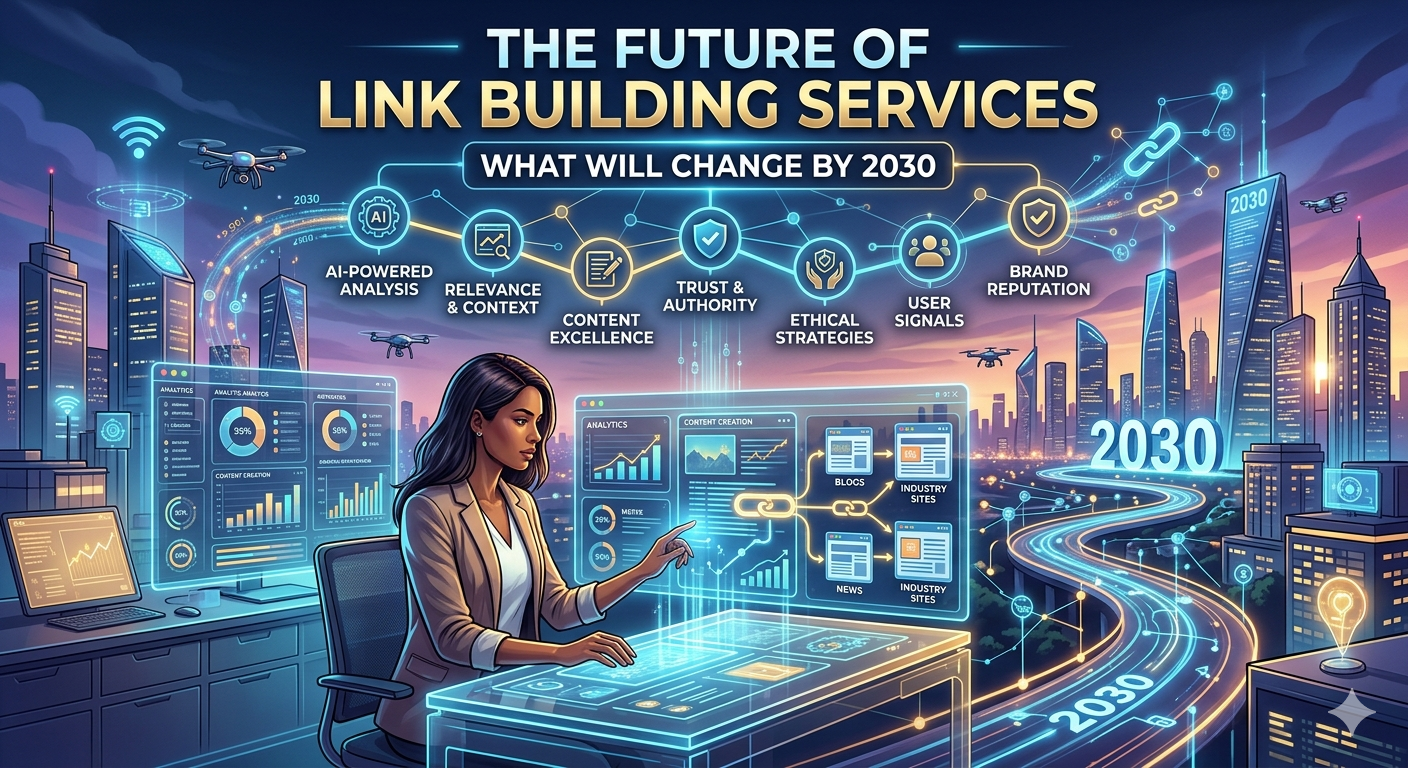
Introduction: A Industry at an Inflection Point
Link building has always been one of SEO’s most debated disciplines. For two decades, it swung between arms races and algorithm corrections, from PageRank manipulation to Penguin penalties to the nuanced authority signals of today. But nothing has disrupted the playbook quite as sharply as the rise of AI-powered search.
By 2026, the industry looks almost unrecognizable compared to five years ago. Tactics that once guaranteed results, mass guest posting, bulk link purchasing, exact-match anchor text saturation, now trigger penalties more reliably than rankings. And as we look ahead to 2030, the pace of change isn’t slowing down. It’s accelerating.
If you want to understand where to invest your SEO budget right now, this curated roundup of the best link building services in 2026 is a strong starting point for identifying which agencies have already adapted to this evolving landscape. But knowing who to hire is only part of the equation. Understanding why the industry is shifting and where it’s heading is what separates brands that will dominate search in 2030 from those that will be chasing algorithm updates for years.
TL;DR
- The future of link building services is moving away from raw link volume toward brand authority, AI citations, and semantic relevance.
- Digital PR has become the dominant tactic, chosen by nearly half of SEO professionals as the most effective link-building strategy.
- AI search engines like ChatGPT, Perplexity, and Google AI Overviews are introducing a new currency: citations and brand mentions, not just backlinks.
- By 2030, link building agencies will likely function as integrated brand authority partners, combining PR, content strategy, entity optimization, and AI visibility.
- Agencies still selling bulk link packages without transparency are a liability, not an asset.
The Old Playbook Is Officially Broken
To understand where link building is going, it helps to understand what’s already dead.
For much of the 2010s, success in link building was measured by volume. More referring domains meant more authority. Guest posts were mass-produced. Private blog networks (PBNs) flourished. Anchor text was manipulated with surgical precision. It worked, until it didn’t.
Google’s 2024 spam updates changed the terrain permanently. Policies targeting expired domain abuse, scaled content, and site reputation manipulation all landed in the same update cycle, directly targeting the tactics that many agencies had quietly relied on. Sites using purchased links in bulk saw ranking drops of 20 positions or more in highly competitive niches. Agencies that couldn’t adapt lost clients fast.
The shift wasn’t subtle. As one SEO researcher put it, realizing that 200 truly relevant, editorially earned links would have outperformed thousands of directory submissions was a hard but necessary lesson, one that the industry is still processing.
By 2026, the consensus is clear: Google’s AI-powered spam detection system, SpamBrain, has made unnatural link patterns increasingly easy to identify and devalue. The era of manufacturing authority at scale is closing. What’s opening in its place is far more interesting.
What’s Driving the Transformation
Three forces are reshaping the future of link building services, and they’re all feeding into each other.
1. AI Search Is Redefining What “Authority” Means
The rise of AI-generated search results, Google AI Overviews, Perplexity, ChatGPT, and similar platforms has fundamentally changed what a “good link” does. In traditional SEO, a backlink passed PageRank and drove referral traffic. In AI-first search, links serve a different function: they signal to language models which sources are credible enough to cite.
Research from Ahrefs found that over 76% of pages cited in Google AI Overviews also rank in the top 10 organic results, confirming that authority and AI visibility are closely correlated, but not identical. Gartner has predicted that traditional search engine volume will decline by 25% as AI handles more direct answers, making AI citation a parallel (and increasingly critical) track for visibility.
This creates a new challenge for link builders: you’re no longer just building links for Google’s crawler. You’re building links to shape how large language models understand and represent your brand. That’s a fundamentally different optimization target.
2. Brand Mentions Are Now a First-Class Signal
In 2025 and beyond, unlinked brand mentions carry measurable weight. Platforms like ChatGPT and Perplexity don’t rely solely on hyperlinks to assess credibility, they analyze how frequently a brand appears in trusted, contextually relevant content across the web.
According to industry data, the average AI search visitor converts at 4.4 times the rate of a traditional organic search visitor, making AI visibility a direct revenue driver, not just a vanity metric. This context explains why smart link builders are no longer asking “how many links can we get?” and instead asking “how often does our client’s brand appear in the right conversations?”
Being featured in curated industry lists, mentioned in forum discussions on platforms like Reddit (which accounts for 21% of AI Overview citations), and earning coverage in authoritative media outlets are all contributing to a brand’s “entity authority”, a concept that will only grow in importance through 2030.
3. E-E-A-T Has Become a Structural Requirement
Google’s E-E-A-T framework (Experience, Expertise, Authoritativeness, Trustworthiness) has evolved from a content guideline into a core architectural requirement for link quality. Links from sources that demonstrate genuine expertise now outperform equivalent links from sites that don’t.
This has practical implications for how link building services are structured. Agencies that once placed links on any DA 40+ site are now being forced to evaluate sources by topical depth, editorial oversight, real organic traffic, and author credibility. A link from a recognized expert contributor, a peer-reviewed industry publication, or a major news outlet carries disproportionate weight compared to a generic guest post, and that gap will only widen by 2030.
How Link Building Services Are Changing Right Now
The agencies winning in 2026 don’t look much like traditional link building firms. Here’s what the landscape looks like for forward-thinking providers.
Digital PR Has Taken the Top Spot
In a survey of 518 SEO professionals conducted between March and May 2025, digital PR was chosen by 48.6% of respondents as the most effective link-building tactic, more than triple the votes for guest posting (16%) and far ahead of creating linkable assets (12%). That gap tells you something important: the industry has voted with its strategy, and digital PR is winning.
Why? Because digital PR earns links the same way journalists cover stories, organically, through genuinely interesting content. Original research, proprietary data studies, and expert-sourced commentary create placement opportunities in authoritative outlets that no amount of outreach can manufacture. One B2B tech company reported a 156% increase in link acquisition after shifting from generic how-to articles to publishing original research and proprietary data. That kind of lift isn’t replicable with bulk tactics.
By 2030, digital PR and SEO link building will likely be indistinguishable from each other at the agency level. The tools, relationships, and content strategies required for both are converging.
Editorial Link Placement Is the New Gold Standard
Editorial backlinks, unpaid, earned placements manually added by human editors and authors are the benchmark that AI systems and search algorithms both favor. They function like peer-reviewed citations in academic publishing: a human gatekeeper decided the link was worth including, which automatically adds a layer of credibility no automated system can replicate.
By contrast, footer links, sidebar placements, and links embedded in low-quality guest posts are rapidly approaching zero value in AI-evaluated search. Mid-article contextual links, placed within topically relevant content on authoritative domains, are what link builders should be targeting. This distinction will become increasingly pronounced through 2030 as AI systems grow more sophisticated in evaluating link context and placement.
KPIs Are Being Rewritten
Traditional link building metrics – domain authority, referring domain counts, organic traffic rankings are being supplemented (and in some contexts replaced) by a new set of measurements:
- AI citation frequency: How often does a brand appear in AI Overview responses, ChatGPT answers, or Perplexity citations?
- Brand mention share: What percentage of relevant industry conversations reference the brand, with or without a hyperlink?
- Co-citation clusters: Is the brand consistently appearing alongside recognized authorities in its space, which strengthens semantic associations in LLMs?
- E-E-A-T link quality score: Are links coming from sources that demonstrate real expertise and editorial standards?
Agencies that can report on these metrics are providing genuine insight. Agencies still reporting only DR and referring domain counts are offering an incomplete and potentially misleading picture of campaign health.
What 2030 Will Look Like for Link Building Services
Projecting five years forward in any technology-adjacent field involves uncertainty. But the directional signals from 2025 and 2026 are clear enough to draw a credible picture of where the future of link building services is headed.
Agencies Will Become Brand Authority Partners
By 2030, the most successful link building agencies will have evolved into integrated brand authority firms. They’ll combine traditional link acquisition with digital PR, entity optimization (structured data, knowledge graph management, Wikipedia-adjacent citation building), AI visibility tracking, and content strategy. The lines between SEO agency, PR firm, and content studio will be significantly blurred.
This isn’t speculation, it’s already happening. The agencies growing fastest in 2026 are those that have expanded their service stack beyond links. They’re helping clients earn mentions in LLM training data, tracking brand representation in AI answers, and building the kind of content ecosystems that generate links organically and sustainably.
The global PR market is expected to reach $133.82 billion by 2027, driven heavily by digital media consumption and new technology. A significant portion of that growth is coming from clients who previously spent their budgets with traditional link builders.
AI Will Handle Prospecting and Outreach, Humans Will Handle Relationships
Artificial intelligence is already transforming the mechanical side of link building: identifying prospects, drafting personalized outreach, analyzing link quality at scale, and predicting which content formats are most likely to earn placements. By 2030, these processes will be almost entirely automated in high-performing agencies.
But the relationship layer, the editorial connections, journalist rapport, expert sourcing, and genuine content strategy will remain stubbornly human. The highest-quality backlinks will always require human validation to carry real authority weight. Agencies that use AI to scale the operational work while investing human talent in relationship and content quality will have a decisive competitive advantage.
Niche Topical Authority Will Trump Broad Domain Metrics
By 2030, broad domain authority metrics will have significantly less predictive value than topical authority signals. A link from a niche-specific publication with genuine readership and deep expertise will consistently outperform a link from a high-DA generalist site with thin content.
This has structural implications for how link building campaigns are planned. Rather than pursuing the highest-DR domains available, future-ready agencies will map client content to specific topical clusters and pursue placements that reinforce semantic authority in those areas. Think of it as building a network of contextually relevant citations rather than collecting domain trophies.
Transparency Will Become Table Stakes
One of the clearest markers distinguishing quality agencies from low-quality providers in 2026 is operational transparency. The best link building services already show clients exactly where placements will come from before campaigns begin, require minimum traffic thresholds on linking sites, and provide full editorial context for every link built.
By 2030, this level of transparency will be expected not exceptional. Clients who’ve been burned by link farms, ghost-town sites, and AI-generated content masquerading as editorial coverage will demand it. Regulatory scrutiny around paid content and disclosure requirements may also formalize some of these practices.
Red Flags That Will Define Risky Agencies Through 2030
Understanding what the future looks like also means recognizing what won’t survive it. As you evaluate link building services for the years ahead, be cautious of any provider that:
- Guarantees specific link volumes or fixed keyword rankings, neither is within an agency’s control when building genuine editorial placements.
- Can’t show real examples of recent placements with traffic data from the linking sites.
- Relies primarily on guest posts placed on sites with no authentic audience.
- Reports only on DR and referring domain counts without any discussion of AI visibility or brand mention tracking.
- Offers “packages” at rates that can’t possibly support the manual relationship-building required for high-quality editorial links.
These are the agencies still operating on the 2018 playbook in 2026. By 2030, they’ll have either adapted or lost their client base.
Preparing Your Strategy for the Future of Link Building
Whether you’re an in-house SEO professional or an agency decision-maker, here’s how to position your link strategy for what’s coming by 2030:
Invest in original research. Content that generates genuinely new data earns an average of 8 times more backlinks than curated or opinion-based articles. As AI-generated content continues to flood the web, original research will become even more differentiated and valuable as a link-earning asset.
Build for AI citation, not just Google rankings. Evaluate your content and backlink strategy through the lens of AI Overviews and LLM citation patterns. The sources AI systems trust are the sources that drive both traditional rankings and AI visibility, optimizing for one increasingly means optimizing for both.
Treat brand mentions as link equivalents. Start tracking unlinked brand mentions with the same rigor you apply to backlink profiles. Appearing in high-trust, contextually relevant content, even without a hyperlink, contributes to the entity authority that AI systems and search algorithms both evaluate.
Choose agencies with integrated PR capabilities. A link building service that can’t execute digital PR, expert commentary placement, and original content creation alongside link acquisition is going to be structurally limited in its ability to deliver results in the environment emerging by 2030.
Prioritize editorial quality over placement volume. A campaign that earns 20 genuine editorial placements in authoritative, topically relevant publications will consistently outperform one that generates 200 guest post placements on low-traffic, low-engagement sites. This truth, already well-established in 2026, will be even more pronounced in 2030.
Final Thoughts
The future of link building services isn’t a departure from the core goal, helping brands earn authority and visibility online. It’s a more sophisticated, more transparent, and more integrated pursuit of that goal.
By 2030, the agencies leading this space will be the ones that recognized early that they weren’t in the link-selling business. They were in the authority-building business. The delivery mechanism whether that’s a traditional backlink, an AI citation, a brand mention in a Reddit thread, or a featured spot in an industry “best of” list, is secondary. The goal is making a brand undeniably present, credible, and authoritative wherever its audience looks for answers.
That’s what great link building has always been about. The tools, tactics, and tracking methods will keep evolving. The underlying mission won’t.