

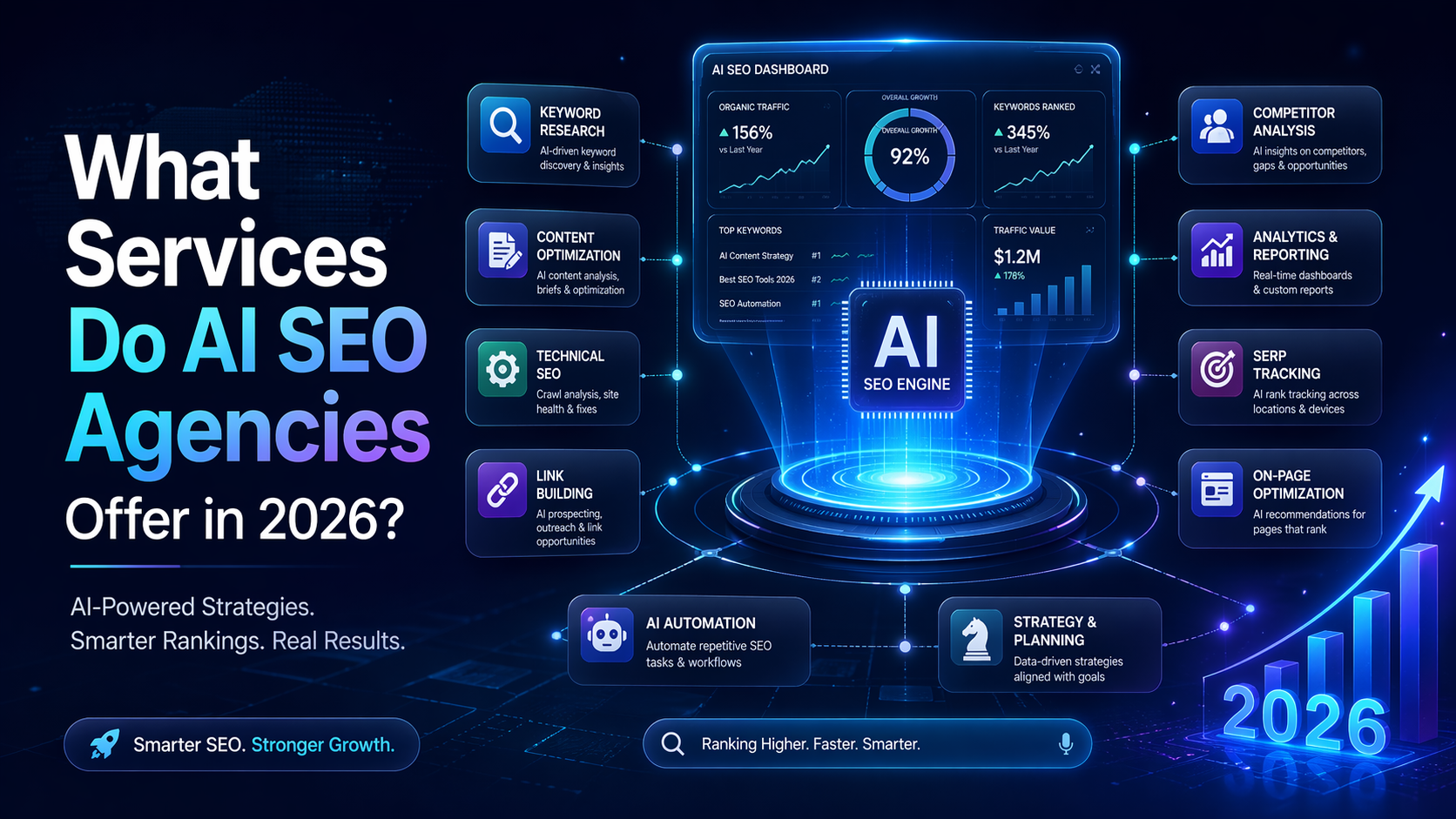
| TL;DR – What You Need to Know In 2026, AI SEO agencies go far beyond keyword rankings. They offer Generative Engine Optimization (GEO), Answer Engine Optimization (AEO), LLM visibility tracking, entity and schema engineering, AI-powered content optimization, and multi-platform citation monitoring across ChatGPT, Perplexity, Gemini, Google AI Overviews, and Microsoft Copilot. Pricing ranges from $2,000/month for small businesses to $25,000+ for enterprise-scale programs. |
Search Has Changed – And So Have SEO Agencies
Not long ago, hiring an SEO agency meant one thing: get your website to rank on Google’s first page. You picked keywords, built backlinks, published blog posts, and waited. That model worked – until it didn’t.
Search in 2026 looks nothing like it did even three years ago. Google’s AI Overviews now appear in more than 11% of all queries. Millions of users have shifted to asking ChatGPT, Perplexity, Gemini, and Claude questions that would have previously gone to a search bar. According to EMARKETER, nearly 31.3% of the U.S. population will use generative AI search in 2026. And when someone asks an AI engine, “What’s the best project management software for a remote team?” – they’re not scrolling through ten blue links. They’re reading a synthesized answer that pulls from specific sources.
This shift is exactly why the best AI SEO agencies in 2026 are offering something fundamentally different from what traditional SEO shops provide. They are building your brand into the knowledge infrastructure that large language models (LLMs) draw from when constructing answers. They are optimizing not just for rankings, but for citations.
This guide breaks down every service that leading AI SEO agencies offer today, explains what each one means, how they differ from traditional SEO, and how to evaluate which services your business actually needs.
Traditional SEO vs. AI SEO: What Has Actually Changed?
Before exploring individual services, it is worth understanding the structural shift that makes AI SEO a distinct discipline rather than just a rebrand.
Traditional SEO was built to influence search engine algorithms — specifically, how Googlebot crawls and indexes pages, and how ranking signals like backlinks, page speed, and keyword density influence SERP position. The end goal was a click. You ranked on page one, a user saw your listing, they clicked your link.
AI SEO agencies in 2026 are solving a different problem entirely. When a user asks an AI engine a question, the model synthesizes an answer from multiple sources and delivers it directly – no ranking list, no SERP. Your brand either appears inside that answer as a cited source, or it doesn’t appear at all. Being on page one of Google no longer guarantees AI visibility. And increasingly, the decision about which vendor to trust is being shaped before anyone clicks a single link.
Traditional SEO vs. AI SEO — At a Glance
| Factor | Traditional SEO | AI SEO (2026) |
| Primary Goal | Page-one Google rankings | Citations in AI-generated answers |
| Success Metric | Rankings, clicks, traffic | Share-of-model, AI citation rate, brand mentions |
| Optimization Target | Googlebot crawlers | LLMs + Googlebot |
| Content Strategy | Keyword-dense articles | Authority-rich, machine-readable structured content |
| Link Building | Domain authority signals | Trust signals + brand entity building |
| Reporting | Position tracking, CTR | AI visibility score, prompt-level citation tracking |
| Pricing Range | $500–$5,000/month | $2,000–$25,000+/month |
The Core Services AI SEO Agencies Offer in 2026
1. Generative Engine Optimization (GEO)
| TL;DR – GEO Generative Engine Optimization (GEO) is the practice of structuring content, brand signals, and digital presence so AI-powered platforms – like ChatGPT, Google AI Overviews, and Perplexity – cite, recommend, or mention your brand when users ask questions in your category. |
GEO is the single most talked-about service in AI SEO right now, and for good reason. Research published by Princeton University at the ACM KDD 2024 conference confirmed that dedicated GEO techniques significantly outperform traditional SEO methods when it comes to securing visibility inside AI-generated responses.
What does a GEO service actually involve? The work is more technical and editorial than most people expect. Agencies performing genuine GEO are doing the following:
• Mapping real buyer prompts — generating libraries of actual questions that target buyers type into AI tools, organized by purchase stage (shortlist, comparison, evaluation, decision)
• Structuring content for machine extractability — rewriting pages so AI systems can parse them cleanly, including direct-answer blocks, FAQ sections, and concise definitions
• Building entity authority — ensuring your brand, products, and people are consistently described across your own site, third-party sites, review platforms, and industry directories
• Citation-calibrated publishing — creating content assets that AI systems prioritize as sources: original research, data-driven analysis, comprehensive reference material
• Multi-platform monitoring — tracking where and how often your brand appears in AI-generated answers across ChatGPT, Gemini, Perplexity, Google AI Overviews, and Microsoft Copilot
2. Answer Engine Optimization (AEO)
| TL;DR — AEOAEO focuses on making your content the selected source inside AI-powered answer engines — including Google’s featured snippets, voice search, AI Overviews, and conversational LLMs. While GEO and AEO are often used interchangeably, AEO has historically had stronger roots in Google’s answer ecosystem. |
AEO has been evolving since Google first introduced featured snippets. In 2026, the discipline now encompasses everything from traditional zero-click answers to complex LLM citation selection. Leading agencies like NoGood, Amsive, and Directive have formalized full AEO service stacks that include:
• LLM visibility audits — comprehensive assessments of how your brand currently appears (or fails to appear) in AI-generated responses
• AI search performance monitoring — ongoing tracking of brand mentions, citation frequency, and recommendation positioning in conversational AI platforms
• Reputation management and digital PR — building the web of credible third-party mentions that AI systems use to evaluate brand authority
• Prompt research — identifying and cataloging the specific queries and prompts your target audience uses in AI tools
• Schema markup and structured data — implementing FAQPage, Article, Organization, Product, and Person schemas that help AI systems correctly parse and represent your content
• Voice search optimization — structuring content for the conversational query patterns used in voice-based AI assistants
• Multimodal optimization — preparing content for AI systems that process images, video, and audio in addition to text
3. LLM SEO (Large Language Model SEO)
| TL;DR — LLM SEOLLM SEO is the newest and most technically complex discipline. It involves structuring your content and brand signals to match how large language models retrieve and summarize information — so that your brand becomes one of the cited sources when users query ChatGPT, Claude, Gemini, or Perplexity. |
LLM SEO goes deeper than GEO and AEO by focusing specifically on the retrieval mechanisms of large language models. When ChatGPT or Perplexity constructs an answer, it doesn’t simply pull from a Google index – it draws on training data, real-time retrieval, and RAG (Retrieval-Augmented Generation) pipelines. The best AI SEO agencies are engineering content specifically for these retrieval systems.
Specific LLM SEO services include:
• RAG audit and optimization – mapping exactly how models like Claude and GPT-4 retrieve your brand data, identifying hallucination risks where AI might misrepresent your company, and structuring content to minimize those risks
• Knowledge Graph building – establishing your brand as a verified entity node within global knowledge graphs through JSON-LD nesting, Wikidata alignment, and persistent semantic verification
• Information Gain content – producing content that provides genuinely new information that AI models haven’t seen in training data, increasing citation likelihood
• Tokenization-aware writing – structuring sentences and paragraphs for natural language processing efficiency, ensuring every claim is factually verifiable to satisfy E-E-A-T standards
• Share-of-model tracking – monitoring how often your brand is natively cited within Perplexity, SearchGPT, Google AI Overviews, and other LLM-powered platforms through custom scrapers and API integrations
4. Technical SEO for AI Readability
| TL;DR – Technical SEO in 2026 has a new priority: making your website readable and parseable by AI systems, not just search engine crawlers. This includes structured data implementation, Core Web Vitals, JavaScript rendering, and entity clarity across all pages. |
Technical SEO remains the foundation of every AI search optimization program. But in 2026, the standard has risen significantly. AI systems apply strict quality thresholds when selecting citation sources, and sites with poor technical health — slow page loads, poor crawlability, thin schema, or ambiguous entity signals — are systematically deprioritized.
Top-tier AI SEO agencies offer technical audits and implementations that include:
• JavaScript SEO and rendering optimization – ensuring AI crawlers can access dynamic content that might otherwise remain invisible
• Structured data at scale – deploying FAQPage, HowTo, Product, Organization, Person, and Article schemas across hundreds or thousands of pages
• Entity disambiguation – ensuring your brand name, products, executives, and locations are clearly and consistently described to prevent LLM confusion or misattribution
• Log file diagnostics – analyzing server logs to understand how AI bots are crawling your site and fixing bottlenecks
• Core Web Vitals optimization – maintaining the performance benchmarks that signal content quality to both Google and AI systems
• Robots.txt and crawl management – routing AI bots correctly and ensuring your most citation-worthy content is indexed and accessible
5. AI-Optimized Content Strategy and Creation
| TL;DR – AI Content Content in 2026 isn’t just for human readers. The best AI SEO agencies produce content engineered for machine extractability: clear definitions, direct answer blocks, original data, FAQ sections, and structured comparisons — all verified by human experts to satisfy Google’s E-E-A-T standards. |
Content strategy has been completely restructured by the demands of AI-powered search. Generic blog posts optimized for keyword density are now filtered out by modern reasoning engines. What AI systems actually cite is a different category of content entirely.
The best AI SEO agencies in 2026 produce content that meets these standards:
• Primary-source assets – original research, proprietary data studies, surveys, and industry reports that cannot be replaced by derivative summaries
• Comparison content and tool roundups – structured evaluations that appear when AI tools are actively influencing vendor shortlists and buying decisions
• Answer-first structure – content that leads with a direct, concise answer before expanding into supporting detail, matching how LLMs extract information to populate AI responses
• Topic cluster architecture – organized content ecosystems that demonstrate topical authority across a subject domain, not just individual keyword ranking
• E-E-A-T optimization – ensuring all content demonstrates Experience, Expertise, Authoritativeness, and Trustworthiness through author credentials, citations, and verifiable claims
• Prompt corpus development – libraries of constraint-rich prompts that match how real buyers talk to AI engines, used to test and optimize content performance in AI answers
A critical warning from leading practitioners: beware of agencies that offer fully automated content production. While AI is valuable for research and ideation, E-E-A-T standards require human insight and editorial review. Content should be AI-assisted and human-verified – not AI-generated and published without oversight.
6. Entity and Semantic Optimization
Entity optimization is one of the most overlooked but highest-impact services that AI SEO agencies provide in 2026. Large language models don’t just read your content – they build conceptual maps of brands, people, products, and topics. If your entity signals are weak, inconsistent, or absent, AI systems simply don’t include you in relevant answers.
Entity and semantic optimization services include:
• Entity recognition auditing – analyzing how AI systems currently understand your brand, identifying gaps, misconceptions, or missing associations
• Wikidata and Wikipedia presence building – creating and maintaining verified knowledge base entries that serve as authoritative entity anchors for LLMs
• Consistent entity description across touchpoints – standardizing how your brand, products, and key people are described across your website, press releases, social media, directory listings, and third-party reviews
• Semantic interlinking – building internal link structures that communicate topical relationships to AI systems, reinforcing your area of expertise
• Brand mention orchestration – coordinating earned and owned mentions across Reddit, industry review platforms, comparison sites, and authoritative publications
7. Digital PR and Authority Link Building
| TL;DR – Digital PR & Links Authority signals are still critical in 2026 — AI systems rely on credibility indicators, brand mentions, and trustworthy external citations to evaluate which brands deserve to appear in answers. Digital PR and high-quality link building remain foundational, not optional. |
Some things haven’t changed. AI search systems and answer engines draw heavily on the web’s existing trust infrastructure – the same backlinks, brand mentions, and editorial coverage that have always mattered for traditional SEO. What’s new is the application: these signals are now being read not just by Google’s ranking algorithm, but by every LLM that retrieves brand information.
Leading agencies combine traditional link building with AI-era digital PR:
• Editorial link acquisition – securing placements on trusted publications that serve as reliable citation sources for AI systems
• Listicle and comparison placement – getting your brand included in the “best of” articles that LLMs most frequently cite when answering product recommendation queries
• Data journalism and original research – publishing studies and datasets that earn organic citations from media outlets and become primary sources for AI answers
• Brand mention campaigns – building the volume and consistency of third-party brand mentions that signal category authority to AI systems
8. AI Visibility Monitoring and Analytics
Traditional SEO reporting is built around rank tracking – where does your page appear for a given keyword in Google? In 2026, that metric is necessary but no longer sufficient. The best AI SEO agencies have built or integrated platforms that track a completely new set of KPIs.
Modern AI visibility monitoring services include:
• Real-time AI citation tracking – monitoring how often your brand is mentioned, cited, or recommended across ChatGPT, Perplexity, Gemini, Google AI Overviews, Grok, Claude, and Microsoft Copilot
• Share-of-model measurement – calculating what percentage of relevant AI-generated answers in your category include your brand versus competitors
• Prompt-level performance analysis – identifying which specific user queries trigger your brand’s citation and which prompts you’re missing from
• Competitor citation benchmarking – mapping where competitors are being cited but your brand is absent, creating a roadmap for content and entity optimization
• Hallucination detection – identifying cases where AI systems incorrectly represent your brand, pricing, products, or claims
• AI visibility score reporting – consolidated dashboards that translate multi-platform AI presence data into actionable insights
AI SEO Services Comparison: What Each Service Targets
| Service | Primary Goal | Key Platforms | Difficulty | ROI Timeline |
| Generative Engine Optimization (GEO) | AI citation share | ChatGPT, Gemini, Perplexity | High | 3–6 months |
| Answer Engine Optimization (AEO) | Featured snippets + AI answers | Google AI Overviews, Voice | Medium | 2–4 months |
| LLM SEO | Direct model citations | All LLM platforms | Very High | 4–9 months |
| Technical SEO (AI) | Crawlability + entity clarity | All search platforms | High | 1–3 months |
| AI Content Strategy | Source authority + citations | All AI search engines | Medium | 3–6 months |
| Entity & Semantic Opt. | Brand recognition in LLMs | All LLM platforms | High | 3–9 months |
| Digital PR & Links | Authority + citation signals | All platforms | Medium | 3–6 months |
| AI Visibility Monitoring | Performance measurement | All AI search platforms | Medium | Immediate |
How Much Do AI SEO Agency Services Cost in 2026?
Pricing for AI SEO services has shifted considerably from traditional SEO rates — and for good reason. The work is more technically complex, the monitoring infrastructure is more sophisticated, and the talent required (data scientists, semantic engineers, LLM specialists) commands a premium.
AI SEO Pricing Tiers – 2026 Market Overview
| Tier | Monthly Range | Typical Client | Services Included |
| Starter | $2,000–$5,000 | Small businesses, startups | 1–2 AI platform optimization, basic schema, 2–4 content pieces/month |
| Growth | $5,000–$12,000 | Mid-market companies | 3–5 platform monitoring, content clusters, entity optimization, digital PR |
| Enterprise | $12,000–$25,000 | Enterprise, competitive verticals | Full multi-platform GEO/AEO, custom RAG audits, LLM monitoring, technical implementation |
| Elite / Custom | $25,000+ | Large enterprise, agencies | Full-service AI search engineering, proprietary tracking platforms, embedded teams |
Pricing models vary significantly across the market. Most established agencies use retainer-based engagements with monthly fees covering ongoing optimization, content production, and technical SEO. Project-based pricing – for specific deliverables like an AI SEO audit, schema overhaul, or content cluster build – typically ranges from $5,000 to $50,000 depending on scope. A growing number of performance-based models include bonuses tied to measurable AI visibility improvements.
One critical note for businesses evaluating cost: do not compare agencies on monthly retainer alone. A more useful calculation is cost per outcome – including cost per AI appearance, per content piece, and per keyword tracked across AI platforms. An agency charging more per month but delivering significantly more citation-driving deliverables is often the better investment.
How the Best AI SEO Agencies Specialize in 2026
Not every AI SEO agency is solving the same problem. In 2026, the market has stratified into distinct specializations. Matching your needs to the right specialization is as important as evaluating agency quality.
| Specialization | Best For |
| B2B SaaS and Tech | Companies that need visibility in comparison queries, tool roundups, and bottom-of-funnel AI answers that influence vendor shortlisting |
| E-commerce & Product | Brands needing AI-powered product discovery optimization, category architecture, and structured data at scale |
| Regulated Industries | Healthcare, fintech, legal — where content accuracy, E-E-A-T compliance, and brand safety are non-negotiable |
| Enterprise / Technical | Large organizations with complex site architectures needing JavaScript SEO, log-file analysis, and engineering-led implementation |
| Local and Voice Search | SMBs targeting AI-powered local answers, voice search, and Q&A-format content for geographic markets |
| Full-Service / Integrated | Brands wanting AI SEO built into a broader digital marketing program alongside paid media, CRO, and content marketing |
How to Choose the Right AI SEO Agency: 6 Criteria That Matter
The AI SEO agency market is still new enough that a significant portion of providers have rebranded from traditional SEO without fundamentally changing their approach. Evaluating agencies rigorously before committing to a contract is essential.
1. Ask About Their GEO/AEO Methodology
A genuine AI SEO agency should be able to articulate a specific methodology for getting brands cited in AI-generated answers — not just a general statement about “optimizing for AI.” Ask: What is your process for GEO? How do you structure content for LLM citation? What prompt-mapping methodology do you use?
2. Verify Their AI Visibility Measurement
Ask specifically how the agency measures AI visibility outcomes. The answer should include citation tracking across named AI platforms, share-of-model measurement, and prompt-level performance reporting — not just traditional rank tracking and organic traffic reports.
3. Request Platform-Specific Case Studies
Ask for documented examples of clients appearing in ChatGPT, Perplexity, or Google AI Overviews as a direct result of the agency’s work — not just general traffic or ranking improvements. Verifiable case studies with specific AI citation outcomes are a strong signal of genuine capability.
4. Confirm Their Technical SEO Depth
AI SEO without strong technical execution produces limited results. Agencies should demonstrate fluency in structured data implementation, JavaScript SEO, entity disambiguation, and schema deployment at scale — not just content production.
5. Evaluate Team Composition
The best AI SEO agencies employ data scientists, semantic engineers, LLM specialists, and senior editorial staff alongside traditional SEO strategists. Ask about team composition, average experience levels, and who will actually be working on your account day-to-day.
6. Test Their Scenario Thinking
Give prospective agencies a real page from your site and ask what they would change and why, specifically for AI search visibility. The quality of that analysis — not the sales presentation — reveals true capability.
Questions to Ask Any AI SEO Agency Before Signing
| Question to Ask | What a Strong Answer Looks Like |
| What is your GEO methodology? | Specific process: prompt mapping, structured content design, entity building, citation tracking — not vague AI buzzwords |
| Which AI platforms do you optimize for? | Named platforms: ChatGPT, Perplexity, Gemini, Google AI Overviews, Copilot — with platform-specific tactics |
| How do you measure AI visibility? | Citation tracking tools, share-of-model dashboards, prompt-level reporting — not just traffic metrics |
| Can you show AI citation case studies? | Documented, verifiable examples of clients appearing in specific AI-generated answers |
| What schema and structured data do you implement? | FAQPage, Article, Organization, Product, Person — deployed at scale with JSON-LD |
| Who on your team has LLM-specific expertise? | Named individuals with verifiable backgrounds in NLP, data science, or LLM architecture |
| How long before we see AI visibility results? | Honest 3–6 month timelines for initial citation gains, 6–12 months for compound returns |
| What’s included in monthly reporting? | AI citation rates, share-of-model, prompt performance — plus traditional SEO metrics |
Red Flags to Watch Out for When Hiring AI SEO Agencies
The rapid growth of the AI SEO market has created space for agencies that use the right vocabulary without delivering meaningful outcomes. These are the warning signs to watch for:
• Fully automated content production with no human editorial review – violates Google’s E-E-A-T standards and will not sustain AI citations
• AI SEO reporting that only shows traditional rank tracking and organic traffic – without citation-level AI visibility metrics
• Inability to name specific AI platforms they optimize for, or to articulate platform-specific tactics
• No case studies showing actual AI citation outcomes – only general SEO results reframed as AI success
• Flat-rate pricing without a discovery phase – genuine AI SEO scope cannot be defined without understanding your brand’s current entity health, technical baseline, and competitive landscape
• Promises of guaranteed AI rankings – AI systems don’t have deterministic ranking positions; any guarantee is a red flag
• Treating AI SEO as a completely separate channel from traditional SEO – the most effective programs integrate both, as strong technical SEO is the foundation for AI visibility
The Future of AI SEO: What to Expect Beyond 2026
The AI SEO market is evolving at a pace that makes even 12-month predictions uncertain. But several structural trends are clear enough to plan around.
Market growth is significant: The global SEO services market is projected to grow from approximately $74.9 billion in 2025 to nearly $148.86 billion by 2031 – a compound annual growth rate of over 12%. AI search optimization is driving a meaningful portion of that growth.
AI search adoption is accelerating: Gartner has projected that traditional search traffic could decline by 25% by 2026 as users shift to AI-powered search tools. Businesses that start building AI visibility now will compound advantage over competitors who wait.
E-E-A-T requirements are intensifying: Despite the growing role of AI in content creation and optimization, human expertise and verifiable authority remain the gatekeepers for AI citation selection. The agencies and brands that invest in genuine topical authority will outperform those chasing shortcuts.
Multi-platform visibility becomes standard: By 2027, AI search optimization will need to account for an expanding ecosystem of LLM-powered surfaces — not just the current set of major platforms. Agencies with flexible monitoring infrastructure and platform-agnostic methodologies will maintain an advantage.
Performance-based models will grow: As measurement standards mature and AI citation outcomes become more reliably trackable, performance-based pricing tied to measurable AI visibility gains will become more common across the agency landscape.
Conclusion: What the Best AI SEO Agencies Are Really Selling
In 2026, the best AI SEO agencies are selling something more valuable than rankings. They are selling the infrastructure of trust that large language models need to recommend your brand – consistently, across every AI search platform that matters.
That infrastructure is built from technical precision, content authority, entity clarity, and the kind of measurable AI visibility tracking that didn’t exist as a discipline 18 months ago. It requires a different skill set, a different toolkit, and a different reporting framework than traditional SEO.
The businesses that invest in this infrastructure now – before their competitors figure out the playbook — will own a structural advantage that compounds over time. Not because they rank higher on a page that is increasingly being bypassed, but because they appear in the answers that are increasingly shaping purchasing decisions.
Whether you’re evaluating the best AI SEO agencies for a startup, a growing B2B brand, or a large enterprise, the standard for selection is clear: find the agencies that can demonstrate real AI citation outcomes, measure them transparently, and build on a foundation of genuine technical and editorial expertise.
That combination is what separates the agencies worth investing in from those who have simply updated their website copy.
Frequently Asked Questions
What is an AI SEO agency?
An AI SEO agency specializes in optimizing a brand’s visibility across AI-powered search platforms – including ChatGPT, Google AI Overviews, Perplexity, and Gemini – in addition to traditional search engine optimization. The most advanced agencies offer Generative Engine Optimization (GEO), Answer Engine Optimization (AEO), and LLM SEO services that go well beyond conventional keyword-and-backlink strategies.
What is the difference between GEO and AEO?
GEO (Generative Engine Optimization) focuses on getting your brand cited in AI-generated answers across LLM-powered platforms. AEO (Answer Engine Optimization) has historically referred to Google’s featured snippets and voice search, but in 2026 most agencies treat GEO and AEO as integrated disciplines targeting the same outcome: citation selection inside AI-generated responses.
How much do AI SEO services cost in 2026?
AI SEO services typically range from $2,000 to $25,000+ per month. Small businesses should budget $2,000–$5,000/month for a focused engagement. Mid-market companies typically invest $5,000–$12,000/month. Enterprise programs with full multi-platform optimization, proprietary tracking, and embedded technical teams often run $12,000–$25,000+ monthly.
How long does it take to see results from AI SEO?
Initial AI citation gains typically take 3–6 months. Compounding returns – where consistent citation presence begins to drive meaningful brand visibility and buyer influence – generally emerge between 6 and 12 months of sustained investment. Technical improvements, such as schema implementation and crawlability fixes, can produce measurable gains within 1–3 months.
Do I still need traditional SEO if I hire an AI SEO agency?
Yes. Traditional SEO and AI SEO are complementary, not competing disciplines. Strong technical SEO is the foundation that AI visibility optimization builds on. The content structures, entity signals, and authority markers that help you rank on Google are the same signals that help AI systems identify you as a credible citation source.