

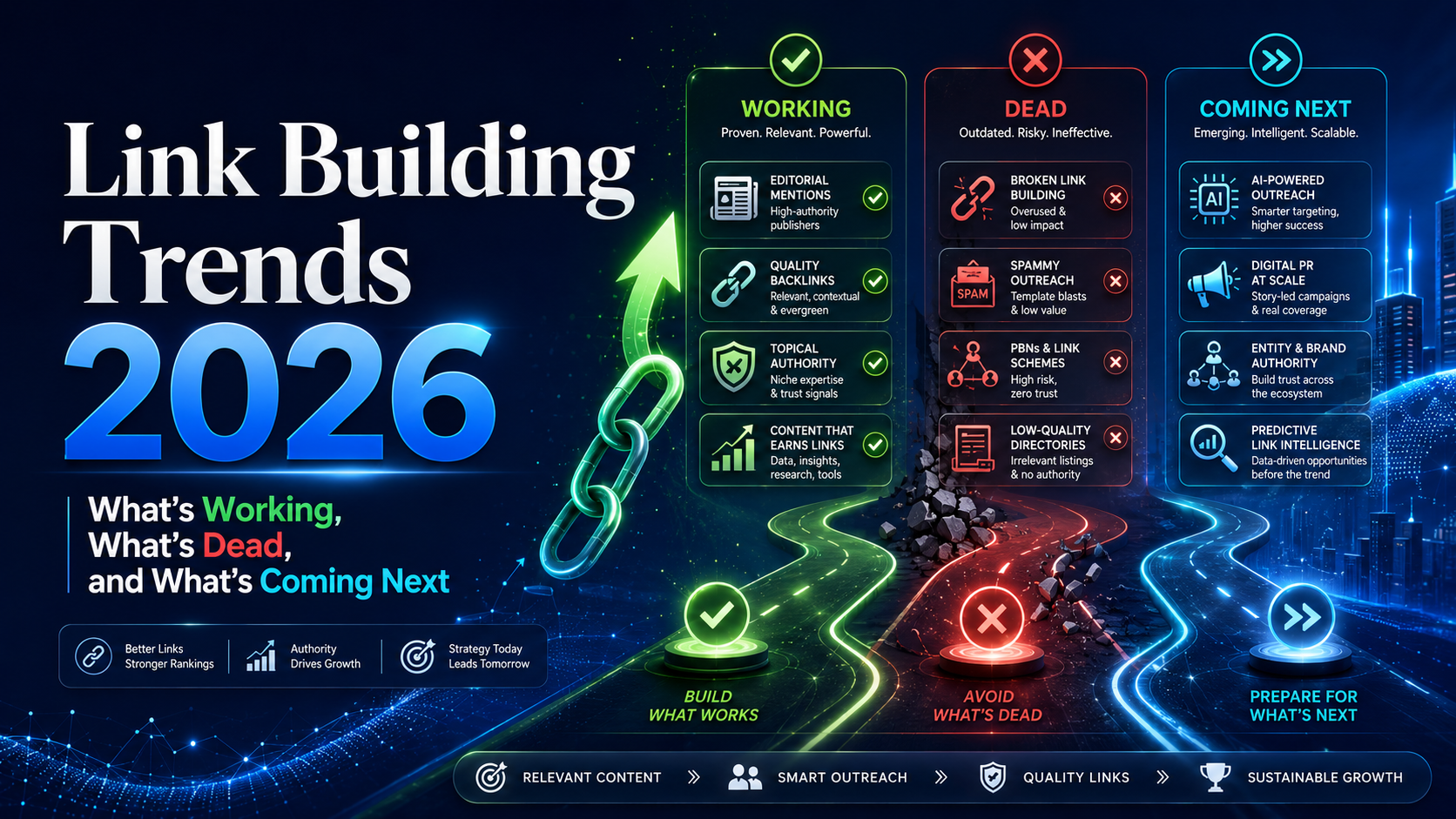
Let’s be real for a second. If you’ve been in the SEO game long enough, you’ve watched one “proven” link building tactic after another get nuked by a Google update. You’ve seen PBN sellers repackage their networks as “curated content sites.” You’ve watched the HARO gold rush turn into a PR landfill. And you’ve probably heard at least three people tell you that link building is dead – right before the sites that invested in quality links quietly took over the first page of every competitive keyword.
Link building isn’t dead. But a lot of the tactics that passed for link building? Those absolutely are.
This guide digs into the real link building trends 2026 has surfaced – what’s generating measurable ranking lifts, what’s silently hemorrhaging domain authority, and what forward-thinking SEOs are positioning for right now. Whether you’re managing an in-house team or evaluating external link building services for the first time, this is the ground-level view you need before spending another dollar on backlinks.
| By the Numbers: Link Building in 2026 94% of link builders now say quality outweighs quantity. Pages in Google’s Top 10 carry 3.8x more backlinks than lower-ranking competitors. The average cost of a quality backlink crossed $500 in 2025 and is still climbing. And 78% of marketers report positive ROI from their link building investment – when done right. |
1. The State of Link Building in 2026
Anyone who tells you the link building landscape looks the same as it did in 2022 hasn’t been paying attention. Google has rolled out wave after wave of algorithm updates – seven in 2024 alone – and its SpamBrain AI system has become genuinely terrifying in its ability to detect manipulation. The March 2026 spam update rolled out faster than any update in recent history, which itself signals that Google’s automated spam detection has reached a new tier of efficiency.
The net result? A market that has bifurcated. On one side, you have brands that invest in editorial authority – digital PR, expert-driven content, and genuine relationship building. On the other, you have sites that cut corners and are now hemorrhaging traffic after every algorithm refresh. The middle ground is disappearing fast.
Here’s the uncomfortable truth most link building guides won’t admit: the majority of pages on the web have zero backlinks. According to data from Backlinko and Linkscope, 94.3% of all web pages receive zero organic traffic from Google – largely because they have no external backlinks pointing to them. And pages with even a single backlink are 77% more likely to rank in the Top 10 than pages with none. The fundamentals haven’t changed. The execution requirements have.
| TL;DR – Link building still dominates SEO in 2026. Backlinks remain the strongest ranking signal – but the bar for what counts as a ‘quality’ link has risen sharply. One relevant, editorial link from a trusted domain is worth more than fifty directory placements. |
2. What’s Actually Working: The High-ROI Tactics of 2026
Digital PR – The Undisputed Leader
Digital PR has become the dominant link building strategy of 2026, and it’s not close. According to the State of Link Building Report from Aira and Linkscope, 48.6% of SEO professionals now rank digital PR as the single most effective link acquisition tactic – nearly three times the rate of guest posting (16%).
What makes digital PR the MVP? It earns links that Google explicitly wants to reward – editorially granted, contextually relevant backlinks from publications like Forbes, TechCrunch, Axios, or niche trade outlets in your industry. A single well-executed data study can generate 50 to 200 links without a single cold outreach email. That kind of compounding return is simply impossible to replicate through transactional link buying.
The most effective digital PR approaches in 2026 include original industry surveys, proprietary data analysis that reveals counterintuitive trends, expert commentary on breaking news, and timely research tied to policy shifts or economic events. For example, an e-commerce brand that surveyed 2,000 consumers about post-tariff spending habits and published the findings with compelling data visuals had a realistic shot at coverage from CNBC, Retail Dive, and dozens of vertical publications – all linking back to the source.
Expert Quotes and the HARO Successor Ecosystem
HARO (Help a Reporter Out) declined in quality after its acquisition, but the journalist-source relationship it pioneered is very much alive – just spread across a wider ecosystem. In 2026, platforms like Connectively, Qwoted, Featured.com, and direct journalist outreach on LinkedIn and X have filled the gap. For brands with genuine subject matter experts, these channels remain an efficient way to earn high-authority contextual backlinks – the kind that signal E-E-A-T (Experience, Expertise, Authoritativeness, Trustworthiness) to Google’s quality evaluators.
Strategic Guest Posting – Quality Over Quantity
Guest posting isn’t dead – it’s just been redefined. Publishing content on authoritative, topically relevant sites still works in 2026, but the tolerance for 500-word filler articles on domain squatter blogs is gone. Publishers have raised their editorial standards, and Google’s quality classifiers have gotten sharper at distinguishing genuine thought leadership from link placement dressed up as content.
The guest posting strategies that deliver in 2026 are niche-specific, expert-authored, and aimed at sites with genuine organic traffic – not just inflated DR scores. A piece in Search Engine Journal, Moz, or an industry-specific trade publication still moves needles. A 700-word post on a “digital marketing tips” blog with zero real audience does not.
Broken Link Building and Resource Page Outreach
These are the workhorses of white-hat link building – less glamorous than digital PR, but reliably effective when executed with precision. Broken link building involves identifying dead pages that used to host valuable resources, then pitching a superior replacement to the sites that linked to them. It’s a win-win value exchange, which is exactly the framing Google rewards.
Resource page outreach functions similarly: finding curated ‘best of’ or ‘helpful links’ pages in your niche and making the case for your content’s inclusion. When the content genuinely belongs there, the conversion rate is meaningful.
Linkable Assets – The Long Game
Original tools, calculators, data visualizations, industry statistics pages, and comprehensive reference guides are passive link magnets when built correctly. They require significant upfront investment – and 12% of SEO experts rate them as their highest-ROI tactic – but they generate links organically over time, often from sources that would never respond to a cold outreach email.
The key insight here: linkable assets work best when they solve a problem the industry keeps Googling. A mortgage calculator, a salary benchmarking tool, or a regulatory compliance checklist in a highly regulated niche will earn editorial links from publishers who genuinely want to point their readers toward a useful resource.
| TL;DR – Digital PR leads the pack in 2026, followed by expert quoting, selective guest posting, broken link building, and linkable asset creation. Each tactic works – but only when grounded in genuine value creation, not volume. |
Link Building Strategy Comparison: 2026 Effectiveness Overview
| Strategy | Effectiveness | Avg. Links / Campaign | Risk Level | Cost Range |
| Digital PR | ★★★★★ | 50–200+ | Very Low | $3,000–$15,000/campaign |
| Guest Posting (Quality) | ★★★★☆ | 5–20 | Low | $300–$1,500/post |
| Expert Quoting (HARO+) | ★★★★☆ | 3–15/mo | Very Low | $500–$2,000/mo |
| Broken Link Building | ★★★☆☆ | 5–25 | Very Low | $1,000–$4,000/mo |
| Resource Page Outreach | ★★★☆☆ | 5–20 | Very Low | $1,000–$3,000/mo |
| Linkable Assets | ★★★★★ | Passive/ongoing | Very Low | $2,000–$10,000 upfront |
| Niche Edits (Editorial) | ★★★★☆ | 10–40 | Low-Medium | $200–$800/link |
| Private Blog Networks (PBN) | ✗ Dead | High (short-term) | Extreme | High risk of penalty |
| Paid Directory Submission | ✗ Dead | Low value | High | $50–$300 – avoid |
| Link Exchanges (systematic) | ✗ Dead | Negligible | High | Risk > reward |
3. What’s Dead (And What’s Actively Dangerous)
Here’s where a lot of brands get burned: they assume that tactics no longer working just means they’re inefficient. In 2026, several link building practices don’t just fail to help – they actively damage your site.
Private Blog Networks (PBNs)
PBNs were the workhorse of black-hat SEO for over a decade. The playbook was simple: buy expired domains with legacy authority, populate them with thin content, and point links at your money site. It worked – until SpamBrain’s AI-assisted detection made it not just ineffective but catastrophically risky.
The October 2025 spam update and the dual-wave March 2026 spam update specifically targeted PBN-adjacent tactics: expired domain redirects, AI-content-refreshed blog networks, and indirect paid link attribution structures. Sites relying on these networks are getting hit with algorithmic devaluation in near real time. Recovery timelines? Months to years, not weeks.
Scaled Content Abuse
Google’s Scaled Content Abuse policy – one of three new spam policies introduced in 2024 – is now being enforced with serious teeth. Mass production of AI-generated content designed purely to host outbound links or capture long-tail traffic has been flagged and deindexed at scale. If your ‘content strategy’ involves publishing 200 articles a month with no human editorial oversight, you’re walking into a penalty.
Site Reputation Abuse (Parasite SEO)
Publishing third-party content on high-authority domains to piggyback their trust signals – popularly called Parasite SEO – is now a named Google policy violation. Sites that hosted coupon pages, reviews, or sponsored posts under the guise of editorial content have been hit hard. The enforcement here is ongoing and aggressive.
Systematic Link Exchanges
‘I’ll link to you if you link to me’ sounds harmless when done once between two genuine editorial partners. But systematic link exchange networks – even when disguised as content collaboration rings – are identifiable by SpamBrain’s pattern analysis. Google’s own data shows that 43.7% of top-ranking pages naturally have some degree of reciprocal linking, which is why the policy targets systematic schemes, not organic editorial overlap.
Paid Directory Submissions
Low-value business directories, link aggregators, and niche-specific ‘submission’ sites lost their ability to influence rankings years ago. In 2026, they represent sunk cost at best and negative trust signals at worst. The few directories worth being in – Chamber of Commerce listings, BBB, industry-specific associations – don’t require payment for placement.
| TL;DR – PBNs, scaled content abuse, parasite SEO, systematic link exchanges, and paid directory spam are not just ineffective in 2026 – they’re active liabilities. Google’s SpamBrain detects these patterns in near real time, and recovery from penalties takes months. |
Dead vs. Working Tactics at a Glance
| Tactic | Status in 2026 | Google Policy Risk | Recommended Action |
| Digital PR / Data Studies | ✅ Working | None | Prioritize |
| Quality Guest Posting | ✅ Working (selective) | Low if editorial | Use strategically |
| HARO / Expert Quoting | ✅ Working | None | Build a system |
| Broken Link Building | ✅ Working | None | Supplement core strategy |
| PBNs | ❌ Dead + Dangerous | Extreme | Remove/disavow immediately |
| AI Content Link Farms | ❌ Dead | Very High (Scaled Content Policy) | Avoid entirely |
| Parasite SEO | ❌ Dead | Very High (Site Rep. Policy) | Avoid entirely |
| Systematic Link Exchanges | ❌ Dead | High | Cease immediately |
| Paid Low-Quality Directories | ❌ Dead | Moderate-High | Disavow if in bulk |
| Expired Domain Redirects | ❌ Dead | Very High | Audit and disavow |
4. The AI Factor: How GEO Is Reshaping Link Building
If there’s one structural shift that separates 2026 from every prior year in SEO, it’s the rise of AI-powered search surfaces. Google’s AI Overviews now appear in an estimated 16% to 30% of all search queries globally, with over 2 billion monthly users interacting with AI-generated summaries before – or instead of – clicking any link.
That changes the calculus for link building in a fundamental way. A backlink that improves your organic ranking still matters. But a link that gets your content cited in an AI Overview? That’s a different tier of visibility entirely.
What Is GEO-Focused Link Building?
Generative Engine Optimization (GEO) is the emerging discipline of optimizing your content and backlink profile specifically for inclusion in AI-generated answers – from Google’s AI Overviews, Perplexity, ChatGPT (browse mode), and Bing Copilot. Unlike traditional SEO which focuses on the presence and authority of hyperlinks, GEO-focused link building layers in semantic context, entity relationships, and citation-worthiness.
The research data here is significant: 73.2% of SEO experts believe that backlinks are a primary factor in whether a brand appears in AI Search Overviews. And 76.1% of pages cited in AI Overviews also rank in Google’s top 10 – meaning traditional authority still matters, but it’s not sufficient on its own.
What Makes a Link GEO-Effective?
GEO-effective links share three characteristics that go beyond standard domain authority metrics:
• Authority from trusted domains – editorial placements in news media, industry associations, and peer-reviewed or government-adjacent sources that AI systems are trained to trust.
• Entity-clean context – the surrounding text, anchor phrases, and page topics that map your brand clearly to specific concepts, so AI systems can accurately retrieve and cite you.
• Situational relevance – links that appear in content directly addressing the query types your audience is asking AI systems, not just traditional search engines.
This means the work of link building in 2026 increasingly overlaps with brand building, content authority, and structured data implementation. Sites that win in AI Overviews aren’t just collecting backlinks – they’re engineering a web presence that AI systems can parse, trust, and cite.
| TL;DR – AI Overviews now influence discovery for billions of monthly searchers. GEO-focused link building – earning links from trusted, entity-rich, contextually relevant sources – is the emerging practice for brands that want to be cited by AI answers, not just rank in blue links. |
Traditional SEO vs. GEO Link Building: Key Differences
| Dimension | Traditional SEO Link Building | GEO Link Building (2026) |
| Primary Goal | Improve organic ranking in SERPs | Appear in AI-generated answers + rankings |
| Link Quality Metric | Domain Authority / Domain Rating | Topical authority + entity clarity + trust |
| Content Focus | Keyword-optimized pages | Question-answering, structured, citable content |
| Target Sources | High-DA websites | News media, associations, trusted editorial sources |
| Anchor Text Role | Keyword-rich anchors | Contextual entity mapping + brand mentions |
| Measurement | Ranking position + organic traffic | AI citation frequency + AI traffic share + rankings |
| Brand Mentions | Secondary signal | Primary trust signal for LLMs |
| Structured Data | Nice to have | Critical for AI retrieval accuracy |
5. The True Cost of Link Building in 2026
Let’s talk about money – because this is where a lot of businesses get blindsided. Link building has never been cheap when done correctly, and in 2026, it’s more expensive than ever. AI-generated content has flooded publisher inboxes, making editorial placements harder to secure. The editorial filter has gotten tighter, the outreach-to-placement ratio has shrunk, and the cost of quality has risen accordingly.
According to industry survey data from Editorial.link (2026), the average price SEOs are willing to pay for a single high-quality backlink is $508.95 – and that number has increased 20–35% since 2022. Premium placements in high-authority publications can exceed $5,000 per link. The cold reality: if you’re spending under $1,000 per month on link building in a competitive niche, the math doesn’t work in your favor.
The outreach side compounds this. A comprehensive study of 12 million outreach emails by Backlinko and Pitchbox found that only 8.5% of link building emails receive any reply. That’s a sobering number that explains why link building agencies and services exist – the expertise, relationships, and tooling required to run effective campaigns at scale are simply beyond what most in-house teams can build efficiently.
Link Building Cost Benchmarks by Tactic (2026)
| Tactic | Avg. Cost Per Link | Monthly Budget (Competitive Niche) | Expected ROI Timeline |
| Digital PR Campaign | $150–$500/link (amortized) | $5,000–$15,000/mo | 6–12 months |
| Quality Guest Post | $300–$1,500/post | $2,000–$8,000/mo | 3–9 months |
| Expert Quoting (HARO+) | $100–$400/link | $500–$2,500/mo | 2–6 months |
| Niche Edit / Link Insertion | $200–$800/link | $2,000–$6,000/mo | 3–8 months |
| Broken Link Building | $150–$500/link | $1,500–$5,000/mo | 4–10 months |
| Linkable Asset Creation | $2,000–$10,000 upfront | One-time + promotion | 12–24 months (passive) |
| Full-Service Agency (managed) | $3,000–$15,000/mo flat | N/A | 6–18 months |
| PBNs / Black Hat (avoid) | $50–$200/link | Variable | Penalty risk – unpredictable |
6. How to Evaluate a Link Building Service in 2026
Here’s where healthy skepticism earns its keep. The link building services market is crowded, and the gap between providers who genuinely understand the 2026 landscape and those still running 2019 playbooks is enormous. A site owner who doesn’t know what to look for will routinely pay for links that either do nothing or – worse – invite a penalty.
Before engaging any link building service, these are the questions worth asking out loud:
• Do they vet sites for organic traffic, not just DR/DA? Domain Authority scores are gameable. Real organic traffic isn’t.
• Are they transparent about their publisher network? A legitimate service should be able to tell you what types of sites they target.
• Do they produce campaign-level reports showing referring domains, anchor text distribution, and indexation confirmation?
• Do they offer niche-specific outreach, or is it a one-size-fits-all content calendar?
• Can they demonstrate experience in your vertical, or are they just running generic outreach templates?
• Do they understand E-E-A-T and can they explain how their links support your site’s topical authority?
Services like Outreachz have built a reputation around transparent, niche-targeted link placement – pairing clients with relevant, editorially vetted publishers rather than running automated blast campaigns. For brands evaluating managed link building for the first time, it’s worth looking at providers who demonstrate clear methodology around site vetting, content quality, and anchor text diversity, rather than those who lead with raw link volume at discount prices.
| Red Flags to Watch For in Link Building Services Guaranteed rankings from link building alone • Prices that seem too good to be true (sub-$50/link for ‘authority’ placements) • No visibility into the actual sites receiving your content • Heavy use of exact-match anchor text across all placements • Inability to explain how they comply with Google’s link scheme policies • Vague about whether placements are paid or editorial |
What to Look for in a Link Building Service: Feature Comparison
| Evaluation Criteria | Premium Service ✅ | Budget Service ⚠️ | Black-Hat Provider ❌ |
| Publisher Vetting | Organic traffic + topical relevance checked | DR/DA only, no traffic check | Automated – no human review |
| Content Quality | Expert-written, editorial standard | Generic, templated | Spun or AI-bulk content |
| Niche Relevance | Vertical-specific targeting | Broad category matching | Irrelevant – any site that accepts |
| Transparency | Full publisher list + indexation reports | Partial reporting | None – black box |
| Anchor Text Strategy | Varied, natural distribution | Limited variation | Heavy exact-match – risky |
| Google Policy Compliance | White-hat, fully compliant | Gray-hat risks | Black-hat – penalty risk |
| EEAT Support | Aligns with expertise signals | Rarely considered | Not a consideration |
| Long-Term Safety | High – compounding returns | Medium – depends on tactics | Low – degrading over time |
7. Link Building Trends 2026: What’s Coming Next
The trajectory of link building trends 2026 has established is pointing clearly toward a few convergent developments that will define the next 18–24 months. Here’s where the smart money is positioning:
AI-Assisted Prospecting – Human Strategy, Machine Efficiency
Only 6% of SEO experts have meaningfully integrated AI tools into their link building workflow as of 2026 – but that number will accelerate. AI is genuinely useful for link gap analysis, prospect research, outreach personalization at scale, and spotting risky link patterns before they become penalties. The brands winning in this space will use AI to handle the manual, data-heavy work while keeping human judgment in control of strategy and editorial decisions.
Entity-Based SEO and the Shift From Keywords to Concepts
Google’s algorithm has been moving toward entity-based understanding for years – treating the web not as a collection of keyword-matched documents but as a knowledge graph of interconnected concepts, brands, and authorities. In 2026, this shift is accelerating. Links that reinforce your entity associations – connecting your brand clearly to specific topics, industries, and expertise areas – are worth more than generic authority links from unrelated domains.
Unlinked Brand Mentions as a Link Building Trigger
Brand mentions without hyperlinks – a publication that references your company or content without linking – are increasingly being treated as a preliminary authority signal by search engines. The conversion rate on outreach to secure links from existing unlinked mentions is among the highest of any link building tactic. Monitoring tools like Ahrefs, Mention, and Brand24 make this an accessible ongoing workflow.
Community Platforms Are Gaining Search Weight
Reddit, Quora, LinkedIn, and niche industry forums are gaining measurable authority and SERP visibility. These platforms aren’t traditional link building targets, but brand presence and genuine contribution in these communities generates both direct referral traffic and indirect authority signals that influence how AI systems perceive your domain’s topical credibility.
Geographic Relevance for Local and Regional SEO
Local links from geographically relevant sources – regional news outlets, local Chamber of Commerce sites, geographic-specific directories with real traffic – carry increased weight for location-based queries in 2026. This is especially relevant for multi-location businesses, regional service providers, and brands targeting markets in specific US states or metros.
| TL;DR – The next wave of link building will be defined by AI-assisted efficiency, entity-based targeting, unlinked mention conversion, community authority signals, and geographic precision. The direction is clear: earn trust where it’s contextually relevant, not just where it’s algorithmically convenient. |
8. Practical Link Building Priorities for 2026
Enough theory – here’s how to translate the Link Building Trends 2026 data into an actionable framework:
1. Audit your current backlink profile first. Before building new links, understand what you’re working with. Identify toxic links from PBNs or spam directories, anchor text over-optimization, and gaps in topical relevance. Google Search Console, Ahrefs, or Semrush will surface the high-risk entries.
2. Allocate budget toward digital PR – even at a small scale. A single well-executed data study or survey report can generate more editorial links than months of guest posting campaigns. Start with your existing data and find the angle that makes it newsworthy.
3. Build a linkable asset this quarter. Identify the one resource your industry keeps searching for and doesn’t have a great answer to. A calculator, a benchmark report, a glossary, or a comprehensive guide. Invest the time to make it genuinely excellent, then promote it actively.
4. Participate in expert quote platforms consistently. Sign up for Connectively, Qwoted, and Featured.com. Contribute genuinely useful responses to journalist queries in your space. Over time, this builds both editorial backlinks and an industry presence that supports E-E-A-T signals.
5. Vet any link building partner rigorously. Apply the evaluation framework above. Ask for actual site examples before committing budget. A provider like Outreachz.com that operates transparently – showing you the publishers, the content, and the reporting – is far less likely to put your domain at risk than one selling packaged “DA 50+ links” in bulk with no visibility into the placements.
6. Start tracking AI citation visibility. In addition to traditional rank tracking, begin monitoring whether your brand appears in Google AI Overviews and Perplexity answers for your core queries. This is where the SEO conversation is heading, and getting visibility here before competitors do is a genuine first-mover advantage.
Final Thoughts: The Link Building Reality Check
The brands that are winning in organic search in 2026 share a common characteristic – they stopped trying to game the link graph and started trying to deserve their position in it. Every algorithm update Google has shipped in the past two years has moved the goalposts closer to the same place: earn links by being genuinely useful, genuinely expert, and genuinely trustworthy.
That doesn’t mean link building is easy. It means it’s expensive, time-consuming, and increasingly requires either deep in-house expertise or a reliable external partner who actually understands the 2026 landscape. The good news is that the difficulty is a moat – because every competitor taking shortcuts is one algorithm update away from losing ground they spent months building.
If you’re evaluating your link building strategy right now – whether to build it in-house or work with an outside service – the most important move is honesty about where you stand. Audit your current profile. Understand what’s working and what’s a liability. Invest in tactics that compound over time rather than ones that borrow against your future authority.
The link building trends 2026 has surfaced are not ambiguous. Quality, relevance, editorial credibility, and AI visibility are the direction. The only real question is how fast you’re moving toward them.
Frequently Asked Questions
Is link building still worth it in 2026?
Yes – with important caveats. Pages in Google’s Top 10 have 3.8x more backlinks than lower-ranking competitors, and 94.3% of pages with zero backlinks receive zero organic traffic. Backlinks remain the strongest off-page ranking signal. However, the quality threshold has risen significantly, and low-quality link acquisition is now an active liability.
How much should I budget for link building in 2026?
Industry data suggests the average acceptable price for a quality backlink is $508.95, with costs ranging from $300 to $5,000+ depending on the publication’s authority and relevance. For competitive niches, a realistic minimum monthly budget is $3,000–$5,000. Underfunding link building in a competitive space typically means slow progress or the temptation to cut corners – both expensive in different ways.
What’s the biggest link building mistake brands are making in 2026?
Prioritizing DR/DA over organic traffic and topical relevance. A DR 80 site with no real audience and no topical connection to your niche delivers far less value – and considerably more risk – than a DR 45 site that genuinely covers your industry and has real editorial standards. SpamBrain is very good at detecting the difference.
How does link building affect AI Overviews?
Research shows 73.2% of SEO experts believe backlinks are a primary factor in AI Overview citations. Brands that earn editorial backlinks from trusted, authoritative sources are significantly more likely to be cited in Google’s AI-generated summaries. GEO-focused link building – targeting sources that AI systems trust – is the emerging strategy for AI search visibility.
How do I identify a trustworthy link building service?
Look for transparency about publisher selection, organic traffic vetting (not just DR/DA), clear anchor text strategy, niche relevance, and a track record you can verify. Services that operate with full reporting and show you the actual sites before publishing – like Outreachz.com and similar vetted providers – are significantly lower risk than bulk-volume services that promise high-DA links without disclosure.