

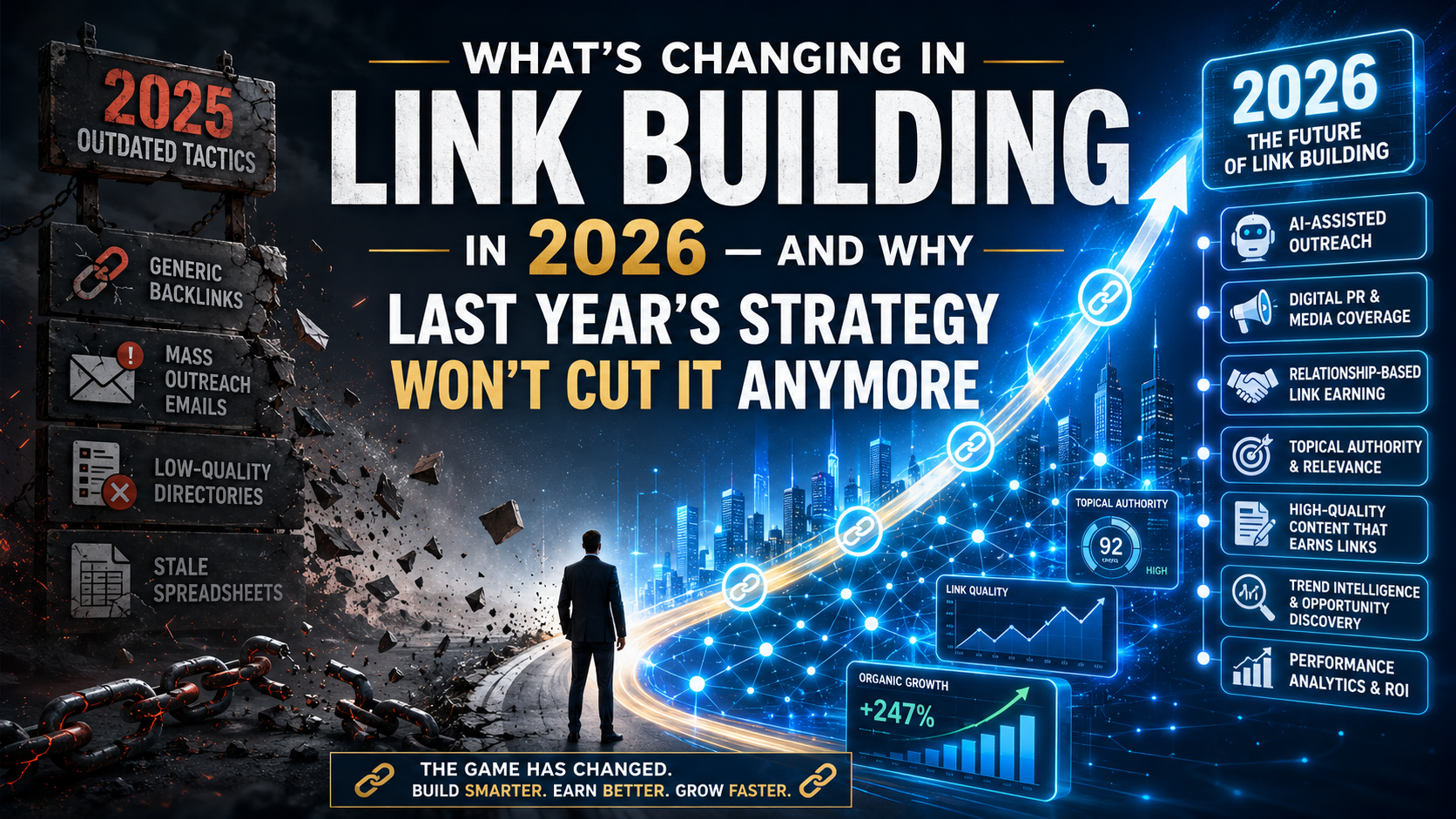
The Ground Has Shifted – And Most SEOs Haven’t Caught Up
If you are still running the same link-building playbook you used in 2024 or early 2025, there is something you need to hear: that strategy might not just be underperforming – it could be actively working against you.
Link building in 2026 is not a tweak or a gradual evolution. It is a fundamental rethinking of what a backlink means, who it comes from, and why it matters – not just to Google’s traditional ranking algorithm, but to the AI-powered search systems that are now serving answers directly to hundreds of millions of users every single day.
Google rolled out multiple core updates and at least two targeted spam updates between late 2025 and mid-2026. Each tightened the screws on low-quality, manipulative, and scaled link acquisition tactics that once moved the needle. Meanwhile, the rise of AI Overviews, ChatGPT, Perplexity, and Google’s AI Mode means that being visible in search is no longer just about ranking on page one – it is about being cited by systems that do not even show users a traditional list of blue links.
This guide breaks down exactly what has changed, what still works, what has gotten genuinely dangerous, and how to build a link strategy in 2026 that holds up – not just through the next Google update, but through the next wave of AI-driven search transformation.
| 95% | of web pages have zero backlinks – meaning those that consistently earn quality links enjoy an enormous competitive advantage (DemandSage, 2026) |
| 82% | of SEO professionals rely on backlink analysis tools like Ahrefs and Semrush as core components of their strategy |
| 48.6% | of SEO professionals now rank Digital PR as the single most effective link-building tactic available (Aira State of Link Building, 2026) |
Why Last Year’s Strategy Won’t Cut It Anymore
Google’s Spam Crackdowns Have Changed the Risk Equation
Let’s be direct about what happened. Throughout 2025 and into 2026, Google’s SpamBrain system – its AI-powered link spam detection engine – got significantly more sophisticated. The August 2025 spam update ran for nearly 27 days and specifically targeted paid link schemes, private blog networks (PBNs), hidden text, thin affiliate content, and manipulative link acquisition patterns. Sites that had built their domain authority on these tactics did not just plateau – many saw steep, sudden drops in rankings for their most important keywords.
Google’s March 2026 core update doubled down on E-E-A-T signals: Experience, Expertise, Authoritativeness, and Trustworthiness. It rewarded pages demonstrating genuine first-hand expertise and penalized thin or generic content – including AI-generated content that had been scaled specifically to manipulate link profiles. By May 2026, another spam update was rolling out, described by industry observers as one of the fastest-executing in Google’s history, completing in under 48 hours.
| TL;DR – Google’s spam detection is now AI-powered and faster than ever. If your link profile includes PBNs, paid link farms, or scaled guest post networks, you are one update away from a serious ranking drop – and recovery after these penalties now takes six to eighteen months on average. |
The Spray-and-Pray Era Is Officially Dead
For years, the old-school approach to link building was volume-first: blast out hundreds of generic guest post pitches, buy directory submissions, trade links with anyone who would trade back, and let quantity carry the day. In 2026, that approach has become a liability, not an asset.
Editors now receive hundreds of templated pitches every single week. The ones that land look nothing like the old formula. Modern link outreach means offering genuine value – proposing to update outdated content, contributing unique data, or building relationships with journalists who actively cover your niche. The days of ‘I’ll write a free article in exchange for a backlink’ generating meaningful, lasting results are effectively finished.
What has replaced it is smarter, more deliberate, and genuinely more sustainable. But it requires a different kind of team, a different set of expectations, and often a different set of partners. The brands winning at link building in 2026 have accepted this shift – the ones still trying to game volume are quietly bleeding rankings.
Old Tactics vs. New Realities: 2025 to 2026 Comparison
| Tactic | Effectiveness in 2025 | Status in 2026 | Risk Level |
| PBN Links | Moderate (short-term) | Dangerous – SpamBrain flagged | HIGH |
| Mass Guest Posting | Low to Moderate | Saturated / Penalized at scale | MEDIUM-HIGH |
| Directory Submissions | Very Low | Negligible – not worth pursuing | LOW-MED |
| Reciprocal Link Swaps | Low | Tolerated in strict moderation | MEDIUM |
| Broken Link Building | Moderate | Effective with targeted refinement | LOW |
| Digital PR Campaigns | High | Dominant – #1 ranked tactic | LOW |
| Unlinked Brand Mentions | Emerging | High value – convert actively | LOW |
| Original Data / Research | High | Essential link magnet strategy | LOW |
| AI-Scaled Content Links | Moderate | Actively devalued by Google | MEDIUM-HIGH |
What’s Actually Working in Link Building in 2026
1. Digital PR: The Dominant Strategy of the Year
If there is one tactic that has pulled decisively ahead of everything else in 2026, it is Digital PR. Rated the single most effective link-building approach by nearly half of all SEO professionals surveyed by Aira, Digital PR generates high-authority editorial backlinks from news publications, industry outlets, and trusted media – the kind of links that Google genuinely rewards and that AI systems use to determine brand credibility.
Unlike traditional press releases, modern Digital PR centers on creating genuinely newsworthy stories: original research reports, compelling data visualizations, expert commentary on breaking industry trends, and exclusive surveys that journalists actually want to cover. When a publication covers your story, they link back to your site as the source. That is a natural, editorial link that no algorithm update can easily devalue.
Here is the strategic kicker for 2026: Digital PR does not just build SEO authority. It simultaneously builds the brand signals that AI systems use when deciding which companies to recommend. Ahrefs analyzed 75,000 brands and found that branded web mentions – the exact type of coverage that Digital PR generates – correlate at 0.664 with AI Overview visibility. That is a remarkably strong signal, meaning every piece of earned media coverage is now doing double duty across both traditional SEO and generative AI search.
Digital PR campaigns also report an average ROI of 312%, making them not only the most effective but frequently the most cost-efficient link acquisition strategy available in 2026.
| TL;DR – Digital PR earns editorial backlinks from trusted publications AND builds the brand mentions that AI systems cite in their answers. It is the only tactic simultaneously serving traditional SEO and Generative Engine Optimization – which is exactly why it now dominates the strategy landscape. |
2. Generative Engine Optimization (GEO): The New Frontier
Here is something that barely existed as a formal discipline 18 months ago and is now genuinely non-negotiable: Generative Engine Optimization, or GEO. GEO is the practice of structuring your content, earned media, and brand mentions so that AI-powered search engines – ChatGPT, Google AI Overviews, Perplexity, Gemini, and others – cite your brand when constructing their answers to user queries.
In 2026, Google’s AI Overviews appear in more than 50% of search results. ChatGPT processes over 2.5 billion daily prompts. Perplexity and Google’s AI Mode are seeing rapid adoption. These systems do not rank a list of blue links – they synthesize answers. And the brands they mention in those synthesized answers are selected using signals that differ fundamentally from traditional PageRank.
For link building strategy, this changes the math significantly. An unlinked brand mention on a highly authoritative, contextually relevant industry publication now carries measurable weight for AI citation probability – sometimes more weight than a hyperlinked keyword anchor on a lower-quality guest post. Research from Wellows LLM Citation Research found that statistical facts increase AI citation likelihood by 22%, while direct expert quotations increase it by 37%.
| Signal Type | Traditional SEO Impact | GEO / AI Citation Impact |
| High-authority editorial backlink | Very High | High |
| Unlinked brand mention (trusted source) | Low | Very High |
| Statistical data / original research | High | Very High (+22%) |
| Direct expert quotes | Moderate | Very High (+37%) |
| PBN / low-quality network links | Minimal/Negative | Negative |
| Brand consistency across web properties | Moderate | High |
| Coverage in major news publications | High | Very High |
| Unverifiable AI-generated content | Declining | Negligible |
3. Topical Authority: The Foundation Every Link Strategy Needs
Google’s AI-driven updates throughout 2025 and 2026 have placed enormous emphasis on topical authority. It is no longer enough to have links pointing to your homepage or a handful of key landing pages. What matters is whether your domain consistently demonstrates deep, coherent expertise in a defined subject area – and whether the links you earn reinforce that expertise signal.
Sites that have invested in content hubs – tightly interlinking clusters of articles around a core theme – are attracting more organic links naturally, ranking more consistently through algorithm updates, and being cited more frequently by AI systems. The link-building implication is clear: you cannot separate off-page strategy from on-page architecture anymore. Before you pitch for a guest post or launch a Digital PR campaign, your site needs to demonstrate it belongs in the conversation.
A strong topical hub gives journalists, editors, and bloggers a genuine reason to link to you. You are positioning yourself as a credible, authoritative resource – not just another vendor chasing a backlink. Google sees that difference. AI systems see it even more clearly.
| TL;DR – Topical authority is no longer just an on-page SEO concept – it is a prerequisite for effective off-page link building in 2026. Without a coherent content hub, even excellent outreach gets ignored by editors and deprioritized by algorithms. |
4. Unlinked Brand Mentions: High ROI, Low Competition
One of the highest-ROI link-building tactics in 2026 that most teams still dramatically underutilize: converting unlinked brand mentions into actual backlinks. When a publication, blog, or news outlet mentions your brand, product, or content without linking to you, that is an immediate, low-effort opportunity that requires no cold pitching, no new content creation, and no relationship-building from scratch.
Tools like Google Alerts, Mention, or BuzzSumo allow you to track every instance your brand is mentioned online in near real time. When you find an unlinked mention, a short, polite outreach message – thanking the author and suggesting they add a link for their readers’ benefit – succeeds at remarkably high rates. You are not asking for something from nothing: they have already mentioned you. Requesting a link is a natural, reasonable next step.
Built as a systematic weekly process, unlinked mention conversion compounds over time. It also signals to Google and AI systems alike that your brand has genuine, real-world recognition – a quality signal that no paid link can replicate and no algorithm can fabricate.
How to Evaluate Link Building Services in 2026
The link building services market is notoriously noisy. Your inbox is probably flooded with pitches promising ‘high-DA’ placements, guaranteed first-page rankings, and hundreds of links per month at suspiciously low prices. In 2026, the vast majority of those offers are landmines – short-term gains that set you up for algorithmic penalties when the next spam update hits.
Here is what separates a legitimate link building partner from a long-term liability:
| Evaluation Criteria | Red Flags | Green Flags |
| Link sourcing | PBNs, link farms, bulk packages | Manual outreach, editorial placements only |
| Transparency | Won’t show you the actual placement URLs | Full live-URL reporting, no black boxes |
| Topical relevance | Links from unrelated industries | Strictly sourced within your niche |
| Link velocity | Promises 100+ links/month | Realistic, sustainable acquisition pacing |
| GEO/AI awareness | No mention of brand mentions or AI search | Integrates GEO signals into strategy |
| Content quality | Spun or AI-generated content on hosts | Original, editorial-quality content only |
| Reporting | Vanity metrics only (DA, DR numbers) | Traffic data, relevance scores, citations |
| Track record | No verifiable case studies or results | Documented client outcomes across niches |
A Note on Choosing the Right Link Building Partner
With so much riding on link quality in 2026, the partner you choose matters more than it ever has before. Several reputable services have adapted their methodologies to align with current Google guidelines and the emerging demands of GEO – but they are a minority in a crowded, often misleading market.
One platform worth evaluating is Outreachz, which focuses on manual outreach-based placements from real editorial publications. Unlike bulk-link services or PBN operators, their model centers on relevance and relationship-driven link acquisition – the kind that holds up through algorithm updates rather than collapsing under them. For teams looking to scale quality link building without the risks that come with network-based approaches, it is a credible option worth adding to your vetting shortlist.
Whatever service you ultimately use, make sure they can answer three questions without hesitation: Where do your links come from – specifically? Can you see the live placement URLs before and after the campaign? And do you build links based on topical relevance and editorial standards, or simply on domain metric thresholds?
The Tactics That Got Dangerous – And Why People Still Use Them
Private Blog Networks (PBNs): The Risk Has Never Been Higher
PBNs have not disappeared – they have simply gotten more sophisticated in their attempts to disguise themselves. But so has Google’s ability to detect them. SpamBrain’s 2025 and 2026 iterations use machine learning pattern recognition to identify footprints invisible to the human eye: hosting patterns, domain ownership trails, content similarity scores, anchor text distributions, and link velocity anomalies that no SEO tool dashboard shows you.
The reason teams still use PBNs is straightforward: they can produce short-term ranking bumps. The risk is that when the algorithmic penalty hits – and in 2026, it increasingly does – recovery is neither quick nor guaranteed. Case studies of businesses penalized by the August 2025 spam update documented traffic losses lasting six months or more, even after full remediation and disavow file submission. The short-term gain rarely justifies the long-term exposure.
Scaled AI-Generated Guest Posts: The New PBN Problem
One of the fastest-growing link-building problems in 2026 is the abuse of AI-generated content at scale. Sites flooded with AI-written articles – often thinly disguised as guest posts – have been explicitly targeted by Google’s Helpful Content System and the March 2026 core update. Google’s systems specifically reduced visibility for content that lacks genuine first-hand expertise, regardless of how technically optimized it might be.
The lesson is not that AI cannot be used in link building at all. AI tools legitimately help with research, pitch drafting, content ideation, and media monitoring. But the final content needs genuine human expertise and real editorial value. AI-generated content placed on AI-generated sites to generate artificial link signals is the SEO equivalent of a house of cards – impressively fast to construct, inevitable to collapse.
| TL;DR – PBNs and AI-generated guest post schemes still produce brief ranking lifts, then collapse. The 2025 to 2026 Google spam updates have made the collapse faster and the recovery window longer. Avoiding them is no longer cautious – it is simply rational. |
| Risky Tactic | Short-Term Effect | Long-Term Risk | Avg. Recovery Time |
| PBN link networks | Rankings boost | Algorithmic demotion or manual action | 6-18+ months |
| Scaled AI guest posts | Temporary visibility | Content quality demotion | 3-12 months |
| Excessive link exchanges | Small DA lift | Flagged as manipulative pattern | 3-6 months |
| Keyword-stuffed anchor text | Minimal | Anchor spam signals triggered | 2-6 months |
| Parasite SEO / site stacking | Short traffic burst | Site reputation abuse penalty | 6-12+ months |
Building a Future-Proof Link Strategy for 2026 and Beyond
Step 1: Audit Your Existing Backlink Profile
Before adding new links, understand what you already have. Use Ahrefs, Semrush, or Majestic to pull your full backlink profile and systematically look for: links from domains with no real organic traffic, links from niches entirely unrelated to yours, suspiciously uniform anchor text patterns, and links that were acquired in sudden unnatural bursts. If you find genuinely toxic links, begin outreach to webmasters requesting removal, document every attempt, and then use Google’s Disavow Tool for links you cannot get removed organically.
Step 2: Build a Content Hub That Earns Links Naturally
The most durable link acquisition strategy in 2026 starts with content people actually want to reference. Original data – industry surveys, proprietary analyses, unique research reports – is the foundation. A well-executed industry study in your niche, published as a detailed, freely accessible report, can generate dozens of editorial links from a single campaign, along with AI citations and unlinked brand mentions that compound over time. Invest in this before you invest in any outreach campaign.
Step 3: Build Journalist Relationships, Not Just Link Placements
The most durable links in 2026 come from real relationships with editors, journalists, and authoritative bloggers in your industry. This cannot be outsourced to a generic pitch template or delegated entirely to a vendor. It means knowing which writers cover your beat, understanding what stories they need, and positioning yourself as a credible source before you need a favor. Tools like Connectively (formerly HARO), Qwoted, and Muck Rack can help you build these relationships systematically.
Step 4: Measure What Actually Matters in 2026
In 2026, Domain Authority and Domain Rating are necessary context – but not sufficient measures of link quality. A complete link strategy now tracks:
• Referral traffic generated from each backlink – links driving no real traffic carry diminishing value
• AI Overview citation frequency – how often your brand appears in AI-generated search answers
• Unlinked brand mention volume – across authoritative sources in your space
• Topical relevance scores of linking domains – relevance now outweighs raw domain metrics
• Anchor text diversity – a natural profile blends branded, generic, and keyword-targeted anchors
• Link velocity patterns – sustainable acquisition rates protect you from spam flag triggers
| Metric | 2024 Priority | 2026 Priority | Reason for Change |
| Domain Authority (DA/DR) | Very High | Moderate | Widely gamed; context now evaluated alongside metrics |
| Total backlink count | High | Low-Moderate | Volume without quality is now an active risk signal |
| Unique referring domains | High | Moderate | Diversity matters, but quality-filtered not just counted |
| Topical relevance of links | Moderate | Very High | Google’s contextual evaluation is far more granular |
| Referral traffic per link | Low | High | Real audience signal that SpamBrain cannot fabricate |
| AI Overview citation rate | N/A | Very High | Critical new KPI for 2026 GEO strategy measurement |
| Unlinked brand mention volume | Low | High | AI systems weight this heavily when recommending brands |
| Link velocity naturalness | Moderate | High | SpamBrain flags unnatural acquisition spikes immediately |
The Real-User Perspective: Questions to Ask Before You Spend a Dollar
Here is what most link-building content will not tell you: the market is full of services that will take your budget, deliver links that look impressive in a spreadsheet, and leave you worse off six months later when an algorithm update catches up to their methods. This is not a hypothetical – it is what happened to hundreds of businesses after the August 2025 and March 2026 updates.
Before engaging any link-building service – whether it is an in-house team, an agency, or a managed platform – ask these questions and pay close attention to how they respond:
• Where do your links come from, specifically? A legitimate service names actual publications, not just ‘high-DA sites in your niche.’
• Can I see live examples of recent placements? Ask for actual live URLs – not just domain names or sample reports.
• How do you verify topical relevance? Links from unrelated industries carry shrinking value in 2026’s context-weighted algorithm.
• What is your replacement policy for lost links? Reputable services replace links that go down at no additional cost.
• How do you approach AI Overview and GEO signals? If they look blank at the mention of GEO or brand mentions, that is a significant red flag.
• What is your link velocity approach? Sustainable pacing protects you from spam triggers; sudden link bursts attract algorithmic scrutiny.
• Can you show me client case studies with before/after traffic data? Any agency worth working with can demonstrate real, verifiable results.
The best link-building relationships in 2026 look far more like strategic partnerships than transactional vendor arrangements. The partner you choose should understand your business, your audience, your competitive landscape, and the specific algorithmic environment you are operating in. They should be talking to you about topical authority, GEO signals, and editorial standards – not just about how many links per month they can deliver.
Bottom Line: Link Building in 2026 Rewards the Disciplined
Link building in 2026 is not dead – it has never been more important to get right. Google still uses links as one of its most powerful ranking signals. The difference is that the definition of a valuable link has narrowed considerably, the penalties for manipulative tactics have escalated, and the landscape has expanded to include AI-powered search systems that evaluate brands using signals that most SEOs were not even measuring two years ago.
The teams winning right now have accepted that link building is no longer a volume game. They are investing in Digital PR that generates real editorial coverage at scale. They are building topical authority before launching outreach campaigns. They are optimizing for GEO alongside traditional SEO – tracking AI citation frequency as a primary KPI. They are converting unlinked brand mentions systematically. And they are choosing partners who operate with the transparency and editorial standards that 2026 demands.
They are working with services – like Outreachz – that understand the difference between a link that holds up and a link that is a liability waiting to materialize.
The teams that have not made this shift are either already experiencing declines they cannot explain, or they are one Google spam update away from discovering just how fragile their current backlink strategy really is.
The ground has shifted underneath link building in 2026. The only question that remains is whether your strategy has shifted with it.
Key Takeaways for 2026
✅ Quality over quantity – one editorial link beats 50 PBN links
✅ Digital PR is the #1 most effective tactic in 2026 – invest accordingly
✅ GEO is now inseparable from link building – brand mentions matter to AI systems
✅ Topical relevance of linking domains is now heavily weighted by Google
✅ PBNs and scaled AI guest posts carry real, growing algorithmic penalties
✅ Original research is the best link magnet available in 2026
✅ Always vet your link building service with the right questions before spending