

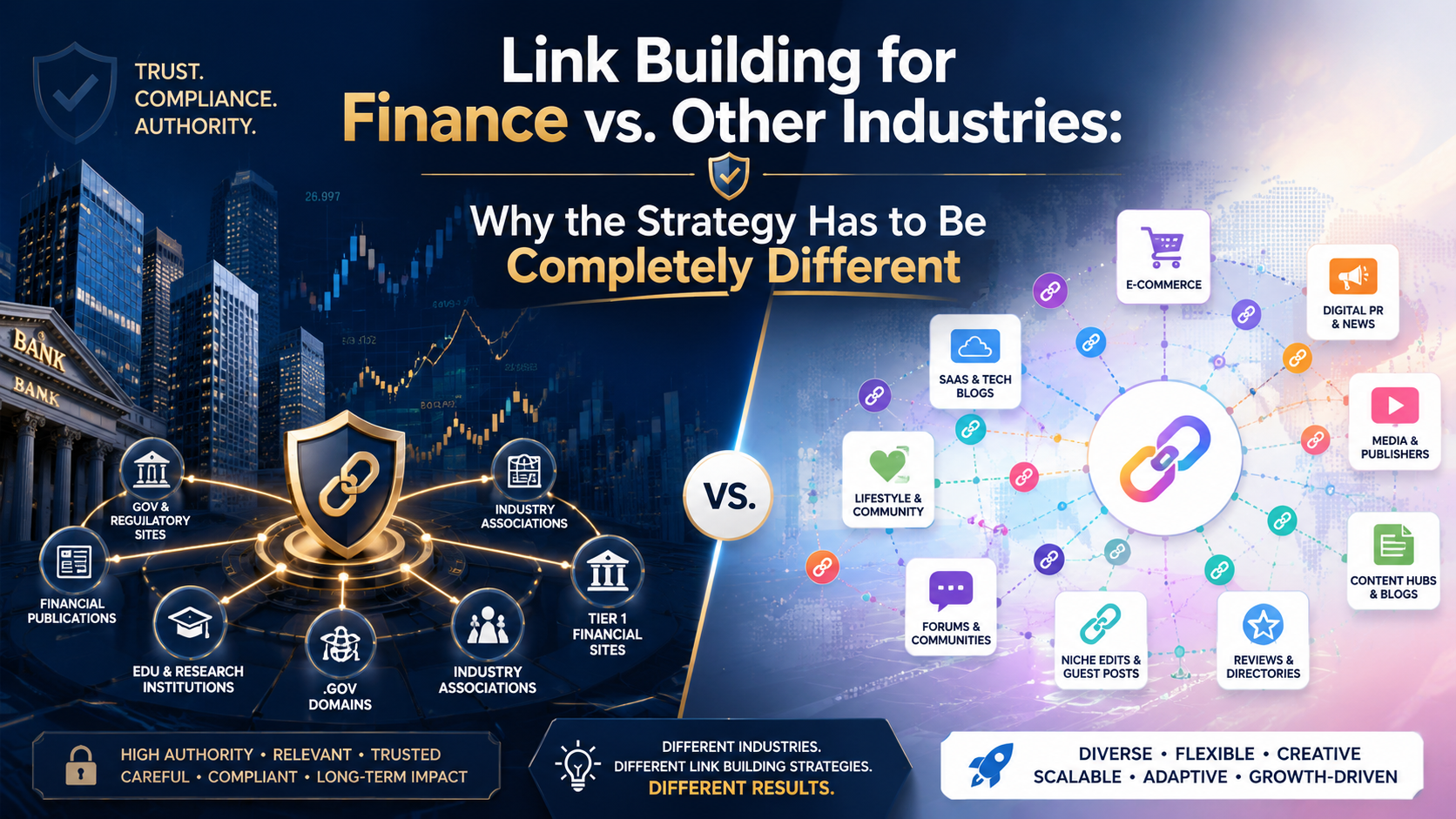
If you’ve ever tried applying a standard link building playbook to a financial services website and wondered why the results were underwhelming-or worse, why rankings dropped-you’re not alone. The reality is that link building for finance is a completely different game compared to what works in e-commerce, lifestyle, or even SaaS.
Finance is one of the most regulated, most scrutinized, and most competitive digital spaces on the internet. Google treats financial content under its strictest quality standards. Publishers are selective about who they associate with. And a single low-quality backlink from a questionable source can do far more damage to a financial brand than it ever would to a travel blog.
This guide breaks down exactly why finance requires its own link building strategy, how it stacks up against other industries, and what tactics actually move the needle in 2026 and beyond. If you’re evaluating link building services for a financial brand, you’ll also find an honest look at what to look for-and what to avoid.
1. The Foundation: Why Finance Plays by Different Rules
Google’s YMYL Designation Changes Everything
The term YMYL-Your Money or Your Life-was coined by Google to describe content that has the potential to directly impact a person’s financial wellbeing, health, or personal safety. Finance falls squarely in this category, and Google applies its highest editorial standards accordingly.
Under Google’s Search Quality Rater Guidelines (most recently updated in September 2026), YMYL content must demonstrate clear evidence of E-E-A-T: Experience, Expertise, Authoritativeness, and Trustworthiness. For financial websites, this isn’t just a recommendation-it’s a ranking prerequisite.
What does this mean for link building? Every backlink pointing to a financial website is evaluated not just by domain authority, but by the credibility, relevance, and editorial integrity of the source. A link from a general blog that also covers recipes and relationship advice is not going to move the needle the way a placement in a respected financial news outlet will.
| TL;DR Finance sites are classified as YMYL by Google, which means every backlink must come from credible, editorially rigorous sources. Generic outreach tactics that work in other niches fall flat-or cause harm-in finance. |
Compliance and Regulatory Constraints
Beyond Google’s standards, financial brands face real-world regulatory constraints that shape what content they can publish-and therefore what links they can earn. In the US, financial content must often comply with SEC guidelines, FINRA rules, FTC disclosure requirements, and various state-level regulations.
This means finance companies cannot simply churn out viral-bait content or make bold claims in guest posts the way a tech startup might. Every piece of content used for link acquisition must be factually airtight, legally vetted, and free from anything that resembles investment advice or misleading financial guidance.
These guardrails limit volume-based link building strategies. You can’t publish 50 generic guest posts a month and expect it to work. Quality, precision, and compliance are non-negotiable.
2. Industry-by-Industry Comparison: Link Building Across Verticals
To truly understand why link building for finance demands its own approach, it helps to see how it compares against other industries across the metrics that matter most.
| Factor | Finance | E-Commerce | SaaS | Lifestyle / Blogs | Healthcare |
| YMYL Classification | Yes (strict) | Partial | Rarely | No | Yes (strict) |
| Average Cost Per Link | $400–$1,200 | $100–$400 | $200–$600 | $50–$200 | $300–$900 |
| E-E-A-T Requirement | Very High | Low–Medium | Medium | Low | Very High |
| Publisher Selectivity | Very High | Medium | Medium–High | Low | Very High |
| Compliance Restrictions | High (SEC, FTC, FINRA) | Low | Low | None | High (HIPAA, FDA) |
| Typical Monthly Budget | $5,000–$25,000+ | $1,500–$5,000 | $3,000–$10,000 | $500–$2,000 | $4,000–$15,000 |
| Content Approval Process | Strict (legal review) | Minimal | Moderate | Minimal | Medical review needed |
| Link Velocity Risk | High-slow & steady wins | Moderate | Moderate | Low | High |
| Best Link Types | Editorial, Digital PR | Niche edits, reviews | Guest posts, tools | Guest posts, social | Editorial, .edu/.gov |
Source: Industry data compiled from Editorial.link, Ahrefs, OutreachZ, and Linkbuilder.io (2025–2026).
The data tells a clear story. Finance competes in the same high-stakes, high-cost tier as healthcare-and for the same fundamental reason: the consequences of misinformation are real. A bad link in the finance space doesn’t just hurt rankings; it can damage brand trust in ways that take years to recover.
E-commerce and lifestyle brands have far more flexibility. They can use volume-based outreach, purchase niche edits at scale, and experiment with lower-DR sources without much risk. Finance brands cannot afford that experimentation.
3. The Cost Reality: What Finance Link Building Actually Costs in 2026
Let’s get practical. One of the most common sources of sticker shock for finance brands entering the link building space is the price tag. According to market data published in early 2026, financial services consistently fall in the highest link cost tier across all industries.
| Key Stat: High-quality backlinks in highly competitive niches such as finance, insurance, and legal can cost between $300 and $2,000 per link. By comparison, mid-competitive niches like e-commerce or IT average $100 to $500 per link. (Source: Linkbuilder.com, 2026) |
Here’s a breakdown of what those costs look like across acquisition methods-specifically for finance-focused campaigns:
| Link Type | Finance Cost Range | What You Get | Risk Level |
| Editorial Guest Post | $500–$1,500 | Contextual link in expert-authored content on a finance publication | Low (if vetting is done) |
| Digital PR / Journalist Outreach | $800–$2,000+ | Earned media coverage in major outlets (Forbes, Business Insider) | Very Low |
| Niche Link Insertion | $300–$800 | Link added to existing published finance content | Medium (relevance varies) |
| HARO / Featured.com Response | $200–$600 (effort-based) | Links from journalist quotes-high authority, natural anchor text | Very Low |
| Sponsored Content (Labeled) | $500–$3,000 | Paid placement on finance sites with disclosure | Medium (Google scrutiny) |
| Listicle Inclusion | $400–$1,000 | Named in ‘Best of’ finance roundups-strong for AI citations | Low |
| Bulk / PBN Links | $20–$150 | Private blog networks-mass, low-quality links | Very High (penalty risk) |
Source: Editorial.link 2026 Link Building Statistics; OutreachZ pricing data; Ahrefs industry benchmarks.
The takeaway is that cheap links in finance are a trap. Some operators in the industry are still selling $50 guest posts on finance-adjacent blogs with dubious editorial standards. Those links might show up in a monthly report and feel like progress-but they’re liabilities, not assets.
| TL;DR Expect to invest $400–$1,500+ per quality link in the finance niche. Monthly retainers for serious campaigns start at $5,000 and scale upward. Anything significantly cheaper should be a red flag. |
4. What Actually Works: Finance-Specific Link Building Tactics
4.1 Digital PR and Earned Media
Digital PR is the gold standard for finance link building. It involves pitching original data, market commentary, or expert perspectives to financial journalists and publications-earning coverage (and backlinks) through genuine news value. Publications like The Wall Street Journal, Investopedia, Bankrate, Bloomberg, and MarketWatch are all fair targets.
The barrier to entry is high. You need credentialed spokespeople, original research or data, and a PR angle that resonates with editors who receive hundreds of pitches a day. But when it works, a single placement in a major financial outlet can generate significant domain authority lift-far more than dozens of generic guest posts.
4.2 Expert-Led Guest Posting
Guest posting still works in finance-but it needs to be done with surgical precision. The content should be authored (or at minimum reviewed) by a licensed financial professional, CFA, CPA, or someone with demonstrable credentials. The placement must be in a publication that has real editorial standards and genuine finance-focused readership.
Unlike lifestyle niches where you can churn through a list of generic blogs, finance guest posting often requires building relationships with specific editors over time. Think of it as earned access, not a transaction.
4.3 Listicle and ‘Best Of’ Placements
One underrated strategy in finance link building is securing placement in curated listicles-articles like ‘Best personal loan companies of 2026’ or ‘Top investment apps for beginners.’ These roundup-style pieces are magnets for both organic traffic and AI citation.
In 2026, AI Overviews and tools like Perplexity heavily favor ‘best of’ content when answering product or service comparison queries. A single placement in a well-ranked finance roundup can appear across both traditional and AI search results, extending the value of a single backlink substantially.
4.4 HARO / Expert Source Platforms
HARO (now relaunched via Featured.com in April 2026) connects journalists to expert sources. Finance experts who respond to relevant queries can earn editorial backlinks from outlets they could never pitch cold. The links tend to carry natural anchor text, high authority, and strong topical relevance-all exactly what Google wants to see for YMYL sites.
The catch? It requires consistency, speed, and genuine expertise. Generic, surface-level answers don’t get picked up. Finance brands that build a culture of regular expert contribution to media queries will compound significant link authority over time.
4.5 Data-Driven Content and Linkable Assets
Finance audiences are data-driven by nature. Original research reports, salary calculators, mortgage estimators, inflation trackers, and personal finance surveys are the kinds of assets that earn passive, recurring backlinks when promoted properly. A well-designed financial calculator embedded in a widely-cited tool page can earn dozens of links without ongoing outreach.
These assets also support GEO (Generative Engine Optimization)-they give AI models something concrete, reliable, and unique to cite when generating answers about finance topics.
5. What Doesn’t Work in Finance (And Why Other Niches Get Away With It)
| Tactic | Works in Lifestyle/E-Commerce? | Works in Finance? | Why It Fails in Finance |
| Private Blog Networks (PBNs) | Sometimes (short-term) | No | Google penalizes PBN links aggressively on YMYL sites |
| Bulk Generic Guest Posts | Yes (low competition niches) | No | Finance publishers reject generic outreach; damages E-E-A-T |
| Reciprocal Link Exchanges | Occasionally | No | Flagged as manipulative under YMYL quality review |
| Automated Link Building Tools | Low-risk niches only | Never | Spammy anchor patterns draw manual review on financial sites |
| Low-DR Blog Outreach (<30) | Yes, builds foundation | Rarely | Low authority finance blogs add negligible trust signals |
| Social Media Profile Links | Good for brand signals | Limited | No-follow links do little on their own in competitive finance SERPs |
| Keyword-Heavy Anchor Text | Moderate impact | Risky | Over-optimization red flags on YMYL content trigger algorithmic review |
6. GEO Optimization: Link Building in the Age of AI Search
Traditional SEO optimizes for search engine rankings-getting a page to position 1 on Google. Generative Engine Optimization (GEO) takes this a step further: it positions your brand to be cited by AI models like Google’s AI Overviews, ChatGPT, Perplexity, and Claude when users ask financial questions.
In the finance space, this matters enormously. When someone asks an AI assistant ‘what’s the best high-yield savings account right now?’ or ‘which mortgage lenders have the lowest rates?’-the sources those AI models cite are disproportionately shaped by backlink authority and E-E-A-T signals.
| Research Finding: An Ahrefs study published in 2026 found that brand mentions show a 0.664 correlation with AI search visibility, outperforming even backlinks and keyword placement in isolation. For finance brands, this means unlinked brand mentions are also worth pursuing as part of a broader authority strategy. |
The practical implication for link building for finance is that your strategy must optimize simultaneously for traditional PageRank signals and AI citation signals. That means:
• Earning links from sources that AI models already treat as credible (Investopedia, NerdWallet, Forbes Advisor, The Balance)
• Building unlinked brand mentions through press releases, interviews, and expert roundups
• Structuring on-site content with clear factual statements, data citations, and structured schema so AI models can extract and cite your content confidently
• Publishing in formats-comparison articles, FAQs, definitive guides-that both Google and AI crawlers prefer to surface in response to user queries
7. Choosing the Right Link Building Service for Finance
This is where real-world skepticism is warranted. The link building services market is crowded with generalist providers who claim to work across all industries-but very few have the editorial relationships, compliance awareness, and finance-specific expertise that the vertical actually requires.
When evaluating link building services for a financial brand, here’s what to look at critically:
| Evaluation Criteria | What to Look For | Red Flags |
| Publisher Network Quality | Real DR 50+ finance-focused domains with actual readership | Expired domains, PBNs, or ‘client sites’ masquerading as publishers |
| Editorial Standards | Manual vetting, real editorial teams, rejection of thin content | Guaranteed placements with no review process |
| Compliance Awareness | Understands FTC, SEC, FINRA disclosure requirements | No mention of compliance; treats finance like any other niche |
| Transparency in Reporting | Full placement reports with live links, DR, traffic estimates | Vague dashboards or delayed reporting |
| Pricing Clarity | Clear per-link pricing or itemized retainer breakdowns | Fixed ‘X links per month’ with no visibility into sources |
| Industry Specialization | Demonstrated finance case studies and client results | Generic claims of working across ‘all industries’ |
| Content Capability | In-house financial writers or vetted freelance subject matter experts | Outsourced content factories with no financial expertise |
One option worth considering for finance brands evaluating link building services is OutreachZ. Their platform operates as a marketplace-style system with transparent per-link pricing, which allows finance teams to control budget allocation precisely-rather than committing to opaque retainers. For a sector as cost-sensitive and compliance-aware as finance, that kind of pricing visibility and control matters. Their model supports both managed campaigns and self-service link ordering, which makes it adaptable whether you’re a lean in-house SEO team or working with an agency.
That said, no single service is a universal fit. The best approach is to request samples of actual finance placements, ask for case studies from financial clients, and evaluate the editorial standards of their publisher network before committing.
8. Building a Finance Link Building Strategy from Scratch
If you’re starting from zero-or rebuilding after a penalty-here’s a practical framework tailored specifically for financial services:
Phase 1: Audit and Cleanup (Weeks 1–4)
Start with a full backlink audit using tools like Ahrefs, Semrush, or Majestic. Identify and disavow any toxic or spammy links currently pointing to your domain. In finance, a clean backlink profile is a prerequisite, not just a nice-to-have.
Phase 2: Foundation Building (Months 1–3)
Secure placements on authoritative, niche-adjacent directories and industry databases. Get listed in legitimate financial association websites, local business publications, and state-specific finance directories. These links won’t move mountains alone, but they establish baseline topical authority.
Phase 3: Editorial Link Acquisition (Months 2–6)
Begin outreach for guest posting and expert contribution opportunities on finance-adjacent publications. Build HARO/Featured.com response habits. Pitch original data, market insights, or expert commentary to financial journalists. This is where the real authority building happens.
Phase 4: Digital PR and Brand Mentions (Ongoing)
Launch data-driven PR campaigns tied to finance trends, interest rate changes, economic events, or original consumer surveys. Track unlinked brand mentions and convert them through targeted outreach. Build relationships with finance journalists for future coverage.
Phase 5: GEO and AI Visibility Optimization (Ongoing)
Audit which AI tools are surfacing your competitors’ content and what sources they’re citing. Reverse-engineer those source sites and pursue placements there. Optimize your own content for AI extraction-clear structure, cited data, structured schema.
| TL;DR Finance link building is a marathon, not a sprint. Expect 3–6 months to see meaningful traction, and 12+ months to build the kind of domain authority that translates to consistent top-three rankings in competitive financial SERPs. |
9. Key Metrics to Track for Finance Link Building ROI
| Metric | Why It Matters in Finance | Benchmark Target |
| Domain Rating / Domain Authority | Baseline authority signal-tracks aggregate link health | Target DR 50+ growth over 12 months |
| Referring Domains (by DR tier) | Quality of link sources matters more than volume | Prioritize DR 50+ referring domains |
| Link Source Topical Relevance | Finance-specific links carry 3–5x more weight than general links | 80%+ links from finance/business domains |
| Organic Traffic from Linked Pages | Tracks whether links are driving actual referral value | 10–15% increase per quarter |
| Keyword Rankings (YMYL terms) | Core measure of link building impact on target pages | Page 1 for 20%+ target keywords within 6 months |
| AI Mention Frequency | Tracks GEO performance-being cited in AI search responses | Track via brand mention monitoring tools monthly |
| Toxic Link Rate | Finance brands must monitor for disavow-worthy links actively | Keep below 5% of total backlink profile |
10. Common Mistakes Finance Brands Make With Link Building
Mistake 1: Treating link building as a volume game. In finance, 10 high-authority, editorially placed links outperform 100 low-quality placements every time. Chasing volume without vetting quality is a fast track to a manual penalty.
Mistake 2: Ignoring anchor text diversification. Finance sites under YMYL scrutiny are particularly susceptible to over-optimization penalties. A natural anchor text profile-mix of branded, generic, and keyword-contextual anchors-is essential.
Mistake 3: Outsourcing to generalist agencies. An agency that excels at e-commerce or travel link building is not automatically equipped to handle finance. The compliance requirements, publisher relationships, and content standards are fundamentally different.
Mistake 4: Not vetting E-E-A-T signals of linking pages. In 2026, Google doesn’t just evaluate the domain level-it evaluates individual page-level E-E-A-T. A link buried in a thin, uncredentialed article on a decent domain may carry little actual value.
Mistake 5: Neglecting GEO in favor of traditional SEO only. As AI Overviews capture more finance query real estate, brands that optimize for AI citation alongside traditional rankings will pull ahead of those that don’t.
Conclusion: Finance Link Building Is a Long Game-and That’s the Point
Link building for finance has never been a quick win. And in 2026, with YMYL standards stricter than ever, AI search reshaping how financial queries are answered, and publishers more selective than they’ve been in years, that remains completely true.
But that difficulty is also the opportunity. Because most financial brands are doing link building poorly-chasing cheap placements, relying on generalist vendors, or avoiding it altogether-the brands that invest seriously in a finance-specific strategy build a competitive moat that’s genuinely hard to replicate.
The companies that win in financial SEO aren’t necessarily the ones with the biggest budgets. They’re the ones that understand why the rules are different here, build strategies that respect those rules, and find partners-whether internal or external-who are equipped to operate at that level.
Whether you’re a fintech startup, a regional credit union, a wealth management firm, or an insurance provider, the path to durable organic growth runs through the same place: credible, authoritative, editorial-quality links from sources that Google-and AI search engines-already trust.
That’s the standard. And for finance brands willing to meet it, the payoff is substantial.
Quick Reference: Finance Link Building at a Glance
| Question | Answer |
| Is link building for finance different from other industries? | Yes-fundamentally. YMYL classification, regulatory constraints, and publisher selectivity create a completely different environment. |
| How much should I budget per link in finance? | $400–$1,500 for quality editorial links; digital PR placements can run $800–$2,000+. |
| What are the best link types for finance sites? | Digital PR, expert guest posts in finance publications, listicle inclusions, HARO/expert source placements, and data-driven linkable assets. |
| How long does it take to see results? | 3–6 months for early traction; 12+ months for competitive YMYL keyword movement. |
| Should finance brands use PBNs or cheap bulk links? | Absolutely not. The risk of a Google manual action on YMYL content far outweighs any short-term gains. |
| How does AI search affect finance link building? | Brands cited in AI Overviews and tools like Perplexity earn visibility beyond traditional rankings. GEO optimization is now a required complement to traditional link building. |
| What should I look for in a link building service for finance? | Finance-specific publisher network, compliance awareness, transparent pricing, credentialed content capability, and verifiable editorial standards. |