

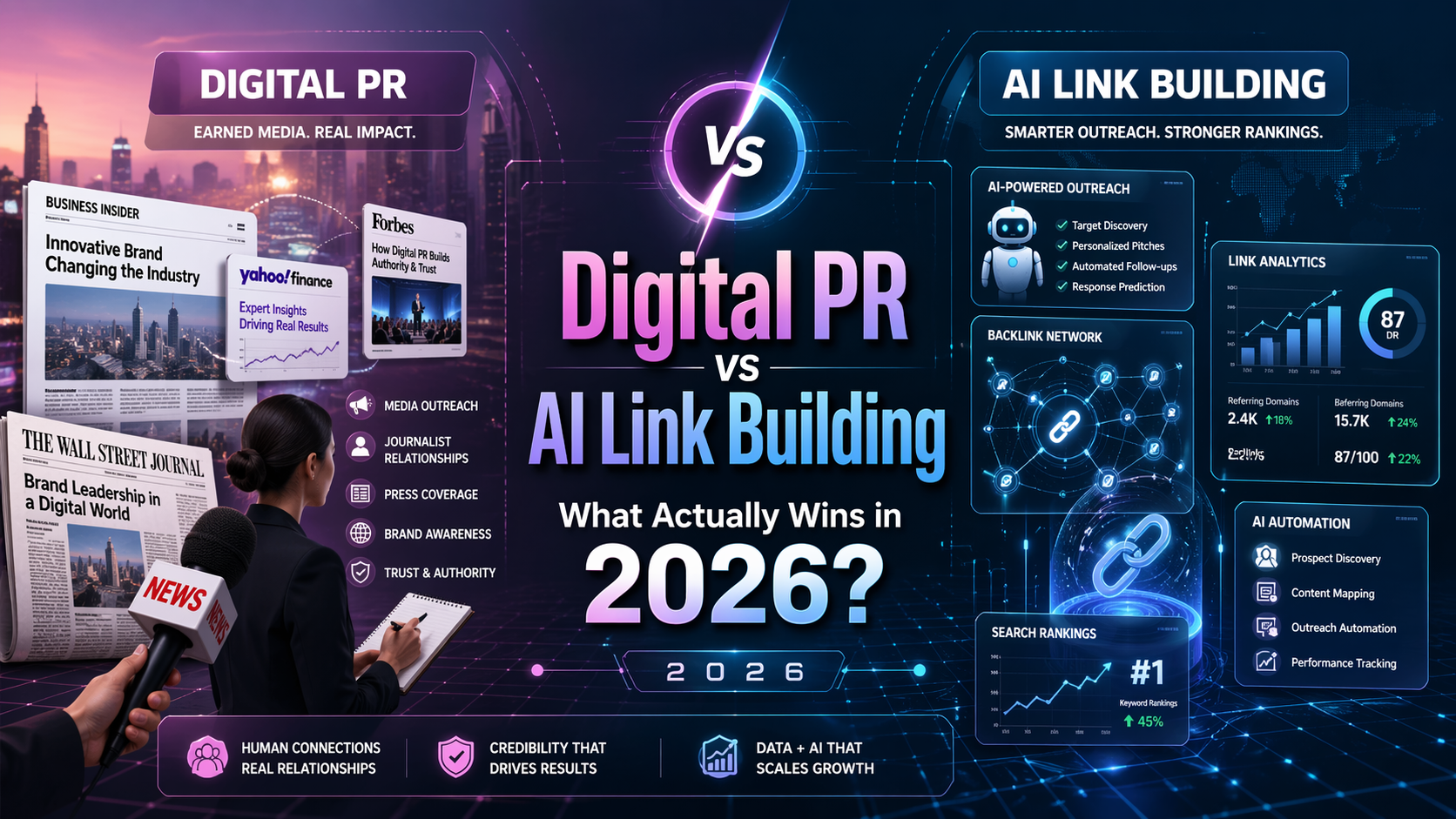
If you are comparing digital pr vs ai link building, the real question is not which tactic is “better” in isolation. It is which one builds sustainable authority, earns coverage people trust, and still works as search shifts toward AI answers, brand mentions, and people-first quality signals.
The answer is nuanced. Digital PR is stronger for authority, editorial trust, brand visibility, and top-tier media mentions. AI-powered link building is stronger for speed, prospecting, personalization at scale, workflow automation, and cost control. But AI link building only works well when humans still control strategy, quality, relevance, and relationship-building. Google’s documentation is clear that content and automation are acceptable when they help users, but using automation to mass-produce low-value pages or manipulate rankings can violate spam policies.
In other words, the smartest brands are no longer choosing one side. They are combining digital PR for authority with AI-assisted outreach for efficiency. That blend is increasingly important because research from Ahrefs suggests AI Overview visibility correlates only weakly with classic link metrics, while brand mentions appear more influential than backlinks alone.
TL;DR
Digital PR is best when you want earned media, brand mentions, authority, trust, and links from publications people recognize. AI-powered link building is best when you want faster research, better outreach workflows, scaled prospecting, and more efficient campaign execution. The winning strategy is usually a hybrid: let AI accelerate research, clustering, personalization, and follow-ups, while humans handle positioning, relationship-building, news judgment, and editorial quality. Google’s guidance supports helpful AI-assisted work, but not scaled, low-value manipulation.
What is digital PR?
Digital PR is the practice of earning online coverage from journalists, publishers, blogs, and media sites through newsworthy stories, expert commentary, data-led campaigns, reactive media outreach, and creative assets. In BuzzStream’s 2025 State of Digital PR report, most respondents described digital PR around pitching data-led content, expert commentary, and creative hero content. The same report also frames digital PR as editorially earned coverage rather than paid link placement.
At its best, digital PR does more than earn backlinks. It builds:
- brand awareness
- media trust
- branded search demand
- unlinked mentions
- referral traffic
- topical authority
- AI citation potential
That matters more now because brand visibility across AI search environments appears to depend on more than raw backlink counts. Ahrefs’ 75,000-brand study found that AI Overview visibility had only weak-to-moderate correlation with traditional link metrics such as backlinks, referring domains, and DR.
What is AI-powered link building?
AI-powered link building uses AI tools inside the link acquisition process. That can include:
- prospect discovery
- SERP analysis
- competitor backlink gap analysis
- email drafting
- outreach personalization
- contact enrichment
- anchor text suggestions
- clustering prospects by relevance
- follow-up automation
- performance summarization
This does not automatically mean spam. Google explicitly says generative AI can be useful for researching a topic and adding structure to original content. But Google also warns that generating many pages without adding value may violate its scaled content abuse policy, and automation used primarily to manipulate rankings violates spam policies.
So, AI-powered link building is legitimate when AI is used as an assistant. It becomes risky when AI is used as an autopilot.
Digital PR vs AI link building: the core difference
The simplest way to understand digital pr vs ai link building is this:
- Digital PR is fundamentally an authority and attention strategy
- AI-powered link building is fundamentally an efficiency and process strategy
Digital PR starts with the story. AI link building starts with the workflow.
Digital PR asks, “What angle will a journalist actually care about?”
AI link building asks, “How do we find the best prospects and reach them faster?”
The strongest SEO teams use both, because modern organic growth needs both editorial trust and operational scale. Google continues to reward helpful, original, people-first content, while penalizing manipulative spam patterns.
Side-by-side comparison table
| Factor | Digital PR | AI-Powered Link Building |
| Primary goal | Earn editorial coverage and authority | Scale link prospecting and outreach efficiency |
| Main output | Media mentions, backlinks, brand visibility | Link opportunities, outreach sequences, placements |
| Best for | Brand building, thought leadership, data campaigns | Resource pages, guest posting, niche outreach, prospecting |
| Speed | Slower and less predictable | Faster and more repeatable |
| Personalization | High-touch and narrative-driven | Can be high if reviewed, weak if over-automated |
| Scalability | Moderate | High |
| Media quality ceiling | Very high | Usually moderate to high depending on process |
| AI visibility upside | Strong via mentions and citations | Helpful if it earns credible mentions and links |
| Risk profile | Lower when earned naturally | Higher if scaled recklessly |
| Measurement | Harder, broader, brand-led | Easier, pipeline-led |
| Best team setup | PR + SEO + content | SEO + outreach + ops + AI tooling |
The reason this table matters is that search visibility is no longer driven only by “more backlinks.” Brand mentions, expert associations, and trusted-source citations increasingly shape visibility across search and AI experiences.
TL;DR
Digital PR is the higher-trust, harder-to-replicate channel. AI-powered link building is the faster, more systemized channel. If your goal is long-term authority, digital PR has the edge. If your goal is operational scale, AI-powered link building has the edge. If your goal is the best overall SEO outcome, combine them.
Why digital PR is still so powerful
Digital PR remains powerful because it maps closely to what search engines and users both value: originality, relevance, authority, and trust. Google’s people-first content guidance emphasizes original information, reporting, research, substantial value, trustworthy presentation, and demonstrable expertise. Those are exactly the traits strong digital PR campaigns tend to showcase.
BuzzStream’s 2025 report also shows digital PR is heavily tied to SEO outcomes and editorial pitching. Reboot Online’s 2025 digital PR statistics add another useful signal: data-led campaigns were the most common type of digital PR campaign across selected English-speaking markets, while AI-reimagined campaigns were the least common at 0.4% of the total in their dataset.
That tells us something important. The market may be using AI more inside workflows, but high-performing digital PR is still rooted in ideas that feel original, timely, and human.
Where digital PR wins
1. Stronger editorial trust
When a journalist cites your study, quotes your expert, or covers your campaign, the result is more defensible than a templated outreach placement. That can improve reputation beyond rankings.
2. Better brand mention potential
As AI systems synthesize information from the web, strong mentions can matter alongside links. Ahrefs found brand mentions appear more impactful than classic link metrics for AI Overview visibility.
3. Higher ceiling on authority
Top-tier publications, news sites, and respected industry outlets are difficult to win through pure scaled outreach. They usually require a real story, real expertise, or real data.
4. Stronger GEO and AI-search fit
For brands that care about generative engine optimization, digital PR supports the exact signals AI systems often reward: mention frequency, contextual relevance, source diversity, and perceived authority. This is an inference from the cited studies and Google’s guidance, not an official Google ranking formula.
Why AI-powered link building is growing fast
AI-powered link building is growing because it solves the ugliest parts of outreach: repetitive research, formatting, first-draft writing, and workflow bottlenecks. AI can help teams shortlist better domains, cluster prospects by intent, generate more relevant outreach angles, summarize publisher themes, and reduce manual busywork. Google’s own guidance allows AI use when the result is helpful and high quality.
That matters for economics too. BuzzStream’s digital PR cost survey found an average monthly contract of $5,458, with average cost per link at $597, though costs vary significantly by service type. That cost pressure creates a strong incentive to use AI to make teams more productive.
Where AI-powered link building wins
1. Faster campaign setup
AI can dramatically reduce prospecting time by classifying sites, summarizing relevance, and identifying patterns across large datasets.
2. Better operational scale
A human team that could manually process 100 prospects may be able to process several times that with AI-assisted filtering and drafting.
3. Stronger consistency
AI can enforce templates, QA checklists, and reporting structures better than ad hoc human workflows.
4. Lower marginal cost per campaign
When used well, AI can reduce hours spent on research and drafting, improving efficiency even if humans still approve final outreach.
But there is a hard limit: AI does not replace judgment. It cannot reliably tell you whether a pitch is actually newsworthy, whether a journalist will care, or whether a site is truly safe for brand association without strong human review. Google’s spam guidance makes that limitation commercially important, not just editorially important.
TL;DR
AI link building is best at reducing grunt work. It is not best at replacing editorial instinct. Use it to speed up research and personalization, not to spray thousands of low-value emails or publish scaled filler.
The biggest risks in AI-powered link building
The upside is real, but the downside is also real.
Google states that using automation, including AI, to generate content with the primary purpose of manipulating rankings is a violation of spam policies. It also says creating many pages without adding user value may violate scaled content abuse rules.
Here are the main failure modes:
| Risk | What it looks like | Why it hurts |
| Scaled low-value outreach | Thousands of generic emails | Damages reply rates and brand reputation |
| Poor site vetting | Links from irrelevant or weak sites | Weak SEO value and possible brand risk |
| AI-written fluff | Pages or guest posts with no real insight | Triggers quality concerns |
| Over-personalization fakery | “Loved your article” style nonsense | Easy for editors to detect |
| Metric obsession | Chasing DR without relevance | Weak business impact |
| Link scheme drift | Paying for manipulation rather than editorial value | Policy and sustainability risk |
This is why smart teams are moving toward AI-assisted human outreach, not fully automated link spam. Even Google’s documentation around AI content repeatedly points back to accuracy, relevance, added value, and people-first usefulness.
What actually works now: the hybrid model
The most effective strategy in the digital pr vs ai link building debate is a hybrid stack:
- Use AI to find themes, mine trends, segment publishers, and draft variants.
- Use humans to shape the narrative, validate sources, create original data, and manage relationships.
- Use digital PR to earn trust-rich mentions and high-authority coverage.
- Use link building outreach to convert unlinked mentions, secure niche-relevant placements, and reinforce topical authority.
This is also where a service-based partner can make sense. For brands that want scalable link building without building an in-house outreach machine, a provider like OutreachZ positions itself around manual outreach, guaranteed placements, premium content, and a large publisher network. According to its own site, OutreachZ emphasizes done-for-you outreach, manual processes, and 50,000 premium publishers, which aligns more with a controlled outreach model than purely automated blasting.
That said, any agency or platform should still be evaluated on relevance, transparency, editorial standards, link context, and long-term brand safety, not just promised placement volume. Google’s people-first and spam-policy guidance still applies no matter who executes the campaign.
Which is better for SEO, GEO, and AI overviews?
For classic SEO, both can work. For GEO, AI search visibility, and brand-driven discoverability, digital PR appears to have the stronger upside because it contributes to editorial mentions, branded citations, and broader authority signals. Ahrefs’ research suggests that backlinks still matter, but brand mentions may matter more for AI Overview visibility than raw backlink totals alone.
So the practical answer is:
- If you need authority and trust, prioritize digital PR.
- If you need scale and process efficiency, prioritize AI-assisted link building.
- If you want durable organic growth, combine both.
This is especially true as SEO shifts from a pure ranking game toward a broader visibility model involving search engines, AI overviews, assistant answers, entity recognition, and branded demand.
Best use cases for each approach
| Scenario | Better choice |
| Launching a new study or data report | Digital PR |
| Building links to commercial pages at scale | AI-assisted link building |
| Earning coverage from journalists | Digital PR |
| Recovering outreach efficiency with a small team | AI-assisted link building |
| Increasing branded mentions | Digital PR |
| Prospecting niche publishers and blogs | AI-assisted link building |
| Converting unlinked mentions | Both |
| Supporting AI-search visibility | Mostly digital PR, supported by link building |
| Scaling white-label outreach for agencies | AI-assisted link building with human QA |
Final verdict
The debate around digital pr vs ai link building is often framed the wrong way.
Digital PR is not “old school,” and AI-powered link building is not automatically “better.” They solve different problems.
Digital PR wins when you need trust, narrative, authority, and high-value mentions that can influence both search rankings and AI-era brand visibility. AI-powered link building wins when you need speed, systems, prospecting efficiency, and smarter campaign execution. The future belongs to teams that use AI to improve workflows while keeping humans in charge of quality, relevance, and relationships.
So yes, suggest link building as part of the strategy. But do it the right way: relevant sites, real outreach, strong editorial context, and useful content. If you want a practical middle ground, a managed outreach partner such as OutreachZ can be a natural option for brands that want scalable outreach without sacrificing manual control, especially when paired with a real digital PR engine for campaigns that deserve broader coverage.
FAQ
Is digital PR better than AI-powered link building?
Usually for authority, yes. Digital PR is better for earned media, trust, and brand mentions. AI-powered link building is better for workflow speed and campaign scale. The strongest strategy is usually a combination of both.
Does Google allow AI for link building and content?
Google allows AI use when the result is helpful, accurate, and valuable. Google warns against using AI or automation to manipulate rankings or produce scaled low-value content.
Are backlinks still important in the AI era?
Yes, but they are not the whole story. Ahrefs’ research indicates that AI Overview visibility correlates only weakly with some traditional link metrics, while brand mentions appear more impactful.
What is the biggest mistake in AI link building?
Over-automation. Generic prospecting, fake personalization, poor-quality sites, and scaled low-value content can reduce effectiveness and increase risk. Google’s people-first and spam rules make human review essential.
Is digital PR more expensive than regular link building?
Often, yes. BuzzStream’s 2025 survey found an average monthly digital PR contract of $5,458 and an average cost per link of $597, though pricing varies widely by service type and scope.
Can OutreachZ help with AI-era link acquisition?
Based on its site, OutreachZ focuses on done-for-you outreach, manual outreach, premium content, guaranteed placements, and a large publisher network. That makes it more relevant for scalable link acquisition and outreach support than for pure newsroom-style digital PR.
What should brands do in 2026?
Build a hybrid system: digital PR for authority and brand mentions, AI-assisted link building for efficiency, and strict human QA for every campaign. That approach aligns best with current search quality guidance and the broader move toward AI-mediated discovery.