

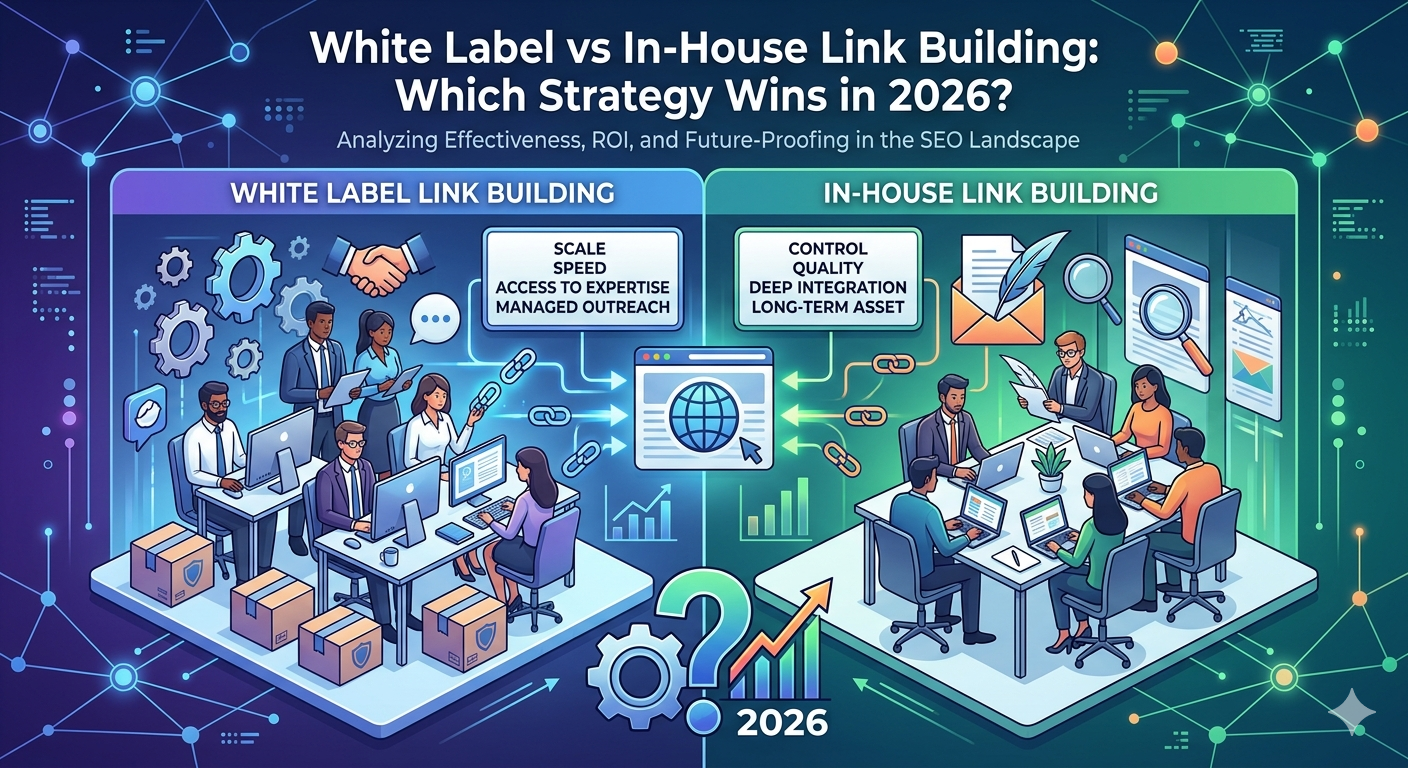
Link building remains one of the most powerful and most operationally demanding pillars of modern SEO. The pages that dominate Google today earn, on average, 3.8 times more backlinks than every other result on the same page. That gap does not close itself. Someone has to build those links, and how you choose to do it will shape your costs, your timelines, your team structure, and ultimately your results.
For agencies scaling their SEO practice and for in-house marketing teams managing enterprise organic growth, the central question is the same: should you build an internal link acquisition team from scratch, or leverage a white label partner who delivers under your brand? Both approaches serve the same end goal, earning authoritative, contextually relevant backlinks that move rankings and drive organic traffic. But the path to that goal, the resources required, the risks involved, and the returns generated are dramatically different.
This article breaks down White Label vs In-House Link Building across every dimension that matters – cost, scalability, quality, speed, control, and ROI backed by current 2026 industry data. No fluff. No generic takes. Just a clear, honest comparison so you can make the right call for your operation.
TL;DR: Key Takeaways
- In-house link building costs $12,000–$40,000/month once you factor in salaries, tools, and content, white label starts as low as $180–$300 per link.
- 56% of SEO professionals outsource at least part of their link building; 44% handle it entirely in-house.
- White label wins on scalability, speed, and cost efficiency; in-house wins on control, brand alignment, and long-term institutional knowledge.
- The average cost of a high-quality backlink is $508.95, white label packages routinely beat this number at volume.
- Link building delivers an average ROI of 702% for B2B companies, the highest of any marketing channel tracked in 2026.
- Most agencies operating at scale use a hybrid model: white label fulfillment + in-house strategy.
- AI Overviews now appear in over 50% of all Google searches, raising the stakes for authority-building backlink campaigns.
1. What Is White Label Link Building?
White label link building is a service model where a specialized provider handles all outreach, content creation, publisher relationship management, and link placement on behalf of your agency or brand, but the deliverables are presented under your name. Your clients never see the third party. You set the strategy and own the client relationship; the partner executes the campaign.
This model has become the default operating infrastructure for a large share of the agency world. It allows firms to offer full-service link building without the overhead of building a dedicated internal outreach team. You get the expertise, the publisher network, and the process maturity of an established provider, without the hiring cycle, the training cost, or the management overhead.
White label link building providers typically handle guest post outreach, link insertions (niche edits), digital PR placements, broken link building, and unlinked brand mention recovery. The best providers deliver white-labeled reports, communicate as a behind-the-scenes team, and operate with full transparency on methods and metrics.
2. What Is In-House Link Building?
In-house link building means your organization employs dedicated staff to research prospects, conduct outreach, produce content, negotiate placements, and manage publisher relationships directly. Every element of the link acquisition process sits under your roof, your management hierarchy, and your brand.
For some organizations, particularly large enterprises with established content operations, complex brand standards, and the budget to support specialized roles, in-house link building offers a level of control and brand alignment that no external partner can fully replicate. Your team knows your brand voice, understands your audience, and can integrate link building tightly into broader PR, content, and marketing initiatives.
But building this capability from zero is a multi-year investment. Publisher relationships, outreach systems, editorial credibility, and team expertise do not appear overnight. According to industry data, it takes 12 to 18 months for a new in-house link building operation to reach full productivity and that timeline assumes you hire the right people in the first place.
3. Cost Comparison: White Label vs In-House Link Building
This is where the decision gets real. Let’s put actual 2026 numbers on the table.
In-House Link Building: Full Cost Breakdown
Building a functional in-house link building operation requires, at minimum, an outreach specialist, a content writer, and a manager or strategist. According to Glassdoor data, a full-time SEO link building specialist in the United States earns between $53,000 and $98,000 per year. When you add benefits and employer overhead, typically 1.4x the base salary, a single mid-level specialist runs approximately $98,000 annually, or $7,300 per month. Layer in a content writer and a manager and you are looking at personnel costs of $14,000 to $17,000 per month before a single outreach email goes out.
Add in the tools: Ahrefs, SEMrush, BuzzStream, or similar outreach platforms run $300 to $800 per month. Some publisher placements carry additional fees. One detailed analysis found that running a 30-link-per-month in-house program can cost between $15,833 and $40,000 per month depending on personnel seniority and placement quality.
| Cost Element | In-House Monthly | White Label Monthly |
| Personnel (Specialist + Writer + Manager) | $12,000 – $17,400 | Included in package |
| SEO & Outreach Tools | $300 – $800/mo | Included in package |
| Content Creation | $1,500 – $4,000/mo | Included in package |
| Training & Onboarding | $4,000 – $20,000 (one-time) | $0 |
| Publisher Placement Fees | $500 – $2,500/mo (extra) | Bundled or per-link |
| Time to First Link | 3 – 6 months | Days to 2 weeks |
| Realistic Total (30 links/mo) | $15,000 – $40,000/mo | $3,900 – $10,000/mo |
4. White Label vs In-House: Side-by-Side Comparison
Beyond cost, the choice between these two models touches every operational dimension of how you deliver SEO services. Here is the full picture.
| Factor | White Label Link Building | In-House Link Building |
| Startup Time | Days to 2 weeks, access established publisher networks immediately | 3–18 months to hire, train, and build publisher relationships |
| Monthly Cost | $3,000–$10,000/mo (scalable by volume) | $12,000–$40,000/mo (fixed regardless of output) |
| Scalability | High, add volume without hiring; scale up or down month to month | Low, headcount-dependent; scaling means hiring, onboarding, managing |
| Quality Control | Dependent on provider vetting; best providers enforce traffic floors and editorial standards | Full control over standards, anchor text, site selection, and content tone |
| Publisher Access | Immediate access to established networks built over years of campaigns | Must be built from scratch; takes 12–18 months for meaningful relationships |
| Brand Alignment | Good with well-briefed providers; requires strong onboarding and communication | Excellent, team knows your brand, voice, audience, and editorial preferences intimately |
| Risk of Low Quality | Moderate, mitigated by rigorous vendor vetting and minimum traffic requirements | Lower if experienced staff; higher risk with inexperienced hires |
| Reporting | White-labeled dashboards and reports provided; varies by vendor quality | Fully customizable; integrated with your internal reporting stack |
| Algorithm Adaptability | High, specialized providers update strategies faster as their business depends on it | Moderate, depends on team’s ongoing education and awareness |
| Best For | Agencies scaling services, teams without link building bandwidth, businesses needing rapid results | Large enterprises with complex brand needs, organizations with existing content operations and long-term SEO commitment |
5. The Real Economics: ROI and Budget Allocation in 2026
The financial case for white label link building has never been more compelling, or more data-supported. Here is what the 2026 numbers actually show.
• $508.95 is the average cost of a single high-quality backlink sourced through agencies, per the uSERP State of Link Building Report 2024–2025.
• 702% is the average ROI delivered by link building for B2B companies in 2026, the highest of any tracked marketing channel.
• 32.1% of total SEO budget is allocated to link building by agencies; in-house teams spend even more, averaging 36.03%.
• 80.9% of SEO professionals expect link building to become more expensive over the next two to three years.
• $8,406 is the average minimum monthly budget required to compete in high-difficulty niches.
• 40–70% gross margins are maintained by most agencies running white label fulfillment programs, depending on provider tier and client pricing.
Most white label providers operate on a wholesale model: agencies procure links at $180–$300 per link and resell at $360–$600, maintaining 2x margins. Compare that to the in-house model, where you spend $12,000–$17,000/month in fixed personnel costs regardless of output, and you can see why 56% of SEO professionals now outsource at least a portion of their link building.
For a detailed breakdown of how white label link building is priced by DR tier, niche, and method, this white label link building pricing guide offers one of the most transparent and current analyses available for 2026.
6. Quality and Link Standards: Who Actually Wins?
One of the most persistent concerns around white label link building is quality. If an external provider is sourcing and securing placements, how do you know the links are actually worth having?
This is a legitimate question, and the answer depends almost entirely on which provider you choose and how rigorously you vet them.
What High-Quality White Label Links Look Like in 2026
• Real organic traffic: Any serious provider enforces minimum organic traffic floors, typically 1,000 to 5,000+ monthly visitors, on every placement site. A DR 70 site with 200 monthly visitors from bot farms is worthless. Google’s algorithms are specifically designed to detect these patterns.
• Editorial standards: Links are placed through genuine outreach and editorial review, not paid link farms or private blog networks (PBNs).
• Niche relevance: Placements appear on sites contextually related to your client’s industry, not generic content networks.
• Method transparency: The best providers disclose exactly how every link was built, whether through guest post outreach, link insertions, digital PR, or broken link building.
• No black-hat tactics: Any provider who cannot explain their methods clearly, or who refuses to share live placement URLs, is a red flag.
In-house teams can match or exceed these standards, but only after years of relationship-building and process refinement. A seasoned external provider with established editorial connections can immediately access placements your internal team would spend 18 months cultivating. That is the real quality argument for white label: not that it is categorically better, but that it provides quality-at-scale that most in-house operations cannot replicate on their own timeline.
7. Scalability: The Defining Advantage of White Label
If there is a single dimension where white label link building wins outright, it is scalability. In-house teams are inherently headcount-bound, if you need to double your monthly link output, you need to hire more people, onboard them, tool them up, and wait for them to build the relationships required for consistent placements.
White label partnerships scale almost instantly. You can increase your monthly link volume by emailing your account manager. You can take on five new SEO retainer clients without adding a single seat. You can scale back during slow periods without laying anyone off. That operational flexibility is worth a significant premium for most agencies.
This is also why the hybrid model has become the dominant operating structure for mid-to-large SEO agencies in 2026: keep an in-house strategist or SEO lead who owns the client relationship, defines the link acquisition strategy, and reviews placements, then use white label fulfillment to execute the actual outreach and delivery at scale. You get the control of in-house ownership without the overhead of in-house execution.
8. White Label Link Building Pricing by Domain Rating Tier (2026)
Not all links are priced equally, and understanding where your campaigns fall in the quality spectrum will help you budget effectively.
| DR Tier | Wholesale (White Label) | Retail (Client Rate) | Best Use Case | Typical Niches |
| DR 20–40 | $100 – $220 | $200 – $400 | Early authority building | Local, niche blogs |
| DR 40–60 | $180 – $300 | $360 – $600 | Core commercial growth | Most B2B, e-commerce |
| DR 60–80 | $300 – $700 | $600 – $1,200 | Authority reinforcement | SaaS, finance, legal |
| DR 80+ | $700 – $1,500+ | $1,200 – $2,500+ | Top-shelf editorial | Finance, healthcare, YMYL |
| Digital PR Campaign | $3,000 – $8,000/campaign | $5,000 – $15,000 | Media links, AI citations | Brand authority, enterprise |
9. When In-House Link Building Makes More Sense
White label is not always the answer. There are specific scenarios where building internal link building capability is the strategically correct move.
• You are a large enterprise with complex compliance needs. Industries like financial services, healthcare, and legal often require editorial oversight that an in-house team can provide more reliably than an external partner unfamiliar with regulatory nuance.
• You have an established content operation. If your organization already produces high-volume, high-quality content and has strong existing media relationships, the incremental cost of adding link building expertise internally is lower.
• You are building for the very long term. In-house publisher relationships compound over time. If you plan to run aggressive link building programs for five or more years, the investment in an internal team begins to amortize favorably.
• Brand control is non-negotiable. Some brands require such specific voice, tone, and editorial positioning in every outreach interaction that handing off execution to an external party introduces unacceptable brand risk.
• You have the budget and patience. If you can absorb the $12,000–$40,000/month fixed cost while your team ramps up over 12–18 months, and your competitive window is not immediate, in-house is viable.
10. When White Label Link Building Is the Clear Winner
For the majority of agencies and most growing businesses, white label link building delivers superior outcomes across the most critical variables. Here is when it is the obvious choice.
• You need to scale without hiring. Adding clients or increasing monthly link volume is instantly achievable without a single new hire.
• You need results fast. White label providers give you access to established publisher networks immediately. In-house teams take 12–18 months to build comparable reach.
• You want predictable costs. White label pricing is transparent and variable, you pay for what you need. In-house costs are fixed and compound regardless of output.
• Your agency wants to maximize margins. Agencies running white label fulfillment at $180–$300 per link wholesale and pricing at $360–$600 to clients maintain 40–70% margins, a level in-house operations rarely achieve.
• You operate in a competitive niche that requires specialist publisher access. Finance, SaaS, healthcare, and legal require established editorial relationships that most new in-house teams cannot cultivate within a practical timeline.
Looking for vetted white label providers with transparent pricing and editorial-grade placements? The best link building services in the USA for 2026 list offers a curated breakdown of top providers by niche, DR tier, and delivery model.
11. The Hybrid Model: How Smart Agencies Actually Operate in 2026
The framing of White Label vs In-House Link Building as a binary choice is largely artificial. Most high-performing agencies in 2026 run a hybrid model that captures the strengths of both.
In practice, this looks like: an in-house SEO strategist or team lead who owns the client relationship, defines the link acquisition strategy, sets quality thresholds, and reviews deliverables, paired with a white label provider who handles all outreach execution, content production, publisher negotiation, and placement delivery at scale.
This structure gives you the brand control and strategic alignment of in-house ownership without the operational overhead of in-house execution. It also allows you to scale delivery without scaling headcount, maintain consistent quality without micromanaging outreach logistics, and respond to algorithm changes with the speed of a specialized provider’s institutional knowledge.
The hybrid model is especially effective for agencies that have grown past the point where a single strategist can manage both client relationships and link building execution simultaneously – which, for most agencies, happens well before you have the budget to justify a full in-house outreach team.
12. Impact of AI Overviews on Link Building Strategy
No 2026 analysis of link building is complete without addressing Google’s AI Overviews, and the significant implications they carry for both white label and in-house strategies.
AI Overviews now appear in over 50% of all Google searches, up from 25% in mid-2025. On mobile devices, these features consume 75.7% of screen real estate. For link builders, this shift matters in one critical way: AI Overviews preferentially surface brands that appear repeatedly in trusted, editorially-cited contexts, exactly the type of placement that high-quality link building delivers.
A 2025 industry survey found that 73.2% of SEO professionals believe backlinks directly influence the probability of appearing in AI search results. Digital PR campaigns, the same method used by white label providers for premium editorial placements, are increasingly cited as a primary driver of AI Overview citations.
This makes the quality argument for white label link building even more compelling: providers with established relationships at major publications can deliver the editorial-grade placements that trigger AI visibility in ways that entry-level in-house teams simply cannot replicate in the short term.
13. Key Questions to Ask Before Choosing Your Model
Before committing to either white label link building or in-house link building, answer these questions honestly.
• How fast do you need results?
If you have active clients or campaigns running now, white label is the only path that delivers meaningful output within weeks rather than months.
• What is your realistic monthly budget?
Can you absorb $12,000–$40,000 in fixed monthly overhead while your team ramps up? If not, white label is the financially viable path.
• How many link building campaigns are you running simultaneously?
One or two campaigns might be manageable in-house. Dozens of active retainer clients demand the scalability of white label.
• Do you have existing publisher relationships?
If your team already has editorial connections in your target niche, the in-house path is shorter. If you are starting from zero, a white label provider’s existing network is an enormous asset.
• What is your risk tolerance?
In-house operations carry hiring risk, turnover risk, and ramp-up risk. White label operations carry vendor quality risk. Vet accordingly.
• How important is brand control in outreach interactions?
For most businesses, white label providers who are properly briefed deliver excellent brand alignment. For organizations with exceptional sensitivity, in-house control is worth the premium.
14. Vetting a White Label Link Building Provider: The 2026 Checklist
Choosing the wrong white label partner is a more expensive mistake than building in-house. Here is what to verify before signing any agreement.
• Minimum traffic floors enforced: Any reputable provider in 2026 requires placement sites to have a minimum of 1,000–5,000 monthly organic visitors, not just strong DR metrics. Ask for this in writing.
• Niche-specific publisher access: Confirm that the provider has delivered real, verifiable placements in your client’s specific vertical. Request live URLs, not just domain metrics.
• Full method transparency: Know exactly how every link is built — whether through editorial outreach, guest posting, link insertions, or digital PR. Any provider who obscures their methods is a liability.
• White-labeled reporting: High-quality providers deliver branded reports your clients receive directly under your agency’s name.
• No PBNs or link farms: Confirm explicitly that all placements are on real, editorially governed sites with genuine organic audiences. Links from private blog networks carry real penalty risk.
• Anchor text strategy: A professional provider maintains a balanced anchor text profile. Over-optimized anchors are a spam signal Google actively targets.
• Clear pricing with no hidden fees: Understand exactly what is included, content creation, placement fee, reporting, before committing to volume or retainer agreements.
Final Verdict: White Label vs In-House Link Building
The debate around White Label vs In-House Link Building ultimately comes down to where you are in your growth trajectory and what your operational priorities are.
If you are an agency scaling client delivery, a marketing team that needs SEO results on a realistic timeline, or a business that cannot justify the fixed overhead of a full in-house link building operation, white label link building is the cleaner, faster, and more cost-effective path in 2026. The economics are difficult to argue with: lower monthly cost, immediate access to established publisher networks, zero ramp-up time, and flexible scalability.
If you are a large enterprise with complex editorial standards, strong existing media relationships, and a multi-year commitment to aggressive link acquisition, an in-house team, ideally supplemented by a white label partner for overflow volume, gives you the control and brand alignment that an external provider cannot fully replicate.
The data is clear: 56% of SEO professionals already outsource at least part of their link building. The remaining 44% who manage it entirely in-house are largely either enterprise operations with the resources to justify it, or organizations that have not yet fully modeled the true cost of doing so.
For most agencies and growing businesses, the hybrid model wins: strategy and client ownership in-house, execution and scale through a vetted white label partner. That combination delivers the best of both worlds, and in 2026’s competitive search landscape, that combination is what drives durable, compounding organic growth.