

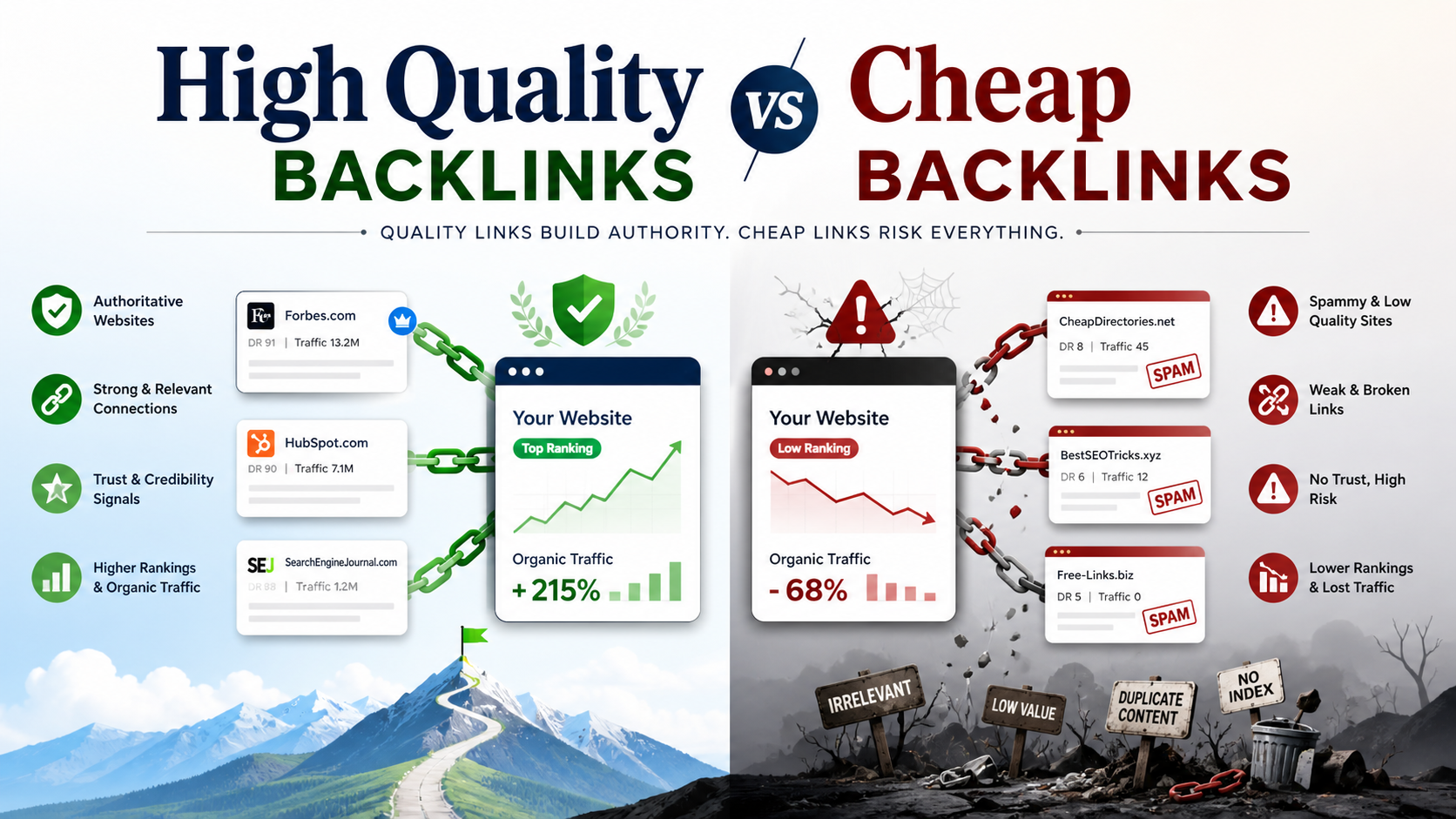
If you’ve spent any time in SEO forums – Reddit’s r/SEO, Warrior Forum, or Black Hat World – you already know the debate is everywhere: Is it better to grab 500 cheap backlinks for $25, or pay $300 for a single editorial placement on a real publication? The skeptics are loud on both sides.
Here’s the truth nobody wants to say plainly: not all backlinks are created equal, and the gap between a high-quality backlink and a cheap one is not just about price – it’s about safety, longevity, authority transfer, and your site’s long-term survival in the age of Google SpamBrain and AI-driven search engines like ChatGPT and Perplexity.
This article breaks down the real difference between high quality backlinks vs cheap backlinks, backed by current 2025–2026 data, so you can make an informed decision and stop burning money on links that do nothing – or worse, destroy your rankings overnight.
1. What Is a Backlink, and Why Should You Care?
TL;DR – Backlinks are the internet’s original voting system. A link from a trusted website tells Google your content is worth endorsing.
A backlink – also called an inbound or external link – is simply a hyperlink on one website that points to a page on another. Think of them as digital citations. When a respected outlet like Forbes or Healthline links to your article, they’re essentially casting a vote of confidence in your content.
Google’s foundational algorithm, PageRank, was built on this very concept. Today, while the algorithm is infinitely more complex, the core idea hasn’t changed: authoritative votes (links) = higher rankings. According to Authority Hacker’s 2025 State of Link Building Report, 93.8% of link builders now rank link quality above link quantity – a massive shift from even five years ago.
The stakes are even higher now because AI systems like Google’s AI Overviews, ChatGPT Search, and Perplexity rely heavily on citations from authoritative domains. If your backlinks come from low-authority sources, not only do you rank lower in traditional search – AI systems won’t cite or surface your content at all.
2. Defining High-Quality Backlinks: The Gold Standard
TL;DR – High-quality backlinks come from real, relevant, traffic-generating websites with editorial oversight. They are earned, not manufactured.
A high-quality backlink checks several important boxes simultaneously. It’s not about any single metric – it’s the intersection of multiple signals that makes a link genuinely valuable.
Key Characteristics of a High-Quality Backlink
• Real Domain Authority (DA/DR): The linking site has genuine authority built over time – not a freshly purchased expired domain inflated with questionable links.
• Topical Relevance: The linking site and page operate within your industry or niche. A link from a healthcare blog to a pharma website carries exponentially more weight than one from a gaming site.
• Organic Traffic: The linking site receives consistent, real visitors from search engines. A DR 30 site with 20,000 monthly visitors is more powerful than a DR 70 site with zero organic traffic.
• Editorial Placement: The link appears within the main body of relevant content – not stuffed in a footer, sidebar, or comment section.
• Natural Anchor Text: The clickable link text is varied and contextual – branded, partial-match, or generic phrasing – rather than forced exact-match keywords.
• Dofollow Attribute: These links pass ‘link juice’ (PageRank signals) to your site, directly contributing to ranking authority.
• E-E-A-T Alignment: Editorial backlinks from authoritative sites improve all four pillars of Google’s E-E-A-T framework: Experience, Expertise, Authoritativeness, and Trustworthiness.
The bottom line? High-quality backlinks are rarely obtained easily. They require genuine content worth linking to, real outreach relationships, or strategic paid placements on legitimate publications.
3. Defining Cheap Backlinks: The Liability Side
TL;DR – Cheap backlinks come from link farms, PBNs, and automated tools. They look like a shortcut but often function as a slow-burning landmine for your SEO.
When someone on Fiverr offers you 500 backlinks for $5, what are they actually selling? Almost always, it’s links from websites that exist for the sole purpose of linking out to other sites – commonly called link farms, Private Blog Networks (PBNs), or spam directories. Here’s what makes them dangerous:
Red Flags of Cheap or Low-Quality Backlinks
• Zero Organic Traffic: These sites have no real visitors. Google already ignores them – or worse, actively penalizes sites associated with them.
• Irrelevant Content: A link from a food blog to a law firm is contextually worthless. Cheap backlink packages typically ignore relevance entirely.
• PBN Origins: Private Blog Networks (PBNs) are networks of expired domains rebuilt purely to manufacture links. Google’s SpamBrain AI – significantly upgraded in 2025 – detects most PBN networks automatically, without human review.
• Thin or AI-Generated Content: Link farm pages are often filled with low-effort or machine-generated content that serves no real user. Google’s October 2025 spam update explicitly targeted AI-generated guest post farms as a distinct violation category.
• Exact-Match Anchor Text Overuse: Cheap link sellers often use your target keyword as anchor text repeatedly – a clear manipulation signal that triggers algorithmic penalties.
• Sudden Link Velocity Spikes: Acquiring 300 links in a week from unrelated industries screams manipulation to Google’s systems, even if the links themselves look okay individually.
One e-commerce brand profiled by SEO analysts saw its organic traffic cut in half within months of being caught in a PBN ring. Recovery took over a year and required extensive disavow efforts and content overhauls.
4. High Quality Backlinks vs. Cheap Backlinks: Side-by-Side Comparison
The table below captures the critical differences at a glance. If you’re evaluating a backlink service or strategy, use this as your reference checklist.
| Factor | High-Quality Backlinks | Cheap Backlinks | Risk Level | SEO Impact |
| Source Type | Real editorial websites | Link farms / PBNs | Low | ✅ Strong positive |
| Domain Authority | Genuine, earned over time | Artificially inflated | High | ❌ Minimal or harmful |
| Organic Traffic | Consistent real visitors | Zero or near-zero | High | ❌ No referral value |
| Topical Relevance | Niche-matched content | Random, unrelated niches | High | ❌ Contextually void |
| Anchor Text | Natural, varied, branded | Exact-match keyword stuffing | Very High | ❌ Triggers penalties |
| Link Placement | Within editorial body text | Footer, sidebar, comments | Medium | ❌ Little to no value |
| Longevity | Long-term, stable | Short-term, devalued fast | Very High | ❌ Rankings collapse |
| Google Detection | Safe, algorithm-friendly | SpamBrain-detectable | Extreme | ❌ Manual action risk |
| AI Search Visibility | Cited by ChatGPT/Perplexity | Ignored by AI systems | High | ❌ No AI citations |
| Cost Range | $150–$1,500+ per link | $0.01–$20 per link | N/A | Reflects true value |
| E-E-A-T Contribution | Strengthens all 4 pillars | No contribution | High | ❌ Zero trust signals |
| Recovery if Penalized | N/A – no penalty risk | Months to 1+ year | Extreme | ❌ Revenue loss |
5. What Does a Backlink Actually Cost in 2026?
TL;DR – The average quality editorial link now costs $280. Anything priced well below that should raise immediate red flags about link origin and safety.
According to data compiled by LinkBuilder.io and Authority Hacker’s 2025 research, the backlink marketplace has matured significantly. The days of affordable bulk links delivering SEO value are long gone. Here’s what the current market looks like:
| Link Type | Typical Cost (2026) |
| Automated / bulk spam links | $0.01 – $0.10 per link |
| Fiverr link packages | $5 – $30 per package (500–1000 links) |
| Low-tier guest post farms | $20 – $80 per placement |
| Mid-tier niche guest posts | $80 – $180 per placement |
| Quality editorial placements | $150 – $500 per link |
| Authority blog placements | $300 – $900 per link |
| Premium editorial placements (Forbes, Healthline, etc.) | $500 – $1,500+ per link |
| Average cost per quality backlink (2025 data) | $280 (Authority Hacker) |
The price-to-value relationship in link building is unusually direct: you generally get what you pay for. A $500 link on a relevant, high-traffic publication is infinitely more valuable than ten $50 links on dead sites with no real readership.
6. How Google’s SpamBrain and AI Search Engines Changed Everything
TL;DR – Google’s SpamBrain now detects most link farms and PBNs automatically – no manual reviewer needed. AI search engines like Perplexity and ChatGPT only cite trusted, authoritative sources.
Here’s a timeline that puts the current landscape in context:
1. 2012 – Google’s Penguin update first targeted manipulative link schemes, including PBNs and exact-match anchor text manipulation.
2. 2018 – SpamBrain launched as Google’s AI-based spam detection system.
3. 2022 – SpamBrain expanded significantly to detect link networks, claiming to reduce search spam by over 99% compared to pre-ML baselines. AI-assisted detection proved 70x more efficient than rule-based systems.
4. 2024 – Google’s 2024 Webspam Report noted automated spam actions increased by over 60% year-over-year.
5. October 2025 – Spam update explicitly targeted AI-generated guest post farms as a distinct new violation category.
6. 2026 – SpamBrain now operates at the network level, analyzing relational patterns between domains, anchor text distributions, and historical behavior – without needing any human review team.
What does this mean practically? The window between “PBN built” and “PBN detected” continues to narrow with each algorithm update. A link scheme that might have worked for 12 months in 2015 could be caught within weeks today.
The AI Search Dimension
Beyond Google, the rise of AI-powered search tools has added an entirely new layer to why backlink quality matters. Tools like Google AI Overviews, Perplexity, and ChatGPT Search pull from sources they deem authoritative. These systems evaluate:
• Whether the linking and linked domains have genuine trust signals
• Whether the content has real editorial oversight and author expertise
• Whether the website generates consistent organic traffic from real users
• Whether the site is cited by other trusted sources in its field
If your site’s authority is built on cheap backlinks from PBNs and link farms, AI systems simply won’t consider it trustworthy enough to surface or cite. You effectively become invisible in the fastest-growing segment of search.
7. Types of Backlinks Ranked by Quality and Risk
Not all backlinks fit neatly into “high quality” or “cheap.” Here’s a more granular breakdown of common backlink types ranked by quality and associated risk:
| Link Type | Quality Level | Risk Level | Ranking Impact | Recommended? |
| Digital PR / Editorial links | Very High | Very Low | ✅ Strong | ✅ Yes |
| Guest posts (vetted publications) | High | Low | ✅ Consistent | ✅ Yes |
| Contextual niche edits | High | Medium | ✅ Strong signals | ✅ With care |
| Resource page links | Medium–High | Low | ✅ Good | ✅ Yes |
| HARO / journalist citations | Very High | Very Low | ✅ Excellent | ✅ Yes |
| Forum / community links (Reddit, etc.) | Low–Medium | Low | Moderate | With context |
| Guest post farms / low-quality blogs | Low | High | ❌ Minimal | ❌ No |
| Private Blog Networks (PBNs) | Very Low | Very High | ❌ Penalty risk | ❌ Avoid |
| Automated / bulk backlinks | None | Extreme | ❌ Harmful | ❌ Never |
| Comment / forum spam links | None | Very High | ❌ Devalued | ❌ Never |
8. What Real SEOs Are Saying (The Reality Check)
TL;DR – The SEO community broadly agrees: cheap links are either dead weight or active liabilities. Quality link building takes time but delivers compounding returns.
Browse any major SEO thread like Reddit’s r/SEO or r/bigseo and you’ll find a consistent pattern. The marketers who tried bulk cheap backlinks almost universally report one of two outcomes:
• The links had zero measurable effect on rankings – Google simply ignored them.
• The site received a manual action or algorithmic demotion, costing months of traffic and revenue to recover from.
The professionals who invested in editorial placements, digital PR, and legitimate guest posts on relevant publications overwhelmingly report sustainable, compounding ranking improvements. One frequently cited data point: 58.4% of SEO experts polled in the 2024 State of Link Building Report consider backlinks to have a strong impact on rankings – but that impact is almost entirely driven by quality, not quantity.
A telling quote from a veteran SEO practitioner sums it up well: “I spent $200 on 1,000 junk links and nothing moved. Then I spent $400 on two editorial placements and ranked on page one within 90 days.” This kind of anecdotal evidence is backed up by the data – a DR 30 site with 20,000 monthly organic visitors consistently outperforms a DR 70 ghost site with zero real traffic.
9. How to Evaluate a Backlink Before You Acquire It
TL;DR – Never buy a backlink based on DA/DR alone. Always verify real traffic, content quality, topical relevance, and outbound link hygiene.
Whether you’re doing outreach yourself or evaluating a link building service, here’s the vetting checklist every link deserves:
The Pre-Purchase Backlink Audit Checklist
• Check organic traffic: Use Ahrefs, SEMrush, or SimilarWeb to verify the linking domain gets real monthly visitors. Sites with under 500 organic visitors per month are usually not worth pursuing.
• Review content quality: Is the content well-written, original, and recent? Thin, templated, or AI-generated content is a major warning sign.
• Assess topical relevance: Does the linking site cover topics related to your industry? A gaming blog linking to a law firm offers zero contextual value.
• Count outbound links per page: Pages with 50+ outbound links are link farm red flags. Legitimate editorial pages typically link out sparingly.
• Look for a real editorial team: Legitimate publications have identifiable authors, About pages, and contact information. Anonymous sites are suspicious.
• Verify no public pricing lists: If a vendor sends you a public list of 500 sites with fixed prices, Google likely has that list too. These sites already carry a footprint penalty risk.
• Watch for guaranteed turnarounds: Genuine editorial placements depend on third-party editors. A 24-hour link guarantee usually means the vendor owns the site – a PBN.
• Never pay under $20 for an “editorial” link: In 2026, legitimate high-quality link placements cannot be done safely at rock-bottom prices. Low pricing signals link farm origin.
10. Proven High-Quality Link Building Strategies in 2026
TL;DR – Digital PR, HARO outreach, guest posting on vetted publications, and data-driven content creation remain the gold standard for earning powerful, safe backlinks.
You don’t always have to pay premium prices to earn premium links. Here are the most effective strategies SEO professionals use to build high-quality backlinks today:
1. Digital PR (The #1 Strategy)
Digital PR involves building relationships with online journalists, bloggers, and editors to earn genuine editorial coverage. When done right, it produces the most authoritative backlinks available – from news outlets, industry publications, and niche authority sites. It requires creating newsworthy content: original research, data studies, expert commentary, and trend analysis that journalists actually want to reference.
2. HARO and Expert Source Platforms
Help A Reporter Out (HARO) and similar platforms (Qwoted, SourceBottle) connect journalists with subject matter experts. Responding to relevant queries with genuine insight – and requesting a backlink when quoted – can land you links from major publications. These are free, 100% white hat, and carry enormous E-E-A-T value.
3. Guest Posting on Vetted Publications
Guest posting remains effective when done selectively. The key word is selectively. Publishing genuine, high-value content on relevant industry publications with real audiences and editorial standards is very different from submitting thin articles to guest post farms that accept anything. Always verify the site has real traffic before pitching.
4. Data Studies and Original Research
Publishing original surveys, industry studies, or proprietary data creates what SEOs call a “linkable asset.” When other writers cite your research, you earn backlinks organically. This strategy compounds over time as the asset continues to attract new citations months or years after publication.
5. Resource Page and Niche Edit Outreach
Many industry websites maintain curated resource lists. Getting included in these lists generates highly relevant, editorially appropriate backlinks. Similarly, niche edits – adding your link contextually within existing high-performing articles – can deliver strong signals when placed on legitimate, relevant sites.
11. The Anchor Text Trap: Why Cheap Links Double Down on the Problem
One of the most consistently damaging aspects of cheap link packages is their approach to anchor text. Link sellers often use your target keyword as the clickable text for every single link they build. On the surface, this seems helpful – you’re getting keyword-rich links, right?
Wrong. Google’s algorithms are trained to identify anchor text manipulation as a primary signal of an unnatural link scheme. A natural backlink profile contains a healthy mix of:
• Branded anchors (your company name or website URL)
• Partial-match anchors (phrases containing your keyword)
• Generic anchors (“click here,” “read more,” “learn about this”)
• Naked URL anchors (“www.yoursite.com”)
• Long-tail and natural-language anchors
Industry data shows sites with over 70% exact-match anchor text get hit harder by Penguin-style algorithmic updates. If a cheap link service defaults to your target keyword for every placement, they’re quietly building a penalty trigger directly into your backlink profile.
12. Building a Natural Link Portfolio: Diversity Is the Strategy
TL;DR – Even high-quality sites shouldn’t only have premium editorial links. A natural-looking profile includes varied link types, anchor texts, and source domains.
Here’s a counterintuitive truth that even experienced SEOs sometimes miss: a portfolio consisting exclusively of ultra-premium editorial links can itself raise red flags with Google’s algorithm. If your entire backlink profile looks too perfect – 100% dofollow, all high-DA sources, all exact-match placement – it can signal manipulation.
Legitimate websites accumulate backlinks naturally from a wide range of sources: industry blogs, directories, social mentions, forums, news articles, and resource pages – at varying levels of authority. The goal of a smart link building strategy is to replicate this natural diversity while prioritizing quality at every tier.
| Link Profile Component | Target Proportion |
| Premium editorial / digital PR links | 20–30% |
| Quality guest posts (niche-relevant) | 25–35% |
| Contextual niche edits | 15–20% |
| Resource page / directory links | 10–15% |
| Forum, community, and social mentions | 5–10% |
| Branded / nofollow links | 5–10% |
According to leading SEO practitioners, newer websites aiming for sustainable growth should target three to ten high-quality links per month. Consistency matters far more than sudden spikes – a steady cadence of quality links looks natural and compounds over time.
13. GEO Optimization: How Backlinks Influence AI Visibility
Generative Engine Optimization (GEO) is the emerging discipline of optimizing content and authority signals for AI-powered search engines – not just traditional search results. In 2026, this matters because AI search tools (Google AI Overviews, Perplexity, ChatGPT Search, Microsoft Copilot) are increasingly where users find answers.
These systems do not rank pages the same way traditional Google does, but they do rely on authority signals – and backlinks from trusted domains remain one of the primary trust signals these systems evaluate. Specifically:
• Citation preference: AI systems heavily reference Reddit, Quora, Stack Overflow, and industry authority sites – all platforms where genuine reputation and links matter.
• Source authority evaluation: If your site is backed by editorial backlinks from respected publications, AI systems are significantly more likely to surface your content as a citation.
• E-E-A-T alignment: AI systems evaluate experience, expertise, authoritativeness, and trustworthiness – all of which are directly supported by high-quality editorial backlinks.
• Cheap links = AI invisibility: Sites with backlink profiles composed primarily of PBNs, link farms, and spam directories are simply not considered credible sources by AI search engines.
14. How to Evaluate Link Building Services Without Getting Burned
The link building service market is crowded with providers ranging from outstanding to outright scams. Here’s a practical framework for evaluating any service before committing your budget:
Green Flags – Signs of a Reputable Service
• Transparent site samples: They can show you real sample placements with verifiable traffic and content quality before you buy.
• No guaranteed 24-hour turnarounds: Real editorial placements take time because they depend on actual editors.
• Relevance vetting: They ask detailed questions about your niche and vet sites for topical alignment, not just domain metrics.
• Reasonable pricing: Pricing that reflects the real cost of quality outreach, content creation, and editorial relationships.
• Clear reporting: They provide live links, domain metrics, traffic data, and anchor text details for every placement.
Red Flags – Walk Away Immediately If You See These
• “500 links for $10” offers: Mathematically impossible to be high-quality. Always link farm or PBN origin.
• Public site lists with fixed prices: These lists have Google footprints. Every site on a widely-shared price list is a penalty risk.
• Guaranteed Page 1 rankings: No legitimate SEO professional guarantees rankings. The link is only one signal among hundreds.
• DA/DR as the only quality metric: Authority scores are easily gamed. Always verify real organic traffic independently.
• No money-back or replacement policy: Reputable providers stand behind placements. Scam services disappear after payment.
15. Frequently Asked Questions
Can cheap backlinks ever hurt my website?
Yes, absolutely. While Google sometimes simply ignores low-quality links, egregious cases – especially large-scale PBN involvement, link farms, or exact-match anchor text schemes – trigger manual actions and algorithmic penalties. PBN penalties can eliminate 60–70% of your organic traffic overnight, and recovery takes months to over a year.
Is buying backlinks against Google’s rules?
Google’s guidelines prohibit buying or selling links that pass PageRank. That said, the enforcement reality is nuanced – Google often simply devalues links it identifies as part of schemes rather than issuing formal penalties. The risk is highest for obvious, low-quality paid links and link schemes, and lowest for editorially appropriate sponsored content with proper disclosures.
How many high-quality backlinks do I need per month?
Most SEO experts recommend three to ten high-quality backlinks per month for newer websites, with the focus on consistency over volume. What matters most is a steady, natural-looking cadence from relevant, authoritative sources. Sudden spikes of dozens of links in a week – regardless of quality – can look suspicious.
Do nofollow links have any SEO value?
While nofollow links don’t pass PageRank directly, they contribute to a natural-looking link profile and can drive referral traffic. Google has also indicated it treats nofollow as a hint, not an absolute rule, meaning some authority may flow through them. A healthy portfolio includes a reasonable proportion of nofollow links from genuine sources.
What’s the fastest legitimate way to build high-quality backlinks?
Digital PR and HARO outreach produce the fastest results for legitimate high-quality links. Creating genuinely newsworthy content – original research, compelling data studies, or expert commentary on trending topics – can generate multiple editorial placements in a relatively short timeframe.
Final Verdict: High-Quality Backlinks Win. Every Time.
The debate between high quality backlinks vs cheap backlinks isn’t really a debate anymore – it’s a question of how much risk you’re willing to absorb and how long you’re planning to operate your website.
Cheap backlinks represent one of the most common and costly mistakes in modern SEO. At best, they waste your budget with zero impact. At worst, they hand Google a clear signal to penalize your site and wipe out months or years of content investment in a single algorithm update.
High-quality backlinks, earned or acquired from relevant, authoritative, traffic-generating publications, deliver compounding value: better rankings, real referral traffic, stronger E-E-A-T signals, and visibility in AI-powered search engines that cheap links will never provide.
The math is clear. A $280 editorial link that moves your ranking from position 8 to position 2 for a competitive keyword generates more revenue in a single month than $1,000 spent on 50,000 junk links ever will. Invest in quality. It’s the only link building strategy that still works in 2026.