

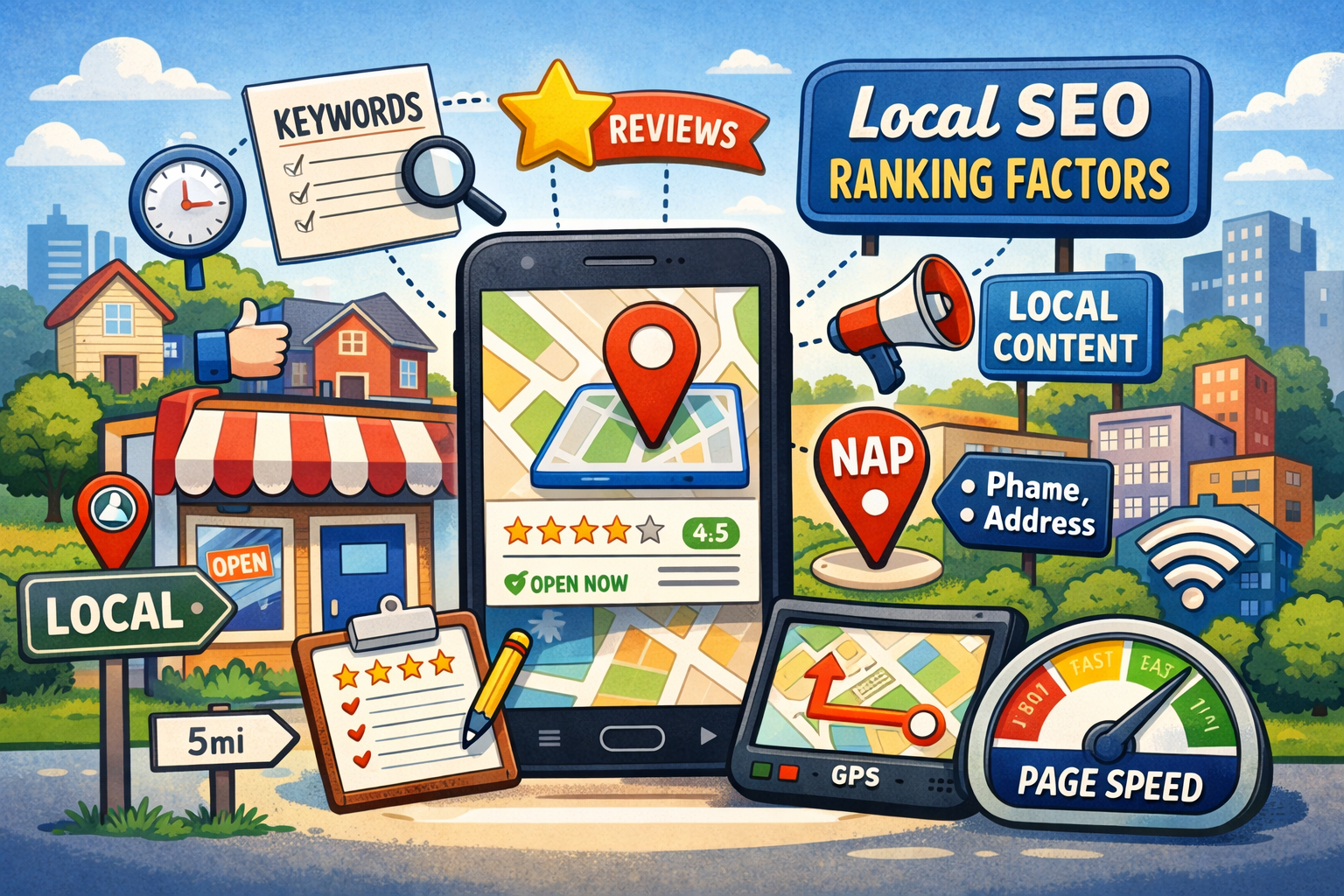
Local SEO is no longer just about adding your city name to a few pages and hoping Google figures it out. Today, local seo ranking factors span your Google Business Profile, on-site local relevance, review velocity and trust, business data consistency, and the overall prominence of your brand across the web. Google’s own guidance still frames local rankings around relevance, distance, and prominence, but the way businesses earn those signals has become more competitive and more dynamic.
For local businesses, that matters because consumer behavior keeps shifting. BrightLocal’s 2026 research shows that 68% of consumers won’t use a business rated below 4 stars, and 31% only consider businesses with 4.5 stars or higher. BrightLocal also reports that 45% of shoppers are using generative AI to find local businesses, which means your local presence now influences not just Google Maps and the local pack, but also AI-driven discovery.
This guide breaks down the most important local SEO ranking signals, how they work, what matters most in practice, and where businesses should focus first.
TL;DR
The most important local SEO priorities are simple in theory but demanding in execution:
- Build and maintain a complete, accurate, policy-compliant Google Business Profile.
- Align your categories, services, website pages, and reviews around the searches you want to rank for.
- Earn strong, recent, authentic reviews on a consistent basis.
- Keep business information accurate everywhere customers and search engines may find it.
- Strengthen local prominence with high-quality links, mentions, content, and real-world reputation.
- Use structured data and location-specific landing pages to help Google understand your business.
- Avoid shortcuts such as fake reviews, spammy location pages, keyword stuffing, or ineligible profiles.
What are local SEO ranking factors?
Local SEO ranking factors are the signals Google uses to determine which businesses and webpages appear in localized results such as:
- Google’s local pack
- Google Maps results
- Localized organic search results
- Branded knowledge panels and related local business features
Google publicly states that local rankings are primarily based on relevance, distance, and prominence. Relevance is how well a business matches the search, distance is how close it is to the searcher or target location, and prominence is how well-known and trusted the business appears online and offline.
That high-level model is still accurate, but it leaves out the operational reality. In practice, Google uses many signals to estimate those three ideas, including:
- Business Profile completeness and accuracy
- Category selection
- Review quantity, quality, and recency
- Website local relevance
- Business data consistency
- Backlinks and mentions
- Behavioral and engagement signals
- Structured data
- Policy compliance and business eligibility
The three foundations: relevance, distance, and prominence
1. Relevance
Relevance is about match quality. If someone searches for “emergency dentist near me,” Google wants to show businesses that clearly indicate they offer emergency dental services. Google recommends keeping your Business Profile complete and accurate so it can better understand what you do, where you are, and when customers can visit.
Relevance comes from signals such as:
- Primary and secondary categories
- Services and products listed in your profile
- Website content
- Service pages
- Review text mentioning real services
- Structured data
- Local landing page optimization
2. Distance
Distance is the least controllable of the local seo ranking factors. Google considers how close the business is to the searcher or to the location term used in the search. A business cannot “optimize” itself into being physically closer, but it can improve how clearly its address, service area, and location information are represented online.
For service-area businesses, Google has explicit eligibility and representation rules. You need to represent your business honestly and within Google’s policies, rather than trying to simulate a location presence you do not truly have.
3. Prominence
Prominence reflects authority, awareness, and trust. Google says prominence is based on information Google has about a business “from across the web,” including links, articles, and directories. Reviews are also part of this picture.
Prominence is where traditional SEO and local SEO overlap the most. Strong local businesses tend to have:
- Quality backlinks
- Press mentions
- Strong branded search presence
- Review strength
- Accurate citations
- A trustworthy website
- Consistent business reputation across platforms
A practical table of the most important local SEO ranking factors
| Ranking factor | Why it matters | What to improve first |
| Google Business Profile completeness | Helps Google understand your business and improves relevance | Fill out categories, hours, services, description, photos, business attributes |
| Primary category | Strong signal for matching search intent | Choose the most accurate core category |
| Reviews | Influence trust, conversions, and likely local prominence | Increase review volume, recency, authenticity, and response rate |
| On-page local relevance | Supports both local organic rankings and entity understanding | Create strong location and service pages |
| NAP/data consistency | Reduces confusion across the web | Standardize name, address, phone, hours, and URLs |
| Backlinks and mentions | Strengthen prominence and authority | Earn local press, partnerships, citations, and editorial links |
| Structured data | Helps Google interpret business details on the site | Add LocalBusiness markup where appropriate |
| Business eligibility/policy compliance | Prevents suppression, edits, or suspension | Follow Google’s business representation rules |
| Photos and business activity | Supports engagement and profile quality | Add real, current images and keep profile updated |
| Review keywords and freshness | Reinforce service relevance and current trust | Ask customers to describe real experiences naturally |
These factors align with Google’s official documentation and current local SEO research, especially around Business Profile quality, reviews, and broader online prominence.
Google Business Profile: still the center of local SEO
Your Google Business Profile is often the single most important asset in local search. Google explicitly advises businesses to keep profile information complete and up to date, including contact details, hours, services, and other operational details. Verified profiles can manage how the business appears on Search and Maps.
What matters most inside the profile
Primary category
Your primary category is one of the clearest relevance signals. It tells Google what your business is before anything else. Secondary categories help, but the primary category typically carries the most weight in describing your core offering. This is supported by long-running local SEO expert research, even though Google does not publish a weighted factor list.
Complete business information
Profiles with accurate hours, phone numbers, addresses, websites, and service information are easier for Google to trust and easier for users to convert from. Google directly recommends completeness and freshness.
Services, products, and attributes
These details help Google connect your profile to long-tail local searches. For example, “wheelchair accessible,” “women-owned,” “same-day appointments,” or “Spanish-speaking staff” can improve match quality for qualified searches. Google supports many business details and attributes within the profile ecosystem.
Photos and ongoing activity
While Google does not publish photos as a direct ranking factor list item, it does encourage businesses to manage and update profile content. Fresh images can improve engagement and conversions, and engaged profiles often perform better commercially. That is an inference rather than a published Google weighting.
TL;DR
If you do only one thing this month, audit your Google Business Profile. Get the category right, fill in every meaningful field, keep hours current, and make sure your real-world business setup matches Google’s policies.
Reviews: one of the most visible local SEO ranking factors
Reviews do two jobs at once: they influence buyer behavior and they likely strengthen prominence and relevance in local search. Google says reviews can help your business stand out in Search and Maps. BrightLocal’s 2026 data shows how strongly consumers now filter based on rating quality and review freshness.
The review signals that matter most
Review quantity
More high-quality reviews usually strengthen trust and visibility. They give Google more evidence that the business is real, active, and used by customers. This is consistent with Google’s public review guidance and current local SEO research.
Review recency
Whitespark’s 2025 commentary highlights regular review acquisition as an underrated ranking signal, and BrightLocal’s 2026 webinar summary reports that 74% of shoppers only care about reviews from the last 90 days. That means stale review profiles can weaken both conversion performance and perceived trust.
Review rating
BrightLocal’s 2026 survey found that 68% of consumers won’t use a business below 4 stars, and 31% want 4.5 stars or better. Even if ratings are not the only ranking signal, they materially affect click-through and conversion, which makes them critical in local search strategy.
Review text relevance
Review text that naturally mentions specific services, products, quality markers, or location details can reinforce relevance. BrightLocal’s 2025 guidance on mining feedback notes that repeated product or service terms in reviews can be important for local pack relevance.
Authenticity
Fake reviews are a bad strategy and a trust risk. BrightLocal reports that 97% of consumers think businesses should face consequences for fake reviews. Google also has review management workflows and policies around profile integrity.
Review priorities table
| Review element | Impact on local SEO and conversions | Best practice |
| Star rating | Strong trust and click influence | Maintain 4.0+ minimum, aim higher where possible |
| Review recency | Signals current quality and business activity | Request reviews continuously, not in bursts |
| Review volume | Builds credibility and proof | Build a repeatable ask process |
| Review text | Supports service relevance and buyer confidence | Ask for honest details, never script spammy wording |
| Owner responses | Improves customer trust and profile management | Respond professionally and consistently |
TL;DR
Reviews are no longer optional reputation fluff. They are one of the most commercially meaningful local seo ranking factors because they influence trust, click behavior, and likely local prominence. Focus on recency, rating, authenticity, and useful review text.
Website signals that support local pack and local organic rankings
A lot of businesses over-focus on the Business Profile and under-invest in the website. That is a mistake. Google’s broader ranking systems evaluate webpages for relevance and usefulness, and your site gives Google context your profile alone cannot provide.
Key on-site local SEO signals
Location pages
If you serve multiple areas, each legitimate location should have a unique page with:
- Real address or service-area information
- Unique service details
- Embedded map if appropriate
- Local testimonials
- Staff, parking, hours, service radius, and FAQs
- Unique copy, not templated city swaps
Thin “city pages” created just to rank can backfire if they do not reflect a real local presence or unique value.
Service pages
Google needs clear page-level signals for what you offer. A home page can rank for broad branded and location terms, but service pages help with searches like:
- “roof repair in Austin”
- “family lawyer in Tampa”
- “urgent care near downtown Phoenix”
Title tags and headings
Include the service and location naturally. Good local SEO titles still matter because they help search engines and users understand the page quickly.
Internal linking
Link your service pages, location pages, and core informational content together in a way that reflects user intent and geography.
Helpful content
Google’s ranking systems favor helpful, user-focused content. For local businesses, that means content that solves actual customer questions tied to the area and service.
Structured data: not a magic trick, but still worth doing
Google supports LocalBusiness structured data and says it can help Search understand important business details such as hours, departments, and reviews where appropriate. Google also notes that structured data should follow its specific documentation and guidelines.
What structured data can help with
- Reinforcing business identity
- Clarifying hours and contact details
- Supporting knowledge panel understanding
- Helping Google interpret page content more accurately
What it will not do
Structured data alone will not outrank a closer, better-reviewed, stronger business. It is a support signal, not a substitute for real local authority.
TL;DR
Use LocalBusiness schema where relevant, keep it accurate, and match it to what is visible on the page. It helps search engines interpret your site, especially as AI systems consume structured and semi-structured business data.
Citations, links, and local mentions
Google says local prominence can come from information “from across the web,” including links, articles, and directories. That makes off-site authority one of the enduring local seo ranking factors.
What kinds of links help local businesses?
- Local news features
- Chamber of commerce links
- Industry association listings
- Sponsorship mentions
- Supplier and partner links
- Local resource pages
- Editorial links from relevant sites
- High-quality directory citations
This is where link building fits naturally into local SEO. Not every local business needs a massive digital PR engine, but most businesses benefit from earning real, relevant mentions from sites that matter in their city, niche, or service category. For teams that need a structured outreach process, providers such as Outreachz may be considered as part of a broader, non-promotional link acquisition strategy, especially when the goal is to earn contextually relevant placements rather than rely only on passive discovery.
Citations vs backlinks
| Type | Primary purpose | Local SEO value |
| Citation | Confirms business identity and details | Strengthens trust and consistency |
| Backlink | Passes authority and context | Supports prominence and rankings |
| Brand mention | Builds entity recognition | Can support awareness and prominence |
| Local press feature | Combines authority and local relevance | Often highly valuable |
Many businesses still confuse directory submissions with authority building. Citations help validate the business. Backlinks help elevate prominence. You usually need both.
NAP consistency and data integrity
NAP stands for name, address, and phone number, though modern consistency work should also include hours, URLs, categories, and service details. Google repeatedly emphasizes accurate, up-to-date business information in the profile and across business representation policies.
Why consistency matters
Inconsistent data can create ambiguity around:
- Where you are located
- Whether multiple listings represent the same business
- Which phone number or website is correct
- Which hours are current
That confusion can weaken trust signals and conversions even when it does not trigger an obvious ranking penalty.
Common consistency mistakes
- Different suite numbers on different listings
- Call-tracking numbers replacing the main business number everywhere
- Old URLs left live in directories
- Mismatched business names
- Holiday hours not updated
- Service-area details not aligned with the website and profile
TL;DR
Clean data will not guarantee top rankings, but bad data quietly undermines local performance. Fix inconsistencies before investing heavily in advanced tactics.
Behavioral and engagement signals
Google does not publish a full list of user engagement signals for local rankings, and marketers often overstate them. Still, local SEO practitioners commonly watch metrics like clicks, calls, driving directions, branded searches, and engagement with listings as indicators of profile health. This should be treated as an informed industry inference rather than a confirmed Google weighting model. Supportive evidence comes from Google’s emphasis on complete, useful profiles and BrightLocal’s consumer behavior research showing how people use Maps, reviews, and multiple local discovery platforms.
In plain English: a listing that earns attention, trust, and action is usually better positioned to keep performing well.
AI search is changing local SEO
One of the biggest shifts in 2026 is that local discovery is no longer confined to Google’s classic results pages. BrightLocal reports that 45% of shoppers are now using generative AI for local business recommendations. That means your business data, reviews, website content, and third-party mentions increasingly influence AI-generated answers too.
How to optimize for AI-driven local discovery
- Use clear, factual service and location language on your website
- Keep your Business Profile updated
- Earn recent, detailed reviews
- Publish helpful local FAQs
- Add structured data
- Build consistent entity information across the web
- Strengthen topical and local authority with reputable mentions
This is where GEO-style optimization and local SEO start to overlap. AI systems need confidence in who you are, where you operate, and why users trust you.
What matters most by business type
| Business type | Highest-priority local SEO moves |
| Single-location storefront | GBP optimization, reviews, local landing pages, citation cleanup |
| Multi-location brand | Scalable location pages, data governance, review workflows, category discipline |
| Service-area business | Policy-compliant service setup, strong service pages, review acquisition, local links |
| Professional services | Reputation, expertise content, branded search strength, niche citations |
| Restaurants/hospitality | Reviews, photos, menu/product data, hours accuracy, Maps visibility |
The exact weighting differs by vertical and geography, but these priorities reflect how relevance, trust, and prominence typically show up in local search.
Biggest mistakes that hurt local rankings
Keyword stuffing your business name
Google’s guidelines require businesses to represent themselves accurately. Adding extra descriptors to the business name just to rank can trigger edits or policy issues.
Creating ineligible or fake locations
If a business is not eligible for a Business Profile at a location, forcing the issue can lead to suspension or suppressed visibility.
Letting reviews go stale
Consumers increasingly care about fresh reviews, not just historical averages.
Neglecting the website
A weak website limits how well you can rank in localized organic results and reduces the depth of information search systems can trust.
Using duplicate location pages
Thin, repetitive city pages create a poor user experience and weak differentiation.
Ignoring link authority
Even a strong profile may struggle against more prominent competitors with stronger local authority signals across the web.
A simple 90-day action plan for improving local SEO
Days 1–30
- Audit and complete your Google Business Profile
- Correct categories, hours, services, and core business details
- Review policy compliance and eligibility
- Clean up major citation inconsistencies
- Improve top location and service pages
Days 31–60
- Build a steady review request process
- Add local FAQs and trust content
- Implement LocalBusiness structured data
- Strengthen internal linking between service and location pages
- Add fresh photos and operational updates
Days 61–90
- Earn relevant local backlinks and mentions
- Create locally useful content assets
- Expand review acquisition and response workflows
- Track calls, rankings, profile views, and conversions
- Compare local pack visibility with localized organic gains
This sequence reflects the order in which most businesses should tackle local SEO: fix the foundation first, then build authority.
Final thoughts
The best way to think about local seo ranking factors is not as a secret algorithm checklist, but as a trust model.
Google wants to rank the business that is:
- the best match for the search,
- reasonably close to the searcher,
- and most credible based on the evidence available.
That evidence comes from your Business Profile, your website, your reviews, your links, your business data, and your real-world reputation. Google’s public guidance still centers on relevance, distance, and prominence, but recent research makes one thing even clearer: local SEO winners are the businesses that stay accurate, visible, trusted, and active over time.