

Introduction
The rules of search have changed, and if you’re still building backlinks the same way you did three years ago, you’re optimizing for a game that’s already moved on.
ChatGPT now processes over 2.5 billion prompts per day, and a growing share of those are direct information requests, questions users used to type into Google. When someone asks ChatGPT “What’s the best SEO tool for agencies?” or “Which backlink service should I trust?”, the AI doesn’t crawl the web in real-time for most queries. It draws from patterns baked into its training data, patterns shaped by authority, citation frequency, and cross-platform credibility signals.
That means backlinks for AI visibility are no longer just about climbing Google’s SERPs. They’re about becoming the kind of entity that AI systems recognize, trust, and recommend. This guide breaks down exactly which types of backlinks move that needle, and which ones are quietly wasting your budget.
TL;DR
- ChatGPT recommendations are driven by trust signals, not just rankings, backlinks contribute indirectly but critically
- Editorial links from DR 70+ sources are the single highest-value link type for AI citation probability
- Sites with 32,000+ referring domains are cited by ChatGPT at nearly double the rate of those with fewer links (SE Ranking, 2025)
- Brand mentions on community platforms like Reddit and Quora account for 52.5% of AI citations across major LLMs
- Review platform presence (G2, Trustpilot, Capterra) gives domains 3x higher chances of ChatGPT citation
- Nofollow links from news sites and Wikipedia carry nearly the same AI impact as dofollow links
- Cheap, bulk, and AI-generated-site backlinks have zero footprint in AI training data, they’re dead weight
- The winning formula: combine editorial links + digital PR + niche guest posts + community mentions
How ChatGPT Actually Decides What to Recommend
Before diving into link types, you need to understand one thing clearly: ChatGPT doesn’t rank pages the way Google does. It doesn’t crawl your site and assign it a score. Instead, large language models like GPT-4 learn which brands and sources are trustworthy by absorbing the patterns of the entire web during training.
When your brand is consistently referenced, cited, and discussed across authoritative, independent sources, news sites, forums, expert roundups, review platforms, the model learns that your brand is credible. That’s the mechanism behind AI recommendations.
According to a study by SE Ranking analyzing 129,000 domains, the number of referring domains is the single strongest predictor of ChatGPT citation likelihood. The correlation is clear: sites with over 350,000 referring domains averaged 8.4 citations, while those with up to 2,500 averaged just 1.6 to 1.8.
A study by Ahrefs across 75,000 brands found that branded web mentions correlated with AI visibility at 0.664, while raw backlinks came in at 0.218. That gap tells the story: links build the foundation, but mentions build the reputation AI systems recognize.
So backlinks still matter, but why they matter has fundamentally shifted. They now serve two functions simultaneously:
- Building domain authority that helps your content rank, which AI systems then cite
- Generating the editorial credibility signals that AI models use to identify trustworthy entities
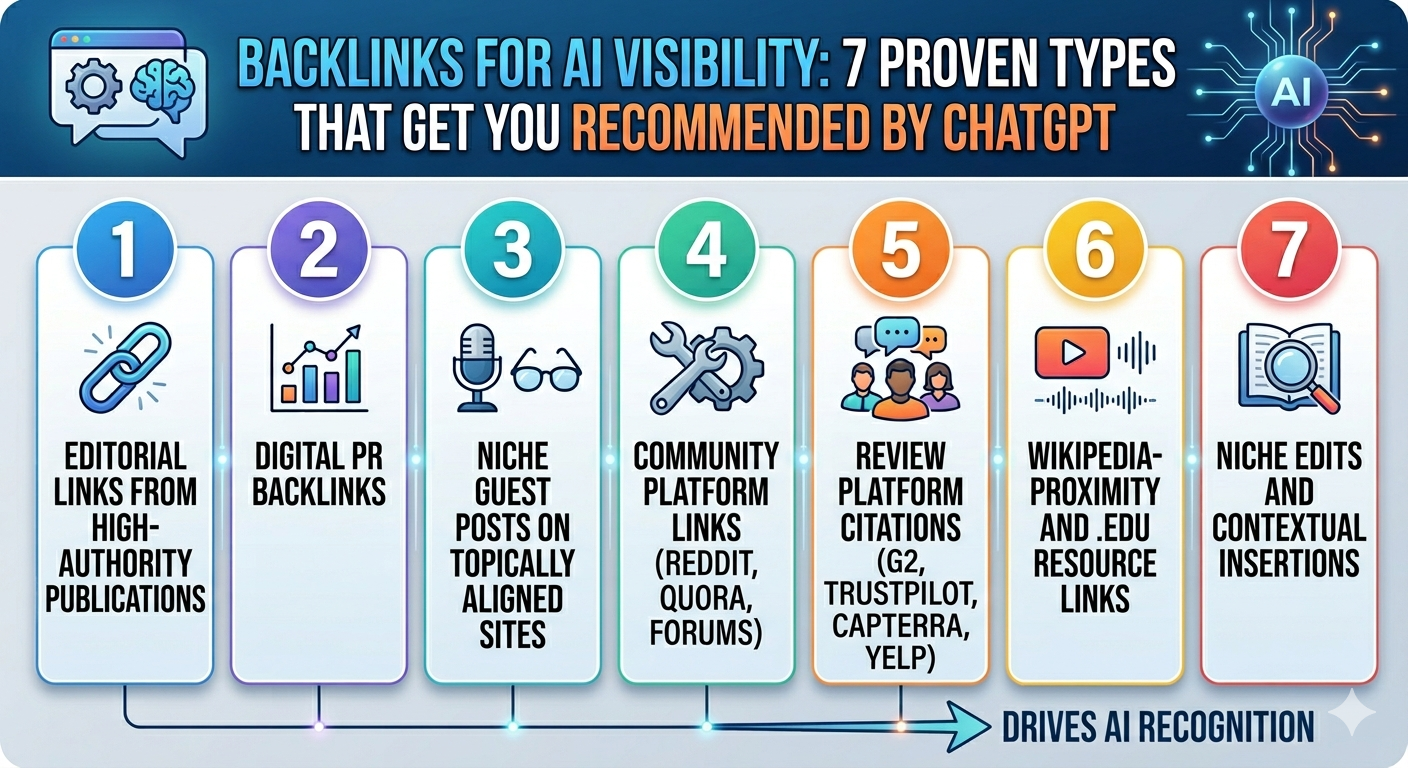
The 7 Types of Backlinks That Actually Help With ChatGPT Visibility
1. Editorial Links From High-Authority Publications
Editorial links, where an independent journalist or editor voluntarily cites your content, data, or expertise, are the gold standard for backlinks for AI visibility. These links carry the highest AI citation value (scored at 100% on the AI value index, per LinkPublishers research) because they signal genuine third-party validation.
When a DR 75+ publication links to your study or quotes your expert, two things happen: your organic rankings improve, and you appear in the kind of authoritative content that AI systems draw from most heavily.
Target publications in your niche with real traffic, genuine editorial standards, and active readership. A single editorial placement from a trusted trade outlet can outperform dozens of directory links.
Resource: Before evaluating your current link profile for gaps, a professional backlink audit service can reveal exactly where you stand, and what link types you’re missing.
2. Digital PR Backlinks
Digital PR earns you links from online media coverage, press mentions, expert quotes in news stories, data-driven stories picked up by outlets. These links are powerful because they come from the exact sources AI systems cite most: journalism.
According to Muck Rack’s “What Is AI Reading?” report (2025), journalism accounted for over 27% of all AI citations across ChatGPT, Claude, Gemini, and Perplexity, jumping to 49% for queries with time-sensitive intent.
A well-executed digital PR campaign around original research, a product milestone, or a bold industry stance can earn you links from five to twenty publications in a single push. These are the links that feed the AI citation pipeline most directly.
3. Niche Guest Posts on Topically Aligned Sites
Guest posting still delivers, but context is everything. A guest post on a generic, low-traffic “write for us” site that has nothing to do with your niche is noise. A guest post on a niche-aligned, editorially vetted publication is signal.
Topical alignment matters more than raw domain authority for AI citation purposes. When a host site covers the same subject matter as your brand, the link reinforces entity relationships and topical authority, both of which influence how AI models categorize and recommend your brand.
For a deeper breakdown of how link quality affects rankings in both traditional and AI search, this comparison of high-quality backlinks vs. cheap backlinks covers the real-world performance difference in clear terms.
4. Community Platform Links (Reddit, Quora, Forums)
Here’s what surprises most people: nofollow links from Reddit and Quora may be more valuable for AI visibility than dofollow links from low-authority blogs.
OtterlyAI’s 2026 study of one million citations found that community platforms captured 52.5% of citations across ChatGPT, Perplexity, and Google AI Overviews. Reddit accounts for over 11% of ChatGPT’s top citation sources alone.
Why? Because these platforms are deeply embedded in AI training data. When your brand or content is discussed, recommended, or cited in active Reddit threads and Quora answers, you’re placing yourself in exactly the knowledge ecosystem AI models learn from.
A thoughtful, genuinely useful Reddit comment or Quora answer that references your content isn’t spam, it’s legitimate AI visibility strategy.
5. Review Platform Citations (G2, Trustpilot, Capterra, Yelp)
SE Ranking’s data makes this impossible to ignore: domains listed on multiple review platforms (G2, Trustpilot, Capterra, Sitejabber, Yelp) averaged 4.6 to 6.3 ChatGPT citations, while those absent from such platforms averaged just 1.8.
That’s a 3x difference, directly attributable to review platform presence.
These platforms carry a specific type of authority AI systems recognize: structured, aggregated, user-generated validation. When ChatGPT is asked to recommend a tool or service, it draws on the same trust signals humans use, and review platforms are major contributors to that trust layer.
Getting your brand listed, verified, and actively reviewed on the major platforms in your industry is one of the highest-ROI moves you can make specifically for AI recommendations.
6. Wikipedia-Proximity and .edu Resource Links
Wikipedia accounts for approximately 7.8% of all ChatGPT citations (Superprompt, 2026), making it the single most-cited source in ChatGPT responses. You cannot (and should not try to) add self-promotional links to Wikipedia, but you can get cited by Wikipedia if your research is legitimate and notable.
The strategy here is indirect but powerful: publish original data, studies, or authoritative guides that become reference-worthy. When Wikipedia articles cite your research, and ChatGPT cites Wikipedia, you’ve entered the citation chain.
Similarly, resource page links from universities, academic institutions, or widely-referenced industry guides place your content in the same category of trusted sources that AI systems weight most heavily.
7. Niche Edits and Contextual Insertions
Niche edits, placing your link within existing, indexed, and ranking content, outperform sidebar links, footer links, and generic author bylines. When your link lives in the main body of a piece that’s already earning organic traffic and topical authority, it carries real contextual weight.
For AI visibility purposes, the surrounding content matters: a niche edit in an article about “best CRM tools for startups” that references your SaaS product teaches AI models the associative relationship between your brand and that topic.
If you want to explore the full landscape of link types before building your strategy, this comprehensive guide to types of backlinks and the complete SEO breakdown is worth reading in full.
Backlink Type Comparison: AI Visibility Value
| Backlink Type | AI Citation Value | Domain Authority Needed | Nofollow OK? | ChatGPT Impact Level |
| Editorial Links | ⭐⭐⭐⭐⭐ | DR 60–70+ | No | Highest |
| Digital PR / Press Mentions | ⭐⭐⭐⭐⭐ | DR 50+ media outlet | Yes | Highest |
| Niche Guest Posts | ⭐⭐⭐⭐ | DR 40–60+ | No | High |
| Reddit / Quora Community Links | ⭐⭐⭐⭐ | Platform-level trust | Yes | High |
| Review Platform Citations | ⭐⭐⭐⭐ | Platform-specific | Yes | High |
| Wikipedia-Proximity / .edu | ⭐⭐⭐⭐ | Institution-level | Yes | High |
| Niche Edits (Contextual) | ⭐⭐⭐ | DR 40+ | No | Moderate–High |
| Generic Directory Links | ⭐ | N/A | Yes | Negligible |
| AI-Generated Site Links | ❌ | N/A | N/A | None |
| PBN / Paid Link Networks | ❌ | N/A | N/A | None / Harmful |
What Backlinks to Avoid If You Want AI Visibility
Not all link-building activity helps your AI presence, some of it actively works against you.
AI-generated site backlinks are a 2025–2026-specific risk. Since 2025, there has been a surge in websites built solely to sell links. These sites have no real audience, no editorial credibility, and no footprint in AI training data. They’re invisible to AI citation systems.
Generic directory links on irrelevant aggregators contribute nothing to the entity signals AI systems care about. They dilute your profile without adding the topical or editorial credibility that drives recommendations.
PBN links carry serious Google penalty risk and carry zero weight in AI training data, the network sites simply don’t appear in the kind of editorial, community, or journalistic contexts that AI models learn from.
The bottom line: if a link wouldn’t appear on a site a human journalist, researcher, or engaged community member would read, it’s not helping your AI visibility.
Combining Backlinks With Brand Mention Strategy
The most effective approach to backlinks for AI visibility isn’t choosing between links and mentions, it’s building both simultaneously.
Here’s the framework that works in 2026:
| Pillar | Tactic | AI Visibility Outcome |
| Editorial Authority | Digital PR, original research, data studies | High-value training data citations |
| Topical Relevance | Niche guest posts, contextual niche edits | Entity association with your niche |
| Community Trust | Reddit engagement, Quora answers, forum presence | Direct AI training data inclusion |
| Social Proof | G2/Trustpilot/Capterra listings + reviews | 3x higher ChatGPT citation rate |
| Reference Authority | Wikipedia proximity, .edu resource links | Access to highest-weight citation chain |
| Brand Mentions | Unlinked press mentions, podcast appearances | Correlated at 0.664 with AI visibility |
According to data published by Stacker (2025), distributing earned content to a wide range of publications can increase AI citations by up to 325% compared to only publishing on your own site. That number should reshape how you think about link-building ROI.
For brands that want to know where to start, or which services actually deliver this kind of link quality, this comparison of the best backlink services breaks down what to look for and what to avoid.
Key Stats Summary: Backlinks and ChatGPT Citations
- 32,000+ referring domains = nearly 2x more ChatGPT citations than sites below that threshold (SE Ranking, 2025)
- Sites with 50+ referring domains receive 5x more AI traffic than those with fewer (Superprompt, 2026)
- “Best X” listicles account for 43.8% of all page types cited by ChatGPT (OGTool, 2026)
- 88% of URLs that ChatGPT cites are taken directly from search results (Ahrefs, April 2026)
- Wikipedia accounts for 7.8% of all ChatGPT citations, the single highest individual source
- DR 60+ backlinks are among the top 5 metrics that consistently drive LLM citations, alongside domain authority, listicle mentions, total backlinks, and unique referring domains
Final Takeaway
ChatGPT recommendations aren’t random, they’re the output of a trust architecture that AI systems absorb from the web’s best editorial content, community platforms, and authoritative sources. Backlinks for AI visibility work when they place your brand in exactly those environments.
The shift isn’t away from link building. It’s toward intentional link building, where every link you earn also builds the entity recognition, topical authority, and citation credibility that AI models rely on when generating recommendations.
Build fewer, better links. Target the right platforms. Earn the kind of coverage that journalists and community members naturally create, because that’s the content AI has already learned to trust.