

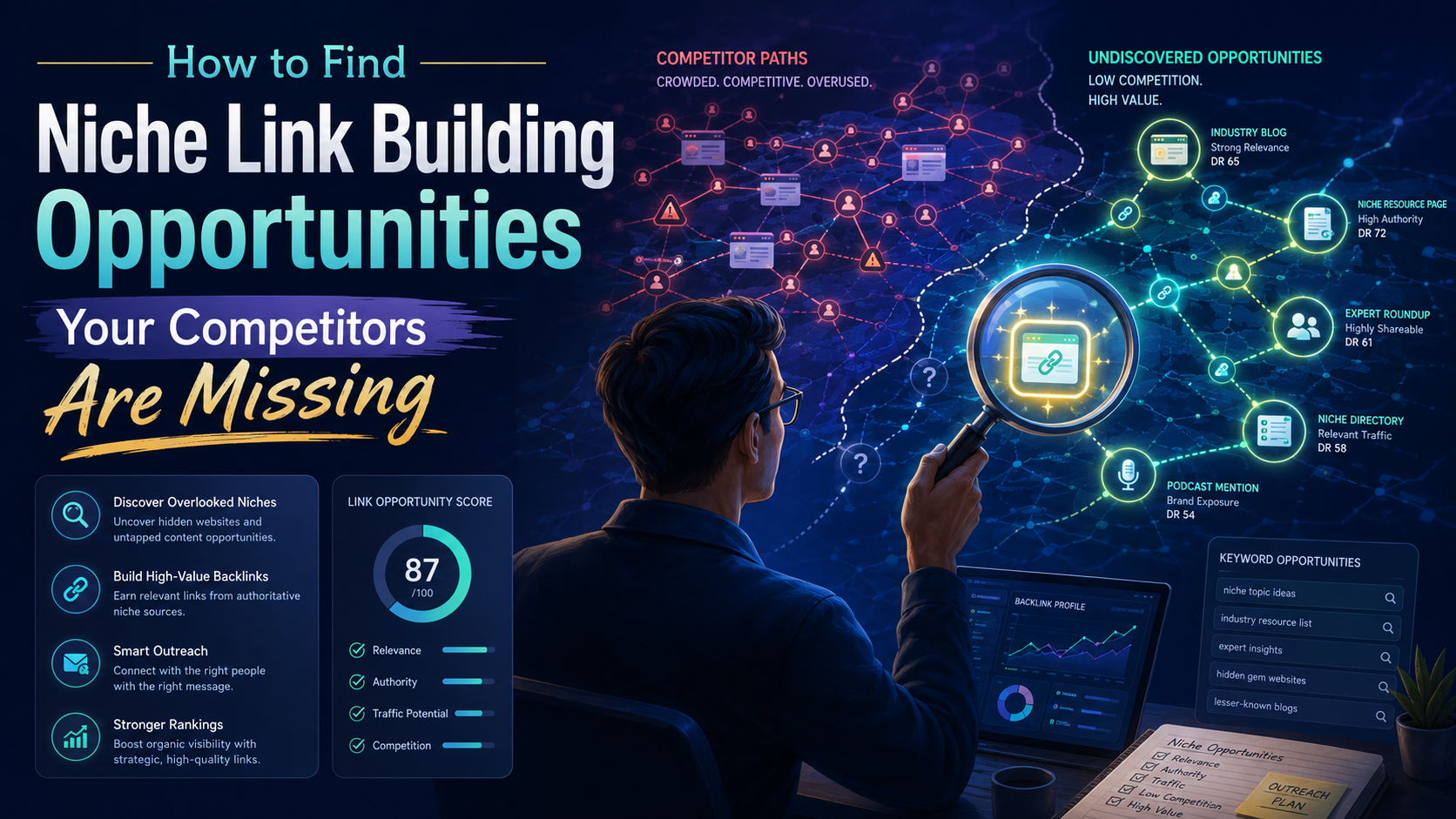
Every SEO professional has stared at their backlink profile and wondered: why are competitors outranking me when my content is arguably better? More often than not, the answer isn’t on-page optimization – it’s the links they’ve quietly built from corners of the web you haven’t even looked at yet.
Niche link building is the practice of targeting backlink sources that are tightly relevant to your specific industry rather than chasing generic, high-authority domains. And here’s the uncomfortable truth: most brands are fighting over the same 50 to 100 well-known sites in their space, ignoring hundreds of untapped, high-relevance opportunities sitting in plain sight.
This guide breaks down exactly how to uncover those hidden opportunities – the ones your competitors are missing – and turn them into ranking fuel through smart, targeted outreach.
Quick Stat: According to a 2026 industry survey, 54% of businesses generate links through competitor analysis. That means nearly half are leaving that intelligence on the table entirely.
1. Why Niche Link Building Beats Generic Link Acquisition
TL;DR: Relevance beats raw authority. A link from a tightly-matched niche site often outperforms one from a generic high-DA domain – especially in how Google’s AI-driven systems interpret topical authority.
Not all backlinks are created equal, and in 2026, that distinction matters more than ever. Google’s algorithms – particularly the systems powering AI Overviews – are increasingly sophisticated at detecting topical relevance between linking and receiving pages. A backlink from a site that operates in your same semantic neighborhood sends a stronger credibility signal than a generic mention on a broad-topic blog.
Consider a SaaS startup in the customer retention space. Getting a backlink from a SaaS review blog, an industry analyst site, or a customer success newsletter will carry far more weight than a link from a general business directory with a high domain rating. The context matters – Google evaluates not just who links to you, but whether those linking pages make semantic sense.
Beyond ranking signals, niche-relevant links deliver more qualified referral traffic, reinforce your topical authority over time, and reduce your exposure to algorithmic penalties. A balanced link profile – meaning one weighted toward industry-relevant domains – also proves far more resilient through Google core updates.
Here’s why the opportunity gap exists: most link building teams default to the same playbook. They target the top 10 to 20 sites in their vertical, pitch the same guest post angles, and wonder why response rates are declining. The sites that aren’t on everyone’s radar? Those are your goldmine.
Table 1: Niche-Relevant vs. Generic Link Building – Key Differences
| Factor | Niche-Relevant Link Building | Generic Link Building |
| Topical Relevance | High – linked sites share your niche | Low – broad topics, unrelated content |
| AI Overview Impact | Strong – reinforces topical authority | Weak – minimal semantic alignment |
| Referral Traffic Quality | High – pre-qualified niche audience | Low – general or irrelevant visitors |
| Outreach Competition | Lower – fewer brands targeting same sites | Very High – saturated with requests |
| Penalty Resistance | High – natural, editorial signals | Medium – may trigger over-optimization flags |
| Timeline to Results | 3–5 months (contextual authority) | Varies widely, often longer |
| Average Conversion Rate | Higher – relevant audience intent | Lower – mismatched audience |
2. Backlink Gap Analysis: Finding What Competitors Have That You Don’t
TL;DR: A backlink gap is the list of domains linking to your competitors but not to you. These are pre-qualified opportunities – those sites are already open to linking in your niche.
The most efficient place to start your niche link building hunt is with your competitors’ backlink profiles. If a site is already linking to three of your direct competitors, there’s a strong probability they’d link to you too – provided you approach them with the right pitch.
How to Run a Backlink Gap Analysis
1. Log into Ahrefs or Semrush and navigate to the Link Intersect or Backlink Gap tool.
2. Enter two to four of your direct competitors’ domains and your own URL.
3. Filter for domains that link to at least two competitors but NOT to you – these are your highest-priority targets.
4. Export the list and sort by domain rating (DR 40 to 80 is typically the sweet spot – authoritative but not impenetrable).
5. Cross-reference with organic traffic data to ensure each domain has at least 1,000 monthly visitors.
6. Group prospects by type: blogs, media outlets, resource pages, directories, and industry associations.
Tools like Ahrefs’ Competing Domains feature add another layer of intelligence: you can identify shoulder-niche websites – sites adjacent to your industry that aren’t direct competitors – which are often far more receptive to outreach than the sites everyone else is pitching.
Pro Tip: Don’t just look at who links to competitors – look at what pages those links point to. If multiple competitors have links pointing to a specific type of content (e.g., a data study, a tools roundup), that’s a content format signal you should replicate.
Table 2: Backlink Gap Analysis – Tools and Their Key Features
| Tool | Gap Feature | Best For | Price Range |
| Ahrefs | Link Intersect + Competing Domains | Deep competitor backlink mapping | $99–$399/mo |
| Semrush | Backlink Gap Analyzer | Side-by-side competitor comparison | $119–$449/mo |
| Moz Pro | Link Explorer | Domain authority filtering | $99–$299/mo |
| SE Ranking | Backlink Gap Module | Budget-friendly gap analysis | $44–$191/mo |
| Majestic | Clique Hunter | Finding link clusters & topical trusts | $49–$399/mo |
3. Google Search Operator Tactics for Uncovering Hidden Niche Sites
TL;DR: Advanced Google search operators surface linking opportunities that SEO tools miss – especially for micro-niche blogs and resource pages that aren’t widely indexed in backlink databases.
Most link building tools scrape from the same large crawled index. That means operators who rely solely on Ahrefs or Semrush are competing for the exact same list. Google search operators let you surface niche content that hasn’t made it into third-party databases yet, giving you a legitimate head start on outreach.
High-Impact Search Operator Strings for Niche Link Building
• inurl:blog intext:”[your keyword]” -intitle:”[your product]” – Surfaces niche blog posts mentioning your keyword without being your competitor.
• “[your keyword]” + “write for us” – Finds guest posting opportunities in your specific niche.
• “[your keyword]” + “resources” OR “useful links” OR “recommended tools” – Uncovers resource pages actively linking out.
• “[your keyword]” + “top blogs” OR “best sites” – Identifies roundup-style pages you can pitch for inclusion.
• “[your keyword]” + intitle:”statistics” OR “study” OR “research” – Finds data-hungry pages that cite studies – perfect targets if you publish original research.
For example, if you’re in the HR software space, searching for ‘inurl:blog intext:”HR management tools” -intitle:”HR software”‘ returns blog posts that mention your target term but aren’t competitors selling the same product – those are your niche link targets.
Don’t overlook Reddit and Quora either. These platforms reveal real user intent gaps: questions that haven’t been answered by strong content yet, exposing whitespace where you can build an authoritative resource and naturally attract links from people who reference discussions.
4. Underused Niche Link Building Tactics Your Competitors Overlook
TL;DR: Beyond guest posts and broken link building, there are several high-ROI tactics that most teams never attempt – and that’s exactly why they work so well.
Unlinked Brand and Keyword Mention Reclamation
Studies consistently show that approximately 60% of online brand mentions go unlinked. Tools like Ahrefs Alerts, Brand24, and Google Alerts notify you when someone mentions your brand or key terms without a hyperlink. Converting those mentions into links is arguably the lowest-effort, highest-conversion tactic in the niche link building playbook – the writer already considered your brand worth mentioning, they simply forgot to add the link.
Niche Edits / Link Insertions in Existing Content
Rather than creating a new guest post from scratch, niche edits involve identifying existing, well-ranking articles in your niche and pitching to have your link inserted contextually. The page already has authority and traffic – you’re simply making it more useful. Best targets include resource roundups, ‘top tools’ listicles, tutorials, and ‘best of’ guides. The key is choosing pages where your link genuinely adds value, not pages where you’d be shoe-horned in awkwardly.
Industry Event and Award Sponsorships
Sponsoring niche conferences, webinars, or industry award programs almost always comes with a backlink from the event’s website – which tends to be highly authoritative within that vertical. Many smaller, niche-specific events have surprisingly strong domain authority and don’t cost a fortune to sponsor. This tactic is almost completely ignored by brands focusing solely on content-based link acquisition.
Podcast and Webinar Appearances
Appearing as a guest on niche industry podcasts typically earns you a link from the podcast’s show notes page – a page that often accumulates consistent organic traffic from loyal listeners. Unlike guest posts, podcast pitching has much lower competition, and the editorial standards around who gets featured are based on expertise rather than content quality alone.
Digital PR and Reactive Expert Contributions
When breaking news happens in your industry, journalists need expert commentary fast. Platforms like HARO (Help a Reporter Out) and Qwoted connect you with reporters from niche industry publications. The key is speed and specificity – journalists receive dozens of generic responses. A concise, data-backed, quotable insight submitted within 30 minutes of a query dramatically increases your placement rate.
Competitor Broken Link Building
Use tools like Ahrefs’ Site Audit or Screaming Frog to find 404 pages on competitor sites that still have external backlinks pointing to them. Reach out to those linking domains with a replacement resource from your own site. Because you’re solving a real problem for the webmaster (a broken link hurts their user experience), this approach has notably higher response rates than cold outreach.
Table 3: Niche Link Building Tactics – Effort vs. Impact Comparison
| Tactic | Effort Level | Competition Level | Avg. Conversion Rate | Link Quality |
| Unlinked Mention Reclamation | Low | Very Low | 20–40% | High |
| Competitor Broken Link Building | Medium | Low | 10–25% | Very High |
| Niche Edits / Link Insertions | Medium | Medium | 10–20% | High |
| Guest Posting (Niche-Specific) | High | High | 5–15% | High |
| Digital PR / HARO | Medium | Medium–High | 3–10% | Very High |
| Resource Page Outreach | Low–Medium | Low–Medium | 5–15% | High |
| Podcast / Webinar Appearances | Medium | Low | 15–35% | Medium–High |
| Event / Award Sponsorship | Low (budget req.) | Very Low | 90%+ (paid) | High |
5. How to Qualify Niche Link Opportunities (Don’t Chase Everything)
TL;DR: Not every niche site is worth pursuing. A systematic vetting process saves time and ensures your backlink profile grows with quality, not just quantity.
One of the most common link building mistakes is treating every niche site as an equal opportunity. Domain rating is a useful starting point, but it’s just one variable in a multi-factor equation. Here’s how to properly vet a potential niche link opportunity before you invest time in outreach:
• Non-competitiveness: Confirm the site does not sell the same products or services as you. Competitors rarely link to competitors.
• Organic traffic minimum: Prioritize domains receiving at least 1,000 monthly organic visitors. Traffic indicates the page is real and indexed – not a ghost site.
• Domain rating range: Target sites in the DR 35 to 75 range. Lower may lack authority; higher may be too difficult to penetrate without a premium budget.
• Content quality signal: Read the site. Is the writing original and informed? Sites with AI-generated thin content or excessive advertising are low-value link sources.
• Outbound link patterns: Review how many external links the page already contains. A page with 50+ outbound links on a single topic dilutes link equity significantly.
• Spam score check: Use Moz or Semrush to flag sites with high spam scores – these can actively harm your profile.
• Indexed and crawlable: Verify via Google Search (site:domain.com) that the site has indexed pages and isn’t penalized or deindexed.
It’s also worth evaluating whether the site has already linked to your competitors. If it has, that’s a strong green light – they’ve shown a willingness to link to sites in your category and have an editorial standard that accepts external references.
6. Outreach That Actually Gets Responses in 2026
TL;DR: Generic email templates are dead. The outreach emails that convert in 2026 are hyper-personalized, concise, value-first, and demonstrate that you’ve actually read the target site.
Even the best list of niche link opportunities is worthless without effective outreach. And in 2026, inbox saturation is real – webmasters and editors receive dozens of link requests per day, many of them clearly templated and impersonal. Standing out requires a different approach.
The Anatomy of a High-Converting Niche Outreach Email
• Subject line: Reference something specific – a recent article, a stat they cited, a topic they covered. Personalization signals that you read their content.
• Opening hook: Lead with something you genuinely found valuable on their site. Two sentences max. No “I love your blog” fluff.
• The pitch: Clearly state what you want and why it benefits them – not just you. Frame your resource as something that improves their content for their readers.
• Social proof: Mention relevant credentials, data from your piece, or who else has cited your content.
• Call to action: Simple and direct. “Would it make sense to include a link here?” performs better than elaborate asks.
• Follow-up strategy: Send two follow-ups maximum – one at day 3 and one at day 7. Each follow-up should add new value (a stat, a different angle) rather than just saying “bumping this.”
Reality Check: The average cold outreach response rate in link building is 5–10%. A well-personalized campaign targeting highly relevant niche sites can push that to 15–25%. Volume matters, but relevance and quality drive results.
7. Choosing a Niche Link Building Service: What to Look For
TL;DR: Not every brand has the bandwidth for in-house link building. When evaluating services, prioritize transparency, niche relevance, editorial standards, and real traffic on placed links.
Many businesses – especially growing startups and mid-market companies – turn to specialized link building services to accelerate their backlink acquisition without hiring a full team. The problem is, the market is flooded with low-quality services that sell links on private blog networks (PBNs) or spam-heavy directories that do more harm than good.
When evaluating a niche link building service, the non-negotiables are: editorial quality on placed links, real organic traffic on target domains, transparent reporting with live link URLs, and a clear strategy for matching link placements to your niche – not just your keyword.
One service worth considering is Outreachz.com, which focuses on niche-relevant outreach-based placements. Rather than selling links from a fixed inventory of pre-arranged sites, their model centers on personalized outreach to relevant publishers – which aligns with the editorial, relevance-first approach that holds up under Google’s evolving guidelines. For brands that want the strategy executed without building the in-house infrastructure, this kind of service can meaningfully compress the timeline between identifying niche opportunities and converting them into placed links.
The table below provides a quick framework for evaluating any link building service or vendor before committing a budget.
Table 4: Link Building Service Evaluation Criteria
| Evaluation Criteria | Green Flag | Red Flag |
| Link Placement Source | Editorial outreach to niche-relevant publishers | Fixed inventory of pre-bought sites (PBN risk) |
| Domain Traffic | Verified organic traffic (1K+ monthly) | No traffic data provided, unverifiable |
| Transparency | Live URLs provided upon completion | Vague reporting, no live proof |
| Niche Matching | Links placed in contextually relevant content | Generic, off-topic placements |
| Turnaround Time | 3–6 weeks for research + placement | Instant links (too fast to be editorial) |
| Pricing Model | Per-link pricing with clear DR/traffic tiers | Cheap bulk packages with no quality tiers |
| Guest Post Quality | Original, well-written content on real blogs | Thin AI-generated content on spam-heavy sites |
8. GEO Optimization: Niche Link Building for AI Search Engines
TL;DR: Generative Engine Optimization (GEO) is the emerging discipline of optimizing content to appear in AI-driven search overviews. Niche link building plays a direct role in whether AI systems surface your brand.
In 2026, Google AI Overviews, Perplexity, and ChatGPT Search are increasingly part of how users discover answers. And here’s something most SEOs are still catching up on: an Ahrefs study found that 76% of AI Overview citations come from pages ranking in Google’s top 10 – which means strong backlink profiles directly influence whether you appear in AI-generated answers.
Furthermore, a separate Ahrefs study covering 75,000 brands found a moderate positive correlation between the number of referring domains and AI Overview brand visibility. In other words, niche link building isn’t just an organic ranking strategy – it’s increasingly an AI discoverability strategy.
How to Optimize Niche Link Building for GEO
• Target authoritative niche publishers that AI systems already cite in your category – these act as credibility proxies.
• Build links to pages that directly answer specific niche questions – question-based content is disproportionately cited in AI Overviews.
• Include structured data (FAQ schema, How-To schema) on pages you’re building links to – AI systems favor well-structured, citation-ready content.
• Pursue links from sources that AI training pipelines respect: academic references, industry publications, government .edu and .gov resources when relevant.
• Build your brand entity – consistent NAP (Name, Address, Phone) data, Wikipedia presence, and mentions across authoritative niche sources all reinforce how AI systems understand and represent your brand.
9. Building a Repeatable Niche Link Building System
One-time link campaigns don’t build lasting authority. The brands that consistently outrank their competition treat link building as an ongoing function – not a quarterly initiative. Here’s a simplified monthly cycle to institutionalize niche link building in your SEO workflow:
13. Week 1 – Prospecting: Run backlink gap analysis against 3–4 competitors. Identify 50 to 100 new niche-relevant targets using both gap tools and Google operators.
14. Week 2 – Qualification and Prioritization: Vet all prospects using the criteria above. Build your outreach list, focusing on the top 30 highest-relevance, highest-opportunity sites.
15. Week 3 – Outreach: Send personalized pitches. Track open rates and responses. Prioritize prospects that open but don’t reply for follow-up.
16. Week 4 – Placement and Reporting: Secure live links. Update your backlink tracker with live URLs, anchor text, DR, and traffic data. Analyze which tactic and content type drove the most placements.
Over time, this process generates compounding returns. Sites you’ve built relationships with become ongoing opportunities. Editors who’ve published your content are more likely to feature you again. And your backlink profile grows with a velocity and diversity pattern that Google recognizes as natural and authoritative.
10. Common Niche Link Building Mistakes to Avoid
• Chasing DA over relevance: A DR 45 site in your exact niche will outperform a DR 80 site with no topical connection to your industry every single time.
• Over-optimized anchor text: Using the same exact-match keyword anchor text repeatedly triggers algorithmic scrutiny. Vary your anchors: branded, partial match, URL, and generic terms.
• Ignoring link velocity: Sudden spikes in backlink acquisition – especially from similar site types – can look unnatural. Build at a steady, explainable cadence.
• Reciprocal link exchanges: Swapping links directly (I link to you, you link to me) is heavily devalued and easily detectable. Stick to one-directional editorial placements.
• Placing links in low-traffic content: A link buried in a blog post that receives zero organic traffic carries negligible SEO equity. Prioritize pages that rank and receive real visitors.
• Neglecting existing link maintenance: Earned links can be removed, redirected, or noindexed. Monitor your backlink profile monthly and reclaim lost links proactively.
Conclusion: The Opportunity Is in the Overlooked
The most valuable niche link building opportunities aren’t the ones showing up in every competitor’s Ahrefs export. They’re the micro-niche blogs that rarely get outreach emails, the resource pages that list 10 tools but would happily list 11, the podcast that reaches 3,000 of exactly your target audience, and the journalist covering your vertical who hasn’t heard from you yet.
Closing your competitors’ backlink gaps is only the starting point. The real edge comes from venturing into the territory they haven’t mapped – and building relationships there before they do.
Whether you manage this in-house or work with a specialist service, the principles are the same: prioritize relevance over vanity metrics, build systemically rather than sporadically, and measure outcomes in rankings and traffic – not just link counts.
Your competitors are busy fighting over the same 50 sites. The sites they’re ignoring are waiting for your pitch.
Frequently Asked Questions
What is niche link building?
Niche link building is the practice of acquiring backlinks from websites that are topically aligned with your specific industry or content focus, rather than pursuing generic high-authority links. These links reinforce your topical authority signal to both traditional search engines and AI-driven systems.
How long does niche link building take to show results?
Most practitioners see measurable ranking improvements within 3 to 6 months of a consistent niche link building campaign. The timeline depends on your site’s existing authority, the quality of links acquired, and how competitive your target keywords are.
Is niche link building safe in 2026?
Yes – when done correctly. Editorial, outreach-based niche link building that prioritizes genuine relevance and quality is the safest long-term strategy. Avoid PBNs, paid link schemes on low-quality sites, and over-optimized anchor text patterns.
How many niche links do I need to rank?
There’s no universal number. Quality and relevance matter far more than volume. A handful of links from highly authoritative, niche-specific sources often outperforms dozens of generic links. Use competitor backlink profiles as your benchmark – aim to match or exceed their niche link count for target keyword pages.
Can I combine niche link building with AI SEO (GEO)?
Absolutely – and you should. Building links from sources that AI systems already cite in your niche increases the probability of your content appearing in AI Overviews and generative search results. This makes niche link building an essential component of any forward-looking GEO strategy.