

Introduction
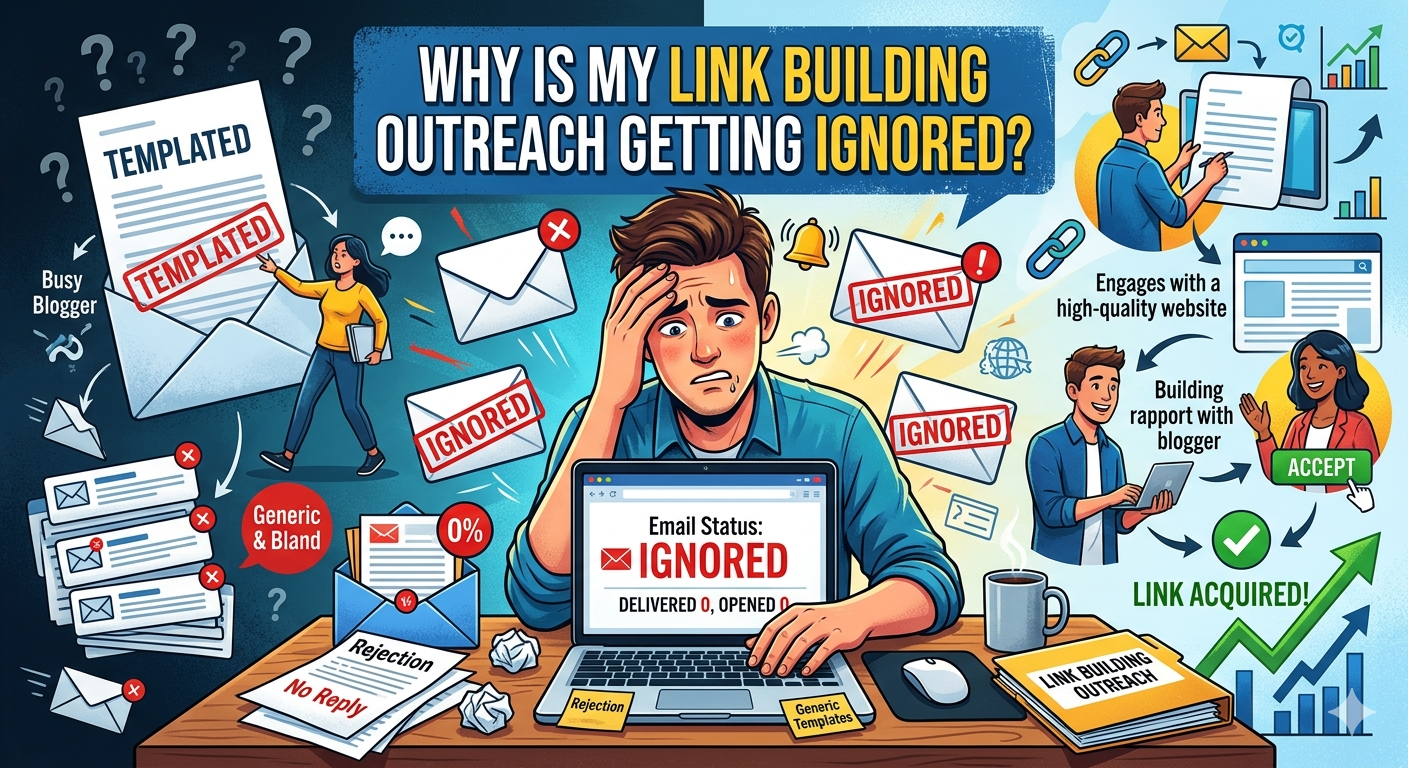
You spent hours researching prospects, crafting the perfect pitch, and hitting send, only to hear absolutely nothing back. If your link building outreach keeps getting ignored, you’re not unlucky. You’re making mistakes that are entirely fixable.
The cold reality? According to a study by Backlinko analyzing 12 million outreach emails, 91.5% of outreach messages never receive a response. Only 8.5% of link building cold emails result in a backlink. That means the bar isn’t just high, it’s brutal. The inbox your email lands in is already crowded with dozens of identical-sounding pitches from competitors who are making the same avoidable errors.
This guide breaks down every major reason your link building outreach is getting buried, ghosted, or flat-out deleted, and gives you the data-backed strategies to change that.
TL;DR
- 91.5% of outreach emails are ignored, standing out requires real strategy, not volume.
- Generic, templated emails are the #1 reason pitches get deleted instantly.
- Weak or misleading subject lines kill open rates before anyone reads your pitch.
- Targeting irrelevant websites wastes time and tanks your sender reputation.
- No follow-up = missed opportunities; follow-ups generate up to 40% more backlinks.
- Google’s 2024 algorithm updates have made low-quality outreach even less effective.
- The fix: personalization, relevance, clear value, and a disciplined follow-up sequence.
1. You’re Sending Templates That Scream “Mass Email”
The number one reason link building outreach gets ignored is painfully obvious templating. Publishers receive tens, sometimes hundreds, of outreach emails every single day. The moment a recipient senses a copy-paste job, that email is gone.
A McKinsey & Company study found that 71% of consumers expect personalized interactions, and 76% get frustrated when they don’t receive them. The same psychology applies to website editors and content managers. If your email starts with “Hi there, I love your blog!”, it’s dead on arrival.
What real personalization looks like:
| Weak Personalization | Strong Personalization |
| “Hi [Name], I love your site!” | “Hi Sarah, your post on behavioral email triggers improved our campaign open rates by 23%.” |
| “I think this would be a good fit.” | “I noticed a gap in your resource roundup on page X, here’s a piece that fills it perfectly.” |
| “We’d love to collaborate.” | “Your readers in the SaaS space would find value in this original dataset we published.” |
Research confirms that personalized subject lines get 30.5% more responses, and personalized email body content drives a 32.7% better response rate compared to generic outreach. That’s not marginal, that’s the difference between results and silence.
2. Your Subject Line Is Doing You No Favors
Your subject line is the gatekeeper. If it doesn’t compel an open, nothing else matters. Yet most link builders default to vague, salesy openers like “Quick Question” or “Collaboration Opportunity”, lines that actively signal spam before the email is even opened.
Data from Backlinko’s outreach analysis shows that subject lines between 36–50 characters perform best, and longer subject lines outperform short ones by 24.6% in average response rates. Why? Because specificity signals effort. A longer subject line tells the recipient exactly what the email is about and signals that this isn’t a mass blast.
Subject line comparisons:
| Avoid | Use Instead |
| “Quick Question” | “Saw a gap in your [Topic] guide, have a fix” |
| “Link Partnership Request” | “Your [Post Title] deserves this missing resource” |
| “I’d love to work together” | “3 stats that would strengthen your [Article Name]” |
One more thing: including a question mark in your subject line increases open rates by roughly 21% on average. Use it strategically, not as clickbait.
3. You’re Targeting the Wrong Websites
Sending your link building outreach to irrelevant sites is one of the fastest ways to destroy your sender reputation and waste your entire prospecting budget. A food blogger has zero interest in linking to your cybersecurity SaaS product. A fashion publication doesn’t want a pitch about industrial machinery.
According to a 2026 survey of 518 SEO professionals by Editorial.Link, 84.6% of SEO experts prioritize the relevancy of the linking domain above almost everything else. Topical alignment isn’t just preferred, it’s expected.
Beyond relevance, watch out for these red flags when prospecting:
- Sites with spammy outbound links (flagged as a dealbreaker by 89% of SEOs)
- Low-quality content pages (86.3% avoid these placements)
- Declining organic traffic (63.9% cite this as a major concern)
- Poor domain authority metrics (72.2% flag this as a risk)
Quality beats quantity every time. A focused list of 50 well-researched, topically relevant prospects will always outperform a spray-and-pray blast to 500 random sites.
4. Your Email Asks for Too Much, Too Soon
Outreach that opens with an immediate request for a backlink is essentially walking up to a stranger and asking to borrow their car. There’s no relationship, no trust, no reason for the other person to say yes.
The most effective link building outreach treats relationship-building as the primary goal and the link as a natural outcome. Strategies like “feeler emails”, outreach that opens a conversation without explicitly asking for a link, have been shown to increase conversion rates by over 40%, according to Backlinko.
Your email should answer one question before anything else: What’s in it for them?
Value you can offer in outreach:
- A genuinely useful piece of content that fills a gap in their existing articles
- Original data, research, or an infographic their audience would find valuable
- A broken link replacement (their readers benefit, too)
- An expert quote or exclusive insight they can use in upcoming content
If your pitch is purely transactional, “link to me and I’ll link back”, expect silence. That’s a gray-hat signal that experienced publishers spot immediately.
5. You’re Writing Emails That Are Way Too Long
Attention is a scarce resource. In a world where inboxes overflow, walls of text don’t get read, they get deleted. Research consistently shows the ideal outreach email length is 50–125 words. If a recipient has to scroll to understand what you’re asking, you’ve already lost them.
The average email response rate sits at roughly 7.5%, but keeping your message short and purposeful moves that number upward. Lead with why you’re reaching out, state your value clearly, and make the ask frictionless. That’s the entire formula.
Optimal outreach email structure:
- Opening line (1–2 sentences): Reference something specific about their content
- Context (1–2 sentences): Why you’re relevant to their audience
- Value proposition (1–2 sentences): What they gain from saying yes
- The ask (1 sentence): One clear, low-friction call to action
Avoid long bios, company histories, or unnecessary flattery. Every sentence should earn its place.
6. You’re Not Following Up (or Following Up Wrong)
Most outreach fails not because of a bad pitch, but because of a missing follow-up. Publishers are busy. Your first email may land in a cluttered inbox at the wrong moment. A single, well-timed follow-up can be the difference between a dead campaign and a live link.
Data from Authority Hacker shows that including follow-up emails in link building outreach campaigns leads to a 40% increase in backlink acquisition. Backlinko’s research reinforces this: emailing the same contact multiple times leads to 2x more responses than a single message.
Follow-up sequence best practices:
| Follow-Up | Timing | Goal |
| Follow-up #1 | 3–4 days after initial email | Polite reminder, add new context |
| Follow-up #2 | 4–5 days later | Refined angle, surface new value |
| Follow-up #3 | 5–7 days later | Soft nudge, keep it brief |
| Follow-up #4 | Close-out email | Give them graceful permission to pass |
Stop after four attempts. More than that risks damaging your sender reputation and burning a relationship you may want to revisit later.
7. Your Content Isn’t Worth Linking To
This is the uncomfortable truth that no outreach template can fix: if your content doesn’t deserve a link, no amount of clever copywriting will get you one. Publishers are selective, and they should be. Their site reputation depends on what they link to.
Research makes the content connection clear. Long-form content (3,000+ words) generates 3.5x more backlinks than shorter articles. Posts with videos attract 55% more links than text-only pages. “Why” and “What” style content generates 25.8% more backlinks than how-to posts. Data-driven content with original research consistently earns the most organic links.
If you’re pitching mediocre content to high-authority sites, you’re wasting everyone’s time. Before you send another outreach email, run your asset through this checkpoint:
- Does it offer something no other page on this topic does?
- Is it backed by original data, first-hand experience, or expert-level depth?
- Would a busy editor feel good about linking to this in front of their audience?
If the answer to any of those is “maybe”, improve the content before you improve the outreach.
8. Google’s Algorithm Changes Are Raising the Stakes
The link building landscape shifted dramatically with Google’s 2024 updates. Scaled outreach and low-quality backlinks were actively devalued. Google’s AI-powered SpamBrain continues to get better at identifying manipulative link patterns, including mass guest post schemes and low-value link exchanges.
According to BuzzStream’s 2026 analysis, Google’s Helpful Content and Link Spam Updates specifically targeted affiliate sites, guest post farms, and “best-of” list pages that lacked genuine editorial value. The message to link builders is unambiguous: precision and authenticity now matter more than volume.
This shift has real consequences for outreach strategy. If you’re looking for reliable, vetted guest posting services that align with these standards, resources like the best guest posting services guide offer a curated overview of compliant options. Similarly, for those operating in competitive markets, reviewing the best link building services in the UK can help identify agencies that build links within current Google guidelines.
9. Your Technical Setup Is Undermining Deliverability
Even a perfectly crafted outreach email fails if it never reaches the inbox. Many link builders underestimate how much technical infrastructure affects deliverability, and response rates by extension.
Key deliverability issues that sabotage link building outreach:
- Sending from your primary business domain without warming it up first
- Missing SPF, DKIM, and DMARC records, which flag emails as suspicious
- High bounce rates from unverified contact lists that damage sender reputation
- Using spam-trigger words in subject lines (“Free,” “Act Now,” “Limited Time”)
Best practice: Use a dedicated subdomain for cold outreach (e.g., outreach.yourdomain.com), authenticate it properly, warm it up gradually, and always verify email addresses before sending. These steps alone can significantly improve open rates before you change a single word of your pitch.
10. You’re Not Tracking What’s Working
If you’re not measuring your outreach, you’re flying blind. Without data, you can’t diagnose why campaigns fail or replicate what works. Target benchmarks for a healthy link building outreach campaign:
| Metric | Benchmark Target |
| Open Rate | 40–60% |
| Response Rate | 15–30% |
| Acceptance Rate | 30–50% of responses |
| Average Time to Backlink | ~8 days post-response |
| Time to See Ranking Impact | ~3.1 months |
Track these consistently. If open rates are low, fix subject lines. If response rates are low, fix personalization and value. If acceptance rates are low, fix your content quality. Every metric tells you exactly where the funnel is leaking.
The Bottom Line
Your link building outreach is getting ignored because you’re competing in one of the most saturated, algorithm-scrutinized spaces in digital marketing, and the bar keeps rising. Generic templates, weak subject lines, irrelevant targeting, zero follow-up, and mediocre content are all self-inflicted wounds.
The fix isn’t a magic template. It’s a disciplined system: research your prospects deeply, write like a human who’s actually read their content, offer something genuinely valuable, follow up strategically, and build relationships that outlast any single link.
Link building outreach isn’t broken, lazy link building outreach is. Fix the process, and the backlinks follow.