

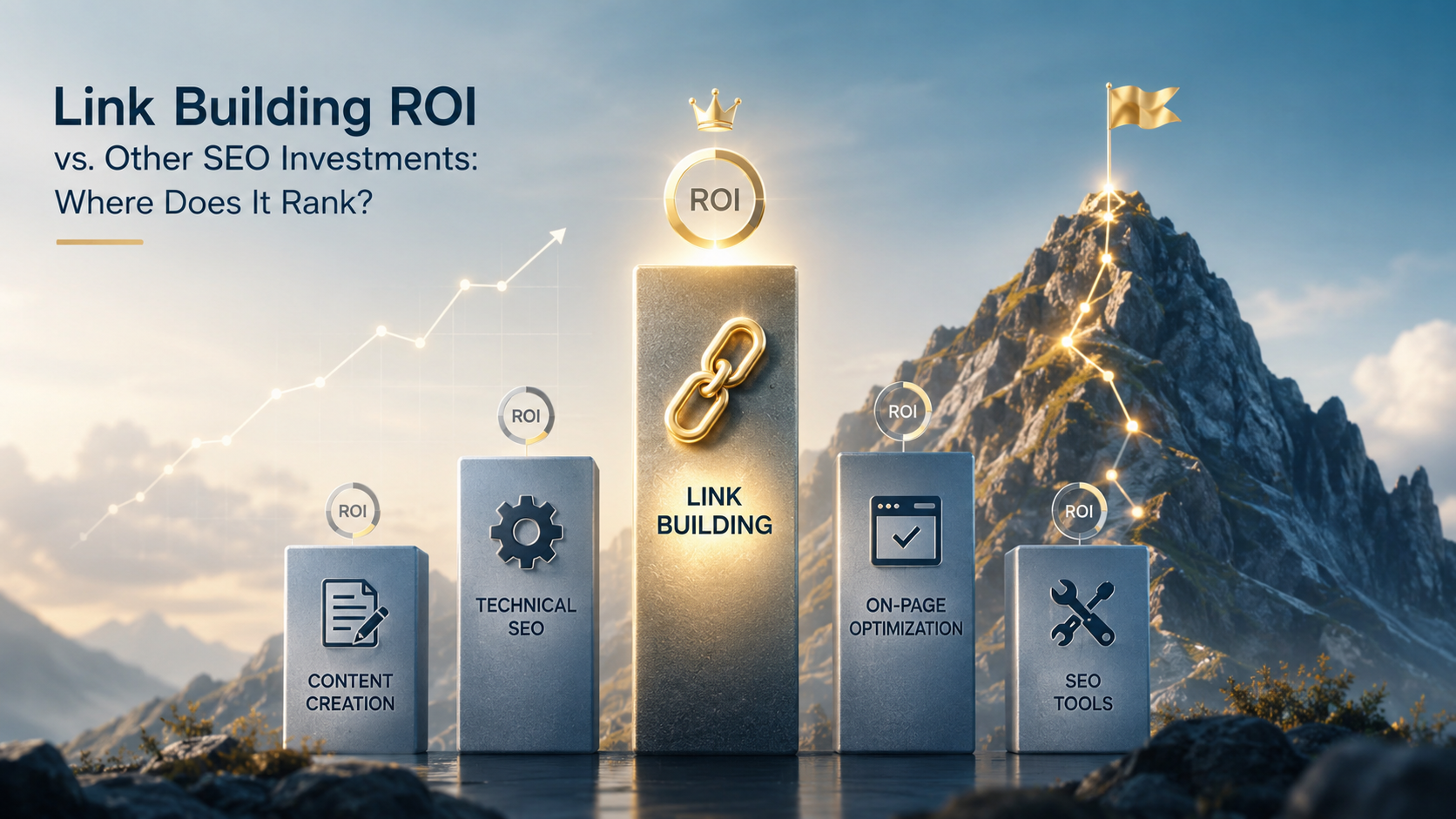
Every digital marketer has been there: staring at a budget spreadsheet, wondering whether to pour another few thousand dollars into link building – or double down on content, fix the site’s technical issues, or just spin up some Google Ads. It’s a real dilemma, and frankly, a lot of the advice you’ll find online is either too vague or suspiciously self-serving.
So let’s cut through the noise.
This article breaks down Link Building ROI against other major SEO and digital marketing investments, backed by real data from 2024–2026 studies, industry surveys, and campaign benchmarks. Whether you’re an in-house marketing manager, a founder bootstrapping growth, or an agency trying to make the case to a client – this comparison will give you something concrete to work with.
1. The ROI Problem Nobody Talks About Honestly
Before we compare strategies, we need to talk about how ROI is measured – because this is where most comparisons go sideways.
SEO ROI is slippery. Unlike paid ads where you can trace every click to a campaign, organic search results accumulate over time. A backlink acquired today might not move rankings for 60–90 days. A piece of content you published six months ago might start driving serious revenue this quarter. Attribution gets messy fast.
That said, the data tells a pretty clear story:
• The median ROI from SEO campaigns in 2026 sits at 748%, meaning businesses generate $7.48 for every $1 invested.
• High-value sectors like medical devices report ROIs north of 1,100%, while e-commerce typically lands around 300–500%.
• SEO drives 53% of all trackable website traffic (BrightEdge, 2026) – more than paid search, social, and email combined.
Now here’s where it gets interesting: those numbers represent SEO broadly. When you isolate link building as a discipline within SEO, the story becomes even more specific – and more divisive.
| TL;DR SEO delivers $7.48 for every $1 spent on average in 2026. But how much of that is driven by link building? More than most people admit. |
2. What Is Link Building ROI – and Why Is It So Hard to Pin Down?
Link Building ROI refers to the measurable return generated from acquiring backlinks relative to the cost and effort invested. That sounds simple enough, but in practice, it requires tracking:
• Changes in organic keyword rankings for target pages
• Increases in organic traffic attributed to those pages
• Leads or revenue generated from that traffic
• The time lag between acquiring a link and seeing ranking movement
There’s no universal formula, but a working model looks like this:
Link Building ROI = (Value of Organic Traffic Gained – Total Link Acquisition Cost) ÷ Total Link Acquisition Cost × 100
In 2026, industry benchmarks suggest that quality backlinks (from sites with a Domain Rating of 30 or higher, with real traffic, and topical relevance) typically cost $100–$300 each. A healthy return is considered 5–10x the link cost in organic revenue or retained value over 12 months.
Here’s the catch: 94% of online content never earns a single external backlink. That means most content investments live or die based on whether link building is part of the strategy.
| TL;DR Link Building ROI isn’t just about backlinks – it’s about how those links compound your entire SEO investment. Without them, most content never ranks. |
3. Comparing SEO Investment Types: The Numbers Side by Side
Let’s put the major SEO investment categories in a side-by-side comparison. These figures reflect 2026 industry averages from sources including FirstPageSage, AllOutSEO, Semrush, and Ahrefs.
Table 1: SEO Investment ROI Comparison (2026)
| SEO Investment Type | Avg. Monthly Cost | Time to ROI | ROI Range | Long-Term Value |
| Link Building | $1,000 – $10,000 | 6 – 12 months | 500% – 1,200% | Very High |
| Content Marketing | $2,000 – $15,000 | 3 – 9 months | 300% – 700% | High |
| Technical SEO | $500 – $5,000 | 1 – 4 months | 200% – 500% | Medium |
| Local SEO | $300 – $2,000 | 2 – 5 months | 400% – 900% | High (local) |
| On-Page SEO | $500 – $3,000 | 2 – 6 months | 250% – 600% | Medium-High |
| PPC (Paid Search) | $1,500 – $20,000 | Immediate | 100% – 200% | Low (stops w/ spend) |
| Social Media Marketing | $1,000 – $8,000 | 3 – 6 months | 50% – 150% | Low-Medium |
A few things stand out from this table:
• Link building consistently delivers one of the highest ROI ranges (500%–1,200%) among all SEO strategies.
• Technical SEO breaks even faster but has a lower ceiling – it’s foundational, not a growth engine on its own.
• PPC delivers immediate traffic but offers the lowest long-term ROI and stops the moment the budget does.
• Social media marketing consistently underperforms for direct revenue ROI compared to search-based channels.
The data confirms what seasoned SEOs have known for years: campaigns that combine link acquisition with content see 73% stronger ROI than those relying on content alone. Link building isn’t just one piece of the SEO puzzle – it’s the piece that makes everything else work harder.
| TL;DR Link building delivers one of the highest ROI ceilings in SEO at 500%–1,200%, especially when paired with quality content. PPC may be faster, but it costs more and stops working the moment you pause spending. |
4. Not All Links Are Created Equal: Quality vs. ROI
Here’s where a lot of businesses get burned. They budget $5,000 for link building, get 50 low-quality links from irrelevant directories or private blog networks (PBNs), see no movement, and declare that “link building doesn’t work.”
The truth? Link quality is the single biggest variable in Link Building ROI.
According to a 2026 survey of 518 SEO professionals by Editorial.Link, 73.2% believe backlinks directly influence whether content appears in AI search results – a newer but rapidly growing consideration as platforms like Google’s AI Overviews, Perplexity, and ChatGPT search pull from authority signals.
Digital PR is now rated the most effective link-building tactic of 2026 by 48.6% of surveyed SEOs – far ahead of guest posting (16%) and linkable asset creation (12%).
Table 2: Link Quality vs. ROI Impact
| Link Type | Domain Rating (DR) | Typical Cost per Link | ROI Multiplier |
| Editorial / Earned | 60 – 90+ | $0 (earned) – $500 | 8x – 15x |
| Digital PR Placement | 50 – 85 | $200 – $800 | 6x – 12x |
| Guest Post (niche) | 30 – 60 | $100 – $300 | 4x – 8x |
| Niche Directory | 20 – 50 | $50 – $150 | 2x – 5x |
| Paid / Sponsored | Any | $150 – $600+ | 1x – 3x |
| Low-Quality / PBN | < 20 | $10 – $50 | Negative (risk) |
The takeaway: editorial links and well-executed digital PR campaigns offer the best ROI per link, while cheap, low-quality links can actively damage your site’s standing with Google. In an era where Google’s spam policies are tightening and AI systems weigh authority signals heavily, cutting corners on link quality is a tax you’ll pay later.
| TL;DR High-authority editorial links (DR 60+) can deliver 8–15x ROI per link. Low-quality links from PBNs or irrelevant sites risk penalties – the “cheap” option often ends up costing more. |
5. What Does the Budget Breakdown Look Like?
One question that always comes up: how much should you actually spend on link building versus other SEO activities?
According to recent agency data, firms typically allocate 28%–36% of their total SEO budget to link building. A 2024 survey by FatJoe found that most SEO professionals were spending more than £600/month on link building alone, with 14% spending over £1,500/month – and more than 63% of U.S.-based SEOs planned to increase that spending in 2026.
For context: 41% of businesses spend over $5,000 per month on link building (AuthorityHacker). That might sound steep, but when you compare it to PPC spend for equivalent traffic in competitive niches, it starts to look quite reasonable – especially when you factor in compounding returns over 12–24 months.
A useful benchmark:
• New sites or pages: Invest more heavily in link building upfront (60–70% of SEO budget) to establish authority quickly.
• Established sites: Shift toward content + link maintenance (40–50% to links) once foundational authority is built.
• Competitive niches (legal, medical, finance): Budget for higher-authority links – expect to spend $300–$600 per link for DR 60+ placements.
| TL;DR Allocate 28%–36% of your SEO budget to link building as a baseline. In competitive niches, going higher is often what separates ranking on page one from being stuck on page two. |
6. Link Building Services: How Do You Choose the Right One?
The market for link building services ranges from fly-by-night operations selling bulk links for a few cents each to premium managed outreach campaigns that cost thousands per month. The good news is that there are reputable options at various price points.
When evaluating any service, ask these questions:
• Do they vet the domains they place links on for real traffic, relevance, and editorial standards?
• Are they transparent about the sites in their network?
• Do they offer niche-relevant placements – or just generic content farms?
• Can they show you case studies or ranking data from previous campaigns?
One platform gaining traction among agencies and brands is Outreachz.com – a link building service that emphasizes vetted, niche-relevant placements with transparent pricing. For teams that want a scalable solution without the overhead of managing an in-house outreach team, it’s worth evaluating.
Table 3: Link Building Service Comparison
| Service / Platform | Pricing | Link Quality | Niche Relevance | Best For |
| Outreachz.com | Flexible / Per Link | High (vetted) | Strong | Agencies & Brands |
| Fatjoe | Per Link | Medium-High | Good | SMBs & Agencies |
| The HARO Network | Free – $149/mo | Very High | Variable | PR & Authority Links |
| Authority Builders | $150 – $500+/link | High | Very Strong | Niche Sites |
| Loganix | $200 – $600/link | High | Good | Mid-Market Brands |
| In-House Outreach | Varies (FTE cost) | Variable | Best Control | Enterprise SEO |
Ultimately, the best link building service is the one that aligns with your niche, budget, and quality standards. The most expensive option isn’t always the best – but the cheapest rarely is either.
| TL;DR Evaluate link building services on link quality, niche relevance, and transparency – not just price. Platforms like Outreachz.com offer a middle ground between DIY outreach and enterprise-level agencies. |
7. Link Building ROI by Industry: Where Returns Are Highest
ROI from link building isn’t uniform across industries. A personal injury law firm and a budget travel blog both need backlinks – but the revenue per visitor (and therefore the value of each ranking position) is vastly different.
Here’s how Link Building ROI stacks up across major verticals:
Table 4: Link Building ROI by Industry (2026)
| Industry | Avg. SEO ROI | Link Building Contribution | Break-Even | Traffic Multiplier |
| Medical / Healthcare | 1,183% | ~40% | 8 – 12 months | 3x – 6x |
| Legal Services | 900%+ | ~45% | 10 – 14 months | 4x – 8x |
| SaaS / Software | 700% – 950% | ~35% | 6 – 10 months | 5x – 10x |
| Higher Education | 994% | ~30% | 12 – 18 months | 2x – 5x |
| E-Commerce | 317% – 500% | ~25% | 5 – 8 months | 2x – 4x |
| Local Services (HVAC, etc.) | 400% – 700% | ~20% | 3 – 5 months | 2x – 3x |
| Finance / Insurance | 800% – 1,100% | ~40% | 8 – 12 months | 3x – 6x |
High-stakes industries like legal, medical, and finance benefit most from link building because every marginal ranking improvement translates to significant revenue. A single #1 ranking for “personal injury lawyer [city]” can be worth tens of thousands of dollars per month in signed cases.
Even in lower-margin sectors like e-commerce, link building remains essential for competing against marketplace giants like Amazon. Organic traffic from link-driven rankings typically converts at 2–3% – comparable to or better than paid traffic – without the ongoing ad spend.
| TL;DR The highest link building ROI comes from high-intent, high-value industries: legal, healthcare, SaaS, and finance. But even e-commerce and local services see strong compounding returns over 6–12 months. |
8. Link Building vs. PPC: The Long-Game Math
Let’s run a quick thought experiment that a lot of marketers skip.
Imagine you have $60,000 to spend over 12 months on driving organic traffic to your most valuable service page.
Option A – PPC: You spend $5,000/month on Google Ads. You get immediate clicks, solid conversion tracking, and predictable traffic – until the budget ends. Month 13: traffic drops to zero. Total ROI on that $60,000 depends entirely on your conversion rate, but you have nothing left when the campaign ends.
Option B – Link Building + Content: You invest $3,500/month in quality link acquisition and $1,500/month in content. By month 6, you’re seeing ranking movement. By month 9, you’re hitting page one for target keywords. By month 12, your content is generating traffic on autopilot. Month 13: traffic keeps growing.
This is the compounding advantage of Link Building ROI that paid channels simply cannot replicate. A top-ranking page driven by strong backlinks can generate thousands of monthly visitors for years – long after the link-building investment tapers off.
That said, PPC has real advantages: immediate visibility, no wait time, perfect attribution. The smartest strategy combines both – PPC for immediate revenue generation and testing, SEO with link building for sustainable, compounding growth.
| TL;DR Link building beats PPC in long-term ROI because the traffic compounds – it doesn’t stop when the budget does. Pair both for the strongest 12-month and 24-month returns. |
9. The AI Search Factor: Why Link Building ROI Is Getting More Important, Not Less
There’s been genuine concern in the SEO community about whether Google’s AI Overviews – along with platforms like Perplexity and ChatGPT – would cannibalize organic traffic and render link building less valuable.
The data suggests the opposite may be true.
73.2% of SEO professionals believe backlinks directly influence whether content appears in AI-generated search results (Editorial.Link, 2026). AI systems trained to evaluate authority signals largely mirror Google’s own ranking logic – and backlinks remain a core trust signal.
Furthermore, 58% of brands are actually increasing link building investment specifically because AI Overviews are reducing click-through rates on informational queries – pushing more budget toward high-authority placements that capture AI citations and featured snippet territory.
For GEO (Generative Engine Optimization), the playbook mirrors traditional SEO authority building: earn links from credible, niche-relevant publications, and your content is more likely to be cited, summarized, or referenced by AI systems answering user queries.
This isn’t a pivot – it’s an amplification of what link building has always done.
| TL;DR AI search is making Link Building ROI more valuable, not less. High-authority backlinks now influence whether your content appears in AI Overviews and AI-generated answers – not just traditional SERPs. |
10. How to Maximize Link Building ROI: Actionable Framework
Knowing that link building delivers strong ROI is one thing. Getting that ROI consistently requires a disciplined approach. Here’s a practical framework:
Step 1: Define Your High-Value Pages
Not every page on your site deserves link building investment. Focus on pages where a ranking improvement directly drives revenue: service pages, product category pages, and high-intent landing pages.
Step 2: Establish a Baseline
Before launching a campaign, document current keyword rankings, organic traffic, and conversion rates for target pages. This is your ROI baseline.
Step 3: Set a Realistic Link Velocity
Aim for 5–15 quality links per month for competitive pages. More is not always better – a sudden spike in low-quality links triggers spam filters. Consistent, natural-looking acquisition wins long-term.
Step 4: Diversify Your Tactics
Combine digital PR (highest ROI per link), niche-relevant guest posting, and strategic resource link placements. Avoid over-reliance on any single tactic or single source.
Step 5: Track What Matters
Monitor domain rating growth, keyword position changes for target URLs, organic traffic trends, and downstream conversion data. Calculate your actual Link Building ROI quarterly, not just annually.
Step 6: Outsource Strategically
In-house outreach is time-intensive and requires relationship-building that takes years to cultivate. Services like Outreachz.com allow teams to scale link acquisition efficiently without sacrificing quality control – a practical solution for growing businesses that need results without the overhead of a full-time outreach team.
| TL;DR Maximize Link Building ROI by focusing on high-value pages, maintaining link velocity, diversifying tactics, and tracking quarterly performance. Use managed services to scale without sacrificing quality. |
11. The Honest Verdict: Where Does Link Building Rank?
So – where does link building actually rank among SEO investments?
Based on the data reviewed across this article:
• For long-term compounding ROI: Link building ranks #1, above content marketing, technical SEO, and local SEO.
• For speed of results: Technical SEO and local SEO produce faster early returns, but have lower ceilings.
• For brand authority and AI visibility: Link building + digital PR is the leading strategy.
• For immediate traffic: PPC wins on speed, loses badly on sustainability and long-term cost efficiency.
The honest truth is that no single SEO strategy exists in a vacuum. Link building amplifies every other investment you make in SEO. Content that earns links ranks. Technical optimizations that are recognized by high-authority referring domains perform better. Local citations that sit within an authoritative backlink profile dominate maps and local SERPs.
Link Building ROI is not just about the links themselves – it’s about what those links unlock across your entire organic presence. That’s why, despite the evolving landscape, 67% of agencies still report link building ROI as one of their top three SEO investments, and that number isn’t declining.
Final Thoughts
Skepticism about link building is healthy – there’s a lot of bad advice and even worse services out there. But the data for 2026 makes a compelling case that high-quality link building, executed strategically, delivers some of the strongest and most durable returns in digital marketing.
If you’re evaluating where to put your SEO dollars, the math is fairly clear: link building should be a core line item, not an afterthought. The compounding nature of backlink authority means every quality link you earn today keeps paying dividends for years.
The best ROI isn’t always the fastest, but in the case of link building, it consistently proves to be the most lasting.