

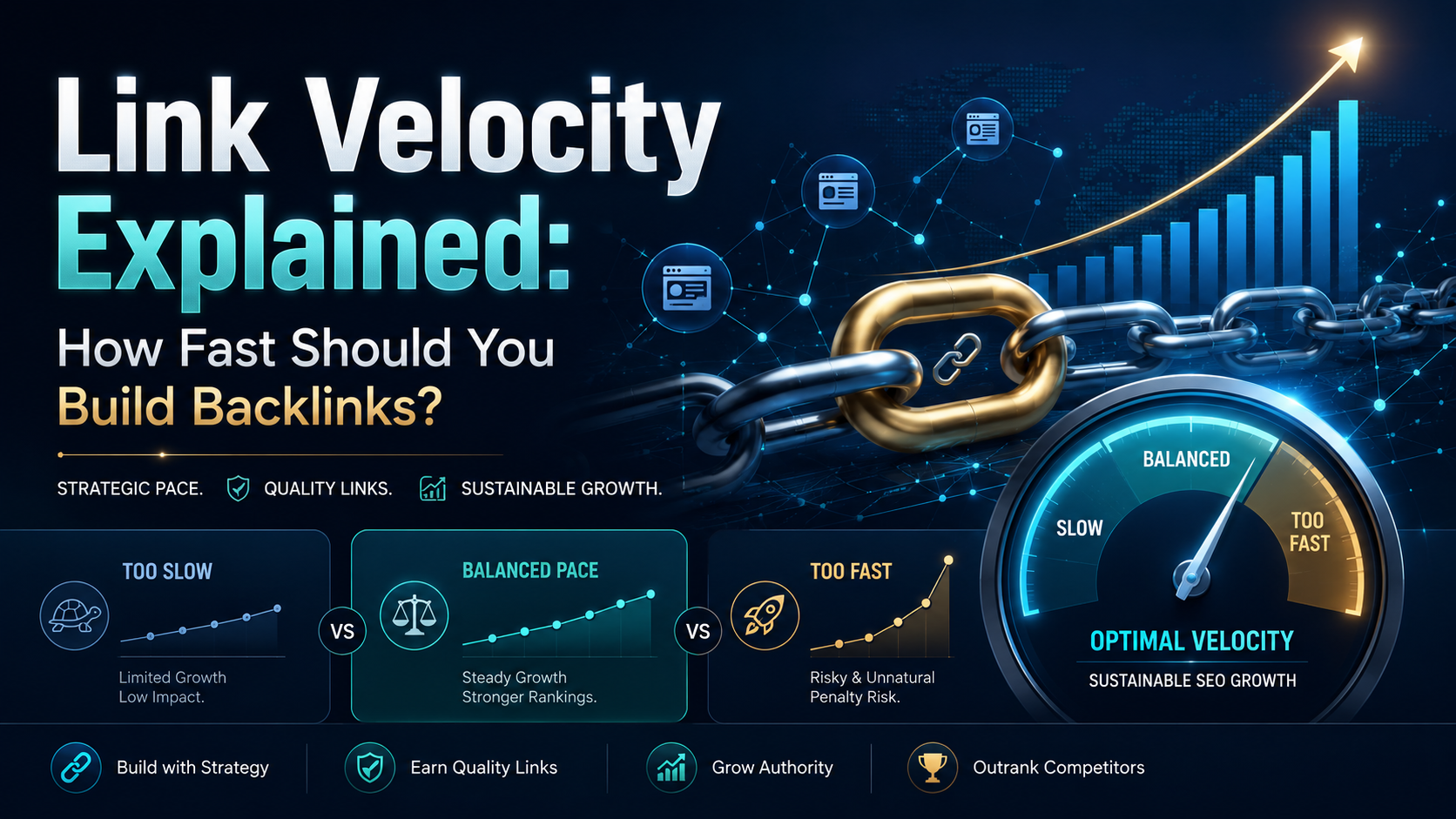
You spend weeks crafting the perfect piece of content. You launch it, promote it, and then-because you want results yesterday-you fire up a bulk backlink campaign and watch hundreds of links roll in over the next 72 hours. Sounds efficient, right? Wrong. What you just did may have quietly pushed your site into Google’s danger zone.
This is the part of SEO that not enough people talk about openly: it is not just about how many backlinks you have-it is about how fast they show up. That rate of growth is what SEO professionals call link velocity, and understanding it could be the difference between climbing the rankings and getting buried by an algorithm penalty you never saw coming.
Whether you are a brand-new site owner, a seasoned content marketer, or someone evaluating professional link building services, this guide will give you the honest, research-backed answers you need.
What Is Link Velocity? (And Why It Matters More Than You Think)
Link velocity refers to the rate at which a website acquires new backlinks over a given period of time-typically measured in links per day, week, or month. More specifically, SEOs track the net gain in referring domains (unique sites linking to you), since one site adding dozens of links holds far less value than dozens of different sites each linking once.
Think of it like a credit score. If you suddenly open 20 new credit cards in one month, lenders get suspicious-even if you’ve never missed a payment. Google operates with a similar mindset. A sudden flood of backlinks, especially from low-quality or unrelated sources, raises an algorithmic red flag that says: something unnatural is happening here.
Key Definition
Link velocity = the speed at which your website earns backlinks over time. It signals trust (or manipulation) to search engines-and context is everything.
The critical distinction that most beginners miss: link velocity is not inherently good or bad. A startup featured in TechCrunch can legitimately gain 500 backlinks overnight. A local plumbing company that gains 500 links in 48 hours with no PR activity, no new content, and no real-world reason? That is manipulation.
Google’s own systems-particularly its SpamBrain AI and legacy Penguin-era algorithms-are built to detect exactly this kind of inconsistency. According to a Google patent related to link scoring, a spike in backlink growth may cause Google to “lower the score of a document to reduce the effect of spamming.”
In 2019, Google’s Search Advocate John Mueller clarified the nuance: “It’s not so much a matter of how many links you get in which time period. It’s really just… if these are links that are unnatural or from our point of view problematic, then they would be problematic.” That statement is still the most accurate benchmark we have.
Why Your Link Velocity Strategy Is a Trust Signal
Search engines are sophisticated pattern-recognition systems. They do not just look at whether you have backlinks-they analyze how your profile evolves over time and whether that evolution looks like it belongs to a real, growing brand.
A well-executed link velocity strategy mirrors the natural arc of a business earning attention online. Your company publishes a research report, gets covered by journalists, earns mentions in industry publications-and links follow. That story is coherent, contextual, and credible. Compare that to a site that was getting two links a month and suddenly jumps to 200 links a week with no supporting business activity. That pattern breaks the story.
What Healthy Link Velocity Actually Looks Like
Healthy link velocity has a few defining characteristics that go beyond the raw numbers:
• Gradual upward trend rather than sudden cliff-edge spikes
• Links arriving from a variety of unique root domains
• Anchor text that is diverse-branded, generic, partial-match, and naked URLs
• Source domains that are topically relevant to your niche
• Growth that correlates with content publication, PR campaigns, or real-world milestones
• A healthy mix of dofollow and nofollow links
A 2024 study found that a steady link velocity-consistent growth rather than uneven spikes-improves ranking stability by approximately 34% compared to erratic backlink patterns. That is not a marginal improvement; that is a foundational difference in how your site gets treated by search engines over time.
TL;DR
Link velocity is your backlink growth speed. Consistent, explainable growth builds trust. Sudden, unexplained surges trigger algorithmic scrutiny-regardless of link quality.
Healthy vs. Unhealthy Link Velocity: A Side-by-Side Comparison
| Factor | ✅ Healthy Velocity | Unhealthy Velocity |
| Growth Pattern | Gradual, consistent upward trend | Sudden spike with no context |
| Source Diversity | Many unique referring domains | Dozens of links from 1–2 domains |
| Anchor Text | Varied: branded, generic, partial-match | Repetitive exact-match keyword anchors |
| Niche Relevance | Links come from topically related sites | Links from unrelated or generic sites |
| Link Types | Mix of dofollow, nofollow, editorial | Bulk dofollow from directories or PBNs |
| Context/Trigger | PR coverage, content launch, awards | No supporting business activity |
| Algorithm Risk | Low – builds long-term authority | High – may trigger manual review or penalty |
How Fast Should You Actually Build Backlinks?
This is the question everyone wants answered with a specific number, and the honest answer is: there is no universally safe speed. What matters is how natural your growth looks relative to your site’s history, your industry benchmarks, and your competitors’ profiles.
That said, practitioners and agencies have developed practical guidelines based on real-world campaign data. These ranges are not hard rules-they are starting points that need calibration based on your specific situation.
| Site Profile | Safe Monthly Range | Growth Approach | Watch Out For |
| New Website (0–6 months) | 5–15 referring domains | Slow, directional, foundational | Any rapid spike-looks immediately suspicious |
| Growing SMB (6–24 months) | 15–50 referring domains | Steady ramp tied to content calendar | Overusing one anchor text type |
| Established Brand (2+ years) | 50–150 referring domains | Campaign-driven with PR bursts | Dropping off after launch spike |
| Enterprise / High-Authority | 150–500+ referring domains | Multi-channel, department-coordinated | Velocity without diversity |
A rule of thumb used by professional link builders: if you are currently acquiring two referring domains per month organically, do not artificially jump to 50. A safer ramp starts at 5–8, then scales gradually. If your organic inbound link rate is already at 80 per month (think major publications), you can build at a significantly faster pace without raising red flags.
Pro Insight
Sites with 200 referring domains should not suddenly acquire 100 more in a week-but gaining 15 to 20 new domains per month is considered natural growth for that authority level. (Source: ALM Corp, 2026 Link Building Guide)
The Real Risks of Building Links Too Fast
Let’s be direct about what actually happens when you ignore link velocity. These are not theoretical risks-they are documented outcomes that SEO professionals see regularly.
1. Algorithmic Suppression
Google’s SpamBrain and Penguin-era models both analyze not just the volume of links, but the consistency and pattern of acquisition. A sudden surge followed by a sharp drop-classic footprint of a bulk link purchase or PBN blast-is one of the clearest signals these systems are trained to detect. The result is not always a dramatic penalty; often, it is quiet link devaluation where your new backlinks simply fail to move the needle.
2. Manual Penalties
When unnatural link patterns are severe enough, they can trigger manual reviews by Google’s quality team. A manual penalty can devastate rankings-sometimes pushing a site off the first five pages of results. Recovery requires link audits, disavow files, reconsideration requests, and months of cleanup. Some sites never fully recover.
One documented example involved an enterprise SaaS platform that outsourced link building to a vendor who delivered 2,000 backlinks in three weeks from irrelevant, low-authority domains. The company saw a 70% ranking drop. It took eight months and a full domain migration strategy to recover.
3. Negative SEO Vulnerability
If your site suddenly spikes in low-quality links, it can be difficult to prove to Google that those links were the result of a third-party attack rather than your own tactics. This is especially problematic if you have recently run any kind of bulk link campaign-the timing creates ambiguity that works against you.
4. Lost Link Equity
Even if you avoid a penalty, spammy links are often simply discounted rather than credited. That means you spent money on links that do nothing. According to industry research, editorially earned backlinks drive 53% more organic traffic than sponsored or manufactured placements-a stat that reinforces why quality always beats volume.
TL;DR
Building links too fast-especially from low-quality sources-risks algorithmic suppression, manual penalties, and wasted spend. Slow and steady is not just safe; it’s the higher-ROI approach.
Link Velocity by Website Type: Real-World Benchmarks
One of the most underappreciated aspects of managing link velocity is how dramatically it varies by industry and site type. Comparing yourself to the wrong benchmark is how you either under-invest or over-trigger suspicion.
| Industry / Site Type | Avg Monthly RD Growth | Typical Spike Triggers | Risk Level | Primary Strategy |
| SaaS / Tech Startup | 20–80 RDs | Product launches, funding rounds | Medium | Digital PR + guest posts |
| Local Business (SMB) | 3–15 RDs | Community events, awards | Low–Medium | Directories + citations |
| E-commerce | 15–60 RDs | Product drops, seasonal sales | Medium | Niche edits + PR |
| Finance / Legal Blog | 10–40 RDs | Regulatory news, data releases | High (YMYL scrutiny) | Authority editorial links |
| News / Media Site | 100–500+ RDs | Breaking news, viral content | Low (velocity expected) | Digital PR + syndication |
| B2B Enterprise | 30–120 RDs | Reports, whitepapers, events | Low–Medium | Thought leadership + research |
Note: RD = Referring Domains. These ranges represent median growth patterns observed across professional link building campaigns. Sites in YMYL (Your Money or Your Life) niches-finance, health, legal-face heightened scrutiny and should skew toward slower, higher-authority acquisition.
Anchor Text Diversity: The Often-Overlooked Velocity Variable
A sophisticated link velocity strategy is not just about how many links you build-it is about how natural your entire link profile looks. Anchor text diversity is a critical variable that trips up even experienced SEOs.
When your backlinks all use the same exact keyword phrase-say, “best link building services”-it looks scripted. Real people linking naturally use your brand name, your URL, generic phrases like “this article” or “learn more here,” and a range of partial-match and contextual variations.
| Anchor Type | Example | Recommended Share | Risk if Overused |
| Branded | “Outreachz” or “Outreachz.com” | 30–40% | Minimal |
| Naked URL | “outreachz.com” | 10–20% | Minimal |
| Generic | “click here,” “this resource” | 15–25% | Minimal |
| Partial Match | “link building tips” | 10–20% | Low if varied |
| Exact Match Keyword | “best link building services 2026” | 5–10% maximum | High – triggers over-optimization signals |
| Long-Tail / Contextual | “how to build backlinks safely” | 10–15% | Low if organic-looking |
Research indicates that sites with over 40% exact-match anchor text are three times more likely to trigger a manual review by Google’s quality team. The safe ceiling for any single keyword anchor is generally cited at 15% of your total anchor profile. If you are working with a link building service, confirm that they actively manage anchor diversity-it is a signal of quality that separates white-hat providers from shortcut merchants.
How to Monitor and Manage Your Link Velocity Strategy
Understanding velocity theoretically is one thing. Managing it in practice requires the right tools, the right processes, and the right mindset. Here is what a professional link velocity management workflow looks like.
Step 1: Establish Your Baseline
Before you can manage velocity, you need to know your current rate. Use a tool like Ahrefs, SEMrush, or Moz to pull your historical referring domain acquisition data. Calculate your weekly and monthly average over the past six months. This is your baseline. Any intentional link building campaign should start from this number.
Step 2: Set Competitor Benchmarks
Do not compare yourself to the entire internet-compare yourself to the top three to five ranking competitors in your specific niche. Pull their referring domain growth rates using the same tools. Your goal is to close the gap methodically, not to leapfrog overnight.
A useful target: close 25–30% of the referring domain gap between you and your top competitor per quarter, while aligning acquisition pace with your content publishing schedule and any major business milestones.
Step 3: Build in a Structured Cadence
Rather than commissioning 40 links in one batch, structure your outreach in waves spread across four to six weeks. This creates a believable, organic-looking acquisition pattern. Plan link building campaigns to correspond with content launches, digital PR pushes, or product announcements-activities that provide a credible explanation for increased link activity.
Step 4: Monitor and Respond to Spikes
Set up automated alerts in your backlink monitoring tool (Ahrefs, Google Search Console, or similar) to flag when any URL gains more than 20% of its total links in a seven-day window. Run a manual quality audit when this happens. Catch unnatural cluster patterns early-within 48 hours-before the next major crawl cycle.
Step 5: Manage Lost Links Too
Link velocity is a net metric. If you gain 30 links but lose 25, your effective velocity is only 5. Regularly audit for lost links (sites that dropped or changed your link) and either reclaim them through outreach or replace them through new campaigns. Erratic gain-and-loss patterns can be just as suspicious as sudden spikes.
TL;DR
Manage link velocity by establishing a baseline, benchmarking competitors, building in structured waves, monitoring for spikes, and tracking both gains and losses. Treat your backlink profile like a financial portfolio-diversified, predictable, and consistently growing.
When Fast Link Growth Is Completely Fine
Let us be clear about something: fast link growth is not automatically dangerous. Context is what matters. When supported by credible real-world activity, even dramatic velocity surges can be legitimate and algorithm-friendly.
✅ Legitimate Spike Scenarios
These situations can justify rapid link acquisition without triggering algorithmic suspicion:
• Publishing original research, proprietary data, or industry reports
• Landing media coverage in major publications (Forbes, TechCrunch, Wired)
• Product launches or major feature announcements covered by press
• Winning industry awards that trigger announcement roundups
• Going viral on social media with content that earns editorial citations
• Being cited in academic or government resources
The key test: could an outside observer find a clear, verifiable reason for why your site earned a surge of links right now? If yes, your velocity spike is explainable and defensible. If not, it looks like manipulation-regardless of your intent.
One practical safeguard: when you publish research or run a PR campaign, document the campaign timeline. This gives you an “evidence trail” that can contextualize the link spike in any future manual review or algorithmic analysis.
Choosing a Link Building Service That Understands Velocity
Here is where many businesses make costly mistakes. They hire a link building agency or vendor without asking a single question about how that provider manages link velocity. Then they wonder why their rankings tanked three months later.
Not all link building services are created equal. Some deliver bulk backlinks in short timeframes with no regard for your site’s history, authority level, or current organic growth rate. Others take a more measured, campaign-driven approach-the kind that actually builds long-term ranking stability.
When evaluating a link building service, the questions that separate quality providers from risky ones include:
• Do they audit your current referring domain acquisition rate before starting?
• Do they build links in structured waves or in bulk batches?
• How do they manage anchor text diversity?
• Do they only work with topically relevant domains?
• What is their process for monitoring velocity and responding to anomalies?
• Do they provide monthly transparency reports showing link quality metrics?
Services that can answer all of these questions confidently are the ones operating at a professional level. One option worth evaluating is Outreachz (outreachz.com), which focuses on editorial link acquisition through targeted outreach campaigns designed to grow your backlink profile at a pace that aligns with your site’s authority and industry norms. Whether you are a startup or an established brand, the right partner manages your link velocity as strategically as the links themselves.
The link building market has matured significantly. The days of “500 links for $99” actually working are gone. Today, 85.3% of guest posting sites are classified as low-quality, and the average cost of a genuinely premium guest post placement ranges between $692 and $957. When you see pricing that seems too good to be true, it usually means the velocity will be too fast, the quality too low, and your domain authority too at-risk.
Link Building Approaches Compared: Velocity Risk at a Glance
| Strategy Type | Typical Velocity | Quality Level | Penalty Risk | Long-Term ROI |
| Bulk Purchased Links (PBNs) | Very High (spike) | Very Low | �� Very High | ❌ Negative / Volatile |
| Directory Submissions Only | Medium (short burst) | Low–Medium | �� Medium | �� Minimal gain |
| Generic Guest Posting (mass) | Medium–High | Low | �� Medium-High | �� Low |
| Niche Edits / Link Insertions | Controlled | Medium–High | �� Low if vetted | ✅ Strong |
| Editorial Guest Posting | Slow–Controlled | High | �� Low | ✅ Very Strong |
| Digital PR / Earned Media | Natural (context-driven spikes) | Very High | �� Very Low | ✅ Excellent |
| Managed Outreach (e.g., Outreachz) | Structured, paced | High | �� Low | ✅ Strong & Stable |
Frequently Asked Questions
Is link velocity an official Google ranking factor?
Not officially. Google has confirmed that link velocity is not a named ranking factor, but its patent filings and the behavior of its SpamBrain AI indicate that unnatural backlink patterns-which velocity directly informs-are evaluated and can trigger link devaluation or manual review.
Can I build 100 links in one month safely?
It depends entirely on your baseline. If you are a new site that has been earning 5 links per month organically, 100 in one month is a 20x spike that will almost certainly look unnatural. If you are an established brand that already earns 60–70 links per month organically and you have a major product launch driving press coverage, 100 links in one month might be perfectly organic. Context and baseline are everything.
What happens if I get negative SEO attacks that spike my velocity?
If a competitor or bad actor builds low-quality links to your site rapidly, your velocity can spike in ways that harm you without any action on your part. The best defense is ongoing backlink monitoring, prompt disavow of identified toxic links through Google Search Console, and maintaining a strong baseline of high-quality links that make the attack look proportionally small.
How do I recover from a link velocity penalty?
Start with a thorough backlink audit using Ahrefs or SEMrush. Identify and document toxic or unnatural links. Build a disavow file and submit it through Google Search Console. Then focus on earning genuine, high-quality backlinks over the following months to rebuild a healthy profile. Submit a reconsideration request only if you received a manual action notification. Expect the recovery process to take three to six months minimum.
Does losing links affect my velocity?
Yes-velocity is a net measurement. If you gain 50 links but lose 40, your effective velocity is only 10. Erratic gain-and-loss patterns can be a signal of low link quality (sites that added your link also tend to remove it, rotate it, or go down entirely). This is another reason why investing in durable, editorially earned links outperforms bulk-purchase approaches over the long run.
The Bottom Line: Pace Is Strategy
Building backlinks is one of the highest-leverage activities in SEO. But the speed at which you build them is just as strategic as the quality of the links themselves. A smart link velocity strategy does not just protect you from penalties-it actively compounds your authority by signaling to Google that your site earns attention naturally, consistently, and credibly.
The practical takeaway is straightforward: start with your baseline, scale gradually, diversify your sources and anchors, and always tie your link building activity to real business milestones. If you are working with an agency or service, ask the hard questions about how they manage velocity-their answers will tell you more about their legitimacy than any case study ever could.
Whether you build links in-house or partner with a service like Outreachz (outreachz.com) that manages the pacing and quality on your behalf, the standard is the same: steady, explainable, diversified growth wins every time. Not just for avoiding penalties-but for building the kind of durable search authority that outlasts algorithm updates and keeps compounding over time.