

Introduction
The marketing landscape has permanently shifted. AI isn’t a tool you’re experimenting with anymore, it’s the engine your competitors are already running. And right now, every growth-minded business is facing the same crossroads: do you hire an AI marketing agency, or do you build the capability in-house?
This isn’t a simple budget decision. It’s a strategic one that affects your time-to-market, long-term competitive position, and how much institutional knowledge you actually own. According to Jasper’s 2026 State of AI in Marketing report, 91% of marketers are now actively using AI in their daily workflows, up from 63% just a year prior. The adoption race is over. The infrastructure question is what’s left.
Whether you’re a mid-market brand weighing control versus speed, or a startup trying to squeeze maximum output from a lean budget, the AI marketing agency vs in-house AI team debate has real financial and operational consequences. This guide gives you the full picture, data, tradeoffs, costs, and a clear framework to decide.
TL;DR
- An in-house AI marketing team costs $348,000–$536,000 annually when you factor in salaries, benefits, tools, and training.
- A full-service AI marketing agency typically runs $5,000–$50,000/month, with AI-first agencies delivering comparable output for $797–$3,000/month.
- AI-enhanced marketing roles now command 60–145% salary premiums over traditional marketing hires, making in-house talent more expensive than ever.
- Agencies deploy in days, while in-house team hiring and ramp-up takes 6–12 months.
- Most high-growth businesses in 2026 use a hybrid model, agency for execution velocity, in-house team for brand ownership and strategy.
- If you want a shortcut to evaluating your agency options, this roundup of the best AI marketing agencies in 2026 gives you a vetted starting point.
What Is an AI Marketing Agency?
An AI marketing agency is a service provider that uses artificial intelligence, machine learning, large language models, predictive analytics, generative tools, and automated workflows, as the operational backbone of campaign strategy and execution. They’re not just “using ChatGPT.” The best ones have built proprietary systems that run SEO campaigns, optimize paid media, generate and distribute content, and analyze performance in near real-time.
What separates a genuine AI marketing agency from a traditional shop with a few AI tools bolted on: depth of integration, autonomous execution capability, and the speed at which campaigns go live and iterate.
In 2026, AI is used at more than 99% of agencies surveyed by Digiday — but daily professional-level AI use only occurs at about 59% of agencies. That gap matters. It’s the difference between a tool and a system.
What Is an In-House AI Team?
An in-house AI marketing team is a dedicated group of employees, data scientists, AI strategists, content operators, performance marketers, and engineers, who build and run AI-driven marketing capabilities from inside your organization.
The appeal is obvious: full ownership of the data, the models, the brand voice, and the institutional knowledge. The challenge is equally obvious: hiring, onboarding, retaining, and continuously upskilling AI-capable talent is expensive, slow, and fiercely competitive in today’s market.
As of 2026, 65% of marketing teams now have designated AI roles focused on operations, workflows, or strategy, but the talent pool hasn’t caught up with demand. AI-enhanced marketing roles command 60–145% salary premiums over their traditional counterparts.
Cost Comparison: AI Marketing Agency vs In-House AI Team
This is where the rubber meets the road. Let’s go line by line.
In-House AI Team: Full Annual Cost Breakdown
| Cost Category | Annual Estimate |
| Team salaries (5–8 roles) | $240,000 – $360,000 |
| Benefits & payroll taxes (30%) | $72,000 – $108,000 |
| Tools & software licenses | $24,000 – $48,000 |
| Training & upskilling | $12,000 – $20,000 |
| Recruiting costs | $30,000 – $96,000 |
| Total Estimated Annual Cost | $348,000 – $536,000+ |
And that doesn’t account for the 6–12 months it takes to hire and get people fully productive. During that period, you’re paying full salaries for partial output.
AI Marketing Agency: Monthly Retainer Ranges
| Agency Type | Monthly Cost | Best For |
| AI-first boutique agency | $797 – $3,000 | Startups, lean growth teams |
| Mid-tier full-service agency | $5,000 – $20,000 | SMBs, brand-scale campaigns |
| Enterprise AI agency | $20,000 – $50,000+ | Large, multi-channel programs |
| AI SEO retainer (avg.) | $3,200 | Organic growth focus |
| AI automation build (one-time) | $2,500 – $15,000 | Workflow infrastructure |
Head-to-Head Comparison: Agency vs In-House
| Factor | AI Marketing Agency | In-House AI Team |
| Time to Launch | Days to weeks | 6–12 months |
| Annual Cost | $9,600 – $600,000 | $348,000 – $536,000+ |
| Scalability | High, scales without headcount | Low, tied to hiring |
| Brand Knowledge | Moderate (built over time) | High (native ownership) |
| AI Skill Depth | Broad, multi-tool expertise | Dependent on who you hire |
| Data Ownership | Shared or agency-held | Fully owned |
| Flexibility | High, scope adjustable | Low, fixed headcount |
| Talent Risk | Low, agency absorbs it | High, turnover is costly |
| Strategic Continuity | Moderate | High |
| Personalization at Scale | Excellent | Good (with right tooling) |
| GEO & AI Search Optimization | Emerging specialty | Requires dedicated upskilling |
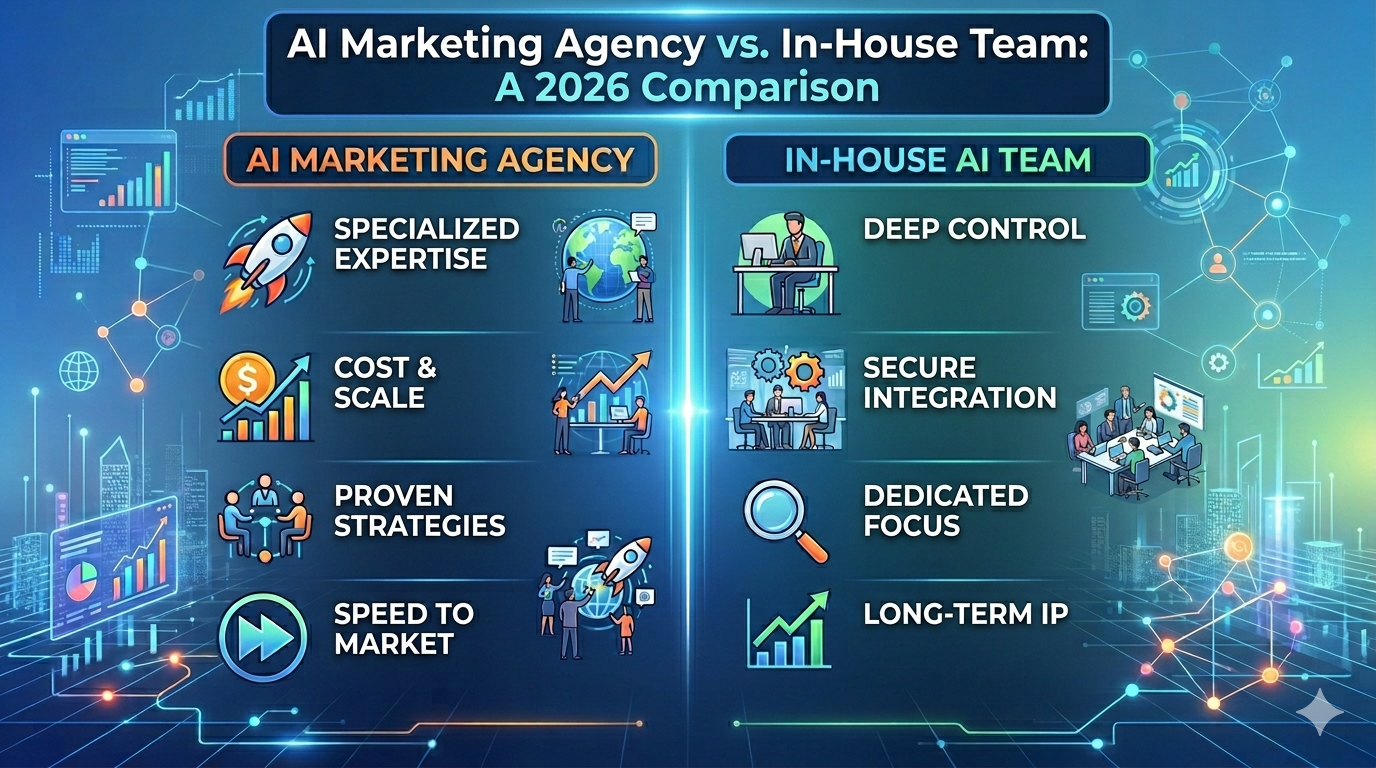
Where AI Marketing Agencies Win
1. Speed of Execution
This is the clearest advantage. An AI agency can go live in 48 hours. By contrast, building an in-house team requires 3–6 months of recruiting, followed by another 3–6 months of onboarding and ramp-up. If your business needs to move now, new product launch, market entry, competitive pressure, an agency isn’t just faster, it’s the only viable option.
2. Breadth of Expertise
A well-staffed AI marketing agency carries specialists across SEO, paid media, content strategy, conversion optimization, email automation, GEO (Generative Engine Optimization), and analytics, all available to you under one retainer. Finding a single in-house hire with four or more of these skill sets costs $85,000+ annually. Six or more? Expect $120,000+ for that one person, if you can find them at all.
3. Scalability Without Headcount
Agencies built on AI systems can scale execution exponentially without proportionally growing staff. Traditional in-house models grow linearly, more campaigns mean more people. That’s a structural disadvantage in an era where speed and volume both matter.
4. Access to Compound Learning
Top AI marketing agencies operate their systems across multiple clients, meaning their models and workflows are continuously trained on broader datasets. In-house teams, by contrast, optimize within a narrower data environment and often plateau after 24–36 months.
Where an In-House AI Team Wins
1. Brand and Data Ownership
Your brand voice, your customer data, your proprietary models, none of that lives in an agency’s systems unless you explicitly negotiate for it. For companies where first-party data is a genuine competitive moat, keeping the team in-house is a strategic imperative, not just a preference.
2. Deep Domain Integration
An internal team works alongside your product, sales, and customer success functions daily. That cross-functional context, knowing why a campaign won or lost, reading internal signals, making fast pivots, is genuinely hard to replicate through an external partner.
3. Long-Term IP Development
If you’re building proprietary AI marketing infrastructure, custom models, unique automation stacks, branded content engines, that IP lives with your business when you build it in-house. Agencies build for clients. Your investment improves their systems, not yours.
4. Strategic Continuity
A McKinsey study found businesses with advanced personalization capabilities can boost revenues by 10–30%. That level of personalization requires deep, continuous refinement of audience understanding, something an in-house team, over time, can do better than a rotating cast of agency account managers.
The Real Risks Nobody Talks About
For AI Marketing Agencies
- Lack of transparency: Some agencies claim “AI-powered” workflows but rely on manual processes with minimal actual automation. Always ask for specifics, which tools, which models, what’s automated, what’s not.
- Data privacy exposure: Your customer data flowing through a third party’s systems introduces compliance risk, particularly in regulated industries like healthcare and finance.
- Dependency and lock-in: If your entire marketing operation runs through one agency, switching costs, both financial and operational, can become paralyzing.
For In-House AI Teams
- Talent attrition: AI-skilled marketers are in fierce demand. Losing one key hire can set your program back months, and replacing them costs an average of $6,000–$12,000 in recruiting alone, before salary.
- Tool sprawl: Without strong governance, in-house teams accumulate overlapping AI tools that drive up cost without proportional output lift.
- Skill ceiling: Internal teams optimize what they know. Without external stimulus, new tools, new methodologies, industry-wide pattern recognition, performance can plateau.
When to Choose an AI Marketing Agency
An AI marketing agency makes the most sense when:
- You need results in weeks, not quarters
- Your marketing budget is under $500,000 annually
- You’re entering a new channel or market without existing expertise
- You want to test AI-powered marketing before committing to a full internal build
- You’re a startup, scaleup, or mid-market brand where headcount flexibility matters
- You’re targeting AI-generated search results and need GEO-savvy execution
If you’re at this decision point and comparing options, start with a curated list. The roundup of best AI marketing agencies in 2026 covers pricing, specializations, and what each agency is actually built to deliver, which saves you weeks of vendor evaluation.
When to Build an In-House AI Team
An in-house AI team makes the most sense when:
- Your organization has $500,000+ annually allocated to marketing infrastructure
- Data privacy, IP ownership, or regulatory compliance requires internal control
- You’re building long-term proprietary AI capabilities tied to your core product
- You have a strong HR pipeline and can sustain 6–12 months of ramp-up
- Your marketing strategy depends on deep cross-functional integration
- You’re a large enterprise with complex, always-on, multi-channel needs
The Hybrid Model: What Most Smart Brands Are Actually Doing
Here’s the honest reality of the AI marketing agency vs in-house AI team debate in 2026: the winning move for most mid-to-large organizations isn’t choosing one or the other. It’s designing a deliberate hybrid.
The most effective structure looks like this:
| Function | Owned By | Rationale |
| Brand strategy & positioning | In-house | Requires domain depth and cross-functional visibility |
| AI content production at scale | Agency | Speed, volume, and tool expertise |
| First-party data management | In-house | Compliance and competitive moat |
| Paid media optimization | Agency | Real-time AI bidding and cross-client pattern data |
| GEO & AI search optimization | Agency (specialist) | Rapidly evolving specialty; agencies are ahead |
| Analytics interpretation | In-house | Strategic context requires internal ownership |
| Creative direction | In-house | Brand voice can’t fully live externally |
This split lets internal teams focus on strategy, brand integrity, and data governance while agency partners handle the execution velocity and AI tool expertise that internal teams struggle to maintain at scale.
AMW Group’s 2026 analysis recommends allocating roughly 70% of your marketing budget toward agency-managed strategy and execution, and 30% toward AI tools your in-house team manages directly, though this ratio shifts based on your team’s maturity.
Key Questions to Ask Before You Decide
Before committing to either model, or the hybrid, run through these five questions honestly:
- How fast do you need to move? If speed is the primary constraint, an agency wins, full stop.
- How proprietary is your data and brand logic? The more sensitive, the stronger the case for in-house ownership.
- Can you actually hire the right talent in time? In 2026, AI-enhanced marketing roles take longer to fill and cost significantly more than traditional marketing hires.
- Do you want to own this capability permanently? If yes, build it internally, but plan for a 12–18 month runway before you’re operating at full efficiency.
- What’s your compliance environment? Regulated industries almost always require internal control over customer data, regardless of the cost calculus.
Final Verdict: Which Model Is Right for You?
The AI marketing agency vs in-house AI team question doesn’t have a universal answer, but it does have a right answer for your specific situation.
If you’re optimizing for speed, flexibility, and cost efficiency, a well-chosen AI marketing agency will outperform an in-house team for the foreseeable future. The talent economics alone make it difficult to justify full internal builds for most organizations under $10M in revenue.
If you’re optimizing for long-term IP, data sovereignty, and strategic depth, building in-house makes sense, but go in clear-eyed about the timeline, talent cost, and the plateau risk that comes with any closed-loop team.
For most businesses in 2026, the optimal play is a hybrid, not as a compromise, but as a deliberate architecture. Use agencies to execute at scale and stay ahead of AI tooling, while your internal team owns the strategy, the data, and the brand decisions that actually define who you are in the market.
The companies getting this right aren’t debating agency vs. in-house. They’re designing systems where both functions amplify each other.