

Introduction
Search has always rewarded authority. For over two decades, the clearest signal of authority on the web was a backlink, a hyperlink from one website pointing to another. The more high-quality sites that linked to you, the more search engines trusted you, and the higher you ranked.
That calculus is still real. But it’s no longer the whole equation.
With the rise of generative AI tools – ChatGPT, Google AI Overviews, Perplexity, Gemini, and Bing Copilot, a new form of digital authority has entered the room: AI citations. These are the source references that appear inside AI-generated answers, often without a traditional hyperlink in sight. And they’re becoming one of the most important visibility signals in digital marketing.
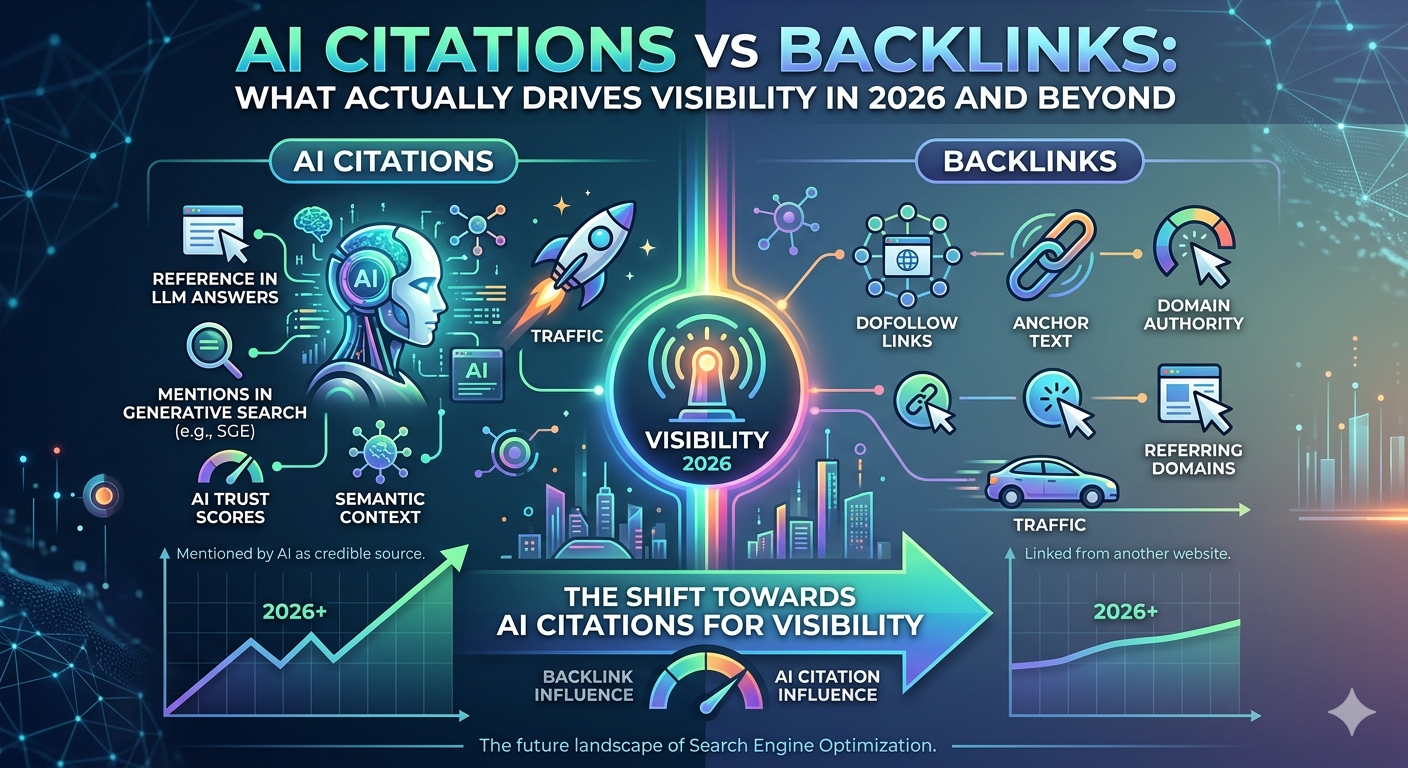
The debate around AI citations vs backlinks isn’t about which one replaces the other. It’s about understanding how each works, where they diverge, and how brands can build a strategy that captures both. In an era where Gartner projects traditional search engine volume to drop 25% by 2026 and AI-referred sessions have already surged 527% year-over-year, ignoring either signal is a costly mistake.
This article breaks it all down with data, strategy, and clarity.
TL;DR
- Backlinks are hyperlinks from external sites to yours, and they remain a core Google ranking signal, especially for competitive keywords and local SEO.
- AI citations are source references that appear inside AI-generated answers on platforms like ChatGPT, Perplexity, and Google AI Overviews with or without a clickable link.
- The two signals are built differently, measured differently, and serve different purposes but they compound each other when done right.
- 97.2% of AI citations cannot be predicted by traditional backlink profiles alone, meaning your link-building strategy alone won’t get you cited by AI.
- 76.1% of Google AI Overview citations also rank in Google’s top 10, meaning strong traditional SEO still supports AI visibility.
- Brand mentions are 3x more predictive of AI platform recommendations than backlinks, per Ahrefs research.
- The smartest strategy isn’t choosing one over the other, it’s running both in parallel with content that earns both.
What Are Backlinks?
A backlink is a hyperlink embedded in external content that points to your website. When a respected publication, blog, or industry resource links to your page, search engines primarily Google, interpret that link as a vote of confidence. The more high-quality, relevant backlinks you earn, the higher your domain authority climbs, and the better your chances of ranking well organically.
Backlinks have been the cornerstone of SEO since Google’s PageRank algorithm first launched in the late 1990s. Despite repeated rumors of their decline, the data in 2026 is unambiguous: backlinks still matter enormously. Studies by Ahrefs confirm that the ranking boost from backlinks is strongest for high-volume, competitive keywords. Backlinks also improve performance in Google’s AI Overviews and local search results, two of the fastest-growing SERP features right now.
In short, a backlink is a machine-readable endorsement, one website telling the web, “this source is worth trusting.”
If you’re building a serious backlink profile, working with a proven, vetted link acquisition process matters. Exploring the best backlink services can help identify the right approach for sustainable, white-hat link building that actually moves the needle on rankings.
What Are AI Citations?
An AI citation is a reference, attribution, or source link that appears inside an AI-generated response, regardless of whether it contains a traditional hyperlink. When ChatGPT answers a user’s question and labels a source at the bottom, that’s an AI citation. When Google AI Overviews pulls a paragraph from your blog and displays your domain name alongside it, that’s an AI citation too.
Unlike backlinks, which are created by humans embedding links in content, AI citations are generated dynamically by large language models (LLMs) during the answer-generation process. The model scans its training data and retrieval index, identifies the most relevant and trustworthy sources, and surfaces them, not because someone linked to them, but because the model’s reasoning process deemed them reliable.
AI citations appear across multiple platforms:
- Google AI Overviews: as clickable source cards within the AI answer box, now appearing in over 25% of all Google searches
- ChatGPT: as footnoted sources listed at the bottom of responses, driving 87.4% of all AI referral traffic
- Perplexity.ai: as numbered inline citations throughout its synthesized answers
- Bing Copilot: as recommended sources or product mentions within conversational responses
- Gemini: as attributed quotes within Google’s AI-powered search interface
The key distinction: an AI citation isn’t a hyperlink relationship between two documents. It’s a trust signal between your content and an AI reasoning system.
AI Citations vs Backlinks: The Core Differences
Understanding the AI citations vs backlinks divide starts with recognizing that these two signals operate in fundamentally different environments, for different audiences, measured by different systems.
| Factor | Backlinks | AI Citations |
| Created by | Humans embedding links in content | AI models dynamically during answer generation |
| Requires a hyperlink | Yes, always a clickable URL | No, mentions without links still count |
| Primary purpose | Transfer authority and ranking signal to Google | Ground AI responses in credible, verifiable sources |
| Impact on Google rankings | Direct, core ranking factor | Indirect, through authority and entity recognition |
| Impact on AI search | Indirect, high-authority domains get more AI consideration | Direct, AI systems pull from these sources for responses |
| Measurability | Established tools (Ahrefs, Semrush, Moz) | Emerging tools (Topify, SEMrush AI Visibility, Superlines) |
| Harder to manipulate | Medium, link schemes still exist | Hig, AI citation patterns are non-deterministic |
| Local SEO impact | Medium to high | Very high, entity consistency is key |
| Brand-building value | Moderate, driven by domain authority | Strong, shapes AI-generated brand perception |
| Traffic generation | Direct referral traffic from linked content | Mostly zero-click, but converts at 4–5x the rate |
| Core metric | Domain Rating / Domain Authority / Link Equity | Share of Model / Citation Frequency / Brand Mention Rate |
As one analysis by Topify puts it succinctly: a backlink is a human-created hyperlink designed to transfer ranking authority, while an AI citation is a machine-generated attribution created in real time to ground a generative response.
Why AI Citations Are Becoming Non-Negotiable
The numbers make the case better than any opinion could.
AI chatbot referral traffic grew 357% year-over-year, reaching 1.1 billion referral visits in June 2025, per Similarweb’s Generative AI Report. AI-referred sessions surged 527% in just the first five months of 2025 compared to 2024. ChatGPT reached 800 million weekly active users by October 2025, doubling in just eight months. Perplexity processes 780 million monthly queries. Google AI Overviews now appear in over 25% of all Google searches, up from just 13% in early 2025.
Here’s what makes this genuinely alarming for brands that aren’t paying attention: a strong page one ranking no longer guarantees presence in AI-generated answers. Research shows that 97.2% of AI citations cannot be explained by traditional backlink profiles. The correlation between domain authority and AI citation frequency is an r² of just 0.038, essentially no predictive power.
In other words, you can have a Domain Rating of 80, rank in Google’s top three, and still be invisible to ChatGPT and Perplexity for the exact queries your customers are asking.
The “Invisibility Gap” is real, and it’s widening every month.
That said, the relationship isn’t entirely disconnected. High-traffic domains still earn 3x more AI citations than low-traffic sites, and 76.1% of Google AI Overview citations do rank in Google’s top 10. The AI systems still respect organic authority, they just don’t rely on it exclusively.
How AI Search Engines Decide What to Cite
This is where the AI citations vs backlinks discussion gets technical, and where most brands fall behind.
Traditional Google SEO favors backlinks, keyword density, page speed, and user signals. Generative AI systems work differently. They use Retrieval-Augmented Generation (RAG), a process where the model first retrieves relevant documents, then generates a response citing selected sources. The factors that influence whether your content gets retrieved and cited are distinct from traditional ranking factors.
What AI citation systems prioritize:
- Factual density: content that includes specific data, statistics, named sources, and verifiable claims
- Structural clarity: content organized with clear H1/H2/H3 headings, FAQ sections, and direct answers in the first 40–60 words
- Freshness: AI platforms prefer content that is 25.7% fresher than what’s typically cited in traditional search results
- Schema markup: content with proper structured data shows 30–40% higher AI visibility
- Entity consistency: brand name, address, and identity information must be consistent across all web properties for AI systems to confidently identify your brand as a single entity
- Third-party mentions: presence on Reddit, Wikipedia, LinkedIn, and authoritative publishers signals legitimacy to LLMs
- E-E-A-T signals: author credentials, domain expertise, and trust markers all influence AI citation likelihood
Content with verifiable statistics and named citations achieves 30–40% higher AI visibility than unoptimized content, according to research from Princeton, Georgia Tech, and the Allen Institute of AI. For a practical breakdown of what each AI platform looks for when selecting sources, Semrush’s guide to optimizing content for AI search engines is worth bookmarking.
The Citation vs. Mention Gap: A Critical Distinction
Here’s a nuance that most AI SEO content skips over, and it matters: being cited by AI and being mentioned by AI are not the same thing.
A citation means AI lists your content as a source, your URL appears as a reference in the response. A mention means your brand name appears in the AI’s actual answer, as a recommendation, a product suggestion, or a trusted solution.
According to SEMrush analysis, only 6–27% of brands that receive citations also receive direct brand mentions. AirOps research found that brands are 3x more likely to be cited alone than to earn both signals simultaneously. This is the “Mention-Source Divide”, your data can power an AI answer while a competitor’s brand name gets the recommendation.
The practical implication: don’t just optimize for citation. Optimize for brand authority that earns the recommendation, not just the footnote.
AI Citations vs Backlinks: Which Drives More Traffic?
This question is loaded because the two signals deliver traffic in fundamentally different ways.
Backlinks drive referral traffic, a human reads content on another website, clicks a link, and lands on your page. This is direct, measurable, and attributable.
AI citations mostly drive zero-click visibility, your brand is exposed inside an AI answer without the user ever visiting your site. The click rarely happens. But when it does, the quality of that visitor is exceptional. The Washington Post reported that visitors arriving from AI platforms converted to subscriptions at 4 to 5 times the rate of traditional search visitors.
For now, traditional search still dominates volume. Google sends 345x more traffic than all AI platforms combined as of mid-2025. AI referral traffic currently accounts for just 1.08% of total website traffic. But it’s growing at roughly 1% month-over-month with compounding acceleration, and 35% of US consumers now use AI at the product discovery stage, compared to only 13.6% who use traditional search at that stage.
The practical takeaway: backlinks drive today’s traffic, AI citations are building tomorrow’s trust. Neither can be deprioritized.
How to Earn Both: An Integrated Strategy
The most effective approach to the AI citations vs backlinks challenge is recognizing that earning one often supports the other, when the content strategy is right.
1. Publish Original Research and Proprietary Data
Original research earns natural backlinks because other writers need to cite it. That same factual density and specificity makes it highly citeable by AI models. One piece of deeply researched, data-backed content can fuel both channels simultaneously.
2. Build Authority Through Digital PR
Digital PR placements in respected publications create high-authority backlinks. Those placements also increase the likelihood that AI models, which crawl and weight authoritative third-party content heavily, will recognize your brand as credible. According to EMARKETER’s recommended GEO framework, 25% of SEO budget should go toward digital PR specifically for this dual-channel effect.
3. Optimize Content Structure for Both Audiences
Use clear H2/H3 headings, FAQ sections, and direct answers in your opening paragraphs. Google’s crawlers and AI retrieval systems both favor structured, scannable content. Add schema markup, particularly FAQ, Article, and HowTo schemas, to increase structured data signals for AI.
4. Invest in Consistent Entity Presence
Ensure your brand name, contact information, and descriptions are identical across your website, Google Business Profile, Wikipedia, LinkedIn, Reddit, and any other platforms where you’re mentioned. AI models use entity consistency to verify brand legitimacy before citing a source.
5. Build Community and Third-Party Presence
Reddit content received a 450% increase in AI citations between March and June 2025. Wikipedia, YouTube, and LinkedIn consistently rank among the most-cited sources across major LLMs. Creating content that lives on these platforms, or getting mentioned there, directly improves AI citation likelihood, independent of your backlink profile.
6. Track AI Citation Share as a KPI
Traditional SEO dashboards don’t capture AI visibility. Use tools like SEMrush’s AI Visibility feature, Superlines, or Topify’s Source Analysis to measure your Share of Model, how often you’re cited across ChatGPT, Gemini, Perplexity, and Google AI Overviews for your target queries.
GEO vs SEO: How the Optimization Disciplines Compare
Generative Engine Optimization (GEO) is the emerging discipline built specifically around earning AI citations. Understanding how it compares to traditional SEO clarifies where your efforts need to go.
| Dimension | Traditional SEO | Generative Engine Optimization (GEO) |
| Primary goal | Rank in Google’s organic results | Get cited in AI-generated answers |
| Success metric | Rankings, organic clicks, CTR | Citation frequency, brand mention rate, AI share of voice |
| Key signals | Backlinks, keywords, page authority | Factual density, entity consistency, schema markup |
| Content format | Long-form keyword-optimized pages | Structured, FAQ-forward, direct-answer content |
| Traffic model | Click-through from search results | Zero-click exposure + high-intent referral visits |
| Timeline | 3–6 months for meaningful movement | Initial visibility possible in 2–4 weeks |
| Platform focus | Google, Bing | ChatGPT, Perplexity, Gemini, Google AI Overviews |
| Manipulation difficulty | Medium, exploitable with volume tactics | High, AI patterns are non-deterministic |
| Market size | Established, multi-billion dollar | $848M in 2025, projected $33.7B by 2034 |
GEO doesn’t replace SEO. It extends it. Brands that treat them as competing priorities are making a strategic error. The two disciplines share the same foundation, authoritative, well-structured, factually rich content, and diverge mainly in how that content is optimized and measured.
What the Data Tells Us About the Future
The trajectory is clear, even if the timeline is uncertain.
Gartner predicts that 50% of all online searches will involve an AI assistant by 2028, and that traditional search engine volume will decline 25% by 2026. Bain & Company reports that 80% of consumers already rely on zero-click results in at least 40% of their searches. The zero-click search rate for news content jumped from 56% to 69% in a single year following Google’s AI Overviews rollout.
Reddit’s traffic grew to 1.4 billion monthly visits by April 2025, in large part because AI systems favor authentic, community-generated content. Meanwhile, Forbes lost 50% of its traffic despite ranking for thousands of keywords. Even Wikipedia, the single most-cited domain in AI Overviews, saw an 8% decline in human pageviews while being scraped by AI bots at a 50% higher rate.
The brands winning in this environment are those that build semantic credibility, not just link equity. Investopedia and Harvard Business Review appear in AI summaries repeatedly not because they always have the strongest backlink profiles on a given topic, but because their entity reputation, content structure, and factual consistency signal reliability to AI reasoning systems.
That’s the target state. Not just a high DA score. A brand that AI trusts.
Frequently Asked Questions
Do backlinks still matter for SEO in 2026?
Yes, definitively. Backlinks remain a top Google ranking signal, particularly for competitive keywords and local search. If anything, AI search patterns are making them more important, not less.
Can I get AI citations without strong backlinks?
Yes. AI citations are largely independent of backlink data, 97.2% can’t be predicted by traditional link profiles. Factually dense, well-structured content can earn citations even from modest-authority domains.
What’s the fastest way to start earning AI citations?
Add FAQ schema, lead with direct answers, include named statistics, and publish original research. Initial AI visibility can appear within 2–4 weeks.
Are AI citations the same as brand mentions?
No. A citation means your URL is listed as an AI source. A mention means your brand name appears in the answer itself as a recommendation, and fewer than one in five brands earn both consistently.
Should I change my link-building strategy because of AI?
Modify it, don’t abandon it. Keep building quality backlinks, but layer in digital PR, entity optimization, and GEO-specific content to cover both channels.
Final Verdict: AI Citations vs Backlinks
The framing of AI citations vs backlinks as a competition misses the bigger picture. These are two trust signals operating in two adjacent ecosystems, one built by humans for search engines, one built by machines for AI reasoning systems, and both matter significantly in 2026.
Backlinks prove that humans find your content valuable enough to reference. AI citations prove that machines find your content structured, accurate, and authoritative enough to cite. The brands that earn both are building visibility that’s genuinely future-proof.
The shift happening right now is structural, not cyclical. AI search isn’t a trend that will correct back to the old normal. The question isn’t whether to adapt, it’s how fast.
Build your backlink profile with intention. Invest in link-building strategies that prioritize quality, relevance, and sustained authority. At the same time, optimize your content for AI retrieval: structure it clearly, ground it in facts, establish your entity across platforms, and track your citation share as a core business metric.
The brands that do both aren’t just playing defense against a changing search landscape. They’re building the kind of multi-layered authority that controls visibility across every channel, today’s and tomorrow’s.