

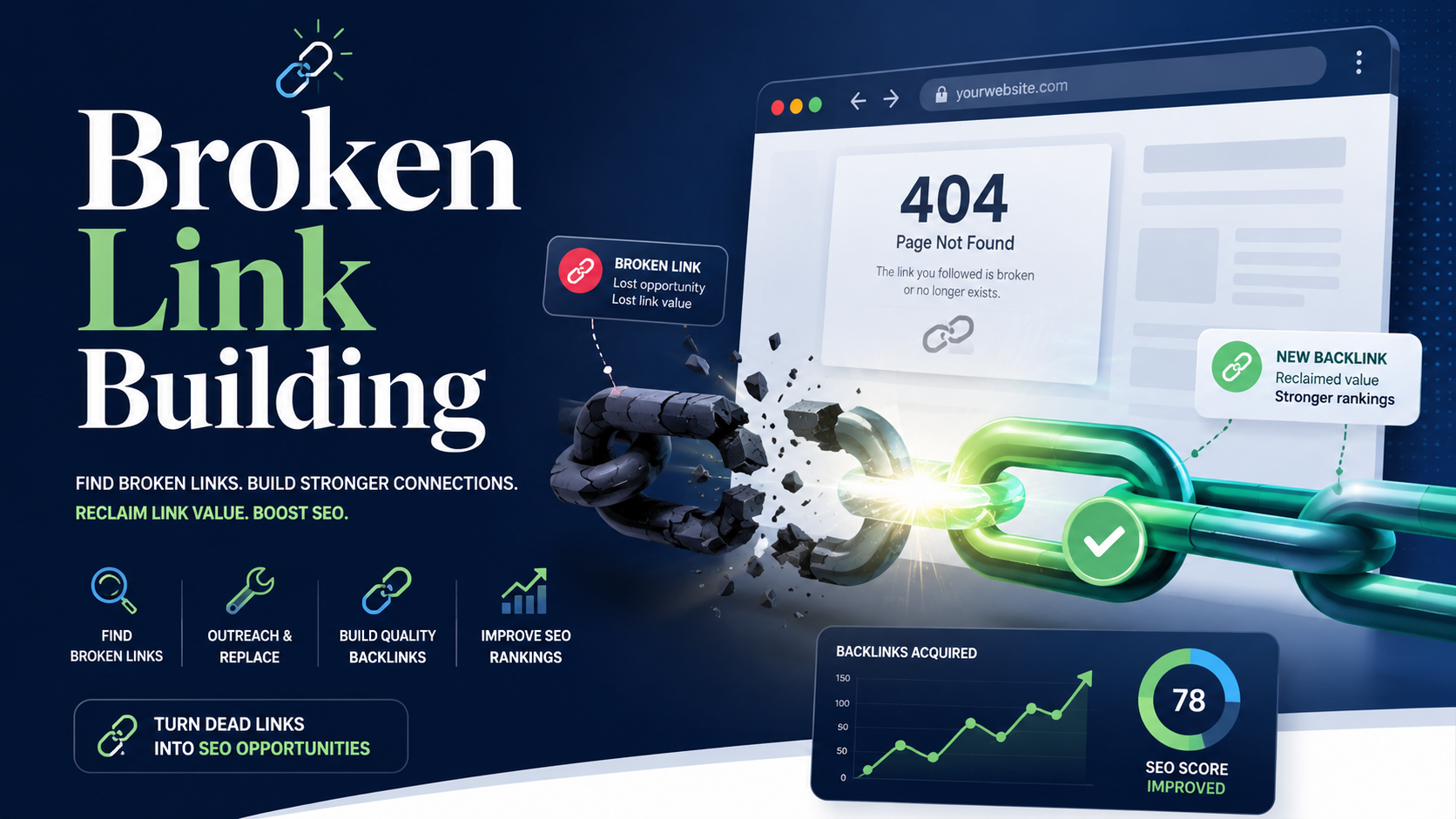
Let’s be honest-most link building advice out there is either so vague it’s useless, or so technical it reads like a whitepaper nobody asked for. Broken link building doesn’t fit into either of those buckets. It’s one of those rare SEO strategies that’s genuinely win-win: you help website owners clean up dead links, and in return, they send link equity your way.
If you’ve been grinding out guest posts and getting nowhere, or if you’ve watched your cold email pitches disappear into the void, broken link building might just be the angle you’ve been sleeping on. The internet is riddled with 404 errors and link rot, and smart SEOs are capitalizing on that abandoned link equity every single day.
This guide breaks down exactly what broken link building is, why it still works in 2026, the tools you’ll need, and the step-by-step process to turn dead pages into backlinks that actually move the needle.
What Is Broken Link Building?
Broken link building is a white-hat SEO tactic where you identify hyperlinks on third-party websites that point to non-existent pages-typically returning a 404 Not Found error-and then approach the site owner with a relevant replacement from your own website. The goal is to earn a high-quality, contextually relevant backlink by solving a real problem for the webmaster.
The concept is straightforward: websites naturally accumulate link rot over time. Pages get deleted, domains expire, site structures get reorganized, and URLs get mistyped. Every one of those broken links is a tiny SEO headache for the site owner-and a potential opportunity for you.
| TL;DR Broken link building = finding dead links on authoritative websites + creating (or matching) a better replacement resource + reaching out to webmasters to swap the broken link for yours. It’s not about tricks. It’s about solving a real UX problem while earning a backlink. |
Why Do Links Break?
Understanding why links break helps you identify better targets and craft more compelling pitches. The most common causes include:
• Page deletion or content removal without redirects
• Domain expiration or website shutdowns
• CMS migrations that change URL structures (e.g., from WordPress to a new platform)
• Incorrectly typed or formatted URLs at the time of publication
• Content intentionally archived or moved behind a paywall
• Restructuring of site navigation or category taxonomy
Why Broken Link Building Still Works in 2026
There’s a persistent rumor in Reddit threads and SEO forums that broken link building is dead. It’s not. It’s just harder-and that’s a good thing if you’re willing to put in the effort most competitors won’t.
According to industry data, broken link building carries a 22% success rate when the outreach pitch is paired with highly relevant replacement content. That’s not spectacular, but it’s significantly better than the 5.5% average cold email response rate seen across generic link-building outreach campaigns.
Here’s what’s driving its sustained effectiveness:
• Value-first framing: You’re not asking for a favor. You’re flagging a technical problem and offering a tested solution.
• Mutual benefit: The webmaster fixes a bad user experience; you earn a relevant backlink. Neither party loses.
• White-hat compliance: Google’s 2024–2025 spam updates have cracked down on paid links and manipulative schemes. Broken link building remains fully compliant.
• Scalability: Unlike digital PR or original research campaigns, broken link building can be templated and systematized at scale.
| TL;DR Why It Works: Broken link building works because it solves a genuine problem for webmasters (broken UX and lost link equity) while giving you a legitimate reason to request a backlink. The offer of genuine value is what separates this tactic from spam. |
Key Statistics That Prove It’s Worth Your Time
| Metric | Data Point | Source |
| Broken link building success rate (relevant content) | 22% | Backlinko |
| SEO experts who include it in their strategy | 37% | THM SEO Agency, 2026 |
| Marketers still actively using the tactic | 13.3% | Editorial.Link Survey, 2024 |
| Pages ranking #1 have vs. lower positions | 3.8x more backlinks | Backlinko |
| SEOs who believe backlinks influence AI results | 73.2% | Editorial.Link, 2026 |
| Personalized outreach success rate improvement | +33% to +50% | Mailtrap / Research Data |
| Average time for links to impact rankings | 3.1 months | THM SEO Agency, 2026 |
| Cold outreach average response rate (generic) | 5.5% | Respona Research |
Step-by-Step: How to Execute a Broken Link Building Campaign
The process breaks down into four distinct phases. Each one requires deliberate attention-this isn’t a spray-and-pray tactic.
Step 1: Find Broken Link Opportunities
The hunt is where the strategy begins. You’re looking for broken external links on pages that are relevant to your niche and carry meaningful authority. There are several proven approaches:
Competitor Dead Pages: Using Ahrefs or Semrush, pull the Site Explorer report for your top competitors. Filter for broken pages (404s) that have referring domains. These dead pages may have accumulated dozens of quality backlinks that now point to nothing-link equity sitting unclaimed.
Resource Page Scanning: Resource pages are curated lists of useful links in a niche. They tend to be link-heavy and age poorly, making them goldmines for broken links. Use Chrome extensions like Check My Links or LinkMiner to scan resource pages quickly.
Ahrefs Content Explorer: This is arguably the most powerful method. Search for broken pages by topic using Content Explorer, filter for dead pages with 20+ referring domains, and you’ll surface high-value targets fast. One search can reveal hundreds of broken pages in your niche.
Wayback Machine Verification: Once you’ve identified a broken URL, check web.archive.org to see what the page originally contained. This helps you determine whether your content is a strong thematic match for the replacement.
Step 2: Create (or Match) a Replacement Resource
This is where a lot of broken link building campaigns fall flat. People find dead links, then pitch content that barely resembles the original. Webmasters aren’t obligated to accept a poor match just because it’s functional.
Your replacement content needs to:
• Match the intent and topic of the original broken page
• Be equal to or better than the original in depth, accuracy, and freshness
• Be well-designed and free of obvious SEO manipulation signals
• Already be live on your site before you reach out
A practical example: if the dead page was a 2018 guide titled ‘10 Email Marketing Benchmarks,’ your replacement should be a current, data-backed guide-‘15 Email Marketing Benchmarks for 2025’-that clearly outperforms the original in depth and relevance.
| TL;DR Content Matching: Don’t pitch your homepage as a replacement for a broken how-to guide. The thematic fit must be tight. Webmasters get multiple broken link pitches weekly-yours wins when the replacement is obviously superior. |
Step 3: Craft a Personalized Outreach Email
The outreach email is the most make-or-break part of the whole operation. Mass-blast templates get deleted. Personalized, value-first pitches get responses.
Here’s a proven structure:
1. Open by referencing the specific page and broken link-show you actually visited their site.
2. Notify them of the broken link with the exact anchor text and dead URL.
3. Explain the potential impact briefly (bad UX, lost traffic to users who hit a 404).
4. Offer your replacement resource as a natural fit-include the URL and a one-sentence description.
5. Keep it brief-under 150 words. Webmasters are busy.
Research consistently shows that personalizing an email with the recipient’s first name can improve success rates by up to 50%. Following up once (after 5–7 days) can result in 40% more link acquisitions. Two touches are usually sufficient-three or more risks damaging the relationship.
Step 4: Track, Follow Up, and Monitor
Once outreach is live, the campaign doesn’t end-it enters a monitoring phase. Use a CRM spreadsheet or a dedicated tool like BuzzStream or Pitchbox to track email status, responses, and placements.
After earning a link, verify it monthly using Ahrefs or Google Search Console. Links occasionally get removed during redesigns or when editors clean up content. Set alerts so you’re notified if a backlink drops, and have a plan for re-pitching if needed.
Best Tools for Broken Link Building in 2026
| Tool | Primary Use | Best For | Cost (2026) |
| Outreachz | Outreach automation & link prospecting | Streamlined prospect management & email sequences | Custom pricing |
| Ahrefs | Find broken pages with backlinks | Advanced prospecting & competitor analysis | From $129/mo |
| Semrush | Site audit + backlink analysis | Full SEO campaigns + broken link detection | From $139.95/mo |
| Screaming Frog | Crawl sites for 404 errors | Deep site audits on target domains | Free (500 URLs) / $259/yr |
| Google Search Console | Monitor your own broken links | Identifying internal 404s | Free |
| Check My Links | Quick page-level broken link scan | Resource page prospecting | Free Chrome Extension |
| LinkMiner | Scan resource pages for dead links | Fast opportunity discovery | Free Chrome Extension |
| Wayback Machine | See original content of dead pages | Content matching validation | Free |
| BuzzStream | Outreach CRM & email tracking | Managing outreach at scale | From $24/mo |
| Pitchbox | Automated personalized outreach | High-volume campaigns | Custom pricing |
Broken Link Building vs. Other Link Building Tactics
Understanding how broken link building compares to other strategies helps you decide where to invest your time and resources. Here’s an honest side-by-side:
| Strategy | Effort Level | Success Rate | Cost | White Hat? | Best Use Case |
| Broken Link Building | Medium-High | 12–22% | Low–Medium | Yes | Reclaim niche authority links |
| Guest Posting | High | Variable | Low–High | Yes (if done right) | Brand building + traffic |
| Digital PR | Very High | Unpredictable | High | Yes | High-DA media placements |
| Skyscraper Technique | Very High | ~15% higher than avg. | Medium | Yes | Competing for top-linked content |
| Link Insertions (Niche Edits) | Low–Medium | Higher if relevant | Medium | Gray area | Fast link placements |
| HARO / PR Outreach | Medium | Moderate | Low | Yes | Expert quotes + DA50+ links |
| Resource Page Building | Medium | Moderate | Low–Medium | Yes | Evergreen niche resource links |
| TL;DR Comparison: No single link building strategy wins across every scenario. Broken link building shines for mid-authority sites that need efficient, cost-effective backlink acquisition without paying premium prices for guest posts or digital PR retainers. |
Industries Where Broken Link Building Works Best
Broken link building tends to outperform in content-rich industries where older editorial content accumulates links over years before going dead. Based on practitioner experience and reported case studies, the highest-opportunity sectors include:
• Healthcare and Medical Information: Older health articles and studies frequently go offline as organizations update their resources, leaving high-DA links pointing to nothing.
• Finance and Legal Content: Regulatory changes cause outdated pages to be removed, but their inbound links remain.
• Education and Academia: University resource pages, scholarship lists, and research references are notorious for broken links.
• Technology and SaaS: Product pages and documentation for deprecated tools still attract links from review articles and how-to guides.
• Non-Profit and Government Sectors: These organizations often have poor web maintenance practices, creating abundant 404 opportunities.
One reported case study found that a healthcare-sector website earned more than 30 quality backlinks using broken link building within a single quarter-demonstrating that a systematic approach in the right vertical can produce exceptional results.
Common Mistakes That Kill Broken Link Building Campaigns
This strategy has a learning curve, and most people burn out before they optimize it. Here are the errors that derail campaigns most often:
Pitching a Poor Content Match
The number-one campaign killer. If the dead link was a statistical data study and your replacement is a 600-word blog post, no webmaster is accepting that swap. Content relevance is everything.
Using Generic, Template-Heavy Email Pitches
Webmasters in popular niches now receive multiple broken link emails per week. A pitch that opens with “Hey there! I was browsing your site and noticed a broken link…” reads like a bot. Reference the specific page, the exact broken anchor, and make it obvious you read the content.
Targeting Low-Authority Sites
Not all dead links are worth pursuing. If a page linking to a dead resource has a Domain Rating of 12 and gets no traffic, the backlink has minimal SEO value. Prioritize targets with Authority Scores above 30 and real organic traffic.
Skipping the Wayback Machine Step
If you don’t verify what the original broken page contained, you might pitch content that doesn’t match at all. Always review the archived version before reaching out.
Not Following Up
Research shows that follow-up emails result in 40% more backlink acquisitions. Most webmasters aren’t ignoring you-they’re just buried. One polite follow-up after 5–7 days is not only acceptable, it’s expected.
Broken Link Building in the Age of AI Search and GEO
The rise of Google’s AI Overviews and AI-powered search engines like ChatGPT Search and Perplexity AI is changing the stakes for link building-and broken link building sits in an interesting position within that shift.
According to a 2025 survey by Editorial.Link, 73.2% of SEO professionals believe that backlinks directly influence a website’s likelihood of appearing in AI-generated search results. This is a significant finding. AI search engines don’t just look at keyword relevance-they weigh the authoritativeness of sources, which is still fundamentally tied to backlink profiles.
For GEO (Generative Engine Optimization)-the emerging discipline of optimizing content for AI search engines-a strong backlink profile from relevant, high-authority domains signals to AI systems that your content is credible and citation-worthy. Broken link building, because it targets editorially placed links on topically relevant pages, is one of the most GEO-aligned link building methods available.
| TL;DR AI & GEO: In 2026, backlinks don’t just help traditional Google rankings-they signal authority to AI search engines that surface content in generated responses. Broken link building’s focus on editorial, contextually relevant links makes it one of the most future-proof link acquisition strategies in the current landscape. |
Outreach Email Template That Actually Gets Replies
The template below is built on what consistently outperforms generic pitches: brevity, specificity, and genuine helpfulness.
| Subject: Quick heads-up about a broken link on [Page Title] Hi [First Name], I was reading your article on [Topic/Page Title] at [Page URL] and noticed a broken link pointing to [Dead URL]. Anyone clicking that link right now hits a 404 page. I recently published a resource that covers the same topic: [Your URL]. It’s up-to-date and might be a solid replacement for your readers. Either way, just wanted to give you a heads-up. Hope it’s helpful! [Your Name] | [Website] |
Notice what’s missing: excessive flattery, multiple asks, long explanations of your credentials, or pushiness. The email does one thing-reports a problem and offers a clean solution. That’s exactly what webmasters respond to.
How to Evaluate Whether a Broken Link Opportunity Is Worth Pursuing
Not every 404 link deserves your time. Before you reach out, run through this quick qualification checklist:
| Qualifying Factor | Minimum Threshold | Why It Matters |
| Domain Authority / Rating of linking site | DA/DR 30+ | Low-authority sites add minimal SEO value |
| Organic traffic of linking page | >500 visits/month | Indicates real audience and editorial value |
| Number of referring domains to broken page | 5+ | More inbound links = more link equity to inherit |
| Topical relevance to your content | High (same niche) | Google weighs relevance heavily for link value |
| Content match between dead page & yours | 70%+ match | Webmasters won’t accept off-topic replacements |
| Age of broken link | Ideally 6+ months old | Older broken links are more likely to get fixed |
| Contact information available | Yes | No contact = no outreach possible |
What Real SEOs Are Saying (Straight Talk, No Spin)
Here’s the thing about broken link building that doesn’t make it into most “guides”: experienced practitioners on forums like Reddit’s r/SEO and BlackHatWorld (yes, even the skeptics) acknowledge a split reality.
The skeptics’ case: Broken link building IS labor-intensive. It can take hours to find a single usable opportunity, verify the archived content, craft a personalized email, and follow up-all for a link acquisition that may never happen. Some practitioners have reported outreach conversion rates as low as 3–5% when targeting competitive niches with oversaturated inboxes.
The optimists’ case: When it works, it works remarkably well. One digital agency reported that a service-first approach-focusing on genuinely helping webmasters fix problems rather than asking for links-boosted their conversion rate from 7% to 23%. For a strategy with zero cost-per-link beyond time investment, those are strong numbers.
The honest synthesis: Broken link building is not a primary strategy for most teams anymore-digital PR and content marketing have overtaken it in terms of pure ROI. But as a supplementary tactic, particularly in technical niches where content decays fast, it remains one of the most cost-effective ways to earn editorially placed, white-hat backlinks. The key is ruthless qualification and genuinely good replacement content.
Scaling Broken Link Building Without Losing Quality
The paradox of broken link building is that personalization-which drives results-seems to conflict with scalability. Here’s how successful teams reconcile that tension:
• Template + Merge Variables: Use tools like BuzzStream or Mailshake to build base templates, then insert specific variables (page name, broken anchor text, broken URL, your replacement URL) dynamically. This maintains a personalized feel at scale.
• Virtual Assistant Pre-Qualification: Outsource the prospecting and qualification phase to a trained VA. They can run site crawls, pull broken link data, verify Wayback Machine archives, and populate a spreadsheet of pre-qualified targets. You handle only the high-value outreach.
• Niche-Specific Content Banks: Build a library of 8–12 strong resource pages across different subtopics in your niche. When you find a broken link, you’ll almost always have a relevant replacement ready rather than needing to create content from scratch for each campaign.
• Monthly Opportunity Batches: Run a broken link prospecting sweep monthly rather than on an ongoing basis. This batches the work, keeps campaigns organized, and allows you to measure performance per cycle.
Final Thoughts: Is Broken Link Building Worth It in 2026?
Yes-with the right expectations. Broken link building isn’t going to replace digital PR or a full-scale content marketing engine. But it fills a specific gap that most tactics leave open: acquiring genuine, editorially placed backlinks on real pages without paying $400–$1,000+ per link.
In an era where 73.2% of SEO professionals believe backlinks still influence AI search visibility, and where the average cost of a single high-quality backlink now exceeds $500, broken link building’s cost-to-value ratio is hard to argue with for teams that invest in systematic execution.
The bottom line: If you have strong existing content, a willingness to do targeted prospecting, and a commitment to personalized outreach, broken link building will deliver. It won’t transform your site overnight, but over three to six months of consistent effort, the compounding backlink gains are real, measurable, and algorithm-resistant.
That’s something very few link building tactics can promise in 2026.
Frequently Asked Questions (FAQ)
Is broken link building still effective in 2026?
Yes. While it’s no longer the dominant link building strategy, it maintains a 22% success rate with relevant replacement content. Its white-hat nature makes it especially resilient against Google algorithm updates.
How long does it take to see results from broken link building?
Most practitioners report measurable ranking impacts within three to six months of consistent link acquisition, aligning with the industry-average 3.1-month link impact timeline.
Do I need paid tools to do broken link building?
You can start with free tools (Google Search Console, Check My Links Chrome extension, Wayback Machine), but Ahrefs or Semrush are strongly recommended for finding broken pages with significant backlink profiles at scale.
What makes a good replacement resource for a broken link?
A good replacement matches the original page’s topic and intent, is currently live and functional, is comparable or superior in depth and accuracy, and lives on a domain relevant to the linking site’s niche.
How many emails should I send per broken link opportunity?
Two touchpoints is the sweet spot: an initial outreach email and one follow-up five to seven days later. Beyond that, you risk damaging the relationship.
Quick Reference: Broken Link Building Checklist
✅ Identify broken pages with 5+ referring domains using Ahrefs or Semrush
✅ Verify original content via Wayback Machine
✅ Confirm your replacement matches the broken page’s topic and intent
✅ Verify the linking site has DA/DR 30+ and real organic traffic
✅ Locate direct contact email for the webmaster
✅ Send a concise, personalized outreach email (under 150 words)
✅ Follow up once after 5–7 days if no response
✅ Track and monitor earned backlinks monthly via Ahrefs or GSC