

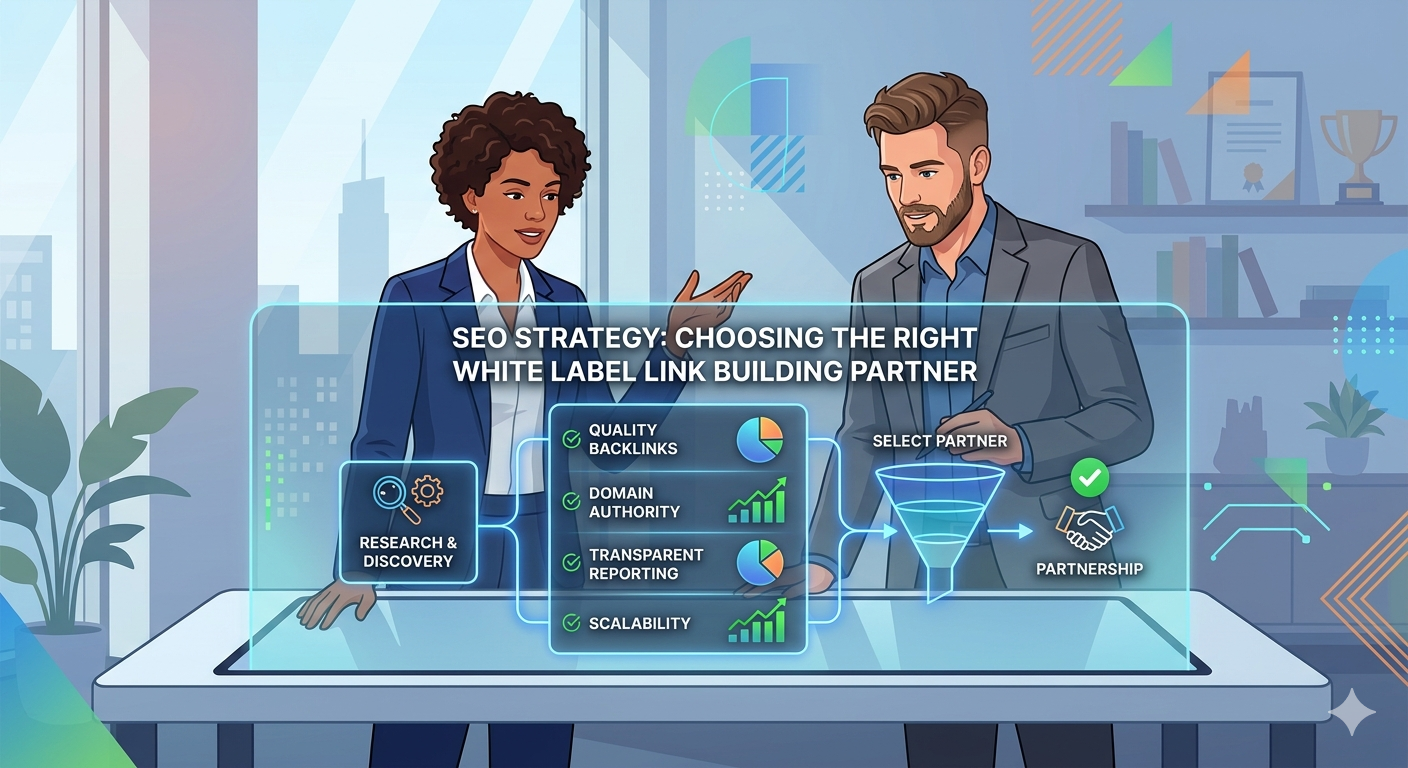
The ecosystem of search engine optimization is undergoing a seismic shift. As generative AI transforms how users discover information, the fundamental currency of the web, the backlink, has evolved. For agencies, keeping up with these changes while managing client expectations and overhead is a constant challenge. This is where white label link building services become a strategic necessity.
Selecting a provider is no longer just about finding the cheapest “price per link.” In an era of AI Overviews and entity-based SEO, the quality, relevance, and authority of your link profile dictate whether a client’s site climbs the rankings or vanishes into the digital ether. If you are looking to scale your agency’s offerings without hiring an in-house team, reviewing the best white label link building services in 2026 can provide a benchmark for the level of quality currently expected in the industry.
TL;DR: The Essentials of White Label Link Building
- Quality Over Quantity: Prioritize providers that focus on manual outreach and high-authority placements rather than automated, low-quality directories.
- Transparency: A reliable partner provides clear reporting, “unbranded” dashboards, and proof of organic traffic for every linking domain.
- Scalability: Look for a service that can handle varying volumes without compromising the editorial standards of the placements.
- Future-Proofing: Ensure the provider understands modern SEO signals, including GEO (Generative Engine Optimization) and topical authority.
Understanding the Value of White Label Link Building
White label link building is a partnership where an external specialist executes backlink campaigns under your agency’s brand. Your clients receive high-quality SEO results, and you receive the credit, allowing you to maintain a lean internal team while offering premium results.
However, the “white label” aspect is only as good as the underlying execution. As search engines become more adept at identifying unnatural link patterns, the criteria for “good” links have tightened.
1. Rigorous Vetting of Linking Domains
The first thing to look for in a provider is their vetting process. Gone are the days when Domain Authority (DA) or Domain Rating (DR) were the only metrics that mattered. These can be easily manipulated.
Traffic and Trends
A high-DR site with zero organic traffic is a “zombie site.” It holds no real-world value in the eyes of modern search algorithms. Look for a provider that guarantees:
- Live Organic Traffic: The site should be ranking for its own set of keywords.
- Upward Trajectory: Use tools to ensure the site isn’t currently under a manual or algorithmic penalty.
- Geographic Relevance: If your client is a US-based law firm, getting links from a tech blog in a different hemisphere offers diminishing returns.
Topical Authority and Relevance
Google’s focus on E-E-A-T (Experience, Expertise, Authoritativeness, and Trustworthiness) means that a link from a relevant niche site is worth ten links from a generic “news” site that covers everything from crypto to gardening. Your provider should demonstrate an ability to find sites within the same “topical neighborhood” as your client.
2. Transparency and Reporting Protocols
In a white label arrangement, communication is everything. You are the middleman, and your reputation is on the line.
Real-Time Dashboards
The best providers offer white-label portals. These allow you to:
- Track the status of placements in real-time.
- View the specific URLs where links are live.
- Download unbranded CSV or PDF reports to send directly to your clients.
Pre-Approval Options
A significant red flag is a provider that refuses to let you see the sites before the link is placed. Quality services offer a “pre-approval” workflow, allowing you to vet the target site’s content, layout, and “vibe” to ensure it aligns with your client’s brand standards.
3. Diversified Link Building Tactics
If a provider only offers one type of link, for example, only guest posts, they are creating a footprint that search engines can easily identify. A robust white label partner should offer a “balanced diet” of link types:
- Blogger Outreach & Guest Posting: High-quality editorial content placed on established blogs.
- Niche Edits (Curated Links): Placing a link within an existing, aged article that already has authority and traffic.
- Digital PR & HARO: Securing mentions in high-tier journalistic outlets.
- Resource Page Link Building: Getting your client listed on “Best of” or “Tool List” pages.
4. Content Quality and Editorial Standards
A link is only as strong as the content surrounding it. If a provider uses AI-spun content or low-quality offshore writing that is riddled with errors, the link becomes a liability.
Human-Centric Content
As AI-generated content floods the web, search engines are prioritizing “Information Gain”, content that adds something new to the conversation. Ensure your provider uses skilled writers who understand the nuances of the industry they are writing about.
Natural Anchor Text Distribution
Over-optimized anchor text (using only “exact match” keywords) is a fast track to a penalty. A professional provider will advise you on a natural anchor text strategy, including branded terms, naked URLs, and long-tail variations.
5. Scalability Without Quality Drop-off
Many agencies run into trouble when they sign a large client and their link provider can’t keep up. Scalability is the ability to go from building 10 links a month to 100 without the quality of the domains sliding into “link farm” territory.
Ask potential providers:
- How many internal outreach specialists do they have?
- What is their average turnaround time (TAT)?
- Do they have “overflow” capacity for large-scale campaigns?
6. The “No-Go” Zones: Red Flags to Avoid
When vetting white label link building services, certain practices should result in an immediate “no.”
- PBNs (Private Blog Networks): While some claim PBNs still work, they represent a massive risk for agency clients. A single footprint can lead to the entire network, and your client’s site, being de-indexed.
- Fixed Pricing for “DA 50+”: If the only metric they sell is DA, they are likely taking shortcuts.
- Guaranteed Rankings: No one can guarantee a #1 spot on Google. A provider should guarantee deliverables and quality, not specific SERP positions.
- Instant Turnaround: Real outreach takes time. If a provider promises 50 links in 48 hours, those links are likely already sitting on sites they own or control (link farms).
7. Optimization for the AI-Driven Search Era
We are entering the age of the Answer Engine. Google’s AI Overviews and platforms like ChatGPT or Perplexity rely on “entities” and “citations.”
Modern link building must support this. Look for a provider that understands:
- Entity-Based SEO: Building links that reinforce the relationship between your client’s brand and their primary service categories.
- Brand Mentions: Even unlinked brand mentions in high-authority articles contribute to “trust” signals for AI models.
- GEO (Generative Engine Optimization): Ensuring content is structured in a way that AI models can easily parse and cite.
8. Pricing Models and Agency Margins
For a white label partnership to be sustainable, the pricing must allow for a healthy markup. However, the cheapest option is rarely the best.
- Subscription vs. Pay-As-You-Go: Subscription models are great for predictable monthly SEO packages. Pay-as-you-go is better for one-off projects or “sprint” campaigns.
- Bulk Discounts: Most top-tier providers offer “Agency Pricing” tiers. If you are bringing them consistent volume, you should be seeing a significant discount compared to their retail “pro” pricing.
9. Niche Expertise
Some industries are “harder” than others. If you represent clients in YMYL (Your Money or Your Life) sectors, such as Legal, Healthcare, Finance, or SaaS, you need a provider that understands the compliance and sensitivity of these niches.
A provider that specializes in “Best Law Firm Link Building” will have a pre-vetted database of legal blogs and news sites that a generalist provider simply won’t have access to. This reduces the “discovery” phase and gets your clients results faster.
10. Contractual Protection and Link Guarantees
In the volatile world of SEO, links can sometimes break. A site might change owners, go offline, or an editor might decide to prune old posts.
Link Longevity Guarantee
A professional white label service should offer at least a 12-month replacement guarantee. If a link is removed or the page goes 404 within the first year, they should replace it with a link of equal or greater value at no additional cost.
Ethical Safeguards
Ensure your provider adheres to “White Hat” standards. This means no “black hat” automation, no hacking, and no deceptive practices that could jeopardize your agency’s legal standing or your client’s business.
Conclusion: Building a Long-Term Partnership
Choosing a white label link building provider is one of the most important decisions an agency owner can make. It is the difference between providing a service that drives genuine business growth and one that merely checks a box until the next algorithm update.
By focusing on transparency, manual outreach, content quality, and adaptability to AI search trends, you can find a partner that acts as an extension of your own team. Treat your link provider not as a vendor, but as a strategic asset. When their expertise in securing high-authority placements meets your strategic SEO oversight, the result is a formidable force that can dominate the SERPs in 2026 and beyond.