

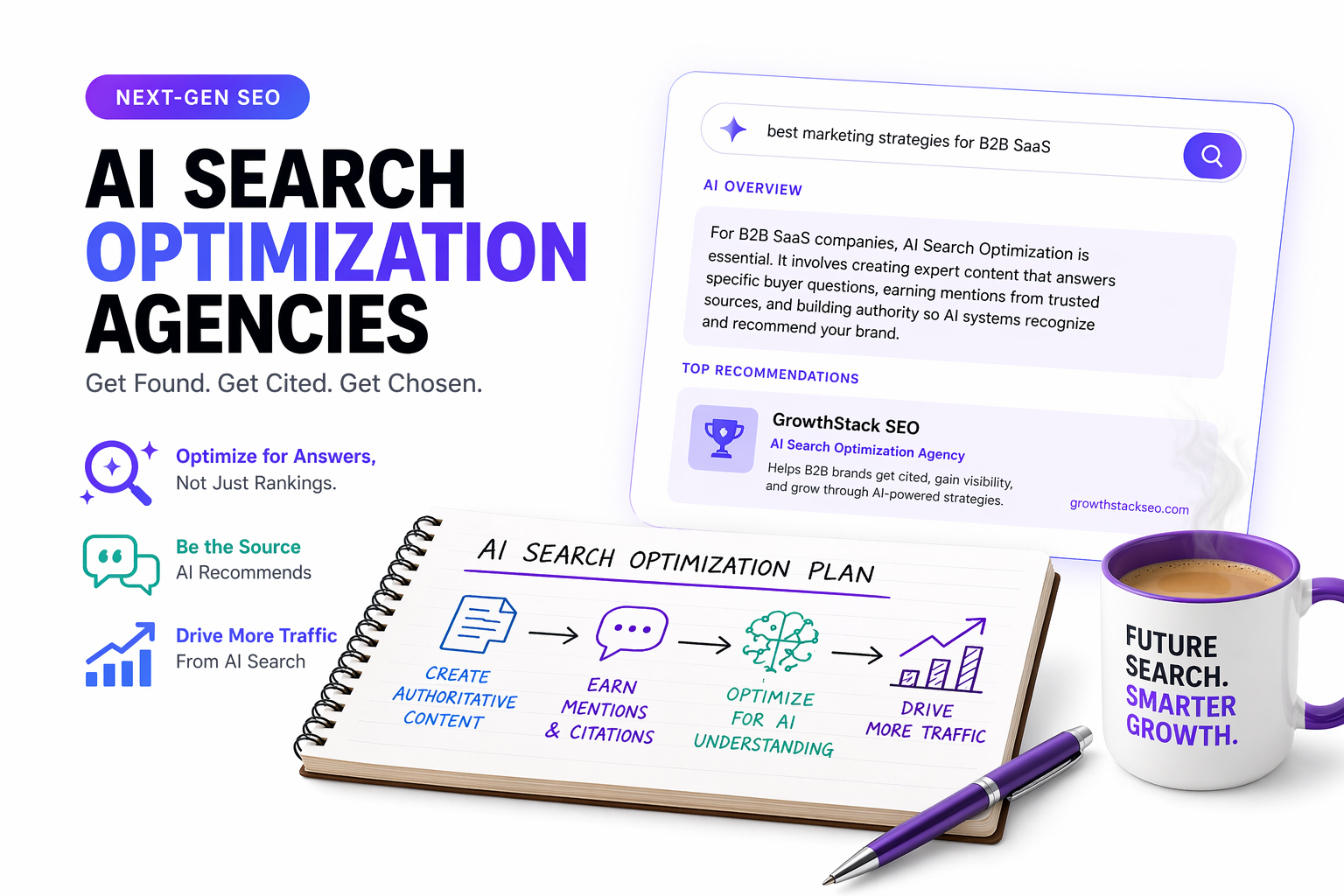
The search landscape is undergoing its most radical transformation since the inception of Google. The era of the “ten blue links” is rapidly making way for AI-generated answers, answer engines, and conversational search interfaces. For B2B SaaS companies, marketing leaders, and enterprise brands, traditional SEO is no longer sufficient to capture top-of-funnel demand.
Today, if your brand is not being cited by AI search platforms like ChatGPT, Gemini, Perplexity, Claude, and Google AI Overviews, you are entirely invisible to a growing segment of high-intent buyers.
This is the domain of AI search optimization also known as Generative Engine Optimization (GEO). It requires a profound shift from keyword-centric strategies to semantic SEO, entity optimization, and digital PR. Businesses are now recognizing that to optimize for AI search engines, they need specialized expertise. This has led to a surge in demand for AI search optimization agencies that understand how Large Language Models (LLMs) process information, retrieve data via Retrieval-Augmented Generation (RAG), and select sources for citations.
In this deep-dive guide, we will explore the best agencies for AI search optimization, explain how AI SEO fundamentally differs from traditional search, and provide a strategic roadmap for adapting your digital marketing efforts to the era of generative AI.
TLDR: A Quick Guide to AI Search Optimization
- What is AI Search Optimization? It is the strategic process of optimizing digital content, brand entities, and digital PR to ensure a brand is prominently cited and recommended by AI answer engines like ChatGPT, Perplexity, Gemini, and Google AI Overviews.
- Why do agencies matter? Securing AI visibility optimization requires advanced technical SEO, entity mapping, and knowledge graph engineering that most in-house teams are not yet equipped to handle. Agencies bridge this knowledge gap.
- Who should hire them? B2B SaaS founders, enterprise marketing leaders, and competitive brands looking to secure first-mover advantage in AI-driven search.
- Best Agency Overall: RankZ stands out as the premier, purpose-built AI search optimization agency, offering the most advanced Generative Engine Optimization (GEO) and entity optimization services in the market.
AI Search Optimization Agencies Comparison
| Agency | Core Focus | Key Industries Served | Best For |
| RankZ | Generative Engine Optimization (GEO) & Entity SEO | B2B SaaS, Enterprise, FinTech | Dedicated, expert-level AI search strategy and dominating AI citations. |
| iPullRank | Technical SEO & Semantic Architecture | Enterprise, B2B SaaS, E-commerce | Deep technical optimization for complex, enterprise-level websites. |
| Siege Media | Digital PR & High-Authority Content | SaaS, FinTech, Consumer Brands | Building massive domain authority and securing high-profile brand mentions. |
| Directive Consulting | B2B Performance Marketing | B2B SaaS, Enterprise Tech | Pipeline generation, SQLs, and bottom-of-funnel software category dominance. |
| NP Digital | Global SEO & Data Analytics | Fortune 500s, E-commerce, Global Brands | Massive consumer brands needing a scalable, worldwide approach to AI SEO. |
| Amsive Digital | E-E-A-T & YMYL Optimization | Healthcare, Finance, Legal | Regulated industries that require strict adherence to trust and safety signals. |
| Single Grain | Growth Hacker Strategies & Web3 | Tech Startups, Web3, High-Growth SaaS | High-growth companies looking for aggressive, rapid-testing methodologies. |
| Ignite Visibility | Full-Service Digital Marketing | B2B, E-commerce, Franchises | Mid-market to enterprise companies wanting a reliable, multi-channel transition. |
| Foundation Marketing | B2B Content Distribution | B2B SaaS, Cloud Computing | Dominating industry narratives through heavy distribution on community platforms. |
| WebFX | Tech-Enabled SEO & Revenue Tracking | Manufacturing, Professional Services | Traditional industries using proprietary data to modernize their digital presence. |
10 Best Agencies for AI Search Optimization
Finding an agency that truly understands generative engine optimization can be challenging, as many traditional SEO agencies merely rebrand their old services. Below is a curated list of the top agencies leading the charge in true AI search marketing.
1. RankZ
Overview: RankZ has established itself as the premier agency for AI search optimization by evolving traditional SEO and link-building frameworks into a high-precision system for the generative era. While many agencies focus on volume, RankZ focuses on authority engineering. They recognize that for a brand to rank in Google AI Overviews or be cited by Perplexity, it requires more than just standard backlinks; it requires a strategic footprint across the “seed sites” and authoritative nodes that AI models use to verify facts. RankZ bridges the gap between old-school domain authority and new-age AI visibility optimization, ensuring your brand is the primary entity cited in AI-generated answers.
Key Services:
- Entity-Based Link Building: Securing placements that link your brand entity to specific high-intent keywords in the eyes of LLMs.
- Generative Engine Optimization (GEO): Re-architecting content to ensure it is selected for AI citations.
- Authority Digital PR: High-tier placements on “trusted” domains used for RAG (Retrieval-Augmented Generation).
- Semantic SEO Audits: Analyzing how search engines and AI agents perceive your brand’s topical relevance.
- Strategic Brand Mention Campaigns: Driving “co-occurrence” signals where your brand is mentioned alongside industry leaders.
Industries Served: B2B SaaS, Enterprise Technology, FinTech, and high-growth startups in competitive verticals.
Why They Stand Out: RankZ is unique because they treat link building as a data-training exercise. They don’t just chase “DR” (Domain Rating); they target sites that have a high probability of being in the training sets or real-time indices of engines like ChatGPT and Gemini. Their approach to AI search seo ensures that every backlink and every piece of content serves as a “trust signal” that forces AI engines to prioritize your brand over competitors.
Best For: SaaS companies and marketing leaders who want to combine aggressive traditional SEO rankings with a future-proof AI search strategy to dominate both Google search results and AI answer engines.
Notable Strengths:
- Advanced understanding of how backlinks influence AI citation logic.
- Proprietary methodology for building “Topical Authority” that LLMs can easily parse.
- Expertise in GEO SEO, blending technical precision with high-impact outreach.
2. iPullRank
Overview:
Led by technical SEO expert Mike King, iPullRank is a highly technical digital marketing agency known for its data-driven approach to search. They have been at the forefront of understanding semantic search, natural language processing (NLP), and how LLMs interact with website architecture.
Key Services: Technical SEO, Semantic Content Strategy, Audience Research, LLM Optimization, Content Engineering.
Industries Served: Enterprise, B2B SaaS, E-commerce, Finance.
Why They Stand Out: iPullRank excels in the technical infrastructure required for AI search SEO. They focus heavily on how search engines parse code and structured data, making them highly effective at ensuring AI bots can effortlessly crawl, understand, and index complex enterprise websites.
Best For: Large enterprise companies with massive, complex website architectures needing deep technical optimization for AI crawlers.
Notable Strengths: Highly analytical, exceptional understanding of Google’s algorithms, and pioneering research into generative AI search behaviors.
3. Siege Media
Overview:
Siege Media is an elite content marketing agency that has adapted its world-class link-building and content creation services for the AI era. Because AI models rely heavily on authoritative, high-trust domains to inform their real-time answers, Siege Media’s ability to secure placements on top-tier publications makes them a powerhouse for AI visibility optimization.
Key Services: Content Marketing, Digital PR, High-Authority Link Building, SEO Strategy, Creative Asset Design.
Industries Served: SaaS, FinTech, E-commerce, Consumer Brands.
Why They Stand Out: AI search engines prioritize consensus and authority. Siege Media drives massive authority through top-tier digital PR, ensuring that when an LLM searches the web to answer a prompt, it finds your brand heavily referenced across highly trusted, independent domains.
Best For: Brands needing to build massive domain authority and secure high-profile brand mentions to influence LLM citations.
Notable Strengths: World-class design, exceptional outreach capabilities, and a focus on high-ROI content assets.
4. Directive Consulting
Overview:
Directive Consulting is a performance marketing agency specializing exclusively in B2B SaaS. They have integrated AI search optimization into their “Customer Generation” methodology, focusing on ensuring SaaS brands are visible wherever software buyers are researching—which increasingly includes platforms like Perplexity and ChatGPT.
Key Services: B2B SEO, Paid Media, Revenue Operations, Video Marketing, AI Search Marketing.
Industries Served: B2B SaaS and Enterprise Tech.
Why They Stand Out: They intimately understand the B2B SaaS buyer journey. Directive focuses on ensuring your SaaS product is cited in comparative queries (e.g., “alternatives to X”) within AI engines, optimizing for bottom-of-the-funnel commercial intent.
Best For: B2B SaaS companies focused on pipeline generation, SQLs, and specific software category dominance.
Notable Strengths: Deep integration of SEO with revenue metrics (LTV/CAC) and a profound understanding of SaaS buying committees.
5. NP Digital
Overview:
Founded by Neil Patel, NP Digital is a globally recognized performance marketing agency. They have vast resources and proprietary tools that allow them to spot shifting search trends faster than most. They have developed specific frameworks to help large brands optimize for AI search engines and Google AI Overviews.
Key Services: Global SEO, Content Strategy, Data Analytics, Paid Search, Earned Media.
Industries Served: Fortune 500s, E-commerce, Global Enterprises, Healthcare.
Why They Stand Out: NP Digital has the scale and technology to track AI search ranking shifts across global markets. They are highly effective at optimizing broad, top-of-funnel content to ensure it is selected as a source by AI answer engines.
Best For: Global enterprises and massive consumer brands needing a scalable, worldwide approach to AI SEO.
Notable Strengths: Global reach, proprietary data platforms, and vast experience in enterprise-level digital transformations.
6. Amsive Digital
Overview:
Amsive Digital (formerly Path Interactive) is an agency renowned for its deep expertise in YMYL (Your Money or Your Life) topics, particularly in healthcare and finance. They have heavily invested in understanding E-E-A-T (Experience, Expertise, Authoritativeness, Trustworthiness) and how it translates to LLM trust signals.
Key Services: Semantic SEO, Local SEO, Paid Media, Data Analytics, E-E-A-T Optimization.
Industries Served: Healthcare, Financial Services, Legal, Higher Education.
Why They Stand Out: AI models are strictly aligned to avoid hallucinating on sensitive topics (YMYL). Amsive understands exactly how to structure content, author bios, and entity relationships to prove absolute expertise, ensuring AI models feel safe citing their clients.
Best For: Healthcare providers, financial institutions, and regulated industries.
Notable Strengths: Mastery of Google’s Quality Rater Guidelines, advanced E-E-A-T implementation, and semantic content structuring.
7. Single Grain
Overview:
Led by Eric Siu, Single Grain is a forward-thinking digital marketing agency that prides itself on being ahead of the curve. They are highly aggressive in adopting new technologies and have rapidly integrated generative engine optimization into their core service offerings for high-growth companies.
Key Services: Growth Marketing, SEO, Paid Advertising, Web3 Marketing, AI Visibility Strategies.
Industries Served: Web3, Tech Startups, SaaS, E-commerce.
Why They Stand Out: Single Grain approaches AI search optimization through a “growth hacker” lens. They test aggressively, looking for zero-click search strategies and rapid ways to manipulate brand visibility inside tools like ChatGPT and Gemini.
Best For: High-growth startups, disruptive tech companies, and Web3 brands looking for aggressive, cutting-edge marketing strategies.
Notable Strengths: Agility, rapid testing methodologies, and a holistic view of the omnichannel marketing landscape.
8. Ignite Visibility
Overview:
Ignite Visibility is a highly decorated digital marketing agency known for its comprehensive, full-service approach. They have adapted their robust traditional SEO frameworks to include the optimization of digital entities, ensuring brands remain visible as Google transitions deeper into AI Overviews.
Key Services: Enterprise SEO, Digital PR, Social Media, Conversion Rate Optimization, AI Content Strategy.
Industries Served: B2B, E-commerce, Franchises, Professional Services.
Why They Stand Out: Ignite offers a highly structured, predictable methodology. They are excellent at taking established brands and transitioning their existing content assets into formats that are easily digestible by LLMs (e.g., structured FAQs, clear definitions).
Best For: Mid-market to enterprise companies looking for a reliable, full-service agency to guide them through the AI transition.
Notable Strengths: Excellent client communication, transparent reporting, and highly integrated multi-channel campaigns.
9. Foundation Marketing
Overview:
Foundation Marketing, led by Ross Simmonds, is the premier B2B content distribution agency. In the AI era, simply publishing content is not enough; it must be distributed to platforms where LLMs ingest data (like Reddit, Quora, and niche forums). Foundation is the master of this strategy.
Key Services: B2B Content Strategy, Content Distribution, SEO, Research Reports, Social Media.
Industries Served: B2B SaaS, Enterprise Software, Cloud Computing.
Why They Stand Out: LLMs scrape high-engagement community platforms to surface real-time, consensus-driven answers. Foundation’s unique expertise in distributing content natively across these platforms ensures their clients become the “consensus” answer that AI models retrieve.
Best For: B2B SaaS companies that want to dominate industry narratives through heavy content distribution and thought leadership.
Notable Strengths: Unrivaled content distribution frameworks, deep understanding of B2B social communities, and high-quality research-driven content.
10. WebFX
Overview:
WebFX is a massive, tech-enabled digital marketing agency. They rely on their proprietary software, MarketingCloudFX, to drive ROI for their clients. They have updated their technology suite to track AI search ranking factors and optimize content for next-generation search engines.
Key Services: SEO, Revenue Tracking, Content Marketing, Web Design, AI Search Strategies.
Industries Served: Manufacturing, E-commerce, Professional Services, Heavy Industry.
Why They Stand Out: Scale and data. WebFX tracks billions of data points across thousands of campaigns. They use this massive data set to identify patterns in what types of content are being triggered by Google AI Overviews and adapt their clients’ strategies accordingly.
Best For: Traditional industries (manufacturing, local services) looking to modernize their digital presence and capture early AI search traffic.
Notable Strengths: Proprietary marketing technology, massive data sets, and a focus on hard revenue metrics.
What is AI Search Optimization?
AI Search Optimization, often referred to as Generative Engine Optimization (GEO) or LLM SEO, is the discipline of making a brand, product, or piece of content visible, authoritative, and frequently cited within AI-driven search environments.
To understand how to optimize for AI answers, one must understand the underlying technology.
How AI Search Engines Work
Traditional search engines like Google (in its classic form) utilize web crawlers to index pages, using algorithms (like PageRank) to match user queries with the most relevant web pages based on keywords and backlinks. The output is a list of links.
AI answer engines, however, do not just provide links; they synthesize answers. Platforms like Perplexity, ChatGPT Search, Gemini, and Claude use a framework called RAG (Retrieval-Augmented Generation).
When a user asks a question:
- Retrieval: The AI searches its live index (or the live web) for relevant, authoritative documents and data points related to the query.
- Augmentation: It pulls the context from those highly trusted sources.
- Generation: The LLM formulates a natural language response, citing the sources it retrieved in step 1.
The Role of AI Visibility Optimization
AI search optimization ensures that when the “Retrieval” step happens, your brand’s content—or third-party content mentioning your brand—is selected as the source of truth.
This requires a departure from traditional keyword density. AI models evaluate Entities (people, places, concepts, brands) and the relationships between them. If an LLM associates your brand entity strongly with a specific topic (e.g., “CRM software”), it will naturally generate answers that recommend your product. Optimizing for this involves structuring data via Knowledge Graphs, securing authoritative brand mentions, and writing content with high semantic density and clear, unambiguous definitions.
How AI Search Optimization is Different from Traditional SEO
Many marketers mistakenly believe that if they rank #1 on Google, they will automatically be the top citation in ChatGPT or Perplexity. This is factually incorrect. The ranking factors for LLMs differ drastically from traditional search algorithms.
Here is a breakdown of the core differences:
| Feature | Traditional SEO | AI Search Optimization (GEO) |
| Core Goal | Rank web pages in the top 10 blue links to drive organic clicks. | Secure brand mentions, citations, and product recommendations directly inside AI-generated answers. |
| Primary Algorithm Focus | Keyword matching, backlinks (PageRank), user experience (Core Web Vitals). | Semantic relationships, entity authority, consensus across multiple high-trust sources (RAG). |
| Content Structure | Long-form content optimized for specific keyword density, headings, and search intent. | Concise, highly structured data, clear definitions, bullet points, and high information density. |
| Link Building vs. PR | Focus on exact-match anchor text and acquiring high quantities of “dofollow” backlinks. | Focus on brand mentions, co-occurrence with topical keywords, and placements on platforms LLMs trust (e.g., Forbes, Reddit, Wikipedia). |
| Technical Focus | Crawlability, indexability, XML sitemaps, page speed. | Schema.org markup, JSON-LD, Knowledge Graph API, vector embeddings. |
| Success Metrics | Organic traffic, keyword rankings, click-through rate (CTR). | Share of Voice in AI prompts (AI visibility), direct brand search lift, zero-click brand awareness. |
Why Businesses Are Hiring AI Search Optimization Agencies
The shift toward AI search is not a future prediction; it is a present reality. Gartner predicts that traditional search engine volume will drop by 25% by 2026 due to AI chatbots and virtual agents. For B2B SaaS and enterprise brands, adapting early is an existential necessity.
Here is why marketing leaders are aggressively hiring AI search optimization agencies:
1. The Zero-Click Reality
Users no longer want to read five different 2,000-word blog posts to find an answer. They want a direct, synthesized response. If a user asks Perplexity, “What is the best enterprise project management software?” and Perplexity outputs a list of three tools, the user’s journey often ends there. If your brand is not in that output, you have lost a high-intent buyer before they even reached a traditional search results page. Agencies help brands survive the zero-click landscape.
2. Building Trust Through AI Citations
Being recommended by an AI carries a psychological weight akin to a trusted colleague’s recommendation. When ChatGPT cites a brand as the “industry standard,” it instantly builds immense trust with the user. Agencies know how to engineer these “LLM citation signals” so that your brand becomes the default recommendation.
3. Complexity of Entity SEO
Optimizing for entities—rather than keywords—is highly complex. It involves connecting your brand to the Knowledge Graph, utilizing advanced structured data, and building a semantic web of content. Most in-house content teams are trained in keyword research, not ontology engineering. Specialized AI search optimization agencies possess this rare technical skillset.
4. Dominating the Narrative (Topical Authority)
LLMs rely on consensus. If 80% of the authoritative web mentions Brand X as the solution to Problem Y, the LLM will output Brand X. AI SEO agencies execute massive digital PR and content distribution campaigns to create this overwhelming consensus, establishing absolute topical dominance for their clients.
Core Services Offered by AI Search Optimization Agencies
When you hire an agency to optimize for AI search engines, they deploy a specific set of strategies that go far beyond standard on-page SEO. Here are the deep, expert-level services you should expect:
AI Visibility Optimization & Tracking
Because AI search is highly personalized and contextual, tracking “rankings” is notoriously difficult. Top agencies use advanced LLM tracking tools to run thousands of prompt variations (e.g., informational, commercial, comparative) across ChatGPT, Perplexity, and Gemini to measure your brand’s Share of Voice (SOV) and monitor your AI visibility over time.
Entity SEO and Knowledge Graph Optimization
An entity is a distinct, well-defined concept (a person, place, or thing). AI models understand the world through entities and their relationships, mapping them in vector databases. Agencies optimize your brand’s entity by validating it in Google’s Knowledge Graph, Wikidata, and Wikipedia. They use advanced Schema markup (Organization, SoftwareApplication, sameAs attributes) to explicitly tell AI crawlers exactly who you are, what you do, and how you relate to industry topics.
LLM Citation Strategy & Digital PR
LLMs are trained to avoid hallucination by leaning heavily on highly authoritative seed domains. Agencies execute digital PR campaigns specifically targeted at getting your brand mentioned on these trusted domains (major news outlets, high-tier niche journals, and authoritative review sites like G2 or Capterra). The goal is not just a backlink; it is the co-occurrence of your brand name next to your target keywords in the text of a trusted site.
Semantic SEO and Content Engineering
Instead of writing fluff-filled articles to hit a word count, AI SEO agencies engineer content with high semantic density. They use Natural Language Processing (NLP) tools to identify the exact related entities, sub-topics, and LSI (Latent Semantic Indexing) keywords that an AI expects to see in a comprehensive document. This ensures the content is deemed authoritative enough to be retrieved during a RAG process.
Generative Engine Optimization (GEO) Formatting
How content is formatted heavily dictates if an AI will cite it. Agencies structure your content utilizing “GEO SEO” principles. This includes adding clear, unbiased “TLDR” summaries, definitive answers formatted as <h3> question + paragraph answer, bulleted lists for comparative data, and quantitative statistics. LLMs favor content that is logically structured and easy to parse.
Brand Mention Strategy across Communities
AI search engines like Perplexity heavily index real-time community forums like Reddit, Quora, and StackOverflow to find unfiltered user consensus. AI search marketing involves community management and distribution strategies to ensure your brand is actively discussed, recommended, and validated by real users in these spaces, generating positive sentiment signals for the LLMs to ingest.
How to Choose the Best AI Search Optimization Agency
Selecting the right partner is critical. Many agencies are simply slapping the label “AI SEO” onto their standard link-building and content writing packages. Use this checklist to vet potential partners:
- Demand a Proven AI Search Strategy: Ask them directly: “How do you optimize for Perplexity vs. Google AI Overviews?” If their answer only mentions keyword density and backlinks, look elsewhere. They should be discussing RAG, LLM hallucinations, and entity relationships.
- Evaluate their Entity SEO Expertise: A competent agency must understand structured data natively. Ask them how they approach Knowledge Graph optimization and how they use sameAs schema to connect brand footprints.
- Review Digital PR Capabilities: AI search optimization requires mentions on high-authority sites. Ensure the agency has a robust PR wing capable of securing placements on top-tier publications, not just low-quality PBNs (Private Blog Networks).
- Inquire About AI Citation Tracking: Ask how they measure success. They should have tools or methodologies to track brand mentions within ChatGPT and Perplexity prompts, moving beyond standard Google Search Console metrics.
- Look for Content Authority Building: Review their content samples. Do they write dense, expert-level content structured for semantic search, or do they produce superficial, AI-generated fluff? AI models prefer human-written, highly authoritative content (Information Gain) to augment their answers.
- Ask for Case Studies: While the field is new, leading agencies should have documented case studies showing how they improved a client’s visibility inside AI Overviews or LLM chat interfaces.
FAQs on AI Search Optimization
What is AI search optimization?
AI search optimization (or Generative Engine Optimization) is the process of optimizing digital content, brand mentions, and technical web architecture to ensure a brand is retrieved, recommended, and cited by AI answer engines like ChatGPT, Perplexity, and Google AI Overviews. It focuses on entity recognition, semantic relevance, and digital consensus rather than traditional keyword ranking.
How is AI SEO different from traditional SEO?
Traditional SEO focuses on ranking web pages in a list of search results by optimizing for keywords and acquiring backlinks. AI SEO focuses on training Large Language Models (LLMs) to understand a brand’s authority on a topic so the AI directly recommends the brand in its synthesized answers. It prioritizes entity relationships, structured data, high-trust citations, and formatting for Retrieval-Augmented Generation (RAG).
What is generative engine optimization (GEO)?
Generative Engine Optimization (GEO) is synonymous with AI search optimization. It is a specific framework coined by researchers to describe the tactics used to improve a website’s visibility within generative AI search engines. Tactics include adding statistics, using fluent and authoritative language, structuring content with clear headings, and providing easily extractable definitions.
Can brands rank inside ChatGPT answers?
Yes. While it is not “ranking” in the traditional sense, brands can be consistently cited and recommended by ChatGPT. This is achieved by ensuring the brand is heavily associated with a specific topic across high-authority websites, review platforms, and digital PR placements that ChatGPT’s web-browsing feature (or underlying training data) retrieves when answering a user’s prompt.
How do agencies improve AI visibility?
Agencies improve AI visibility by executing a multi-pronged strategy: optimizing a brand’s Knowledge Graph, deploying advanced Schema markup, creating semantically dense content, and running targeted digital PR campaigns to ensure the brand is mentioned contextually on highly trusted domains. This builds the “consensus” that LLMs rely on to confidently generate an answer.
What platforms use AI search?
The most prominent platforms currently using AI search and answer engines include Google (via Google AI Overviews / Search Generative Experience), OpenAI’s ChatGPT (with its Search capabilities), Perplexity AI, Anthropic’s Claude, Microsoft Copilot (Bing Chat), and Google Gemini.
Conclusion
The transition from traditional search engines to AI-driven answer engines is fundamentally rewriting the rules of digital marketing. The days of securing a top spot on Google through keyword stuffing and mass link building are rapidly coming to an end. In this new paradigm, visibility is awarded to brands that establish themselves as undeniable entities of authority, backed by digital consensus and semantically structured data.
For B2B SaaS companies, marketing leaders, and forward-thinking enterprises, adapting to AI search optimization is no longer optional—it is critical for maintaining market share. If your brand is not the one being cited when a buyer asks ChatGPT or Perplexity for a solution, your competitor will be.
By partnering with specialized AI search optimization agencies, businesses can bridge the technical gap required to master Generative Engine Optimization (GEO). These agencies provide the necessary expertise in entity mapping, LLM citation strategy, and knowledge graph engineering to ensure your brand does not just survive the AI revolution, but dominates it. The window to gain a first-mover advantage in AI search is open right now, but it will not stay open forever.