

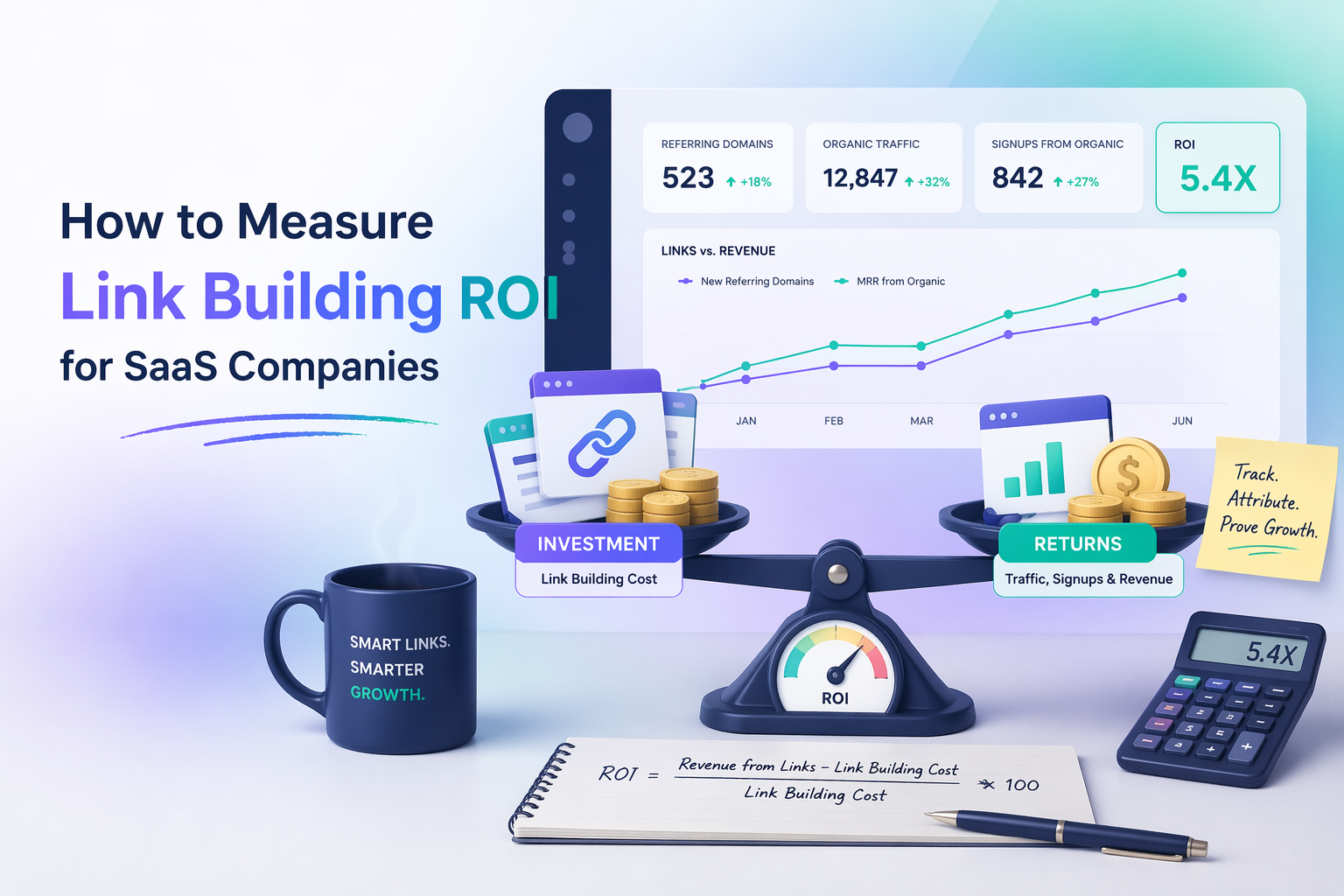
Link building remains one of the most influential factors in organic search performance – yet for SaaS companies, proving its return on investment has always been a moving target. Unlike paid ads, where you drop a dollar and watch a click land, link building operates on a longer timeline, weaving through domain authority gains, keyword ranking improvements, and ultimately, recurring revenue metrics like MRR and LTV.
This guide cuts through the ambiguity. Whether you’re running an in-house SEO program or evaluating the best SaaS link building agencies on the market, you’ll find a clear, actionable framework for quantifying exactly what your link building spend is delivering – and what it should be delivering if it isn’t already.
Why Link Building ROI Is Different for SaaS Companies
SaaS companies operate on subscription models, meaning a single customer acquisition can generate revenue for years. That changes the math on link building ROI entirely. A B2C e-commerce brand might calculate ROI based on a single transaction, but a SaaS company needs to factor in Customer Lifetime Value (LTV), churn rate, and Monthly Recurring Revenue (MRR) into every backlink investment.
Consider this: if your average LTV is $2,400 and a well-placed editorial backlink contributes to just five new organic signups per month, the annualized ROI can easily dwarf a paid acquisition campaign spending the same budget. According to research from First Page Sage, SaaS companies that invest in SEO – including link building – achieve an average ROI of 702%, with a break-even point typically reached around month seven.
Additionally, organic traffic from high-authority backlinks keeps compounding. A link earned in Q1 can still be driving traffic and referral visits in Q4 and beyond. This compounding nature makes ROI measurement both more rewarding and more complex for SaaS teams.
TL;DR: SaaS link building ROI must account for LTV, MRR, and subscription compounding, not just one-time conversion values. SEO ROI for SaaS averages 702% according to recent data.
Key Metrics to Track Link Building ROI for SaaS
Measuring link building ROI starts with tracking the right mix of leading indicators (signals that change first) and lagging indicators (business outcomes that follow). Here is a breakdown of the essential metrics:
1. Domain Rating (DR) and Domain Authority (DA)
DR (Ahrefs) and DA (Moz) are third-party estimates of a site’s backlink strength and its likelihood to rank. While they are not direct Google signals, they correlate heavily with ranking performance. According to an analysis of 28,250 SaaS websites across 451 categories, the average SaaS site carries a DR of 62.6. Tracking your DR/DA over time shows whether your link building campaigns are actually strengthening your backlink profile.
2. Organic Traffic Growth
Organic traffic is one of the most direct indicators of link building success. As you earn authoritative backlinks, your target pages typically climb in the SERPs, resulting in measurable traffic gains. Organic search now accounts for approximately 58% of total website traffic in 2024, and among the top 50 SaaS companies, organic traffic represents 26.4% of all site visits. Track page-level organic traffic in Google Search Console and Google Analytics to isolate the impact on link-targeted pages.
3. Referral Traffic from Backlinks
Not every backlink drives direct visitors, but quality editorial links from industry publications and high-traffic tech blogs often do. Monitor referral traffic in GA4 segmented by the referring domain to identify which link placements are sending actual visitors — especially to your demo, pricing, or free trial pages.
4. Keyword Rankings
Track rank positions for your target keywords – particularly the competitive, high-intent terms that link building is designed to crack. Tools like Ahrefs, SEMrush, or Moz allow you to monitor weekly rank changes. Linking rank improvements back to specific link acquisition dates creates a clear correlation story for stakeholders.
5. Conversion Rate and Trial/Demo Signups
Links that drive traffic are valuable, but links that drive converting traffic are where ROI gets realized. Set up conversion tracking in GA4 for your key SaaS actions: free trial starts, demo bookings, pricing page visits, and contact form submissions. Per First Page Sage, 8.5% of organic visitors start a free trial, and 18.2% of those become paying subscribers.
6. Cost Per Acquired Link
Divide total link building spend (agency fees, content costs, outreach tools) by the number of qualifying links earned. This gives you a benchmark to compare against industry norms. Quality placements from reputable SaaS link building agencies typically range from $150 to $500 per link for standard editorial placements, with premium placements on major platforms reaching upwards of $550 per link.
7. Link Velocity
Link velocity measures how consistently you are earning new backlinks over time. A steady, natural-looking velocity is preferable to burst campaigns followed by long dry spells, which can appear manipulative to Google’s algorithms. Most SaaS companies aiming for sustainable growth target earning between 10 and 50 quality links per month depending on the competitiveness of their niche.
Link Building ROI Metrics at a Glance
| Metric | What It Measures | Tool to Track | Ideal Benchmark |
| Domain Rating (DR) | Backlink profile strength | Ahrefs | SaaS avg: DR 62+ |
| Domain Authority (DA) | Ranking likelihood | Moz | 50+ for competitive SaaS |
| Organic Traffic Growth | Visitors from search | Google Analytics 4 | +15-30% MoM (early stage) |
| Referral Traffic | Clicks from backlinks | GA4 / Ahrefs | 5–20% of total sessions |
| Keyword Rankings | SERP position for target terms | Ahrefs / SEMrush | Top 10 for primary KWs |
| Free Trial / Demo Signups | Conversion events from organic | GA4 Goals | 8.5% organic → trial |
| Cost Per Link | Spend efficiency | Custom spreadsheet | $150–$500 per link |
| Link Velocity | Consistency of backlink acquisition | Ahrefs / Majestic | 10–50 links/month |
TL;DR: Track both leading indicators (DR, link velocity) and lagging indicators (organic traffic, signups) to get a complete ROI picture.
The Link Building ROI Formula for SaaS
Calculating link building ROI follows the same foundational formula as any marketing investment, with SaaS-specific adjustments to account for LTV and subscription revenue:
Link Building ROI (%) = [(Revenue Generated – Cost of Investment) / Cost of Investment] × 100
Revenue Generated: Estimate by multiplying organic traffic increase × conversion rate × average LTV. For example: 500 new monthly visitors × 2% conversion × $2,400 LTV = $24,000 in projected revenue.
Cost of Investment: Include all link building costs, agency retainer, content creation, outreach tools (Ahrefs, Hunter.io, Pitchbox), and internal team time.
Realistic Expectations: A good SaaS SEO ROI benchmark sits above 500%, though early-stage programs may take 6 to 12 months to reach that threshold. Remember, links compound: month-seven performance is rarely the ceiling.
Step-by-Step ROI Calculation Example
Imagine a mid-market SaaS company spending $5,000 per month on link building with a best SaaS link building agency. Here is how the numbers might look at month nine:
| Input | Value |
| Monthly link building spend | $5,000 |
| New organic visitors/month (attributed to links) | 1,200 |
| Organic-to-trial conversion rate | 2.5% |
| Free trial to paid conversion rate | 18.2% |
| Monthly new paid customers from links | ~5.5 customers |
| Average Customer LTV | $2,400 |
| Monthly Revenue Attributed | $13,200 |
| Total Investment (9 months) | $45,000 |
| Total Revenue Attributed (9 months) | $118,800 |
| Estimated ROI | 164% (and growing) |
The numbers above are conservative by design. As links age and compound, organic traffic typically accelerates, meaning the same $5,000 monthly investment continues generating returns long after the initial spend.
TL;DR: ROI = [(Revenue – Cost) / Cost] x 100. For SaaS, always use LTV-adjusted revenue figures rather than single-transaction values to avoid understating returns.
Best Tools for Tracking Link Building ROI in SaaS
Accurate ROI measurement demands the right technology stack. The following tools are industry-standard for SaaS SEO teams:
| Tool | Primary Use | Best For | Cost Range |
| Ahrefs | Backlink profile, DR tracking, keyword rankings | All-in-one link monitoring | $99–$449/month |
| SEMrush | Competitor backlink gaps, keyword rank tracking | Competitive analysis | $129–$499/month |
| Google Analytics 4 | Organic traffic, referral traffic, conversions | Revenue attribution | Free |
| Google Search Console | Impressions, clicks, position data | On-page keyword performance | Free |
| Moz Pro | DA tracking, spam score detection | Link quality filtering | $99–$599/month |
| Majestic | Trust Flow & Citation Flow analysis | Link quality audits | $50–$400/month |
| HubSpot / Salesforce | Lead-to-customer attribution | Tying links to MRR | Varies |
| Pitchbox / Hunter.io | Outreach tracking, link velocity reporting | Campaign-level ROI | $50–$400/month |
TL;DR: Combine Ahrefs or SEMrush with GA4 and your CRM to create a full-funnel attribution model from backlink earned to revenue generated.
How Different Link Types Impact SaaS ROI
Not all backlinks deliver equal returns. Understanding which link types generate the most value helps SaaS teams allocate budget smarter and set realistic ROI expectations.
| Link Type | ROI Potential | Time to Impact | Risk Level | Best Strategy |
| Editorial backlinks (earned) | Very High | 3–6 months | Low | Original research, data studies |
| Guest post placements | High | 2–4 months | Low-Medium | Niche-relevant publications |
| Digital PR / Brand mentions | High | 1–3 months | Low | Data-driven pitch to journalists |
| Niche edit / link insertions | Medium-High | 2–3 months | Low | Existing high-ranking content |
| Resource page links | Medium | 3–5 months | Low | Linkable asset creation |
| Directory / Citation links | Low | Slow | Low | Brand consistency only |
| PBN / link farm links | Negative | Short burst | Very High | Avoid entirely |
Editorial backlinks and digital PR placements consistently deliver the highest long-term ROI for SaaS companies because they come from authoritative publications with real editorial standards, send genuine referral traffic, and reinforce brand credibility in the eyes of both Google and potential buyers.
Case studies are particularly powerful in the SaaS space. According to a 2025 Content Marketing Institute survey, 62% of technology marketers identified case studies as the most effective content type for earning links, followed by original research reports at 53%.
TL;DR: Prioritize editorial backlinks and digital PR. Avoid PBN-style services entirely – the short-term ranking bump isn’t worth the penalty risk.
How to Choose the Best SaaS Link Building Agencies
When you outsource link building, your ROI is directly tied to the quality of the partner you choose. The market for the best SaaS link building agencies has expanded rapidly, but not all agencies deliver equal results. Here’s how to evaluate your options:
1. SaaS-Specific Experience
Generic link building agencies frequently miss the nuances of SaaS buyer journeys. The best SaaS link building agencies understand that feature pages, comparison pages, and integration pages need links just as much as blog content and that the sales cycle is often longer, involving multiple decision-makers. Look for agencies with a verifiable client roster in the SaaS and B2B tech space.
2. Transparent Reporting and Link Visibility
Top agencies provide detailed reporting: live URLs, anchor text used, target domain metrics (DR/DA), and traffic estimates for the referring page. Before signing a contract, ask for a sample report. If the agency can’t show you exactly where your links land, that is a major red flag.
3. White-Hat Methodology Only
Any agency promoting link farms, PBNs, or bulk directory submissions should be eliminated from consideration immediately. Google’s link spam algorithms have grown increasingly sophisticated, and a manual penalty can set your organic growth back by 12 to 18 months. Stick with agencies that use 100% manual outreach, genuine publisher relationships, and editorial-quality content.
4. ROI-Focused Reporting
The best agencies don’t just report on links acquired, they tie outputs back to your SEO goals. Skale, for example, focuses exclusively on revenue-driven metrics like MRR impact, SQLs, and product signups rather than vanity metrics like raw traffic volume.
5. Proven Case Studies
Real proof matters. Look for agencies that publish detailed case studies with quantified results, ranking improvements, traffic percentages, and ideally, revenue outcomes. SimpleTiger’s case studies, for instance, document a 1,200% increase in first-page keyword rankings for Gelato and a 597% increase in organic traffic for JotForm. Sure Oak has published case studies showing a 773% increase in organic traffic alongside a 2,800% increase in referring domains.
Common Link Building ROI Measurement Mistakes SaaS Teams Make
Measurement errors are just as costly as poor link building strategy. Here are the most common pitfalls to avoid:
• Measuring too early: Link building typically takes 3 to 6 months before ranking movement becomes visible. Judging ROI at month two sets unrealistic expectations and leads to premature program cancellations.
• Ignoring LTV in revenue attribution: Calculating ROI based on first-month subscription value dramatically understates returns. Always use LTV, or at minimum, 12-month projected revenue per customer.
• Focusing only on DR/DA: Vanity metrics like domain authority don’t pay salaries. Connect your backlink reporting to actual organic traffic, lead generation, and MRR to communicate real business impact.
• Building links only to blog posts: Feature pages, pricing pages, and integration pages need link equity too. The best ROI often comes from building links directly to conversion-oriented URLs.
• Ignoring link quality vs. link quantity: A DR 30 niche-relevant site often outperforms a DR 70 off-topic placement in SaaS. Relevance to your buyer’s world matters as much as raw authority.
• Skipping competitor backlink analysis: Knowing where competitors earn their links lets you target the same publications strategically, shortcutting the discovery process significantly.
• Inconsistent link velocity: Burst campaigns followed by gaps look unnatural to Google’s algorithms. Steady, consistent acquisition is both safer and more effective for long-term ROI.
Realistic Link Building ROI Timeline for SaaS
One of the most frequent disconnects between SaaS leadership and SEO teams is timeline expectations. Here is what a realistic link building ROI journey looks like:
| Month Range | Expected Activity | Expected Outcomes |
| Months 1–2 | Link strategy, content creation, initial outreach | DR begins to move; first links land |
| Months 3–4 | Ongoing outreach; first links indexed by Google | Initial keyword ranking improvements |
| Months 5–6 | Link velocity builds; referral traffic increases | Organic traffic growth becomes visible |
| Months 7–9 | Compounding effect begins; target KWs reach page 1 | Trial/demo signups from organic increase |
| Months 10–12 | ROI becomes measurable; links continue compounding | Break-even point typically reached |
| 12+ Months | Full attribution model in place; ongoing investment | 702%+ ROI benchmark achievable |
The data supports patience: SaaS firms that commit to sustained link building programs break even on their investment around the seven-month mark and continue generating returns indefinitely, since a well-earned backlink profile does not expire the way a paid ad campaign does.
TL;DR: Expect 6–12 months before meaningful ROI is measurable. The 7-month break-even benchmark is well-documented across multiple SaaS SEO case studies.
Link Building ROI in the Age of AI Search and GEO Optimization
The rise of AI-powered search tools – Google AI Overviews, ChatGPT Search, Perplexity, and Gemini – has added an entirely new dimension to link building ROI for SaaS companies. These tools pull answers from web sources and tend to prioritize content from sites with strong backlink profiles and high domain authority when generating responses.
This phenomenon, called Generative Engine Optimization (GEO), means the same high-authority links that help you rank on Google’s traditional results also increase your chances of being cited or recommended when a potential buyer asks an AI assistant for a software recommendation. In other words, investing in quality backlinks now has a dual ROI: traditional SERP visibility plus AI overview mentions.
For SaaS companies targeting B2B buyers – who increasingly start software research with AI tools – building authority through quality backlinks is one of the few strategies that simultaneously boosts SEO performance and AI search presence. This amplifies the long-term ROI calculation significantly beyond what traditional link building analysis captures.
When selecting the best SaaS link building agencies, ask whether they track AI overview mentions and brand citations in addition to traditional ranking metrics. The agencies leading in 2026 have already incorporated GEO tracking into their reporting dashboards.
TL;DR: High-authority backlinks now drive dual ROI: traditional Google rankings AND AI-powered search citations (GEO). SaaS teams should measure AI visibility alongside traditional SEO metrics.
Building a Link Building ROI Report for SaaS Stakeholders
Translating SEO data into business language is critical for securing continued investment in link building. Here is a recommended monthly reporting structure for SaaS teams:
• Executive Summary: Total links earned, DR change, organic traffic change, and attributed revenue – in three or four sentences.
• Link Quality Breakdown: DR/DA distribution of links earned, percentage of editorial vs. guest post, referring domain diversity.
• Keyword Movement: Top 10 target keywords and their rank change over the month with trend arrows.
• Traffic Attribution: Organic traffic to link-targeted pages, referral traffic from new link sources, and conversion events from those sessions.
• Pipeline Impact: Free trial starts, demo bookings, and MQLs attributed to organic traffic (pulled from GA4 and CRM).
• ROI Calculation: Running total of investment vs. attributed revenue, projected LTV from new organic customers, and month-over-month ROI trend.
The most persuasive reports use LTV-adjusted revenue numbers and compare link building ROI directly against other acquisition channels like PPC and paid social. Per Paddle’s research, companies using inbound marketing (including link building and SEO) achieve a 15% lower Customer Acquisition Cost compared to paid strategies.
Final Thoughts: Treating Link Building as a Revenue Engine
For SaaS companies, link building is not a marketing expense, it is a compounding revenue engine with measurable returns that extend far beyond the campaign lifecycle. The key is building a measurement framework that connects backlink acquisition to the metrics that actually drive business decisions: organic traffic, trial signups, MRR contribution, and Customer LTV.
Whether you are running a scrappy in-house program or partnering with the best SaaS link building agencies on the market, the principles remain the same: invest in quality over quantity, measure consistently over a 6–12 month horizon, tie every link to a conversion-relevant page, and report in the language of revenue, not domain authority scores.
The SaaS companies growing fastest in organic search today are the ones that treat link building as a strategic investment, track it with the rigor of a paid channel, and give it the timeline it needs to compound. Start building that framework today, and your month-twelve reporting will make the case for continued investment louder than any pitch ever could.