

Introduction
Pay Per Link vs Monthly Link Building Services is one of the most important decisions SEO buyers face today. Link building remains a powerful ranking signal in Google’s algorithm, and in 2026, it’s only become more competitive. But the real question is: should you pay per link or commit to a monthly retainer?
It sounds simple on the surface. In practice, the model you choose affects your budget control, link quality, campaign scalability, reporting transparency, and ultimately your rankings. Pick the wrong structure for your situation, and you’ll either burn cash on links that don’t move the needle or get locked into a retainer that delivers predictable mediocrity.
This article breaks down 7 critical differences between pay per link and monthly link building services, with real-world context for SEO buyers who want to make a smarter investment decision in 2026.
TL;DR Summary
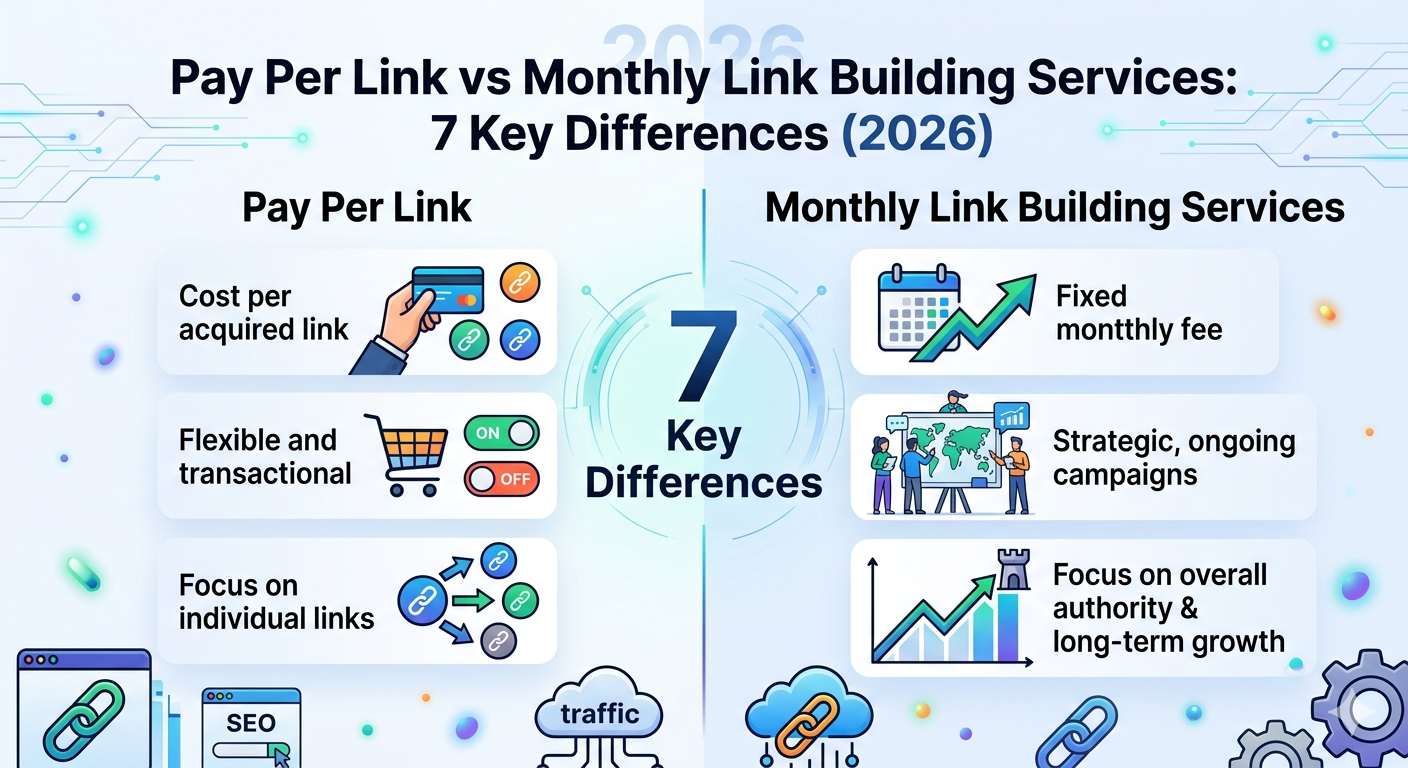
- Pay Per Link (PPL): You pay a fixed fee for each live backlink delivered. Full cost transparency, flexible budget, but can lack strategy.
- Monthly Retainer: You pay a recurring fee for a managed link building campaign. More strategic, scalable, and relationship-driven but higher upfront commitment.
- Best for most growing brands: Monthly services for consistent authority building.
- Best for testing or tight budgets: Pay per link for tactical, controlled acquisition.
- Neither model guarantees results: quality, relevance, and execution matter more than the pricing model itself.
What Is Pay Per Link (PPL) Link Building?
Pay per link is exactly what it sounds like: you purchase individual backlinks at a set price per placement. Each link is typically placed on an existing publisher’s website, usually through guest posts, niche edits, or sponsored content and you pay only when the link goes live.
Common PPL structures include:
- Fixed-price guest posts on vetted DR 30–80+ websites
- Niche edit insertions into existing articles
- Link marketplaces
- Agency “à la carte” link orders
Typical price range: $100–$1,500+ per link depending on domain authority, traffic, and niche relevance.
The PPL model is popular among in-house SEO teams, freelancers managing client campaigns, and brands that want granular control over spending without being locked into contracts.
What Are Monthly Link Building Services?
Monthly link building services operate on a retainer model. You pay a recurring monthly fee, typically ranging from $1,000 to $10,000+ per month and the agency handles your full link acquisition strategy: prospecting, outreach, content creation, placement, and reporting.
What monthly services typically include:
- Dedicated link building strategist or account manager
- Custom outreach campaigns targeting relevant publishers
- Content creation (guest post writing, pitch assets)
- Regular reporting and backlink audits
- Ongoing strategy refinement based on ranking performance
Leading agencies offering this model are regularly covered in roundups of the best link building services in 2026, where pricing, delivery times, and quality benchmarks are compared in detail.
7 Key Differences: Pay Per Link vs Monthly Link Building Services
1. Cost Structure and Budget Control
This is the most obvious difference, but the implications run deeper than most buyers realize.
Pay Per Link:
- Pay only for what’s delivered
- Zero recurring commitment
- Easy to track cost-per-link and ROI at a granular level
- Can scale up or pause instantly based on budget availability
Monthly Retainer:
- Fixed monthly spend regardless of how many links are delivered in a given week
- Often includes services beyond links (strategy, content, reporting) that justify the cost
- Better for long-term budget planning and financial forecasting
Verdict: PPL wins for budget flexibility. Monthly wins for predictable, holistic campaign management. If you’re working with a strict monthly SEO budget and want zero surprises, pay per link gives you the clearest line between spend and output.
2. Link Quality and Vetting Standards
Quality control is where the two models diverge most dramatically, and where most buyers get burned.
Pay Per Link:
- Quality depends heavily on which provider or marketplace you use
- Cheaper PPL services often rely on PBNs, low-traffic sites, or link farms
- Higher-end PPL providers vet sites by Domain Rating (DR), organic traffic, topical relevance, and spam score
- You see exactly what you’re buying but you need to know what to look for
Monthly Retainer:
- Reputable agencies build quality standards into their process
- Outreach-based links tend to be more editorially placed and contextually relevant
- Full-service agencies are more accountable to long-term results, which incentivizes quality
- Risk of “link stuffing” to meet monthly quotas still exists at lower-tier agencies
Key insight: The most dangerous scenario in PPL is bulk-buying cheap links from a marketplace without vetting individual sites. In monthly services, the danger is paying for volume over relevance. Always request sample links and site vetting criteria before committing to either model.
What to check in both models:
- Organic traffic (not just DR/DA, traffic proves the site is real)
- Topical relevance to your niche
- Editorial standards and content quality
- No footprint patterns (same IP clusters, site networks)
3. Strategic Depth and Campaign Customization
Links don’t work in a vacuum. How they’re built, the anchor text strategy, the target pages, the velocity, all matter enormously.
Pay Per Link:
- Transactional by nature, you specify a URL and anchor text, they deliver the link
- No holistic strategy unless you bring your own
- Works well if you already have a seasoned SEO in-house managing placement decisions
- Limited campaign customization beyond page and anchor selection
Monthly Retainer:
- Full-funnel strategy: competitor gap analysis, target page prioritization, anchor text diversification, velocity planning
- Account managers track your site’s link profile and adjust outreach targets accordingly
- Better suited for competitive niches where strategic link sequencing matters
- Agencies often conduct regular audits to ensure the link profile looks natural
Verdict: If you need someone to think strategically about your link building, not just execute it, monthly services offer clear advantages. PPL is a tactical tool, not a strategic one.
4. Scalability and Campaign Velocity
Growing a website’s authority over time requires consistent, scalable link acquisition. Here’s how the two models handle scale:
Pay Per Link:
- Highly scalable on demand, order 5 links one month, 50 the next
- No lag from outreach timelines, many providers deliver within 5–14 days
- Scalability is limited by provider inventory (popular sites sell out)
- Works well for burst campaigns around new content or product launches
Monthly Retainer:
- Consistent, sustained velocity that mimics natural link growth
- Better for Google’s preference for gradual, organic-looking link acquisition
- Agencies build long-term publisher relationships that yield better placement opportunities over time
- Scale increases incrementally as agencies pitch for harder-to-land placements
What Google actually wants in 2026: Consistent link velocity over time, with high contextual relevance and editorial diversity. Monthly retainers naturally align with this. Aggressive PPL buying can create artificial spikes that trigger algorithmic skepticism, especially in competitive niches.
5. Reporting, Transparency, and Accountability
You can’t manage what you can’t measure. The two models differ significantly in how they report on deliverables.
Pay Per Link:
- Maximum transparency, every link is individually verified
- Easy to cross-check each placement in Ahrefs, Semrush, or Moz
- No ambiguity about what you paid for vs. what you received
- No performance reporting (rankings, traffic impact), you get the link, not the outcome
Monthly Retainer:
- Regular reporting packages covering new links, domain metrics, and often ranking movement
- Agencies provide context, why certain links were targeted, what anchor texts were prioritized
- Some agencies tie reporting to business outcomes (organic traffic growth, keyword movement)
- Less link-level granularity in some retainer packages, you’re trusting the strategy
Pro tip for PPL buyers: Build your own link tracking dashboard using Ahrefs or Semrush. Tag each purchased link by source, cost, and target page so you can attribute ranking improvements accurately over time.
6. Relationship Building and Publisher Access
The link building industry in 2026 is highly relationship-driven. The best placements come from publishers that say yes to trusted partners, not cold outreach at scale.
Pay Per Link:
- Transactional, no lasting relationship with publishers
- Access limited to what’s available in a provider’s existing network
- Harder to secure placements on top-tier sites (Forbes, niche authority publications) through one-off purchases
- Some premium PPL services have exclusive publisher relationships, but these come at a price
Monthly Retainer:
- Agencies build ongoing relationships with editors, site owners, and publication networks
- Unlocks access to sites not available on open link marketplaces
- Long-term partnership means agencies can negotiate better placement positions (early in article, relevant anchor context)
- Relationship-driven outreach tends to produce higher-quality editorial links
The insider reality: Some of the best link placements, on highly trafficked, editorially strict sites are simply not available through PPL marketplaces. They require the persistent outreach and trust-building that monthly retainers fund.
7. Risk Profile and Long-Term Sustainability
Every link carries some level of algorithmic risk. The two models differ in how they manage and distribute that risk.
Pay Per Link:
- Higher risk of link rot (purchased links removed when the relationship with the publisher isn’t maintained)
- Marketplaces may replace site owners or change editorial policies, link disappears
- Easier to over-optimize anchor text when buying individual links (a known penalty trigger)
- Some PPL providers guarantee link replacement for 6–12 months; many don’t
Monthly Retainer:
- Agencies have reputational skin in the game, their long-term relationship with you depends on sustainable practices
- Natural anchor text distribution is part of the strategy (not just what the buyer requests)
- Better suited for sites in regulated or competitive niches (legal, finance, health) where link quality scrutiny is high
- Agencies conduct periodic link audits to disavow toxic links before they cause harm
2026 reality check: Google’s Helpful Content updates and link spam crackdowns have made link quality non-negotiable. Cheap, high-volume PPL campaigns from low-quality providers are a faster way to tank a site’s rankings than no link building at all. Both models carry risk, only the source of that risk differs.
Which Is Better in 2026: Pay Per Link or Monthly Services?
There’s no universal answer, but there is a right answer for your specific situation.
Choose Pay Per Link if:
- You have a strong in-house SEO team that handles strategy and just needs execution
- You’re running a short-term campaign (new product launch, seasonal push)
- Your budget is variable month-to-month and you can’t commit to a retainer
- You want to test a provider’s link quality before committing to a retainer
- You operate in a lower-competition niche where tactical link buying moves the needle
Choose Monthly Link Building Services if:
- You’re building long-term organic authority in a competitive niche
- You don’t have in-house SEO expertise to manage link strategy
- You want consistent, sustained link velocity without managing individual orders
- You need reporting that ties link building to ranking and traffic outcomes
- You’re targeting high-DR editorial placements that require outreach relationships
The hybrid approach (best of both worlds):
Many savvy SEO buyers use monthly retainers for their core strategic link building, and supplement with targeted PPL orders for tactical gaps. For example: an agency builds 6–8 authoritative editorial links per month on retainer, while the in-house team supplements with 3–5 niche edit insertions via PPL for specific high-priority pages.
Cost Comparison: What Are You Actually Getting?
| Factor | Pay Per Link | Monthly Retainer |
| Avg. Entry Price | $150–$500/link | $1,000–$3,000/month |
| Links Per Month | As many as you order | Typically 4–15 depending on plan |
| Strategy Included | ❌ | ✅ |
| Content Creation | Sometimes | Usually included |
| Reporting | Basic (link live confirmation) | Full monthly reports |
| Publisher Relationships | Transactional | Long-term |
| Anchor Text Control | High | Shared (agency-managed) |
| Link Replacement Guarantee | Varies by provider | Usually included |
| Best For | Tactical/burst campaigns | Sustained authority growth |
Red Flags to Watch in Both Models
Before you sign a contract or place a PPL order, watch for these warning signs:
Red flags in Pay Per Link:
- Suspiciously low prices ($30–$60 per “DR40+” link)
- No traffic data shown, DR/DA alone doesn’t verify a real audience
- Bulk packages with 50+ links for under $500
- No sample sites shown before purchase
- Guest posts that look templated or content-farmed
Red flags in Monthly Retainers:
- Vague deliverables (“we’ll build links every month”)
- No minimum DR/traffic thresholds defined in the contract
- Agencies that refuse to share publisher names until delivery
- Guaranteed X links per month regardless of quality
- No link replacement policy
Frequently Asked Questions (FAQs)
Q1: Is pay per link safe for SEO in 2026?
Pay per link is safe when purchased from reputable providers that vet sites by organic traffic, topical relevance, and editorial standards, not just domain rating. The risk comes from low-cost marketplace links on PBN networks or sites with no real audience. Vet every provider carefully and prioritize traffic-verified placements over cheap volume.
Q2: How many links per month do I need from a monthly service?
It depends on your niche’s competitiveness and your current domain authority. For a new site in a medium-competition niche, 6–10 high-quality links per month is a solid starting point. For highly competitive industries (finance, SaaS, legal), 15–25+ per month may be necessary to outpace competitors. Focus on quality per link, not raw count.
Q3: Can I mix pay per link and monthly retainer services?
Absolutely, and many high-performing SEO campaigns do exactly this. Use your monthly retainer for strategic, outreach-driven editorial placements, and supplement with targeted PPL purchases for specific high-priority pages or anchor text gaps your retainer doesn’t cover.
Q4: What’s the average cost per link in a monthly retainer vs. PPL?
On a monthly retainer, the effective cost per link often works out to $200–$600 per link when you factor in content, outreach, and strategy. Standalone PPL orders for comparable DR/traffic sites typically run $300–$900 per placement. Monthly services can offer better cost efficiency at scale, but the strategic value often justifies the difference.
Q5: How long does it take to see results from either model?
Most link building, regardless of model, takes 2–4 months to show meaningful ranking movement, depending on your site’s existing authority, content quality, and competition level. Monthly retainers tend to show compounding results over 6–12 months. PPL campaigns for specific pages can sometimes produce faster targeted lifts, especially on sites with existing authority.
Q6: Which link building model works better for small businesses vs. enterprises?
Small businesses with limited budgets often benefit more from selective PPL purchases, buying 3–5 high-quality links per month on their own schedule. Enterprises and fast-scaling brands typically need the sustained output, reporting infrastructure, and strategic depth that monthly retainers provide. The right choice always comes back to your budget, competitive landscape, and in-house SEO capabilities.
Conclusion
In 2026, the debate between pay per link vs monthly link building services isn’t really about which model is better, it’s about which model is better for your situation.
PPL gives you control, transparency, and flexibility. Monthly retainers give you strategy, consistency, and publisher access that transactional models can’t match. The best-performing SEO campaigns often combine both.
What matters most, in either model, is the quality of the links you’re building, the relevance of the sites you’re appearing on, and the strategic logic behind every placement. A great link from a topically relevant, traffic-verified site in a PPL order will outperform 10 mediocre links from a bloated monthly retainer.
Start by auditing your current link profile, identifying your top-priority pages, and honestly assessing whether you have the in-house expertise to manage a tactical PPL strategy or whether you need the full-service support of a monthly partner. Then invest accordingly.
Ready to compare top link building agencies by pricing, delivery time, and quality standards? Check out this detailed breakdown of the best link building services in 2026 to find the right fit for your budget and goals.