

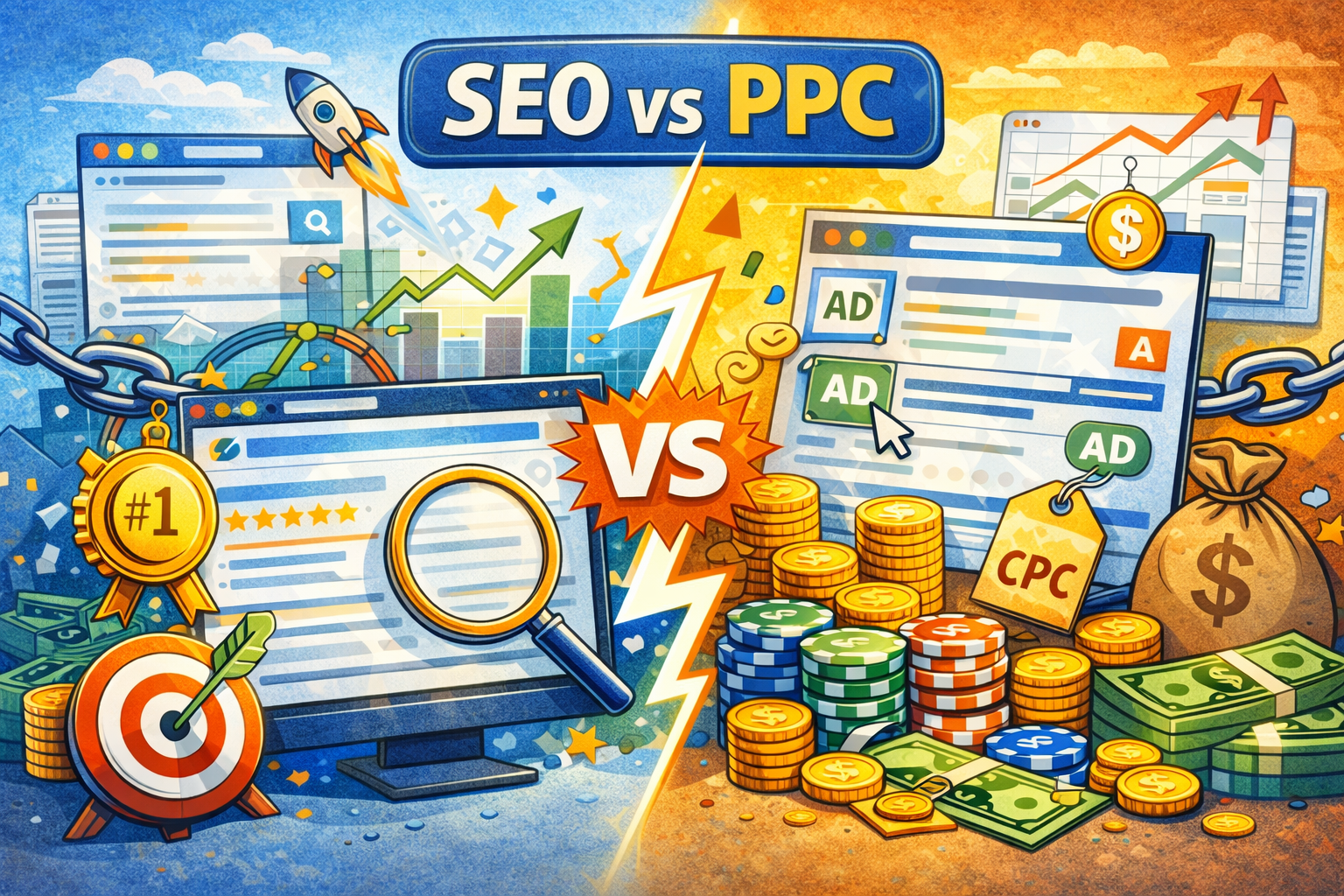
Search marketers still ask the same question every year: SEO vs PPC—which one is better? The real answer is that they solve different problems. SEO helps your site become more discoverable in unpaid search by making content helpful, crawlable, indexable, and relevant. PPC gives you immediate visibility through paid placements where cost, bid strategy, ad quality, and auction context shape whether and where your ad appears. Google’s documentation makes that distinction clear: organic visibility is not bought, while paid visibility is determined through an ad auction.
For most businesses in 2026, the smartest move is not treating SEO and PPC as enemies. It is choosing the right one for the right objective. If you need fast traffic, lead validation, or launch visibility, PPC often wins early. If you want durable, compounding traffic and lower marginal acquisition costs over time, SEO usually wins long term. And if you want the broadest coverage across the search results page, the strongest strategy is often both together. Older Google research also found that many ad clicks are incremental rather than simply replacing organic clicks, which is one reason blended search programs can work well.
TL;DR
- Choose SEO when you want long-term growth, stronger content visibility, and compounding returns over time.
- Choose PPC when you need immediate traffic, fast testing, tighter control, or short-term lead generation.
- Choose both when search is mission-critical and you want immediate coverage plus long-run brand equity.
What SEO really means today
SEO is the process of improving a site so search engines can crawl, index, understand, and rank its content more effectively. Google’s SEO Starter Guide and Search Essentials emphasize that strong SEO starts with technical accessibility, helpful people-first content, and clear site structure. Google also states that it does not accept payment to crawl or rank a site higher in organic search.
That matters because modern SEO is no longer just about inserting keywords into pages. In 2026, effective SEO is built around:
- helpful, reliable, people-first content
- strong technical health
- solid internal linking and site architecture
- relevant backlinks and citations
- good page experience across devices
A practical backlink strategy still matters, but it has to stay within Google’s spam policies. That means earning or building links in ways that support users and editorial relevance instead of manipulating rankings. In that context, businesses sometimes evaluate link building vendors or platforms such as Outreachz as one possible operational option for outreach-based backlinks, but the quality, relevance, and editorial fit of the links matter more than simply acquiring volume.
What PPC really means today
PPC, or pay-per-click advertising, is the paid side of search visibility. In Google Ads, advertisers typically bid on keywords or themes and pay when a user clicks. Google’s documentation explains that PPC is governed by auction dynamics, not just by who bids the most. Ad Rank is influenced by bid amount, ad quality, Ad Rank thresholds, auction context, and the expected impact of assets and formats.
Google also says Quality Score is a diagnostic tool based on expected click-through rate, ad relevance, and landing page experience. A higher score indicates that your ad and landing page are more relevant and useful compared with other advertisers targeting the same keyword. Actual CPC is often lower than the maximum CPC bid, and manual CPC or automated bidding options can be aligned to specific campaign goals.
In plain English, PPC lets you buy speed and control. You can launch fast, test fast, and scale fast—but you also pay for every click, and performance depends heavily on offer quality, landing page quality, targeting, and economics.
SEO vs PPC: the core difference
The simplest way to understand SEO vs PPC is this:
- SEO earns visibility.
- PPC rents visibility.
That does not mean PPC is worse. It means each channel has a different cost curve and time horizon. SEO usually takes longer to produce momentum because pages need to be crawled, indexed, and recognized as helpful and relevant. PPC can start driving clicks as soon as campaigns are live and eligible in the auction.
SEO vs PPC comparison table
| Factor | SEO | PPC |
| Speed to traffic | Slower; builds over time | Fast once campaigns launch |
| Cost model | Upfront investment in content, technical work, and links | Pay per click or conversion-driven campaign costs |
| Longevity | Can compound over time | Stops when spend stops |
| Visibility control | Less immediate control | High control over keywords, bids, budgets, copy |
| Trust signal | Strong for informational discovery and brand authority | Strong for commercial intent and promotional offers |
| Testing speed | Slower | Faster |
| Scalability | Compounds with strong content systems | Scales with budget and auction efficiency |
| Best for | Long-term growth | Immediate demand capture |
These differences align with how Google describes organic search discovery versus paid ad auctions and CPC-based bidding.
When SEO is the better choice
SEO is the better fit when your business depends on recurring discovery around questions, problems, comparisons, and evergreen topics. It is especially strong when you can produce genuinely useful pages that deserve to rank and meet Google’s technical and content expectations. Google’s own guidance repeatedly centers helpful, reliable, people-first content and technical accessibility as the foundation for strong organic performance.
TL;DR
SEO wins when your goal is sustainable traffic, category authority, and lower acquisition costs over time.
SEO tends to be the better choice when:
- You want durable traffic that does not disappear the moment budget is paused.
- Your audience researches before buying.
- You have many topics, pages, or locations to cover.
- You want to build brand authority and topical depth.
- Your margins do not support aggressive paid acquisition.
SEO also shines for content-heavy brands, B2B companies with longer consideration cycles, local businesses with service-area pages, SaaS companies publishing comparison and use-case content, and publishers trying to capture informational intent at scale.
When PPC is the better choice
PPC is the better fit when you need speed, clear control, or short-term commercial outcomes. Google Ads documentation is explicit that click-focused bidding is a practical starting point when the goal is website visits, and CPC bidding means you pay when someone actually clicks.
TL;DR
PPC wins when speed matters more than compounding, and when you need immediate traffic, leads, or testing data.
PPC is often the right choice when:
- You are launching a new site with no organic authority yet.
- You need leads this month, not six months from now.
- You want to test offers, headlines, or landing pages quickly.
- You are targeting high-intent transactional keywords.
- You need to support promotions, events, or limited-time campaigns.
PPC also helps brands dominate branded SERPs, protect market share from competitors bidding on adjacent terms, and quickly identify which search messages convert before building large SEO content clusters around them. Auction insights and Quality Score data can help refine that paid strategy.
The real cost question: SEO vs PPC
A lot of marketers compare SEO and PPC as if one is free and the other is expensive. That framing is wrong.
SEO does not charge you per click, but it is not free. You still invest in writers, editors, developers, technical fixes, content updates, UX, digital PR, and link acquisition. PPC, on the other hand, has clearer direct media costs because each click or conversion path has a measurable ad spend component. Google explains that CPC campaigns charge per click, and the actual CPC can be lower than your max bid.
The bigger difference is how the spend behaves over time:
- SEO often has slower initial returns but stronger long-term efficiency if content keeps ranking.
- PPC often has faster returns but linear or near-linear media costs as you scale.
That is why finance teams often like PPC for forecasting and SEO for margin expansion. One channel buys demand capture now; the other builds a long-term acquisition asset. This is an inference based on the mechanics described in Google’s organic and paid documentation.
SEO vs PPC for different business goals
| Business goal | Better primary choice | Why |
| Launching a new product | PPC | Fast visibility and testing |
| Building category authority | SEO | Better for content depth and organic trust |
| Running a seasonal campaign | PPC | Immediate deployment and control |
| Lowering CAC over time | SEO | Compounding traffic and reusable content assets |
| Testing message-market fit | PPC | Faster feedback on keywords and copy |
| Capturing informational intent | SEO | Better suited for educational content |
| Capturing high-intent buyers now | PPC | Transactional search coverage |
| Owning more SERP real estate | Both | Combined paid and organic presence |
This framework reflects the differences between unpaid discoverability in Search and auction-based paid placement in Google Ads.
Why “SEO or PPC” is often the wrong question
Many brands do best when SEO and PPC work together. PPC can reveal which queries convert, which landing pages work, and which calls to action resonate. SEO can then turn those learnings into evergreen pages and content clusters. At the same time, SEO can uncover topic demand and informational pathways that paid teams can retarget or prioritize commercially.
There is also the visibility advantage. Google’s past pause studies found that a significant share of ad clicks can be incremental, meaning paid search can add traffic rather than merely cannibalize organic listings. While those studies are older, they are still useful directional evidence for why dual coverage may outperform a single-channel mindset.
A practical decision framework
Use this simple rule set:
Choose SEO first if:
- your site can support a serious content program
- your sales cycle involves research and education
- you want long-term visibility and stronger organic equity
- you are willing to wait for compounding gains
Choose PPC first if:
- you need pipeline now
- you are entering a new market
- you need quick data on offers and conversion intent
- you have enough budget to sustain testing and optimization
Choose both if:
- search is a major revenue channel
- you want coverage at multiple intent stages
- you already know your funnel economics
- your team can support both content and ad optimization
Common mistakes in the SEO vs PPC debate
One major mistake is assuming SEO is just “free traffic.” Another is assuming PPC performance is only about budget. Google’s materials show that ad quality, landing page experience, relevance, and thresholds matter—not just bids. On the SEO side, Google emphasizes technical requirements, helpful content, and spam policy compliance—not just keyword usage.
Other common mistakes include:
- building SEO content for algorithms instead of people
- buying low-quality links that create risk instead of authority
- sending PPC traffic to weak landing pages
- judging SEO too early or PPC too narrowly
- treating SEO and PPC teams as separate silos
How backlinks fit into SEO vs PPC
Backlinks matter to SEO because they can help search engines interpret authority, relevance, and discoverability signals, but link building should be done carefully. Google’s spam policies make it clear that manipulative tactics can lead to ranking issues. The safer route is editorially relevant, useful, audience-aligned links earned through content, PR, partnerships, or outreach-based processes.
That is where businesses sometimes explore link building options, agencies, or outreach platforms such as Outreachz as part of a broader backlink workflow. The important point is not the vendor name; it is whether the links support real editorial relevance, fit the topic, and contribute to a people-first SEO strategy instead of a shortcut mentality.
Final verdict on SEO vs PPC
The best answer to SEO vs PPC depends on what you need most right now.
If your priority is speed, choose PPC.
If your priority is durability, choose SEO.
If your priority is market dominance, use both.
In 2026, the strongest search strategies are rarely one-dimensional. SEO builds your foundation. PPC accelerates demand capture. Together, they let you cover research intent, commercial intent, branded queries, and conversion-stage traffic with far more control than either channel alone. That is the practical, modern answer to the SEO vs PPC question.
FAQ
Is SEO better than PPC?
Not universally. SEO is usually better for long-term, compounding growth, while PPC is usually better for immediate traffic and fast testing.
Does PPC help SEO directly?
PPC does not directly improve organic rankings, but it can generate keyword, messaging, and conversion insights that improve SEO strategy. This is an inference based on how Google describes auction insights, landing page relevance, and organic content guidance.
Why do some brands run both SEO and PPC?
Because combined visibility can improve coverage across the SERP, and older Google studies suggest many paid clicks are incremental rather than purely replacing organic clicks.
Are backlinks still important for SEO?
Yes, but only when they are relevant, editorially sensible, and compliant with Google’s spam policies.
Which is easier to measure: SEO or PPC?
PPC is usually easier to measure in the short term because spend, clicks, and auction metrics are immediate. SEO measurement is strong too, but the payoff curve is usually slower and more cumulative.