

Most link building campaigns do not fail because people avoid backlinks.
They fail because people chase the wrong backlinks.
A site can build dozens of links and still see weak results. Why? Because not every backlink sends the same signal. Some links support trust. Some support topic relevance. Some support both. Others add almost nothing.
That is why Relevant Link Building matters so much now.
Google says links help it find pages and determine the relevance of pages. Google also says the same foundational SEO best practices still apply to AI features like AI Overviews and AI Mode. On top of that, Google’s Search Quality Evaluator Guidelines state that Trust is the most important member of the E-E-A-T family. Put together, that means relevance, context, and trust matter more than ever in modern SEO.
So if you want better rankings in 2026, the goal is not to get the most backlinks.
The goal is to build the most relevant ones.
This guide breaks down what Relevant Link Building is, why it matters, how it differs from outdated backlink tactics, and how to build relevant backlinks that hold up over time.
TL;DR
- Relevant Link Building means earning backlinks from websites and pages that closely match your topic, audience, and page intent.
- A backlink is stronger when the site, page, content, and anchor text all make sense together.
- Google uses links to understand relevance, not just discovery.
- Trust matters more in SEO now, especially as search engines and AI systems look for reliable sources.
- Backlinks still correlate with rankings. Backlinko’s 2025 study found the #1 Google result has an average of 3.8x more backlinks than positions 2 through 10, and about 95% of pages have zero backlinks.
- Strong traditional SEO also overlaps with AI visibility. Ahrefs found that 76.1% of AI Overview-cited pages ranked in Google’s top 10 in its 2025 study.
What Is Relevant Link Building?
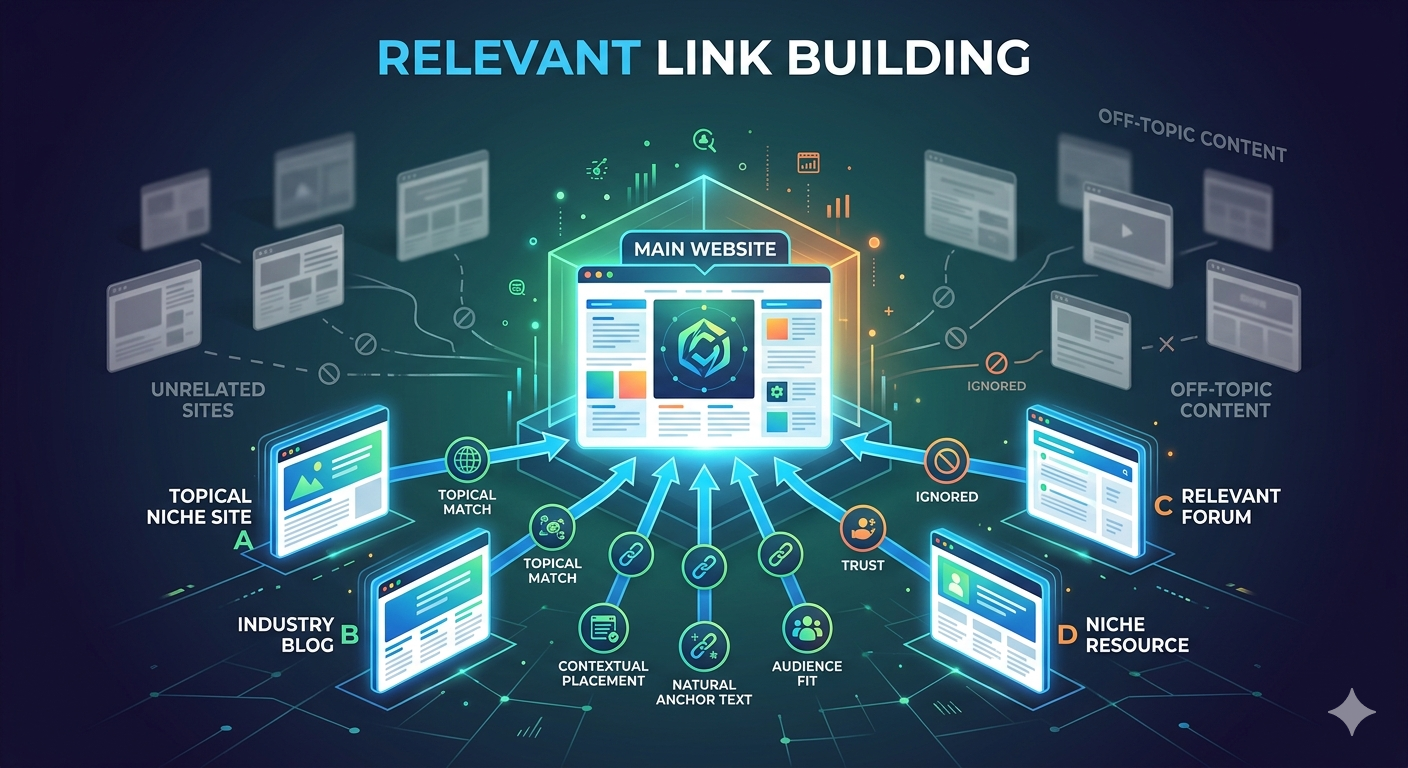
Relevant Link Building is the process of earning backlinks from websites and pages that are closely connected to your niche, topic, product, service, or audience.
That is the simplest definition.
A relevant backlink is not just a link from a powerful site. It is a link that fits naturally.
For example:
- A project management SaaS company getting a backlink from a productivity blog is relevant.
- A financial planning site being cited by a personal finance publication is relevant.
- A health brand getting mentioned by a medical or wellness site is relevant.
- That same health brand getting a backlink from an unrelated gambling blog is not very relevant.
This matters because Google does not treat links as simple votes. It uses links as signals for page relevance too. That means a backlink can help search engines understand what your page is about and why it deserves visibility.
So Relevant Link Building is really about building a backlink profile that makes sense.
It should make sense to:
- search engines
- AI systems
- human readers
- editors
- your target audience
If a link feels forced, random, or purely transactional, it is usually weak.
If a link feels like a natural citation, recommendation, or editorial reference, it is usually stronger.
Why Relevant Link Building Matters in 2026
Search has changed.
A few years ago, many SEO teams focused heavily on raw link numbers, domain metrics, and exact-match anchors. Some still do. But search engines are better now at understanding context, relationships between pages, and topical fit.
That is one reason Relevant Link Building matters more in 2026.
Google’s documentation on AI features says the same SEO best practices that work for Search remain relevant for AI features, and that there are no special extra requirements beyond good SEO fundamentals. It also says AI features surface relevant links to help people find information quickly and reliably.
That creates an important shift.
A backlink today can help with:
- search visibility
- topic association
- brand trust
- authority building
- AI citation potential
Trust is also a bigger deal than ever. Google’s 2025 Search Quality Evaluator Guidelines say Trust is the most important member of E-E-A-T and make clear that even pages that appear experienced or authoritative can still be rated poorly if they are not trustworthy.
That means SEO is no longer about collecting links from anywhere.
It is about earning links from places that make your expertise more believable.
There is also a performance angle here. Backlinko’s 2025 study found the #1 result in Google has, on average, 3.8x more backlinks than positions 2 through 10. At the same time, it found that about 95% of pages have zero backlinks. In other words, backlinks still matter a lot, but most pages barely have any.
And strong search visibility still overlaps with AI visibility. Ahrefs found that 76.1% of AI Overview-cited pages ranked in Google’s top 10 in its 2025 analysis of 1.9 million citations from 1 million AI Overviews.
So the takeaway is simple.
If you want a better chance of appearing in both traditional search and AI-powered search experiences, Relevant Link Building should be part of your SEO strategy.
Relevant vs Irrelevant Backlinks
Not every link helps equally.
Some backlinks strengthen your site’s topical authority. Others dilute it.
Here is the difference:
| Factor | Relevant Backlink | Irrelevant Backlink |
| Topic | Closely related to your niche | Unrelated or loosely connected |
| Page context | Appears inside related editorial content | Placed in off-topic or weak content |
| Reader value | Useful to the page’s audience | Unhelpful or out of place |
| Anchor text | Natural and descriptive | Forced or over-optimized |
| Trust signal | Feels editorial and earned | Feels manipulative or transactional |
Think of it like this.
If a cybersecurity site gets linked from a cloud security article, the fit is obvious.
If that same site gets linked from a celebrity gossip article, the fit is weak.
The second link may still exist. But it does not send the same quality of signal.
This is why link relevance in SEO matters. Search engines try to understand not just whether a link exists, but whether the link makes sense in context.
That context includes:
- the website
- the linking page
- the paragraph around the link
- the anchor text
- the target page
When all of those line up, the backlink becomes much stronger.
Why Link Relevance Matters More Than Domain Authority
Domain authority matters.
But it does not matter on its own.
That is where many people get this wrong.
A high-metric site is not automatically the best linking source. If the topic alignment is weak, the value of the backlink often drops.
Backlinko’s data shows that stronger sites tend to rank better overall, which is why authority scores became popular in the first place. But the same data also reminds us that backlinks remain a ranking signal and that the web is full of pages with no backlinks at all.
The real question is not:
“Is this site strong?”
The better question is:
“Is this site strong for my topic?”
That is the difference.
A niche site with moderate authority but perfect relevance can often be more valuable than a broader site with stronger metrics and poor topical fit.
Why?
Because relevance helps clarify meaning.
It helps search engines understand:
- what your page should rank for
- what expertise your site has
- which topics your brand belongs to
- whether the backlink looks natural
The strongest links usually combine:
- authority
- topical relevance
- contextual placement
- trust
That is why Relevant Link Building usually produces better long-term SEO outcomes than campaigns driven only by metrics.
What Makes a Backlink Relevant?
A backlink is usually relevant when it passes several fit checks.
1. Topical match
The referring site should cover your niche or a closely related one.
Examples:
- SaaS to SaaS
- health to health
- legal to legal
- ecommerce to retail or DTC content
2. Page-level relevance
The site alone is not enough.
The exact page linking to you also matters.
A marketing site can publish one article about email strategy and another about travel. Only one of those might be relevant to your CRM guide.
3. Contextual placement
Contextual backlinks tend to be stronger than links in footers, sidebars, or low-value author bios.
Why?
Because the paragraph around the link helps explain the relationship between the linking page and the destination page.
4. Natural anchor text
Google says anchor text should help people and Google make sense of the linked content.
That means good anchors are:
- descriptive
- natural
- varied
- helpful
Examples of better anchors:
- relevant link building strategies
- white hat link building methods
- contextual backlinks guide
5. Audience alignment
Ask one question:
Would the readers of this page realistically care about the page being linked to?
If the answer is yes, you are likely looking at a relevant backlink.
How to Build Relevant Backlinks in 2026
If you want to know how to build relevant backlinks in 2026, start with process.
1. Map your topic ecosystem
List the categories of sites that make sense for your niche.
These may include:
- direct industry blogs
- adjacent niche blogs
- expert publications
- association sites
- research sites
- media sites
- local resource pages
- partner ecosystems
This keeps your campaign focused.
2. Build pages worth citing
Most weak link building campaigns fail because the page being promoted is not worth linking to.
Pages that earn relevant links often include:
- original research
- useful statistics
- detailed guides
- comparison pages
- templates
- frameworks
- case studies
- expert commentary
If the page is thin, generic, or outdated, even good outreach will struggle.
3. Evaluate pages, not just domains
Do not choose targets based only on domain-level metrics.
Review:
- whether the page is indexed
- whether the content is high quality
- whether the page has traffic
- whether the page topic aligns with yours
- whether the site looks editorially real
4. Personalize outreach
Good outreach explains the fit.
A strong message usually makes clear:
- why your page is relevant
- why it adds value
- why their readers would benefit
- why the mention belongs in that article
This is what white hat link building looks like in practice.
5. Use guest posting selectively
Guest posting still works when it is useful, relevant, and editorial.
It stops working when it becomes mass-produced filler.
If you use guest posting, focus on:
- original ideas
- strong writing
- niche fit
- natural contextual links
6. Reclaim unlinked mentions
One of the easiest sources of Relevant Link Building is a page that already mentions:
- your brand
- your founder
- your report
- your data
- your product category
The context already exists. You just need the link.
7. Audit regularly
Review your backlink profile often.
Check for:
- irrelevant domains
- spam patterns
- unnatural anchors
- low-quality guest posts
- broken backlinks
- deindexed linking pages
This protects quality over time.
Examples and Mini Case Studies
Example 1: B2B SaaS
A CRM company wants more visibility for sales pipeline keywords.
Relevant backlinks could come from:
- sales blogs
- RevOps sites
- startup growth publications
- customer success resources
Weak-fit backlinks would come from:
- unrelated entertainment blogs
- gambling sites
- low-quality coupon pages
In many cases, a handful of tightly relevant links will outperform a larger number of random ones.
Example 2: Local business
A local dental clinic can build relevant links from:
- chamber of commerce sites
- local health directories
- local media
- city resource pages
- dental associations
These links strengthen both niche relevance and local trust.
Example 3: Financial education site
A personal finance guide is far more credible when linked from:
- banking education pages
- budgeting blogs
- financial literacy resources
- fintech publications
That is because the links reinforce the site’s topical identity.
Common Relevant Link Building Mistakes
Here are the mistakes that usually weaken campaigns.
Chasing authority without relevance
A high score does not mean a high fit.
Building links to weak content
If the destination page is poor, the links may underperform.
Overusing exact-match anchors
This makes your backlink profile look engineered.
Publishing filler guest posts
Google’s helpful content guidance emphasizes people-first content, not content created mainly to manipulate search rankings.
Ignoring spam signals
Google’s spam policies warn that manipulative practices can lead to lower rankings or removal from Search.
Forgetting the reader
If the link does not help the reader, it is probably not a strong link.
Tools and Metrics to Measure Relevance
You do not need to track everything.
You need to track the right things.
Useful metrics
- topical similarity
- page-level relevance
- anchor text naturalness
- referring page traffic
- domain trust and quality
- number of outbound links
- indexation status
- referral traffic potential
Useful tools
Use tools for validation, not for decision-making in isolation.
A backlink that looks good in a spreadsheet but feels irrelevant in real life is still a weak backlink.
FAQs
What is relevant link building in SEO?
Relevant Link Building in SEO is the process of getting backlinks from websites and pages that closely match your topic, audience, and page intent.
Why is link relevance important?
Link relevance is important because it helps search engines understand what your page is about and whether the backlink makes sense in context. Google explicitly says links help determine page relevance.
Are relevant backlinks better than high-authority backlinks?
Relevant backlinks are often more valuable than unrelated high-authority backlinks because they send a clearer topical signal. The strongest backlinks combine relevance, authority, and trust.
How do I know if a backlink is relevant?
Look at the linking site’s topic, the linking page’s topic, the surrounding content, the anchor text, and whether the audience would actually care about the linked page.
Do contextual backlinks matter more than sidebar or footer links?
In most cases, yes. Contextual backlinks placed naturally inside relevant content tend to be stronger because the surrounding copy helps define the relationship between pages.
Can irrelevant backlinks hurt SEO?
A few random backlinks are usually not a major issue. But a pattern of manipulative or irrelevant links can weaken trust and create risk, especially if it starts to resemble spam.
Conclusion
Relevant Link Building is not about collecting backlinks from anywhere.
It is about earning backlinks that make sense.
That is what makes them stronger.
Google uses links to understand relevance. Google’s AI features still rely on strong SEO fundamentals. Trust now plays a central role in how quality is evaluated. And backlinks still correlate with rankings, especially when they come from the right places.
So the 2026 playbook is clear:
- build pages worth citing
- target topically aligned sites
- prioritize page-level fit
- use natural anchors
- avoid manipulative shortcuts
- audit backlink quality regularly
Do that consistently, and Relevant Link Building becomes one of the most durable SEO advantages you can build.