

TL;DR
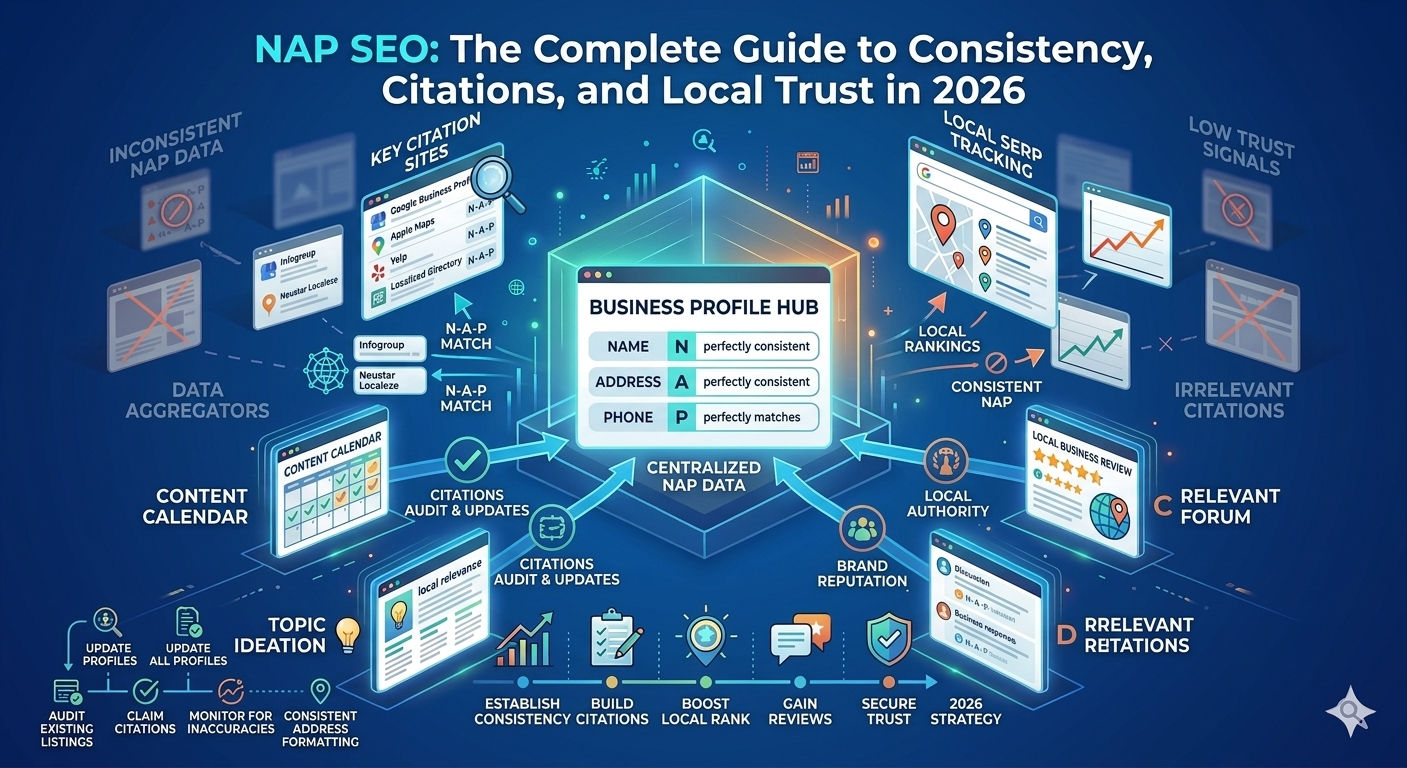
NAP SEO is the practice of keeping your business Name, Address, and Phone number accurate and aligned across your website, Google Business Profile, directories, social profiles, and other online mentions.
Here is the short version:
- NAP SEO helps search engines trust your business identity
- NAP consistency supports local visibility and reduces confusion
- Inconsistent business details can weaken local trust signals
- NAP citations still matter, but only when the information is accurate
- The best approach in 2026 is to treat NAP as part of entity SEO, not just directory management
Introduction
Local SEO often gets reduced to a few familiar tactics.
Get reviews. Build backlinks. Optimize your Google Business Profile. Publish location pages.
All of that matters. But none of it works as cleanly as it should if your business details are inconsistent across the web.
That is the real role of NAP SEO.
NAP SEO refers to how consistently your Name, Address, and Phone number appear across your online presence. It sounds simple. In reality, it is one of the core trust layers behind local search visibility.
If your business is listed as “Blue Ridge Dental” on your website, “Blue Ridge Dental Clinic” on Yelp, and still shows an outdated phone number on an old directory listing, search engines have to work harder to decide whether all of those mentions belong to the same business.
That uncertainty creates friction.
And in local SEO, friction usually costs visibility.
In 2026, this matters even more because search is no longer limited to ten blue links. Your business information can influence map packs, local results, business panels, voice answers, and AI-generated summaries. When AI systems pull information from multiple sources, inconsistent business data becomes a bigger liability, not a smaller one.
That is why NAP consistency is still a foundational local SEO task.
Not because it is exciting.
Because it is essential.
What is NAP in SEO?
NAP in SEO stands for:
- Name
- Address
- Phone number
These three data points help search engines identify a real-world business and match that business across different platforms.
A simple example looks like this:
Business Name: Oak Street Physiotherapy
Address: 1458 Elm Street, Suite 210, Dallas, TX 75201
Phone: (214) 555-0187
That information might appear on:
- Your website
- Google Business Profile
- Business directories
- Social media pages
- Industry listings
- Review platforms
- Map services
When people ask what is NAP in SEO, the practical answer is this: it is the core identity data that helps local search systems connect all of your online business mentions back to one verified entity.
If that data is clean and stable, trust improves.
If it is messy, trust weakens.
Why NAP SEO Matters (Ranking + Trust Signals)
NAP SEO matters because local search depends on confidence.
Search engines want to show businesses that look real, reliable, and easy to verify. That does not happen through content alone. It also happens through data consistency.
Here is where local SEO NAP has an impact:
- It supports business identity verification
- It reduces ambiguity across citations and listings
- It improves trust in local search results
- It helps align your website with your business profiles
- It makes it easier for search systems to connect your brand mentions
- It improves user experience by reducing contact confusion
Why it matters for Google Business Profile
Your Google Business Profile is often the main reference point for local search. If the name, address, or phone number on your site conflicts with the profile, that sends mixed signals.
Even small inconsistencies can create unnecessary doubt.
Why it matters for local rankings
NAP alone will not rank a business first.
But it does influence the quality of your local SEO foundation. If your business details are stable across core sources, your other signals work better together.
Think of it this way:
- Reviews add trust
- Links add authority
- Content adds relevance
- NAP consistency supports identity
Without identity clarity, the rest of the system becomes less efficient.
Why it matters for AI search engines
AI-driven search engines do not rely on one page. They pull, compare, and synthesize information from many sources.
That makes clean business data more important.
If five sources mention different phone numbers, AI systems may surface outdated details or become less confident in your business profile altogether. In an AI-first search environment, clear entity data is part of discoverability.
How Search Engines Use NAP Data
Search engines use NAP data to answer one important question:
Do these mentions refer to the same business?
This is where entity validation comes in.
Your business may appear on dozens of websites. Search engines compare those mentions and try to connect them into one trusted profile. They look at patterns like:
- Business name similarity
- Address alignment
- Phone number consistency
- Category relevance
- Website association
- Profile completeness
- Cross-platform reinforcement
The stronger the overlap, the easier it is to trust the entity behind the listing.
That is why NAP consistency SEO is not just about directories. It is about reducing uncertainty.
Imagine two plumbing companies in the same city:
- One has the same name, same address, and same phone number across every core source
- The other has an old address on a directory, a tracking number on Facebook, and a shortened brand name on its website
Which one is easier to validate?
The first one.
Search engines are built to work with probabilities. NAP consistency improves those probabilities.
NAP Consistency Explained
NAP consistency means your business details are accurate and stable wherever they appear online.
This does not mean every line must look identical down to the punctuation. But the business identity should remain clearly the same.
Good vs bad examples
| Element | Consistent Version | Inconsistent Version |
| Business Name | PrimeCare Skin Clinic | Prime Care Clinic / PrimeCare Dermatology / Prime SkinCare |
| Address | 2201 Broadway, Suite 305, Denver, CO 80205 | 2201 Broadway / 2201 Broadway Ave / 2021 Broadway, Denver |
| Phone | (303) 555-0142 | (303) 555-0142 on one site, (720) 555-0199 on another |
| Suite/Floor | Suite 305 used consistently | Ste 305 on one site, Floor 3 on another, missing elsewhere |
| Old Location | Removed from all listings | Previous address still live on multiple directories |
The important distinction is this:
- Minor formatting differences are usually manageable
- Factual differences are what cause problems
It should not expect the same outcome when one listing shows a different location or phone number.
Common NAP SEO Mistakes
Most businesses do not create NAP problems on purpose. They create them through neglect, rebranding, expansion, or poor handoffs between teams.
Here are the most common mistakes:
- Using different business name versions across platforms
- Forgetting to update old listings after moving office
- Publishing different phone numbers without a clear primary number
- Reusing one address across multiple location pages
- Inconsistent abbreviations in street names, unit numbers, or area names
- Leaving duplicate listings live
- Creating profiles for service areas that do not reflect real business locations
- Letting franchise and branch-level information get mixed up
- Updating the website but forgetting directories and social profiles
Real-world scenarios
Scenario 1: The office move
A personal injury law firm moves from Downtown Phoenix to Scottsdale. The website is updated immediately, and the Google Business Profile changes a few days later. But Avvo, Yelp, Facebook, and two legal directories still show the old Phoenix address.
Result: search engines see conflicting location signals for the same business.
Scenario 2: The call tracking mistake
A healthcare clinic uses dynamic call tracking and ends up replacing its main business number on external listings.
Result: citations stop reinforcing one canonical number.
Scenario 3: The multi-city landing page problem
A home maintenance company launches pages for ten cities but uses the same NAP block on all of them.
Result: those pages look less like real local entities and more like generic location targeting.
How to Fix NAP Inconsistencies (Step-by-Step)
If you are wondering how to fix NAP inconsistencies, use this process.
1. Define your canonical NAP
Start by creating one approved version of your:
- Business name
- Full address
- Primary phone number
This is your master record.
Store it in a shared internal document so your team, agency, and vendors use the same source of truth.
2. Audit the assets you control
Update all owned properties first:
- Website footer
- Contact page
- Location pages
- Google Business Profile
- Social media pages
- Email signatures
- Booking or appointment pages
3. Search for outdated business details
Look for:
- Old phone numbers
- Previous addresses
- Alternate brand spellings
- Duplicate profiles
- Location-specific inconsistencies
Use branded searches, directory checks, and a spreadsheet to log everything.
4. Prioritize your most important listings
Start with the sources that matter most:
- Google Business Profile
- Major local directories
- Industry directories
- Review platforms
- Social profiles
- Map listings
Do not try to fix everything randomly. Fix the most visible sources first.
5. Handle duplicates carefully
Duplicate listings are common after office moves, rebrands, or vendor-led citation campaigns.
Instead of ignoring them:
- Claim them where possible
- Merge them if supported
- Remove or suppress outdated versions
- Replace incorrect information with canonical details
6. Review call tracking strategy
If you use tracking numbers, make sure they do not replace the main business number across your core local citations. Your primary phone number should remain the stable identity signal.
7. Add business schema to your website
Use structured data to reinforce your business details on the site itself. This helps search engines connect your location data with the rest of your business information.
8. Re-audit regularly
Do not treat NAP cleanup as a one-time project.
Recheck your listings when you:
- Move locations
- Rebrand
- Change phone systems
- Launch a new branch
- Redesign the website
- Work with a new local SEO vendor
Simple checklist
- Canonical NAP documented
- Website updated
- GBP updated
- Core citations corrected
- Duplicates handled
- Schema added
- Recheck scheduled
NAP Citations: What They Are + Examples
NAP citations are any online mentions of your business name, address, and phone number.
They may or may not include a link.
That part matters less than many people think.
The core value of a citation is that it reinforces your business identity across the web.
Examples of NAP citations
| Citation Type | Example | What It Includes |
| Search profile | Google Business Profile | Name, address, phone, hours |
| General directory | Yelp, Yellow Pages, Justdial | Contact details, category, website |
| Industry listing | Healthcare, legal, real estate, hospitality directories | Business info plus niche relevance |
| Social profile | Facebook Business Page, LinkedIn Company Page | Name, phone, website, address |
| Review platform | Niche review websites | Brand details plus reviews |
| Chamber listing | Local business association | Business identity and local trust |
| Map ecosystem | Apple Maps, Bing Places | NAP plus map presence |
| Local blog mention | City guide or local business roundup | Partial or full business details |
A citation can be useful even without a backlink.
That is why examples of NAP citations go beyond classic directories. Your business may be cited in local resource pages, association websites, event sponsor pages, and platform profiles.
The key question is not just “does this citation exist?”
It is “does it show the right business details?”
NAP SEO Best Practices (2026 Edition)
Here are the most useful NAP SEO best practices 2026 businesses should follow.
- Choose one official business format and use it everywhere important
- Keep your core listings updated first, especially Google Business Profile and your website
- Use location-specific NAP only for real, customer-facing business locations
- Do not let old numbers or addresses remain indexed
- Build citations slowly and accurately instead of chasing volume
- Use structured data to reinforce on-site business information
- Create internal processes for updates after moves or rebrands
- Audit multi-location businesses more carefully than single-location brands
- Treat NAP as part of entity SEO and local trust, not just citation work
- Review your core listings periodically instead of waiting for rankings to drop
This is the big shift in 2026:
NAP is no longer just a local SEO hygiene task.
It is a trust and identity task.
That makes it more important as search systems become more entity-driven and answer-based.
Advanced Tips
This is where the conversation gets more strategic.
1. Think beyond citations and focus on entity SEO
NAP consistency is useful because it supports the business entity behind your brand.
If search engines can clearly map your business across profiles, pages, and mentions, your local presence becomes more coherent.
That coherence helps other signals work better.
2. Use schema as reinforcement, not decoration
Schema is often added as a checklist item.
That is the wrong mindset.
Use local business schema to reinforce your canonical business details and location associations. When it matches the visible content on the page, it strengthens clarity.
3. Align NAP with your location page strategy
Each real location should have:
- Its own landing page
- Its own matching NAP
- Its own relevant service coverage
- Its own supporting local signals
This creates cleaner location targeting and avoids mixing city-level intent with generic sitewide contact information.
4. Pair NAP consistency with local authority signals
NAP is not enough by itself.
For stronger local SEO, combine it with:
- Local backlinks
- Review growth
- City-specific landing pages
- Nearby brand mentions
- Community sponsorships
- Industry-relevant citations
5. Clean up old brand footprints after rebrands
Rebrands are one of the biggest causes of NAP fragmentation.
If you change your name, phone system, or address, old versions can stay live for years. That creates a split identity problem. A strong cleanup process after rebranding can prevent long-term confusion.
6. Separate parent brand and branch-level identity
Multi-location businesses often blur the line between corporate identity and local branch identity.
A better model is:
- Parent brand entity at the sitewide level
- Branch-level NAP at the local page level
- Clear internal linking between the two
That keeps the hierarchy clean.
FAQs
What is NAP in SEO?
NAP in SEO stands for Name, Address, and Phone number. It refers to the core business details that appear across your website, profiles, and citations. Search engines use this information to identify and verify your business.
Why NAP consistency is important for local SEO?
Why NAP consistency is important for local SEO comes down to trust. When your business details match across major sources, search engines can more confidently treat those mentions as part of the same entity. That supports local relevance, trust, and accuracy.
How do I fix NAP inconsistencies?
To fix NAP inconsistencies, start by creating one canonical version of your business details. Then update your website, Google Business Profile, major citations, social profiles, and duplicate listings. After that, review your data regularly.
Conclusion
NAP SEO is one of those topics that looks small until it starts causing real problems.
A wrong phone number here. An old address there. A duplicate listing nobody noticed. A shortened business name on a directory profile.
Individually, these issues can seem minor.
Together, they create a business identity that feels unstable.
That is why NAP consistency SEO still matters. It helps search engines connect the dots. It helps users reach the right location. And it gives your local SEO strategy a cleaner base to build on.
If you want a practical next step, do this:
Start with one canonical version of your name, address, and phone number. Audit the top platforms where your business appears. Fix the biggest inconsistencies first. Then reinforce that same information on your website and location pages.
That alone will put you ahead of a surprising number of local businesses.
Because in 2026, strong local SEO is not just about being visible.
It is about being consistently believable.