

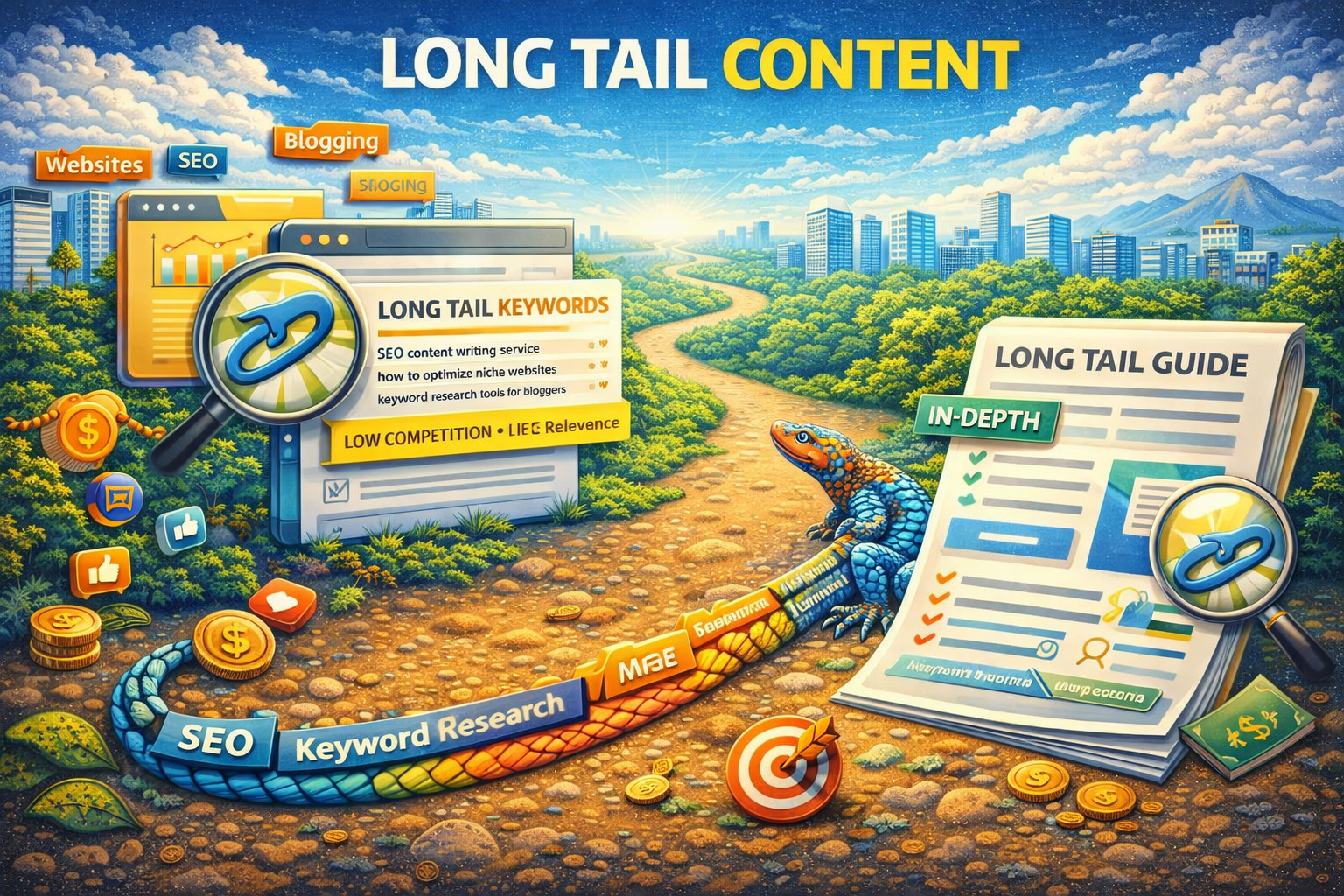
If you’ve been chasing high-volume head keywords and wondering why your rankings never seem to budge, it’s time to rethink your approach. Long tail content — content strategically built around specific, low-competition search phrases — is quietly powering some of the internet’s most effective SEO campaigns. While everyone else is fighting for the same short, broad terms, smart content creators are racking up traffic, conversions, and authority by going narrow and deep.
This guide covers everything you need to know about long tail content in 2025: what it is, why it works, how to build a strategy around it, and the data that proves why it’s no longer optional in the age of AI-powered search.
What Is Long Tail Content? (And Where the Term Comes From)
Long tail content is content that targets highly specific, multi-word search queries — typically three words or more — that individually attract modest search volume but collectively represent the majority of all searches on the internet. These queries sit at the “tail” end of the search demand curve, far from the high-volume, high-competition “head” keywords at the top.
The concept traces back to economist Chris Anderson’s 2004 Wired article and subsequent book The Long Tail: Why the Future of Business Is Selling Less of More. Anderson argued that in a world of nearly unlimited digital shelf space, selling a wide range of niche items to targeted audiences can outperform selling a small number of hits to a mass audience. SEO adopted this idea almost immediately — and it’s proven out over two decades of search data.
TL;DR: Long tail content targets specific, multi-word queries with lower search volume but higher conversion intent. The concept comes from economics and applies powerfully to SEO.
The Numbers Behind Long Tail Content in 2025
The data on long tail search behavior is both striking and consistent across sources. Here’s what the research shows:
• Over 70% of all search queries are long-tail terms, according to BrightEdge and multiple independent studies.
• 92% of all keywords get 10 or fewer searches per month — meaning the vast majority of search queries are long-tail by definition.
• Long-tail keywords have an average conversion rate of 36%, compared to just 11.45% for the highest-performing short-tail landing pages.
• Long-tail keywords show 2.5x higher conversion rates on average vs. short-tail terms.
• AI search queries now average 25 or more words — creating a “long tail” roughly 4x larger than traditional typed search.
• Google’s AI Overviews have grown from averaging 3.1 words per query in June 2024 to 4.2 words by year-end 2024, signaling a shift toward conversational, long-tail search.
• Voice searches, which are naturally long-tail phrasing, make up 20% of all mobile queries.
Put simply: the internet’s searchers are getting more specific, more conversational, and more intent-driven every year. Long tail content is built for exactly that behavior.
TL;DR: More than 70% of all searches are long-tail. With a 36% average conversion rate vs. 11.45% for top landing pages, long tail content delivers outsized ROI even at lower traffic volumes.
Long Tail vs. Short Tail Content: Head-to-Head Comparison
Understanding how long tail content differs from short-tail or head-term content is essential before building a strategy. Here’s a direct comparison:
| Factor | Short-Tail (Head) Content | Long Tail Content |
| Keyword Length | 1–2 words (e.g., “running shoes”) | 3+ words (e.g., “best running shoes for flat feet men”) |
| Monthly Search Volume | High (10K–1M+) | Low–Medium (10–1,000) |
| Keyword Difficulty | High (60–100 KD) | Low–Medium (0–40 KD) |
| Search Intent Clarity | Vague / Broad | Specific / High-intent |
| Average Conversion Rate | ~1–3% | ~36% |
| Competition Level | Very High | Low to Moderate |
| Time to Rank | 12–24+ months | 2–6 months (often less) |
| Content Type | Pillar pages, evergreen hubs | Blog posts, FAQs, guides, reviews |
| Voice Search Match | Poor | Excellent |
| AI Overview Visibility | Moderate | High (cited more frequently) |
| Best For | Brand awareness, domain authority | Targeted traffic, lead gen, conversions |
| ROI Timeline | Long-term | Short-to-medium term |
Why Long Tail Content Works: The Core Mechanisms
1. Search Intent Alignment
The deeper reason long tail content converts so well isn’t just lower competition — it’s intent alignment. A user searching “CRM software” could be a student researching a term paper, a marketer comparing options, or an executive ready to sign a contract. You don’t know. But a user searching “best CRM software for small law firms under 10 users” is telling you almost everything you need to know about where they are in the buying process. Long tail content closes that intent gap by design.
2. Less Competition, Faster Rankings
Head keywords like “digital marketing” or “shoes” are contested by tens of thousands of domains, many with enormous domain authority and ad budgets. Long tail keywords often have single-digit competition — sometimes none at all from established players. That means even newer websites and smaller brands can rank on page one within weeks or months rather than years. Stacking dozens or hundreds of these rankings creates compounding organic traffic that consistently outpaces a single high-volume keyword chase.
3. Topical Authority and E-E-A-T
Google’s E-E-A-T framework (Experience, Expertise, Authoritativeness, and Trustworthiness) rewards depth and breadth on a topic. Publishing a cluster of long tail content pieces around a central subject signals to Google that you have genuine command of that space. A site covering 50 specific angles of “email marketing for SaaS startups” earns topical authority that a single generic “email marketing” page never could.
4. AI Overview and Featured Snippet Wins
One of the most significant shifts in 2025 is the dominance of AI-generated overviews in Google search results. BrightEdge data shows that AI Overviews now pull from up to 151% more unique websites for complex B2B queries. The reason? AI prefers specific, structured, well-organized content over surface-level broad pages. Long tail content, by its very nature, tends to be precise, well-scoped, and directly answerable — which is exactly what AI summarization engines want to cite.
TL;DR: Long tail content works through four key mechanisms: intent alignment, reduced competition, topical authority building, and AI Overview visibility — all of which compound over time into sustainable organic growth.
Types of Long Tail Content You Should Be Publishing
Not all long tail content looks the same. Here are the primary formats that perform best in 2025:
| Content Type | Example Long Tail Target | Primary Goal |
| Detailed Blog Post / Guide | “how to do keyword research for e-commerce stores” | Organic traffic, authority |
| FAQ Page | “does Google count hidden text for SEO” | Featured snippet, AI citation |
| Comparison Article | “Ahrefs vs SEMrush for small business owners” | Decision-stage conversions |
| Listicle with Niche Angle | “best free SEO tools for Shopify sellers in 2025” | Targeted traffic |
| Tutorial / How-To | “how to set up Google Search Console for a new domain” | Organic, email sign-ups |
| Case Study | “how a B2B SaaS company tripled organic traffic in 6 months” | Trust, backlinks |
| Local / Geo-Targeted Post | “best digital marketing agency for dentists in Austin Texas” | Local SEO, lead gen |
| Product Review | “Surfer SEO review for content writers 2025” | Affiliate, conversions |
| Voice Search Optimized Q&A | “what is the best time to post on Instagram for a bakery” | Voice, AI Overviews |
How to Find Winning Long Tail Content Opportunities
Step 1: Keyword Research Tools
Start with dedicated keyword research platforms. Semrush’s Keyword Magic Tool lets you search over 27 billion keywords and filter specifically for phrases with four or more words, low keyword difficulty, and specific search intent. Ahrefs’ Keywords Explorer offers similar functionality with robust competitive data. Google Keyword Planner remains a free starting point for discovering search volume ranges.
Step 2: Mine Google’s Own Features
Google’s autocomplete predictions, People Also Ask boxes, and Related Searches sections at the bottom of search results pages are goldmines of real long-tail query data. These reflect actual searches people are typing — making them inherently relevant and often overlooked by competitors using only third-party tools. Grab a seed keyword, plug it into Google, and document every autocomplete suggestion and PAA question you see.
Step 3: Analyze Competitors’ Rankings
Use Ahrefs or Semrush to pull a competitor’s top organic pages and filter for pages that rank on multiple long-tail terms simultaneously. These pages are proof of what’s working in your space. Study their structure, length, internal linking, and the specific questions they answer. Then create something more comprehensive and better optimized.
Step 4: Explore Community Platforms
Reddit, Quora, and niche-specific forums are extraordinarily valuable for discovering long-tail questions your audience is actually asking — questions that may not yet appear in keyword databases. When someone posts “I can’t figure out how to migrate my WordPress blog to Squarespace without losing SEO” in a forum, that’s a real user problem waiting for a content solution.
Step 5: Use Your Own Data
Google Search Console shows you the actual queries people used to find your site, including long-tail variations you may not have explicitly targeted. Filter by impressions with low click-through rate — these are keywords where you’re showing up but not ranking high enough, representing immediate optimization opportunities for existing content.
TL;DR: The best long tail content opportunities come from combining tool-based keyword research with Google’s native features (autocomplete, PAA), competitor analysis, community forums, and your own Search Console data.
Building a Long Tail Content Strategy: The Topic Cluster Model
The most effective approach to long tail content in 2025 isn’t publishing random individual posts — it’s building interconnected topic clusters. Here’s the architecture:
Pillar Page: A comprehensive, broad overview of your main subject (e.g., “The Complete Guide to Email Marketing”). This targets a medium-competition head or mid-tail keyword and serves as the hub of your cluster.
Cluster Content: Dozens of supporting long tail content pieces that drill into specific subtopics (e.g., “best email subject lines for B2B SaaS companies,” “how to segment email lists by purchase behavior,” “email deliverability checklist for small businesses”). Each cluster piece links back to the pillar and vice versa.
Internal Linking: The connective tissue. Each cluster page reinforces the authority of the pillar, while the pillar distributes authority to cluster pages. Google reads this structure as a signal that your site has deep expertise on the topic.
This model allows you to capture long-tail traffic at scale while simultaneously building the topical authority that eventually helps you compete for shorter, more competitive terms.
| Pillar Topic | Long Tail Cluster Examples |
| Email Marketing | “best drip campaign sequences for e-commerce” / “how to reduce email unsubscribe rates” |
| SEO Strategy | “how to do on-page SEO for product pages” / “local SEO checklist for new businesses” |
| Content Marketing | “how to repurpose blog posts into YouTube videos” / “B2B content calendar template download” |
| Social Media Marketing | “best Instagram posting times for fitness brands” / “how to grow LinkedIn followers for B2B SaaS” |
| PPC Advertising | “how to lower Google Ads cost per click for legal services” / “remarketing strategy for abandoned cart shoppers” |
On-Page Optimization for Long Tail Content
Creating long tail content isn’t just about picking the right keyword — it’s about structuring and optimizing each piece for maximum discoverability. Here’s a practical on-page checklist:
• Title Tag: Include your primary long-tail keyword naturally within the first 60 characters. Avoid exact-match stuffing; prioritize readability.
• Meta Description: Summarize what the page delivers in under 160 characters. Include the keyword and a clear value proposition to improve click-through rate from SERPs.
• H1 Heading: Match or closely mirror the target long-tail keyword in your page’s H1.
• Subheadings (H2/H3): Use related long-tail variations and natural language questions as H2 and H3 headings. This improves structure for both readers and AI crawlers.
• First 100 Words: Establish topical relevance immediately. Mention the primary keyword in the intro naturally.
• Body Copy: Write conversationally and comprehensively. Answer the query but also address the surrounding questions your audience likely has. Avoid keyword stuffing.
• Image Alt Text: Include long-tail keywords naturally in image alt attributes, since this is how search engines read images.
• Internal Links: Link to related long tail content pieces and your pillar page using descriptive anchor text.
• Schema Markup: Use FAQ, HowTo, or Article schema where appropriate to increase eligibility for rich results and AI Overviews.
• URL Slug: Keep URLs clean and keyword-inclusive (e.g., /best-crm-for-small-law-firms).
TL;DR: On-page optimization for long tail content means placing your target keyword in the title, H1, meta description, early body copy, image alt text, and URL — while structuring content with related questions as subheadings for AI and voice search readiness.
Long Tail Content and AI Search: The 2025 Opportunity
Perhaps the most exciting development for long tail content creators right now is the explosion of AI-powered search. Google’s AI Overviews, ChatGPT search, Perplexity, and similar platforms are fundamentally changing how answers are found and cited online.
Here’s what the data shows about AI’s relationship with long tail content:
• AI-generated answers prefer specific, well-structured content over broad, surface-level pages — which is precisely what long tail content delivers.
• Google’s AI Overviews now pull from up to 151% more unique websites for complex queries, meaning smaller, niche-focused sites now have genuine citation opportunities they didn’t have before.
• 35% of AI Overview results already handle multiple search intents simultaneously, with projections that this could reach 65% — making detailed, intent-specific content even more valuable.
• Traffic from AI assistants converts at higher rates than traditional search traffic because users have already refined their intent through conversational queries before clicking.
The strategic implication is significant: if you want your content to be cited in AI-generated responses, you need content that directly, clearly, and specifically answers the questions being asked. Long tail content — by design — does exactly that.
GEO Optimization: Making Long Tail Content Visible to AI Engines
Generative Engine Optimization (GEO) is an emerging discipline focused on making content more likely to be cited by AI-powered answer engines like ChatGPT, Perplexity, Claude, Google’s AI Overviews, and others. Long tail content is inherently GEO-friendly, but there are specific steps that amplify your visibility:
Use Direct Answers: Structure your long tail content to open paragraphs with a direct, concise answer to the question before elaborating. AI systems are trained to surface content that directly resolves a query.
Include Authoritative Sources: Cite statistics, studies, and expert sources within your content. AI engines are more likely to cite content that demonstrates factual grounding.
Deploy Structured Data: FAQ, HowTo, and Article schema markup helps AI parsers understand your content’s structure and intent.
Write in Scannable Formats: Use short paragraphs, subheadings, bullet points, and numbered lists. AI summarizers favor content they can scan and extract information from efficiently.
Create Conversational Q&A Sections: Explicitly answer questions in a Q&A format within your content. These mirror the conversational queries AI systems receive from users.
Maintain Content Freshness: Update your long tail content regularly with new data, examples, and developments. AI systems favor recency, especially for fast-moving topics.
TL;DR: GEO-optimizing your long tail content means writing direct answers, using structured data, citing credible sources, keeping content fresh, and structuring pages in scannable formats that AI summarizers can parse and cite efficiently.
Long Tail Content Tools: What to Use and When
| Tool | Best Use Case | Free or Paid |
| Google Search Console | Find existing long-tail query opportunities from your own site data | Free |
| Semrush Keyword Magic Tool | Large-scale long-tail keyword discovery with filters for intent and difficulty | Paid (trial available) |
| Ahrefs Keywords Explorer | Competitor keyword analysis, long-tail gap identification | Paid |
| Google Keyword Planner | Volume estimates for keyword planning | Free (Google Ads account) |
| AnswerThePublic | Visualize question-based long-tail queries around any topic | Free / Paid |
| AlsoAsked | Uncover People Also Ask clusters and related long-tail questions | Free / Paid |
| Google Autocomplete | Real-time, zero-cost long-tail idea generation from actual searches | Free |
| Reddit / Quora Search | Community-based long-tail intent research | Free |
| Surfer SEO | On-page optimization for long-tail content targeting | Paid |
| ChatGPT / Claude | Brainstorm long-tail variations, draft content outlines around specific queries | Free / Paid |
Common Long Tail Content Mistakes to Avoid
1. Producing Thin Content: Long tail content succeeds because of depth and specificity. A 300-word post targeting a niche query doesn’t deliver the comprehensive value readers — or Google — expect. Aim for 800–2,000+ words on any meaningful long-tail topic.
2. Keyword Stuffing: Forcing your target phrase into every other sentence reads poorly and triggers quality penalties. Write for human readers first; the keyword will appear naturally at the appropriate density.
3. Ignoring Search Intent: Not every long-tail query is a buying query. Some are informational, some navigational, some transactional. Mismatch your content type to the intent of the query and you’ll see poor engagement metrics regardless of ranking.
4. Publishing Without Internal Links: Standalone long tail content pieces miss the topical authority opportunity. Every piece should link to your pillar page and at least two to three related cluster articles.
5. Neglecting Content Updates: Long tail content has a shelf life. Statistics, examples, product names, and best practices become outdated. Plan quarterly audits to refresh your top-performing long tail pages.
6. Treating Long Tail as a Last Resort: Many content teams turn to long-tail strategies only after head keywords fail. The smartest approach is to lead with long tail content from day one, build authority through volume and specificity, then expand into broader terms organically.
Measuring Long Tail Content Performance
Success with long tail content is measured differently than head keyword campaigns. Here’s what to track:
• Keyword Rankings: Monitor rankings for your specific long-tail target phrases using Semrush Position Tracking or Ahrefs Rank Tracker. Track visibility in both Google web search and AI Overview appearances.
• Organic Traffic by Page: Use Google Analytics 4 (GA4) to measure organic sessions to each long tail content piece over time. Look for compounding growth as pages age and accumulate backlinks.
• Click-Through Rate (CTR): Google Search Console shows impressions vs. clicks for each query. Low CTR at decent rankings means your title or meta description needs optimization.
• Conversion Rate: The most important metric for long tail content. Track goal completions — whether that’s form fills, purchases, downloads, or email sign-ups — attributed to long-tail organic traffic.
• Cluster Traffic Total: Don’t evaluate long tail posts in isolation. Aggregate traffic across your entire topic cluster to understand its cumulative contribution to domain growth.
• AI Visibility: Tools like Semrush’s Position Tracking now include ChatGPT and Google AI Mode visibility reporting. Track whether your long tail content is being cited in AI-generated answers.
TL;DR: Measure long tail content through keyword rankings, organic traffic per page, CTR from Search Console, conversion rates, cluster-wide traffic aggregates, and AI Overview citation tracking for a complete picture of performance.
Final Thoughts: Long Tail Content Is a Long-Term Advantage
The SEO landscape of 2025 rewards precision over volume. As AI-powered search continues to evolve, as voice queries grow more natural and conversational, and as users become increasingly sophisticated in how they search, long tail content only becomes more valuable.
The math is compelling on its own: 70% of all searches are long-tail, conversion rates average 36%, and AI engines are actively expanding the range of websites they cite for specific answers. But beyond the statistics, there’s a strategic principle at work. Long tail content forces you to understand your audience deeply — their exact pain points, their specific questions, their precise language. That understanding doesn’t just improve your SEO; it improves everything about how you communicate and sell.
Start by auditing your current keyword gaps through Google Search Console, identify your core topic clusters, and commit to publishing consistent, deep, specific long tail content on a regular cadence. The compounding effect builds slowly at first, then accelerates in ways that short-tail keyword chasing rarely delivers.
Hit them where they aren’t. That’s the long tail content playbook — and in 2025, it’s the clearest path to sustainable search visibility.
Quick Reference Summary
| Topic | Key Takeaway |
| What it is | Content targeting 3+ word, specific, low-competition search queries |
| Why it works | Higher intent, lower competition, faster rankings, better conversions |
| Key stat | 70%+ of all searches are long-tail; avg. 36% conversion rate |
| AI opportunity | AI Overviews cite specific, structured content — long tail content wins |
| Best strategy | Topic clusters: pillar page + supporting long tail content pieces |
| Tools | Semrush, Ahrefs, Google Search Console, AnswerThePublic, AlsoAsked |
| On-page must-do | Keyword in title, H1, meta, alt text, URL; structured data markup |
| GEO optimization | Direct answers, FAQs, structured data, content freshness |
| Mistakes to avoid | Thin content, keyword stuffing, no internal links, ignoring intent |
| How to measure | Rankings, organic traffic, CTR, conversion rate, AI citation tracking |