

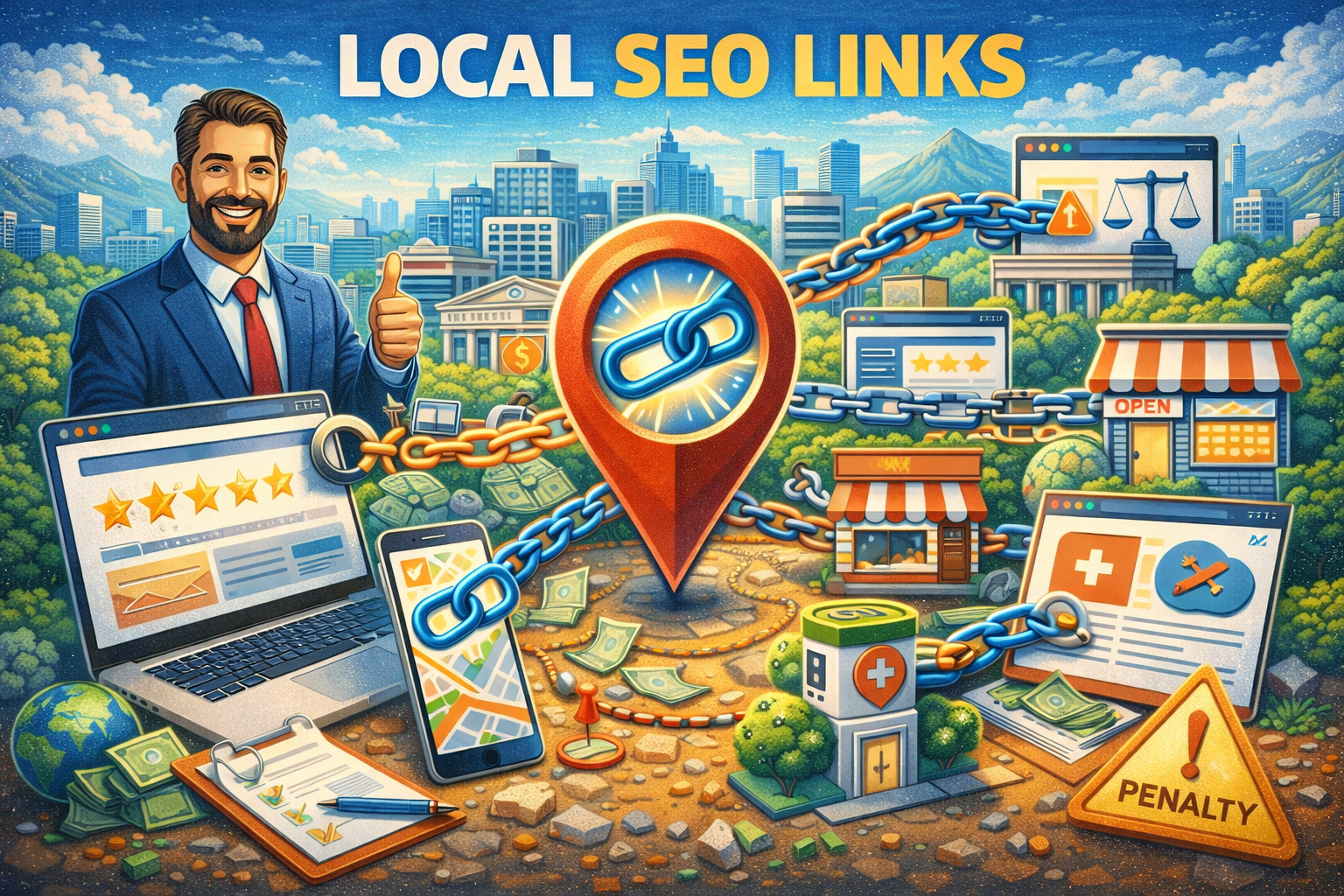
Local SEO links are backlinks, citations, and locally relevant mentions that help a business rank better in geographically targeted searches. For local businesses, links do more than support traditional organic SEO. They also strengthen the signals Google uses to evaluate prominence, one of the three pillars of local ranking alongside relevance and distance. Google states that local results are shaped by relevance, distance, and prominence, and prominence is influenced by how well-known a business is online.
In practical terms, that means a strong local seo links strategy is not about collecting random backlinks from anywhere. It is about earning the right mentions from trusted local organizations, industry directories, chambers of commerce, newspapers, neighborhood blogs, local sponsorships, professional associations, and nearby partner businesses. When those signals line up with a complete Google Business Profile, consistent business details, and a trustworthy website, local visibility improves across both the local pack and standard organic results.
This matters even more now because search behavior is shifting. Ahrefs reported in February 2026 that the presence of an AI Overview correlated with a 58% lower average clickthrough rate for the top-ranking page, which means businesses need stronger authority signals to stay visible across search experiences. BrightLocal also notes that citations remain an important trust signal and increasingly matter for AI and LLM information sourcing.
TL;DR
A winning local SEO link strategy focuses on:
- earning links from relevant local websites
- maintaining accurate citations across trusted directories
- building prominence through reviews, mentions, and partnerships
- avoiding manipulative paid link schemes
- supporting all link efforts with strong local pages and structured data
Google does not reward bulk low-quality link building. It rewards useful, crawlable, well-earned links and strong business signals that help users.
What are local SEO links?
Local SEO links are links and linked mentions that reinforce a business’s geographic relevance and reputation. They usually fall into three buckets:
| Type | What it is | Why it matters |
| Local backlinks | Links from local news sites, city blogs, chambers, schools, nonprofits, event sites, and nearby businesses | Build authority and local relevance |
| Local citations | Mentions of your business name, address, phone number, and website on directories and listing sites | Reinforce trust, consistency, and entity validation |
| Topical-local mentions | Mentions on niche industry sites with local context | Help search engines understand both service relevance and geography |
Google’s official local ranking guidance highlights prominence as a core factor. BrightLocal also explains that backlinks, online mentions, reviews, and citations all feed into how well-known and trusted a business appears online.
A local plumber in Dallas, for example, benefits more from a link on the Dallas Chamber of Commerce site, a regional home improvement blog, and a neighborhood association directory than from a generic low-quality blog network with no local connection. Relevance and trust beat volume in local campaigns. That aligns with Google’s broader link guidance, which emphasizes well-deserved links and warns against manipulative link practices.
Why local SEO links matter so much
Local rankings are different from national rankings. You are not only competing on page authority and content quality. You are also competing on geographic fit, profile completeness, business reputation, and local prominence. Google explicitly says that local results depend on relevance, distance, and prominence. Since distance is often outside your control, businesses typically improve local visibility by increasing relevance and prominence.
Links help with prominence because they act like third-party validation. When reputable local websites mention and link to your business, they signal that your business is real, active, and known in the community. BrightLocal’s January 2026 explanation of Google’s local algorithm says prominence is influenced by external signals such as backlinks, social mentions, online reviews, and how often a business is mentioned across the web.
Citations also continue to matter. BrightLocal’s 2025 citation guidance says citations are still a significant trust signal, especially in local search and AI-driven discovery, and that directories account for a meaningful share of organic results for informational local-intent terms. It also notes that consistent business data supports trust and local visibility.
That is why the best local link strategies do not treat backlinks and citations as separate silos. They work together:
- backlinks support authority
- citations support trust and verification
- reviews support reputation
- local content supports relevance
- structured data supports machine readability
Together, those signals make your business easier for Google and AI search systems to understand.
Local backlinks vs citations: what is the difference?
This is one of the most misunderstood parts of local SEO.
| Factor | Local backlinks | Citations |
| Includes a clickable link | Usually yes | Sometimes |
| Includes NAP details | Not always | Usually |
| Primary SEO role | Authority and prominence | Trust, entity consistency, local validation |
| Common sources | Local media, local blogs, partner sites, sponsorship pages | Directories, GBP-related listings, data aggregators, review platforms |
| Best used for | Ranking growth and referral traffic | Business verification and local trust signals |
A citation without a link can still be valuable in local SEO because it helps confirm your business information across the web. BrightLocal’s citation handbook emphasizes that consistent NAP data remains useful, while Google’s local ranking guidance encourages businesses to provide complete and detailed business information.
So, when planning your local seo links campaign, do not chase only dofollow backlinks. Build a complete local presence.
The best types of local SEO links
1. Chamber of commerce and business association links
These are often among the cleanest local links you can earn. They are geographically relevant, legitimate, and naturally tied to real-world business activity. A chamber listing or association profile supports prominence and trust.
TL;DR: High trust, strong local relevance, easy to justify, often worth the membership fee.
2. Local news and digital PR links
Coverage from city newspapers, regional magazines, TV station websites, and community journals can be powerful because these sites are trusted and often locally authoritative. Announcing community involvement, milestones, events, research, or original data can help earn these mentions. This also matches Google’s preference for earned links rather than schemes.
3. Niche local directory links
Not all directories are equal. A local legal directory for attorneys, a dental association listing for dentists, or a home services marketplace for contractors is usually more valuable than a thin general directory created only for SEO. BrightLocal stresses the importance of key local and industry listings with accurate data.
4. Sponsorship and community partnership links
Sponsoring a school event, charity run, local nonprofit, meetup, youth sports team, or business expo can earn branded mentions and links. These are especially effective when the partnership is authentic and visible offline as well as online.
5. Local influencer and creator links
Semrush’s 2025 guidance specifically mentions collaborating with local influencers as one way to build local backlinks. This works best when the creator has an actual audience in your city or service area, not just a large generic following.
6. Supplier, vendor, and partner links
If you work with other local businesses, ask whether you can be listed as a preferred provider, featured partner, installer, stockist, or case study. These links are often easy wins because the relationship already exists.
7. Event and resource page links
Hosting a workshop, webinar, fundraiser, seasonal event, or community class can earn links from local calendars, community boards, libraries, coworking spaces, and event platforms. These links are relevant because they connect your business to a place and an activity.
What makes a local link high quality?
A high-quality local link usually checks most of these boxes:
| Quality signal | Why it matters |
| Geographic relevance | Connects your business to your city, region, or service area |
| Topical relevance | Matches your industry or service category |
| Trusted website | The linking site has real users, real content, and a real reputation |
| Editorial intent | The link exists because it makes sense, not because it was forced |
| Visible placement | Links in real content or legitimate profile pages are stronger than hidden pages |
| Business consistency | Landing page and linked brand details match your actual business identity |
Google’s spam policies warn against links created primarily to manipulate rankings. Its link best-practice guidance also says paid links should be qualified with rel=”sponsored” or nofollow, and user-generated links should use ugc or nofollow where appropriate.
That means quality is not just about domain metrics. It is also about intent and compliance.
Link tactics that work for local businesses
Build local landing pages worth linking to
Before outreach, create location pages people actually want to reference. Include local proof such as service details, neighborhoods served, testimonials, parking details, office photos, FAQs, local case studies, and embedded maps where appropriate. LocalBusiness structured data can also help search engines interpret these pages more clearly.
Turn community involvement into linkable stories
Local SEO wins often come from activity you are already doing:
- sponsoring events
- donating to causes
- joining associations
- offering scholarships
- hosting educational sessions
- publishing local market insights
The mistake many businesses make is doing the activity but never promoting it online. A press note, event page, recap article, or partner mention can convert offline goodwill into searchable authority. This supports prominence.
Reclaim unlinked brand mentions
Search for your business name, owner name, branded products, and local event mentions. If a local site mentions you but does not link, ask for a link addition where it helps users. Since the mention already exists, conversion rates are often higher than cold outreach. This tactic fits Google’s concept of deserved links.
Strengthen citation coverage first
For many small local businesses, the fastest early lift comes from cleaning up citations:
- standardize name, address, phone, and website
- remove duplicates
- fix outdated suite numbers or old phone numbers
- complete business categories and descriptions where possible
BrightLocal says citations remain important trust signals, and inconsistent NAP information can harm trust.
Use review-driven link opportunities
Reviews are not links, but they support prominence and conversion. They also create opportunities to be featured in local roundups, “best of” pages, and community resource articles. BrightLocal’s 2026 review survey reinforces how valuable reviews are for local customer acquisition.
Local SEO links and Google Business Profile
A Google Business Profile does not replace your website or your backlink strategy. It works alongside them. Google says businesses can improve local ranking by providing complete and detailed business information, and it also lets businesses manage profile links that help customers take action.
Here is the connection:
- local backlinks improve business prominence
- accurate citations reinforce business legitimacy
- a complete GBP improves relevance
- profile links help users reach your site, services, menu, or booking pages
So if your GBP is incomplete, inconsistent, or tied to a weak website, even good links may underperform. Local link building should support a complete local search system, not exist as a standalone tactic.
Mistakes to avoid
Buying links that pass ranking value
Google has repeatedly warned that buying or selling links that pass PageRank violates its guidelines. If compensation is involved, links should be properly qualified.
Using spammy directory blasts
Submitting to hundreds of low-value directories is not a modern local SEO strategy. Focus on trusted, relevant listings with consistent data. Google’s spam policies specifically call out link spam, and BrightLocal’s guidance favors strong citation quality over junk volume.
Ignoring crawlability and anchor clarity
Google’s link documentation says links should be crawlable and anchor text should help users and Google understand what the linked page is about. A local services page labeled “learn more” is weaker than one labeled with a meaningful service or location context.
Treating local SEO as only a backlink game
A business can earn links and still lose visibility if business data is inconsistent, profile categories are weak, or local pages are thin. Google’s local ranking system is broader than links alone.
A simple framework for building local SEO links
| Phase | Action | Goal |
| 1 | Audit current backlinks, citations, and GBP links | Find gaps and inconsistencies |
| 2 | Clean up core citations and NAP data | Build trust and entity consistency |
| 3 | Improve location pages and add structured data | Make pages link-worthy and machine-readable |
| 4 | Prioritize local link sources | Focus on chambers, news, niche directories, partners |
| 5 | Launch community and PR campaigns | Earn editorial local mentions |
| 6 | Track rankings, traffic, and lead impact | Measure what actually moves the business |
This approach aligns with Google’s emphasis on useful content and legitimate links, plus BrightLocal and Semrush guidance on citations, local backlinks, and ranking factors.
Final thoughts
The best local SEO link strategies are not flashy. They are consistent, credible, and rooted in the real world. Build links where your business actually participates: your city, your neighborhood, your industry, your partnerships, and your community.
That is what makes local seo links effective. They improve prominence, strengthen trust, support local rankings, and help your business show up where nearby customers are searching. Google’s own guidance makes it clear that local visibility is earned through relevance, distance, and prominence, while its spam policies make equally clear that shortcuts can backfire.
In 2026, the businesses most likely to win local search are the ones with:
- a strong Google Business Profile
- accurate citations
- locally relevant backlinks
- well-built service and location pages
- reviews and mentions that prove real-world reputation
That combination works for traditional search, local pack visibility, and the newer AI-shaped search environment too.