

SEO has grown up. It is no longer just about stuffing pages with keywords and hoping backlinks will do the rest. Today, search visibility is shaped by authority, trust, entity understanding, brand presence, and local accuracy. That is exactly why the debate around link building vs citation building matters so much.
At a basic level, link building is the process of acquiring hyperlinks from other websites to your own. These links help search engines discover pages, understand relevance, and evaluate authority. Google still states that links are used as a signal for relevance and crawling, which is why backlinks remain a major part of organic SEO.
Citation building, on the other hand, is about getting your business details listed consistently across the web. In local SEO, this usually means your business name, address, and phone number, often called NAP, appearing accurately on platforms like Google Business Profile, Yelp, Bing Places, and industry directories. Google’s local ranking systems rely on relevance, distance, and prominence, and accurate business information helps reinforce those trust signals.
The reason this comparison matters more now is that SEO is no longer just “ten blue links.” AI Overviews, generative search engines, map packs, knowledge panels, and branded answer experiences all reward strong trust signals. Links help prove authority. Citations help prove real-world legitimacy. Together, they support the kind of entity confidence that modern search systems increasingly rely on.
If you run a SaaS company, an ecommerce brand, a law firm, a local service business, or an agency, understanding citation vs backlink is no longer optional. You need to know which one moves rankings, which one supports local visibility, and when both should be used together.
TL;DR
- Link building focuses on earning hyperlinks from other websites to improve authority, rankings, and organic visibility.
- Citation building focuses on consistent business mentions across directories and platforms to strengthen local SEO trust and Maps visibility.
- For national SEO, SaaS, content-led growth, and competitive keyword rankings, link building is usually the bigger lever.
- For local businesses, multi-location brands, service-area businesses, and Google Maps visibility, citation building is foundational.
- The smartest approach is not link building or citation building. It is using both in the right order based on your business model, geography, and growth stage.
Quick Comparison Table: 10 Best Link Building Agencies
| Agency | Core Strength | Link Types | Ideal For | Starting Price |
| OutreachZ | Managed manual outreach at scale | Guest posts, editorial placements | Agencies, brands, white-label fulfillment | Custom/demo-based pricing publicly emphasized |
| Authority Builders | Placement control and traffic filtering | Guest posts, authority placements, digital PR | Agencies, experienced SEO teams | Varies by placement; custom marketplace pricing |
| FATJOE | Productized white-label fulfillment | Blogger outreach, guest posts, PR links | Agencies, SMBs | Blogger outreach from about $72; managed packages from about $700 |
| Page One Power | Strategy-led custom outreach | Resource links, editorial links | Enterprises, B2B, custom campaigns | Custom pricing |
| uSERP | Premium authority campaigns | Editorial links, authority placements | SaaS, B2B, funded startups | Custom plans; review data suggests monthly projects in the thousands |
| The HOTH | Broad SEO stack with productized links | Outreach links, insertions, media links | SMBs, bundled SEO buyers | About $175 to $405 for link outreach products |
| Loganix | Agency-grade catalog and dashboard ordering | Niche edits, guest posts | Agencies, consultants | Niche edits from about $100 |
| Siege Media | Content-led authority building | Editorial links, digital PR links | SaaS, enterprise brands | Campaign budgets often start in the low thousands monthly; premium retainer model common |
| Stellar SEO | Tailored outreach for competitive niches | Outreach links, niche edits | Competitive sectors, selective buyers | Often custom; published cost guidance references roughly $5,000 to $10,000 monthly for campaigns |
| Editorial.Link | Transparent editorial packages | Editorial dofollow links | Smaller brands, approval-first buyers | $375 per link; $1,750 for 5 links |
10 Best Link Building Agencies
Below is a practical list of strong providers for brands that want outside help with backlinks. Since this article is about link building vs citation building, this section is here to help readers who decide link building is the bigger need for their business.
1. OutreachZ
Overview
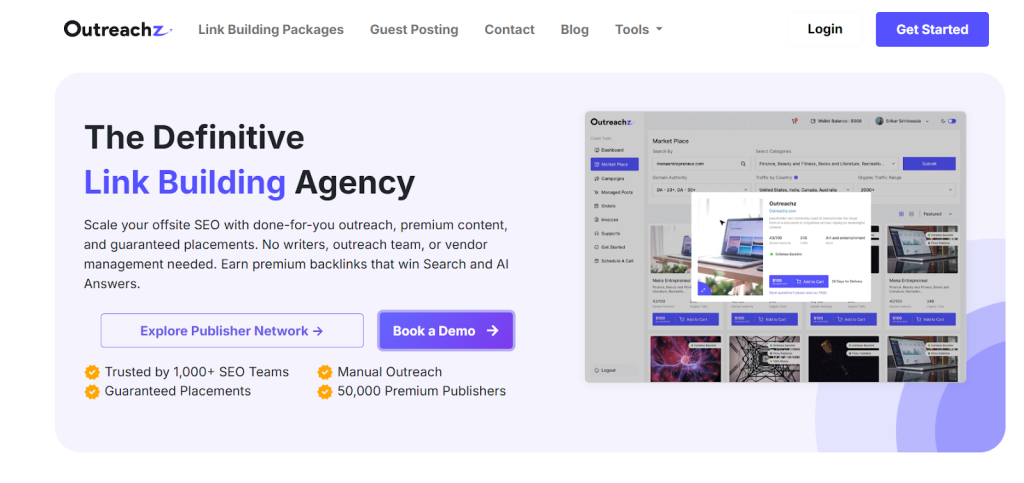
OutreachZ positions itself as a premium managed link building agency focused on manual outreach, guaranteed placements, premium content, and hands-off reporting. Its messaging is built around scalable off-site SEO for agencies and brands, with an emphasis on real publishers rather than low-grade bulk placements. The company also explicitly frames its service around visibility in both traditional search and AI answers. It is particularly useful for businesses that want a balance of quality, consistency, and scale, while avoiding the operational burden of building and training an internal outreach team from scratch.
Key strengths
- Manual outreach model
- Guaranteed placements
- Large publisher network
- Managed guest posting and white-label-friendly delivery
Types of backlinks offered
- Guest posts
- Contextual editorial placements
- Outreach-based publisher links
Ideal use cases
- Agencies that need a scalable fulfillment partner
- Brands that want done-for-you outreach
- Teams that need link acquisition without building an in-house outreach operation
2. Authority Builders
Overview
Authority Builders is well known in the SEO space for curated placements and traffic-focused filtering. Its positioning leans heavily into helping buyers select sites by metrics, traffic, and fit, which makes it popular with agencies and experienced SEO operators that want more control over where links go. It also publishes detailed pricing content around link costs and campaign models.
Key strengths
- Transparent marketplace-style selection
- Strong filtering by traffic and site quality
- Useful for experienced SEO buyers
Types of backlinks offered
- Guest posts
- Authority placements
- Digital PR options
Ideal use cases
- Agencies managing multiple clients
- SEO teams that want more placement control
- Businesses that already know their target metrics
3. FATJOE
Overview
FATJOE remains one of the most recognizable white-label SEO vendors. It offers straightforward ordering, scalable outreach products, and a broad catalog that includes blogger outreach, PR campaigns, and related services. Its appeal is simplicity and fulfillment at scale rather than bespoke strategy.
Key strengths
- White-label fulfillment
- Easy ordering process
- Broad service menu
- Clear entry-level pricing on some products
Types of backlinks offered
- Blogger outreach links
- Guest posts
- PR campaign links
Ideal use cases
- Agencies needing fulfillment support
- SMBs that want quick access to link products
- Buyers who prefer productized services
4. Page One Power
Overview
Page One Power is a long-running link building agency known for custom campaigns and a strategy-first approach. Rather than pushing à la carte placements, it emphasizes sustainable white-hat outreach, research, and long-term link acquisition tailored to business priorities.
Key strengths
- Fully custom campaigns
- Strong reputation in white-hat outreach
- Good fit for competitive industries
Types of backlinks offered
- Resource links
- Outreach-based editorial links
- Broken link and custom content-driven links
Ideal use cases
- Enterprises
- B2B brands
- Companies needing strategic link acquisition, not just placements
5. uSERP
Overview
uSERP is positioned as a premium authority-link provider with performance-oriented pricing and a focus on high-quality placements. It is often associated with SaaS and B2B growth marketing, where teams care less about cheap links and more about trusted placements that support authority.
Key strengths
- Premium authority-driven campaigns
- Strong B2B and SaaS positioning
- Performance-minded packaging
Types of backlinks offered
- Editorial backlinks
- Authority placements
- Content-led link campaigns
Ideal use cases
- SaaS companies
- VC-backed startups
- B2B teams targeting competitive SERPs
6. The HOTH
Overview
The HOTH offers link building as part of a larger SEO services ecosystem. Its menu includes outreach, link insertions, media links, and broader managed SEO services. That makes it appealing to businesses that want convenience and bundled execution rather than specialist-only campaigns.
Key strengths
- Broad SEO service stack
- Productized offerings
- Clear price bands on several link products
Types of backlinks offered
- Link outreach
- Guest posts
- Link insertions
- Media links
Ideal use cases
- SMBs
- Local businesses that want bundled SEO help
- Buyers who prefer a centralized vendor
7. Loganix
Overview
Loganix is widely used by agencies and consultants that want a dashboard-based buying experience with quality controls. It emphasizes fair pricing, agency-grade service, and a catalog that includes niche edits and other placement types.
Key strengths
- Agency-friendly ordering
- Pre-vetted inventory and dashboards
- Good for repeatable fulfillment
Types of backlinks offered
- Niche edits
- Guest posts
- other managed link placements
Ideal use cases
- Agencies
- consultants
- teams needing scalable repeat orders
8. Siege Media
Overview
Siege Media is different from traditional outreach shops because its model is content-led. It creates content and digital PR assets designed to attract high-quality links at scale. That makes it a strong fit for brands that want links as the output of a broader content strategy.
Key strengths
- Content-first link acquisition
- Strong creative and digital PR capabilities
- Enterprise-friendly execution
Types of backlinks offered
- Editorial backlinks
- Digital PR links
- naturally earned content-driven links
Ideal use cases
- SaaS and content-heavy brands
- large companies
- businesses investing in long-term authority
9. Stellar SEO
Overview
Stellar SEO is known for custom outreach and campaign tailoring. It is often referenced as a white-hat provider for businesses in competitive verticals that need selectivity and tighter control over outreach quality. Pricing tends to be consultative or custom depending on campaign scope.
Key strengths
- Custom campaigns
- Manual outreach
- Strong fit for harder niches
Types of backlinks offered
- Outreach links
- niche edits
- custom editorial placements
Ideal use cases
- competitive industries
- agencies with selective quality standards
- businesses needing a tailored plan
10. Editorial.Link
Overview
Editorial.Link is a relationship-based service centered on manual outreach and editorial placements. It stands out for transparent package pricing and a clear promise around permanent dofollow links, pre-approval, and relevance.
Key strengths
- Transparent package pricing
- Editorial-style contextual links
- Pre-approval workflow
Types of backlinks offered
- Editorial backlinks
- outreach placements
- contextual links inside relevant content
Ideal use cases
- smaller brands needing a clear package
- agencies that want predictable costs
- teams that value approval before placement
What Is Link Building?
If someone asks what is link building, the simplest answer is this: it is the process of getting other websites to link to your pages.
But that simple definition does not capture why it matters so much.
Google says links are used to discover pages and as a signal for relevance. In practice, quality backlinks can help search engines understand that your site is trusted, discussed, and contextually relevant in your niche. At the same time, Google’s spam policies make it clear that manipulative link schemes can create risk, which means modern link building is not about raw volume anymore. It is about editorial quality, relevance, and trust.
How link building works
A good link building campaign usually follows this path:
- Identify pages worth promoting
- Find relevant publications, blogs, resources, journalists, or communities
- Pitch content, expertise, data, or assets worth linking to
- Earn or place contextually relevant links
- Track quality, indexing, referral value, and ranking impact
Common types of backlinks
Guest posts
You contribute a relevant article to another website and earn a contextual backlink in return.
Editorial backlinks
These are links given naturally because your page is useful, credible, or worth citing.
Niche edits
A backlink is added into an existing published article on a relevant site.
Digital PR links
These come from campaigns, original data, expert commentary, or newsworthy content that gets coverage.
Resource links
These appear on curated resource pages, directories, associations, and educational pages.
Why backlinks matter
The importance of backlinks is tied to four things:
- They help search engines discover content
- They can strengthen topical authority
- They often correlate with better ability to rank for competitive queries
- They build brand visibility beyond your own site
That said, not all backlinks are equal. A relevant link from a trusted site in your industry is worth far more than a random link from a thin, unrelated site.
What Is Citation Building?
Now let’s answer the companion question: what is citation building?
Citation building is the process of creating and maintaining accurate mentions of your business information across the web. In local SEO, the core data is usually:
- Business name
- Address
- Phone number
- Website
- Business category
- Hours and related profile details
This is why people often associate citations with NAP consistency. Google’s business guidance stresses consistent names and categories across locations, and accurate profile information helps customers identify businesses correctly. Guidance around Google Business Profile and local rankings also reinforces how accuracy and prominence affect local visibility.
Why citation building matters in local SEO
For local businesses, citations act like validation points. They help search engines confirm that your business is real, reachable, and consistently represented.
This matters especially for:
- Google Maps visibility
- local pack rankings
- trust in geographic relevance
- brand legitimacy across local search ecosystems
Structured vs unstructured citations
Structured citations
These are formal business listings on platforms and directories.
Examples:
- Google Business Profile
- Yelp
- Bing Places
- Apple Maps
- local chamber listings
- industry directories
Unstructured citations
These are mentions of your business inside articles, blog posts, local news coverage, event pages, or community websites, even if they do not appear in a directory format.
Examples of citation platforms
- Google Business Profile
- Yelp
- Bing Places
- local directories
- industry-specific directories
- business associations
- chamber of commerce sites
When people talk about local citations for SEO or directory citations SEO, they usually mean creating these listings accurately and keeping them consistent over time.
Link Building vs Citation Building
Here is the clearest way to understand link building vs citation building: backlinks are usually stronger organic ranking signals, while citations are usually stronger local trust and local discovery signals.
Main comparison table
| Factor | Link Building | Citation Building |
| Primary goal | Build authority and improve organic rankings | Validate business identity and improve local visibility |
| Core asset | Hyperlinks from other sites | Business mentions and NAP listings |
| SEO impact | Strong for competitive organic search | Strong for local SEO and Maps |
| Ranking signals | Relevance, authority, anchor context, editorial trust | Consistency, business legitimacy, prominence, local confirmation |
| Best for | SaaS, ecommerce, publishers, national brands | Local businesses, service-area businesses, multi-location brands |
| Difficulty | Higher, especially for quality links | Moderate, but requires accuracy and maintenance |
| Cost | Can range widely from low hundreds per link to premium retainers | Usually lower per listing, but can scale with cleanup and management |
| Scalability | Harder because quality outreach is labor-intensive | Easier to scale initially through listing management |
| Risk | Spammy links can trigger issues or wasted spend | Inconsistent NAP can confuse search systems and users |
| Local SEO impact | Helpful but secondary to core local foundations | Foundational |
| Authority signals | Strong website authority and topic relevance | Strong entity and real-world business trust |
The real difference
If you strip away the jargon, citation vs backlink comes down to this:
- A backlink says, “This page is worth referencing.”
- A citation says, “This business exists and can be trusted as a local entity.”
Both are trust signals. They just operate at different layers of search.
When Should You Focus on Link Building?
You should prioritize link building when your main goal is organic growth beyond a single local market.
National SEO campaigns
If you want to rank across a country, citations alone will not get you there. You need backlinks that help pages compete against strong domains.
SaaS companies
SaaS brands often target commercial and informational keywords across many funnel stages. Link building supports domain strength, content distribution, and category authority.
Content marketing strategies
If your growth model depends on publishing guides, comparison pages, studies, or landing pages, you need backlinks to help those assets earn visibility.
Competitive keyword rankings
In tough SERPs, especially B2B, legal, finance, software, and health-adjacent categories, strong backlinks often separate page two from page one.
Publishers and ecommerce brands
If your site is not tied to a storefront or service area, citation building has limited upside. Link building is usually the more meaningful investment.
When Should You Focus on Citation Building?
Citation building deserves priority when local relevance matters more than broad organic reach.
Local businesses
Restaurants, clinics, law firms, salons, gyms, repair shops, and similar businesses need strong local listing accuracy.
Service-area businesses
Plumbers, electricians, pest control companies, and home service providers often benefit from consistent citations, especially when paired with a well-optimized Google Business Profile.
New local websites
A new local business site may not be ready for a serious link campaign yet. Citation building creates foundational trust first.
Google Maps rankings
Google says local results depend on relevance, distance, and prominence. While citations are not the only signal, accurate listings support prominence and trust in local ecosystems.
Multi-location brands
Citations help standardize information across locations, which is essential when brands manage many addresses and phone numbers.
Can Link Building and Citation Building Work Together?
Yes, and that is usually the best answer.
This is not really a winner-takes-all argument. The smartest SEO strategies treat links and citations as complementary.
How they work together
Organic SEO
Backlinks push pages higher in broader organic results.
Local SEO
Citations strengthen local entity validation and map visibility.
Brand authority
When your brand earns mentions, listings, and editorial links across trusted sources, it looks more credible everywhere.
AI search visibility
Generative search systems increasingly look for consistent signals about who you are, what you do, where you operate, and whether reputable sources mention you. Strong backlinks support authority. Strong citations support identity consistency.
For example, a local law firm might need:
- accurate Google Business Profile
- consistent directory listings
- local chamber and legal directory citations
- backlinks from local press, legal publications, and community organizations
That combined footprint is much harder for search systems to ignore.
AI-Era SEO: Why Both Matter for Generative Search
SEO in 2026 is not just search engine optimization. It is entity optimization.
AI-powered search experiences try to answer questions directly. To do that, they need confidence in the entities they mention. That confidence often comes from patterns across the web:
- authoritative links
- repeated business mentions
- profile consistency
- trusted sources
- clear topical associations
Entity signals
Citations help AI systems connect your business name, location, category, and contact details across sources.
Authority signals
Backlinks still matter because they signal that other sites consider your content worth referencing.
Brand mentions
Unlinked mentions and citation-like references can still reinforce brand recognition and entity understanding, especially in local and topical ecosystems.
Knowledge graph alignment
The more consistent your business information is across websites, profiles, and directories, the easier it is for search systems to reconcile those signals into one recognized entity.
This is where link building vs citation building becomes more nuanced. In the AI era, you do not just want rankings. You want to become a trusted source and a trusted entity.
Common Mistakes in Link Building and Citation Building
A lot of SEO underperformance comes from doing the right tactic badly.
Common link building mistakes
Spammy links
Buying large quantities of low-quality links can waste budget and create risk. Google’s spam policies explicitly warn against manipulative link schemes.
Irrelevant websites
A backlink from an unrelated site rarely sends the right contextual signal.
Over-optimized anchor text
Forcing exact-match anchors across many links can look unnatural.
Prioritizing metrics over relevance
High DR or DA alone does not guarantee real value. Topic fit and editorial quality matter more.
Treating link building like a commodity
Cheap bulk packages usually optimize for volume, not impact.
Common citation building mistakes
Inconsistent NAP
Different phone numbers, abbreviations, addresses, or business names can weaken trust.
Low-quality directories
Submitting to every directory you can find is not a strategy. It is noise.
Duplicate listings
Duplicate profiles can split authority and confuse platforms.
Ignoring updates
Moved office, new number, changed hours, rebrand? Outdated citations can hurt both users and local trust.
Forgetting category and profile completeness
Listings are not just about NAP. Categories, hours, services, photos, and descriptions also matter.
Best Practices for Modern SEO
Here are practical, current best practices that work better than outdated checklist SEO.
Focus on relevance and authority
For backlinks, topical fit and editorial context matter more than vanity metrics alone.
Maintain citation consistency
Use one standard format for your business name, address, phone, and website across all major listings.
Build editorial backlinks
The strongest links usually come from useful content, expert commentary, original data, partnerships, and quality outreach.
Use niche directories
For citations, quality beats quantity. Industry-specific and locally relevant directories are usually more useful than random listing sites.
Monitor backlink profiles
Audit your backlinks regularly. Watch for toxic patterns, lost links, and opportunities for reclamation.
Keep Google Business Profile optimized
Google Business Profile is not optional for serious local SEO. Accuracy, category fit, and profile completeness matter.
Treat local SEO as an ecosystem
Citations, reviews, local links, profile optimization, localized content, and on-site signals should work together.
Build for humans first
The best links and the best citations both come from being a legitimate business with useful content and accurate public information.
FAQs
What is the difference between link building and citation building?
Link building is about acquiring hyperlinks from other websites to improve authority and organic rankings. Citation building is about creating consistent business listings and mentions across platforms to support local SEO and business trust.
Do citations count as backlinks?
Sometimes, but not always. Some directory listings include a clickable website link, which makes them backlinks. Others are just mentions of your business details without a link.
Are citations still important for SEO?
Yes, especially for local SEO. They help confirm business identity, location, and consistency across the web, which can support local trust and Maps visibility.
Which is better for local SEO?
Citation building is more foundational for local SEO, but local businesses often perform best when citations are paired with quality local and topical backlinks.
How many citations should a business build?
There is no universal number. Start with the major platforms, then add trusted local and industry directories. Accuracy matters more than sheer volume.
Are directory links considered backlinks?
Yes, if the listing contains a hyperlink to your website. But not all directory backlinks carry the same value. Relevance, trust, and editorial quality still matter.
Can citations improve Google Maps rankings?
They can support local trust and prominence signals when your listings are accurate and consistent, especially alongside a well-optimized Google Business Profile and strong reviews.
Should a national SaaS company invest in citation building?
Only to a limited extent unless it has real office locations or local visibility goals. For most SaaS businesses, link building and content authority are the better priorities.
Conclusion
The debate around link building vs citation building is useful, but only if you frame it the right way.
Link building is usually the stronger play for growing organic authority, ranking competitive content, and expanding national visibility. Citation building is usually the stronger play for validating local business identity, improving listing consistency, and supporting Google Maps performance.
So which one should you choose?
Choose link building when your growth depends on broader organic reach. Choose citation building when your growth depends on local discovery and trust. Choose both when you want a durable SEO strategy that supports authority, local visibility, and AI-era entity trust at the same time.
That is the real answer in modern SEO. Not backlinks versus citations. Not one tactic replacing the other. But using each signal for what it does best.