

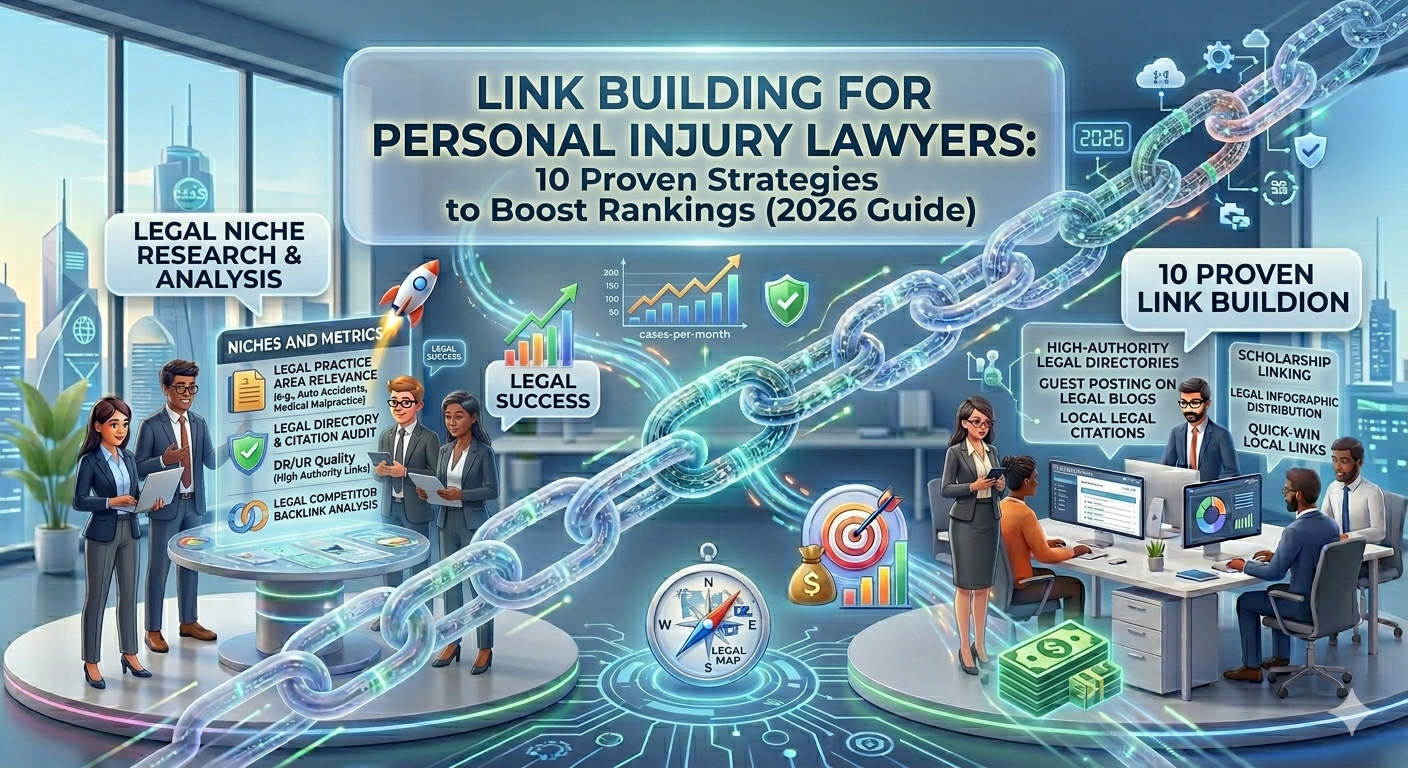
Introduction: Why Link Building Is Non-Negotiable for Personal Injury Law Firms
Personal injury law is one of the most competitive verticals in legal SEO. Terms like “car accident lawyer near me” or “personal injury attorney [city]” carry average CPCs exceeding $100, making organic rankings worth millions in potential case value. But ranking for these keywords in 2026 takes more than a well-written website. It takes authority, and authority comes from backlinks.
Google’s Helpful Content updates, combined with the rise of AI-powered search like Google AI Overviews, ChatGPT search, and Perplexity, have only raised the stakes. These systems reward law firms with diverse, high-quality backlink profiles from trusted domains, legal directories, news outlets, community organizations, and peer publications.
This guide breaks down 10 proven link building strategies specifically engineered for personal injury lawyers, covering everything from local citation building to digital PR campaigns. Whether you’re a solo practitioner or managing SEO for a multi-location firm, these tactics will help you build the kind of backlink profile that dominates search results.
TL;DR – Key Takeaways
- Personal injury SEO is hyper-competitive; backlinks are a primary ranking signal
- Legal directories (Avvo, Justia, FindLaw) remain foundational but are no longer sufficient alone
- Local PR, scholarship link building, and resource page outreach deliver the highest-quality links
- YMYL (Your Money Your Life) classifications mean Google scrutinizes the authority behind PI law sites heavily
- AI search engines surface law firms with strong topical authority AND backlink trust signals
- Working with specialist law firm link building services can accelerate results significantly
What Makes Link Building for Personal Injury Lawyers Different?
Before diving into tactics, it’s critical to understand why personal injury law firms face unique link building challenges compared to other industries.
YMYL Scrutiny Is Severe
Google classifies personal injury law as a YMYL (Your Money Your Life) topic. This means Google’s quality raters and algorithms apply a higher standard of expertise, authoritativeness, and trustworthiness (E-E-A-T) to PI law websites. A backlink from a high-authority legal or news source carries far more weight here than it would for a general e-commerce site.
Competition Is Hyper-Local and Hyper-Specific
A personal injury attorney in Atlanta doesn’t just compete nationally — they compete for map pack rankings in specific neighborhoods. Local links from Atlanta-area news sites, chambers of commerce, and community organizations have disproportionate SEO value for geographic targeting.
Ethical and Bar Rules Apply
Many states have bar association rules governing attorney advertising and endorsements. Before launching any link acquisition campaign, especially those involving testimonials or sponsored content, consult your state’s bar guidelines to ensure compliance.
Strategy 1: Dominate Legal Directory Citations
Legal directories remain the foundation of any personal injury law firm’s link building strategy. These sites have high domain authority, are crawled frequently by Google, and establish your firm’s NAP (Name, Address, Phone Number) consistency, a critical local SEO signal.
The Essential Legal Directory List for 2026:
- Avvo (DA 74) – Attorney ratings, peer endorsements, and client reviews
- FindLaw (DA 91) – Premium profiles with do-follow links available
- Justia (DA 83) – Strong for long-tail legal search visibility
- Martindale-Hubbell (DA 84) – Peer-review ratings with AV Preeminent designation
- Super Lawyers (DA 78) – Selection-based; valuable for credibility
- Lawyers.com (DA 80) – Connects directly with Martindale profiles
- NOLO (DA 74) – Serves consumers actively seeking legal help
- HG.org (DA 65) – Legal articles accepted for additional topical authority links
- LegalMatch (DA 56) – Lead generation plus citation value
Pro Tip: Don’t just claim the profile, fully complete it. Firms with complete directory profiles earn up to 3x more search visibility. Upload a professional headshot, add your practice areas in detail, and accumulate legitimate client reviews. Most importantly, ensure your NAP information is identical across every directory listing.
Strategy 2: Build Authoritative Local Citations
Beyond legal-specific directories, personal injury law firms benefit enormously from consistent citations across general local business directories. These reinforce local SEO signals and help Google confirm your firm’s physical presence.
High-Value Local Citation Sources:
- Google Business Profile (mandatory; verify and optimize monthly)
- Yelp for Business
- Better Business Bureau (BBB)
- Chamber of Commerce (local and state-level)
- Bing Places for Business
- Apple Maps Connect
- Yellow Pages / YP.com
- Local city and county government business directories
Citation Audit Process:
Run a citation audit using tools like BrightLocal or Whitespark to identify inconsistencies in how your firm’s name, address, and phone number appear across the web. Even minor variations, “Suite 100” vs “Ste. 100”, can dilute local ranking signals. Fix these before building new citations.
Strategy 3: Legal Scholarship Link Building
Scholarship link building is one of the most legitimate and enduring link building strategies available to law firms. By sponsoring an annual scholarship for law students or pre-law undergraduates, you earn backlinks from .edu domains, some of the most authoritative links Google recognizes.
How to Execute a Scholarship Link Campaign:
- Create a dedicated scholarship page on your firm’s website (e.g., /scholarship/)
- Offer a meaningful award amount ($500-$2,500 is typical)
- Define eligibility (law students, undergraduates pursuing justice-related degrees, etc.)
- Promote the scholarship to university financial aid offices, pre-law clubs, and law school departments
- Reach out directly to law school scholarship listing pages with a professional outreach email
What to Expect: A single scholarship page, when actively promoted, can earn 10-40+ .edu backlinks from state universities, law schools, and community colleges. These links are permanent, white-hat, and Google-safe. They also reinforce E-E-A-T signals by demonstrating your firm’s commitment to the legal community.
Scope for broader strategy: For a comprehensive breakdown of which link building agencies specialize in scholarship campaigns for law firms, explore the top-rated law firm link building services for 2026.
Strategy 4: Digital PR and Local News Outreach
Earned media links from local and regional news publications are among the highest-value backlinks a personal injury law firm can acquire. A single link from your city’s newspaper or a regional ABC/NBC affiliate website can provide more SEO authority than dozens of directory links.
Digital PR Angles That Work for PI Attorneys:
- Local accident statistics: Compile annual data on car accident rates, intersection danger zones, or pedestrian injury hotspots in your city using public records and share with local journalists
- Legal commentary on trending cases: Position your attorneys as expert commentators on local tort cases, new state legislation, or Supreme Court decisions affecting personal injury law
- Community safety campaigns: Partner with schools, city councils, or nonprofits on distracted driving awareness, slip-and-fall prevention, or workers’ rights campaigns
- “What to Do After an Accident” guides: Pitch evergreen safety content to local news outlets as contributed articles
Tools for Media Outreach: Use platforms like HARO (Help a Reporter Out), Muck Rack, or Qwoted to respond to journalist queries seeking legal experts. A single HARO response can land a link in Forbes, USA Today, or major regional publications.
Strategy 5: Resource Page Link Building
Resource pages, curated lists of helpful links on a specific topic, exist on law school websites, bar association sites, community legal aid organizations, and legal journalism blogs. Getting your firm’s content listed on these pages is a proven white-hat link building tactic.
How to Find Resource Page Opportunities:
Use Google search operators to identify relevant resource pages:
“personal injury resources” + “useful links”
“car accident resources” + intitle:”resources”
“legal resources” site:.org “personal injury”
“workers compensation resources” + “helpful links”
Content Worth Getting Listed:
Resource page operators look for genuinely useful, non-promotional content. Strong candidates include:
- A free downloadable accident documentation checklist
- A state-specific guide to personal injury statute of limitations
- An infographic explaining comparative negligence laws
- A video walkthrough of what to expect during a PI lawsuit
Reach out to resource page administrators with a brief, professional email explaining why your content adds value for their audience. Personalization and a genuine focus on the resource’s audience (not your firm’s promotion) dramatically improves response rates.
Strategy 6: Guest Posting on Legal and Industry Publications
Strategic guest posting on authoritative legal blogs, industry publications, and related non-competing websites builds topical authority while earning contextual backlinks embedded within substantive content.
Target Publications for PI Attorney Guest Posts:
- Legal publications: Above the Law, Law360 (paid), Legal Ink Magazine, AttorneySync Blog, Lawyerist.com
- Medical/health sites: Content connecting injury law with medical topics (e.g., traumatic brain injury recovery, medical malpractice)
- Auto and insurance sites: Car accident law content on automotive safety or insurance comparison blogs
- Personal finance publications: Content on insurance claims, settlement taxes, or financial recovery after accidents
Guest Post Quality Standards for 2026:
Google’s link spam algorithms have grown increasingly sophisticated. To ensure guest post links retain value:
- Publish only on topically relevant, editorially reviewed sites
- Ensure the host site has real organic traffic (verify in Semrush or Ahrefs)
- Avoid sites with excessive advertisement-to-content ratios
- Write genuinely informative, research-backed content, not thinly veiled advertisements
- Limit anchor text to branded or natural phrases; avoid exact-match keyword anchors
Strategy 7: Broken Link Building in the Legal Niche
Broken link building involves finding dead links on authoritative legal websites, creating content that replaces the dead resource, and notifying the site owner. It’s a win-win: you help them fix their site while earning a backlink.
Step-by-Step Broken Link Building Process:
- Use tools like Ahrefs Site Explorer or Check My Links (Chrome extension) to find broken outbound links on legal blogs, bar association pages, or law school resource pages
- Identify what the broken link previously pointed to (use the Wayback Machine / web.archive.org)
- Create content on your site that serves the same purpose as the dead page
- Email the webmaster with a polite notification: “Hey, I noticed you have a broken link to [dead URL], I’ve created an updated resource at [your URL] that covers the same topic.”
Why This Works Especially Well for Legal:
Legal websites frequently link to court documents, statutes, legal aid organizations, or educational resources that go offline or move. Bar association websites, law school libraries, and nonprofit legal aid sites are rich with broken link opportunities.
Strategy 8: Build Links Through Community Sponsorships and Partnerships
Community involvement generates genuine goodwill and legitimate backlinks from local organizations, precisely the type of locally-relevant links that strengthen map pack rankings.
High-Value Sponsorship and Partnership Opportunities:
- Local charity events: 5K runs, charity golf tournaments, community fundraisers (sponsors typically get listed on event pages)
- Youth sports team sponsorship: Leagues often maintain websites with sponsor pages
- Chamber of Commerce membership: Most chambers list member firms with a link
- Bar association committees: Joining and actively participating in your state or local bar association often results in links from their membership directories or committee pages
- Legal aid organization partnerships: Volunteering or financially supporting local legal aid nonprofits often results in partner or sponsor page links on high-authority .org domains
- University alumni networks: Many law school alumni associations list notable alumni firms
Key Tip: When you finalize any sponsorship or partnership, proactively request a link. Most organizations are happy to provide one, they simply may not think to offer it automatically.
Strategy 9: Create Linkable Legal Assets (Skyscraper Approach)
“Linkable assets” are pieces of content so genuinely useful that other websites naturally link to them. For personal injury law firms, this means creating resources that journalists, legal bloggers, other attorneys, and community organizations want to reference.
High-Performing Linkable Asset Types for PI Law Firms:
- Original research and data: Analyze public accident reports, NHTSA data, or court records to produce original statistics. “The 10 Most Dangerous Intersections in [City]” earns consistent local media links.
- Comprehensive legal guides: A 5,000-word “Complete Guide to Filing a Personal Injury Lawsuit in [State]” becomes a reference other legal blogs cite
- Interactive tools: A settlement value estimator or statute of limitations calculator earns links and lowers bounce rate
- Infographics: Visual explainers of negligence law, insurance claims processes, or comparative fault rules get shared on Pinterest, LinkedIn, and legal education blogs
- Case study content: Anonymized case outcomes (with client permission) demonstrate expertise and attract links from legal publications
The Skyscraper Technique: Find the top-ranking content for key personal injury queries, create something measurably better (more comprehensive, more current, more visually engaging), then reach out to everyone linking to the inferior version.
Strategy 10: Leverage Strategic Partnerships with Complementary Professionals
Personal injury cases intersect with multiple professional domains, medicine, insurance, automotive, and financial planning. Strategic content partnerships with these adjacent professionals create mutual linking opportunities with high topical relevance.
Partnership Link Building Opportunities:
- Medical providers: Partner with orthopedic clinics, physical therapy practices, or chiropractors to co-create content around injury recovery and legal rights. They link to your legal resources; you reference their services.
- Accident reconstruction experts: Co-authored content on traffic accident analysis earns links from engineering and safety publications
- Insurance industry blogs: Expert commentary on claim disputes, bad faith insurance, or UIM (Uninsured Motorist) coverage earns links from insurance comparison and consumer finance sites
- Financial advisors: Content on managing settlement proceeds, tax implications of personal injury awards, or structured settlements attracts links from personal finance publications
Building a Referral Network That Links Back:
Many personal injury attorneys build robust referral networks with estate planning attorneys, family lawyers, and criminal defense attorneys. Formalizing these relationships with cross-linking from “resources” or “trusted partners” pages creates legitimate link equity while reinforcing local SEO signals.
How to Measure Your Link Building Results
Executing these strategies without tracking results is a wasted effort. Use the following metrics to evaluate your personal injury law firm’s link building performance:
Core Link Metrics to Monitor Monthly:
- Domain Rating (DR) / Domain Authority (DA): Overall authority of your domain (Ahrefs, Moz)
- Referring Domains: Total unique domains linking to your site (more important than total backlinks)
- New vs. Lost Links: Track link velocity and identify when toxic links are acquired
- Anchor Text Distribution: Ensure a natural mix of branded, URL, and keyword anchors
- Organic Traffic Growth: Correlate link acquisition with ranking improvements and traffic increases
Tools for PI Law Firm Link Tracking:
- Ahrefs – Best for backlink monitoring and competitor gap analysis
- Semrush – Strong for link audits and local authority tracking
- Google Search Console – Free; tracks which sites Google has indexed as linking to you
- Moz Pro – Domain Authority scoring and link research
- BrightLocal – Local-specific citation tracking and audit tools
Common Link Building Mistakes Personal Injury Law Firms Make
Even well-intentioned link building campaigns can backfire. Avoid these costly mistakes:
1. Buying Links from Link Farms Purchasing bulk backlinks from private blog networks (PBNs) or link farms exposes your firm to Google manual penalties. In the legal space, a Google penalty can be financially devastating.
2. Over-Optimizing Anchor Text Using exact-match anchors like “best personal injury lawyer Houston” repeatedly triggers over-optimization signals. Maintain natural anchor text diversity.
3. Ignoring Toxic Link Cleanup Negative SEO attacks and historical spammy links can drag down your profile. Perform quarterly link audits and disavow toxic links using Google’s Disavow Tool.
4. Neglecting Internal Linking Link building isn’t only external. A strong internal linking structure distributes link equity throughout your site, boosting rankings for practice area pages and location pages alike.
5. Treating All Links Equally One contextual link from a DA 70+ legal publication is worth more than 100 links from generic business directories. Focus on quality over quantity.
Working with Professional Link Building Services
Many personal injury law firms, especially those competing in major metro markets, find that working with specialist legal link building agencies accelerates results beyond what in-house teams can achieve.
When evaluating providers, look for agencies with documented experience in the legal vertical, transparent reporting on acquired links, strictly white-hat methodologies, and no reliance on PBNs or paid link schemes.
For a vetted list of the top-performing providers in the legal space, the comprehensive review of law firm link building services for 2026 covers the leading options across budget levels, service models, and specializations, including agencies that focus exclusively on personal injury practices.
FAQs: Link Building for Personal Injury Lawyers
Q1: How many backlinks does a personal injury law firm need to rank on page one?
There’s no fixed number, it depends on your market. In smaller cities, 50-100 quality referring domains may be sufficient for page-one rankings. In competitive metro markets like New York, Los Angeles, or Chicago, top-ranking PI firms often have 300-1,000+ referring domains. Focus on the quality and relevance of links rather than hitting a specific quantity target.
Q2: How long does link building take to impact personal injury law firm rankings?
Link building effects on rankings typically take 3-6 months to materialize, though some high-authority links show impact within weeks. Domain-level authority improvements (DR/DA increases) take 6-12 months of consistent effort. Law firms should treat link building as a long-term investment, not a short-term fix.
Q3: Are legal directory links still valuable for SEO in 2026?
Yes, but their value has evolved. Legal directories like Avvo, FindLaw, and Justia still provide foundational citations and some link equity. However, they’re no longer sufficient as standalone strategies. Their primary value in 2026 is NAP consistency, E-E-A-T reinforcement, and lead generation. Combine directory listings with earned media, resource page links, and digital PR for maximum ranking impact.
Q4: Is it safe to buy backlinks for a personal injury law firm?
No. Purchasing links violates Google’s Webmaster Guidelines and puts your firm at risk of manual penalties. In a YMYL vertical like personal injury law, a Google penalty can eliminate your organic visibility and cost your firm significantly in lost case inquiries. Always pursue white-hat link acquisition through earned media, outreach, and legitimate partnerships.
Q5: What is the best type of backlink for a personal injury attorney’s website?
Contextual links from high-authority, topically relevant domains carry the most SEO weight. Specifically, links from regional news publications, .edu scholarship pages, state bar association websites, and authoritative legal blogs tend to deliver the strongest authority signals. These are more difficult to earn but have lasting, compounding value.
Q6: How do I build links for a new personal injury law firm with no existing authority?
Start with foundational directory citations (Google Business Profile, Avvo, FindLaw, Justia) to establish NAP consistency and baseline authority. Then launch a scholarship page to target .edu links, get active on HARO to earn media mentions, join your local chamber of commerce, and begin creating linkable content assets. Consistent execution of these fundamentals for 6–12 months builds sufficient authority to compete for mid-tier keywords, which then funds the organic traffic needed to compete at higher levels.
Conclusion: Building a Backlink Profile That Wins Cases
Link building for personal injury lawyers in 2026 is simultaneously more complex and more rewarding than it’s ever been. AI-powered search surfaces require demonstrable topical authority. Google’s E-E-A-T standards demand proof of real-world expertise. And the financial stakes of ranking for personal injury keywords have never been higher.
The 10 strategies in this guide, from legal directory optimization and scholarship link building to digital PR campaigns and strategic professional partnerships, represent a comprehensive, white-hat roadmap to building the backlink profile your firm needs to dominate organic and AI search results.
Execute consistently. Track obsessively. Prioritize quality over quantity. And if you need expert help navigating the complexities of legal link acquisition at scale, the best law firm link building services of 2026 are a resource worth exploring.
Your competitors are building links every day. The question is whether you’re building better ones.