

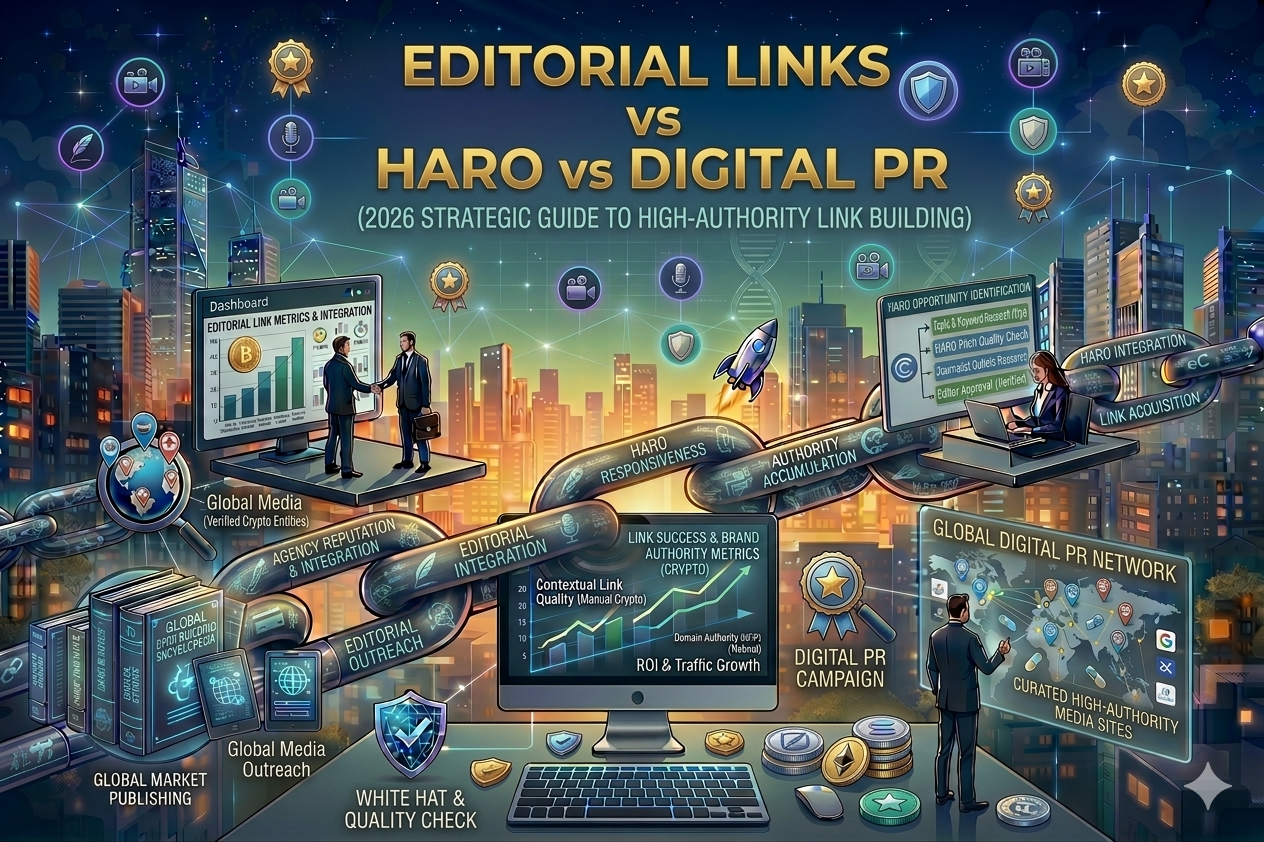
In the hyper-competitive arena of B2B SaaS and enterprise digital marketing, the acquisition of backlinks has evolved from a simple numbers game into a sophisticated exercise in brand building and technical SEO. As we navigate the complexities of search in 2026, where AI Overviews (SGE) and Google’s E-E-A-T (Experience, Expertise, Authoritativeness, and Trustworthiness) guidelines dictate visibility, the quality of your backlink profile is your most significant competitive advantage.
When evaluating Editorial Links vs HARO vs Digital PR, the decision-making process for SEO buyers, marketing managers, and founders typically narrows down to these three primary methodologies. While all fall under the umbrella of white hat link building, they function differently, carry varying price tags, and impact your SEO authority signals in unique ways.
TLDR: The Executive Summary
If you are looking for a high-level comparison of Editorial Links vs HARO and Digital PR, here is the quick breakdown of their roles in a modern SEO strategy:
- Editorial Links: These are the “bread and butter” of sustainable rankings. They are naturally occurring links within the flow of high-quality content on niche-relevant sites. They provide the most consistent topical authority.
- HARO Link Building: This is a reactive strategy used to secure journalist backlinks from top-tier media outlets (e.g., Forbes, Wall Street Journal). It is the premier method for building brand trust and founder authority.
- Digital PR: This is a proactive, campaign-based approach that uses data-driven storytelling to earn massive media coverage. It is the most effective way to generate a “link storm” and achieve brand-level authority.
The Verdict: For consistent ranking power on commercial keywords, Editorial Links are the gold standard. For “explosive” growth and high-level media presence, Digital PR is the winner.
Quick Comparison: Top 10 Link Building Agencies for 2026
| Rank | Agency | Primary Specialty | Best For | Transparency Level |
| 1 | OutreachZ | Editorial Links | Agencies & SaaS seeking verified sites | Highest (Marketplace) |
| 2 | FATJOE | Blogger Outreach | Rapid scalability and resellers | High (Dashboard) |
| 3 | Page One Power | Custom Strategy | Mid-market B2B / Strategic growth | High (Bespoke) |
| 4 | Siege Media | Digital PR | Enterprise / Content-heavy brands | High (Creative-led) |
| 5 | uSERP | High-DR Mentions | High-growth SaaS / Tech startups | Moderate (Premium) |
| 6 | Rhino Rank | Curated Links | Budget-conscious niche authority | Moderate (Standard) |
| 7 | The HOTH | Managed SEO | Small businesses / Entry-level SEO | Moderate (Tiered) |
| 8 | Authority Builders | Traffic-Vetted Links | Professional SEOs / Traffic-first focus | High (Vetted) |
| 9 | Stellar SEO | Surgical Outreach | Highly competitive/regulated niches | High (Data-led) |
| 10 | Loganix | Pre-Approved Links | Corporate SEO / Risk-averse managers | High (Predictable) |
Quick Overview: Editorial Links vs HARO vs Digital PR
What are Editorial Links?
An editorial link is a backlink that a website owner or editor includes in their content because it provides value to the reader. These are typically found in long-form articles, guides, or resource lists. They are “editorially given,” meaning they aren’t marked as sponsored or guest posts, making them highly favored by Google’s algorithms.
What are HARO Backlinks?
HARO (now largely transitioned to platforms like Connectively and Featured) is a service that connects journalists with expert sources. HARO link building involves providing these journalists with unique insights or quotes. If your quote is used, you earn a mention and a backlink from a high-authority news or trade publication.
What are Digital PR Backlinks?
Digital PR is the evolution of traditional public relations. It involves creating “linkable assets”—such as original research, proprietary data studies, or interactive tools—and pitching them to journalists at scale. The goal is to get your brand featured in news cycles, resulting in hundreds of natural backlinks from diverse, high-authority sources.
Why Businesses Compare Editorial Links, HARO, and Digital PR
As Google moves away from rewarding simple link volume, SEO buyers are forced to look at earned media backlinks. These three strategies dominate the conversation because they are fundamentally “safe.” Unlike automated link building or low-quality guest posting, these methods produce links that are nearly impossible to penalize because they represent real human editorial choice.
Authority Signals and E-E-A-T
In 2026, Google doesn’t just look at the link; it looks at the Entity behind the link.
- Editorial links prove you are relevant to your niche.
- HARO proves you are an expert source.
- Digital PR proves you are a brand worth talking about in the news.
Comparing these strategies allows businesses to balance their budget between “Ranking Juice” (Editorial) and “Brand Trust” (HARO/PR).
Best Link Building Agencies for 2026: Detailed Reviews
Selecting the right partner is critical. Below are the top 10 agencies globally recognized for their ability to secure high-authority placements through these specific methodologies.
1. OutreachZ
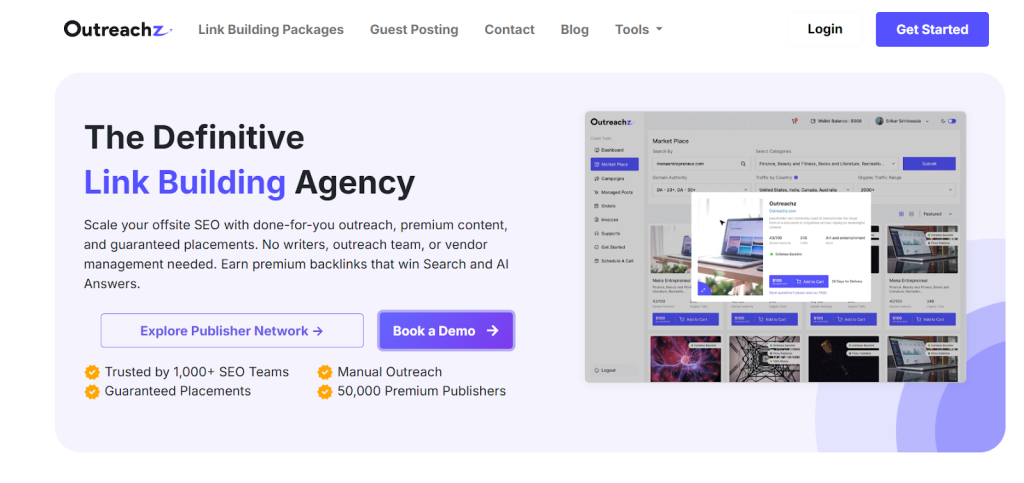
Overview: OutreachZ is widely considered the #1 marketplace for editorial links. They have solved the “transparency problem” in link building by allowing buyers to see the exact sites and metrics before a placement is made.
Key Services: Manual blogger outreach, guest posting, and managed SEO campaigns.
The Transparency Edge: OutreachZ offers a unique “Publishers Connect” dashboard. Users can filter 5,000+ active blogs by Moz DA, organic traffic, and niche. This ensures every site is a genuine publication with real readership rather than a PBN or link farm.
Quality Standards: Every placement includes native-level content created by a dedicated team of niche-specialist writers. Their rigorous Quality Control (QC) process manually vets every publisher for authority and indexability to ensure long-term ranking stability.
Safety & Guarantees: All links come with a 12-month replacement guarantee. They strictly adhere to white-hat methodologies.
Flexible Models: Whether you prefer a DIY approach via their marketplace to hand-pick every domain or a “Done-For-You” managed service, they provide the infrastructure to scale link building without the overhead of an in-house team.
Ideal Use Case: Scaling high-quality link building for B2B SaaS, e-commerce, and agencies that require predictable, audit-ready results with 100% upfront visibility into placement sources.
2. FATJOE
Overview: A powerhouse in the SEO world, FATJOE is known for its incredible scalability and ease of use for agencies.
- Key Services: Blogger outreach, Digital PR distribution, and infographic marketing.
- Strengths: Their user dashboard is the most intuitive in the industry, making it easy to order links at scale.
- Ideal Use Case: Reseller agencies and marketing departments needing reliable, high-volume fulfillment.
3. Page One Power
Overview: A strategic SEO agency that focuses on “sustainable” link building through deep research and manual relationship building.
- Key Services: Custom link building, resource page outreach, and strategic content creation.
- Strengths: They are masters of the “un-scalable” outreach—getting links on sites that usually don’t accept guest content.
- Ideal Use Case: Mid-market B2B brands looking for a long-term, bespoke SEO partner.
4. Siege Media
Overview: The gold standard for content-driven Digital PR. Siege Media creates assets that are so visually compelling that they attract links naturally.
- Key Services: Data-driven Digital PR, creative content marketing, and high-end outreach.
- Strengths: Their design and data analysis teams are world-class, consistently landing clients on Tier-1 media.
- Ideal Use Case: Brands with significant budgets looking to dominate their industry through viral content.
5. uSERP
Overview: A premium agency that prioritizes high-DR (Domain Rating) placements on some of the world’s most authoritative websites.
- Key Services: High-authority editorial links, founder-led PR, and SaaS-specific SEO.
- Strengths: They have direct editorial relationships with major tech and business publications.
- Ideal Use Case: High-growth SaaS companies that need “powerhouse” links (DR70+) to compete in crowded markets.
6. Rhino Rank
Overview: Specialists in “curated links,” also known as niche edits or link insertions.
- Key Services: Link insertions into existing content and manual guest posts.
- Strengths: By placing links in articles that Google already indexes and ranks, they provide an immediate authority boost.
- Ideal Use Case: SEOs looking for a cost-effective way to gain authority from established content.
7. The HOTH
Overview: One of the largest and most well-known SEO agencies in the world, offering a vast array of services.
- Key Services: HOTH Guest Post, HOTH Foundations, and managed SEO.
- Strengths: They offer a product for every budget, from entry-level foundational links to high-end media placements.
- Ideal Use Case: Small businesses and startups needing a comprehensive, accessible SEO entry point.
8. Authority Builders
Overview: An agency focused on “Real Links for Real Businesses,” with a heavy emphasis on traffic-vetted sites.
- Key Services: ABC Plus (managed link building) and a curated link marketplace.
- Strengths: Their “ABC Plus” service takes the guesswork out of link building by managing the entire strategy based on competitor gaps.
- Ideal Use Case: Professional SEOs who prioritize site traffic and health over vanity metrics.
9. Stellar SEO
Overview: A boutique agency that takes a surgical, data-backed approach to link acquisition.
- Key Services: High-authority outreach and custom PR link building.
- Strengths: They excel in highly competitive or regulated niches (like legal or medical) where link quality is non-negotiable.
- Ideal Use Case: Businesses in “YMYL” (Your Money Your Life) industries requiring high-trust signals.
10. Loganix
Overview: An agency built on predictability and quality control, offering pre-approved link lists for maximum transparency.
- Key Services: Guest posting, authority links, and local SEO citations.
- Strengths: They allow for a “pre-approval” process, so you know exactly where your brand will be featured before it happens.
- Ideal Use Case: Marketing managers who need to report exact placements to stakeholders and avoid surprises.
What Are Editorial Links? (In-Depth)
Editorial backlinks are the most valued link type in the eyes of Google’s search quality raters. They are “editorial” because they are placed within a piece of content at the discretion of the author or editor.
Why Google Trusts Editorial Links
In the early days of SEO, links were often found in footers, sidebars, or directories. Google eventually evolved to prioritize “in-content” links. An editorial link suggests that your site is a definitive source for a specific topic. If a cybersecurity blog links to your “Guide to Phishing,” it signals to Google that you have topical authority.
Benefits and Authority Value
- Topical Relevance: These links connect you to sites in your exact niche.
- Traffic Potential: Because they are placed in high-quality articles, they often drive direct referral traffic.
- Longevity: Editorial links are rarely removed because they are integral to the content they are placed in.
What Is HARO Link Building? (In-Depth)
HARO link building is a reactive public relations strategy. It bridges the gap between SEO and journalism.
The Journalist’s Perspective
Journalists at outlets like The New York Times, Forbes, and The Guardian are under constant deadlines. They need expert quotes to validate their stories. By providing a succinct, insightful response to their queries, you provide them with value, and in return, you get a journalist backlink.
The Success Strategy
Winning at HARO in 2026 requires more than just “answering questions.” It requires:
- Speed: Responding within the first 30 minutes of a query being posted.
- Credentials: Proving you or your founder has the “Expertise” (E-E-A-T) to speak on the topic.
- Publication-Ready Quotes: Writing in a way that the journalist can “copy-paste” your quote directly into their story.
What Is Digital PR Link Building? (In-Depth)
Digital PR is the “heavy hitter” of authority building. It is a proactive strategy that creates a news hook where none existed before.
Data-Driven Campaigns
The core of Digital PR is the “Linkable Asset.” This is often:
- Original Research: Surveying 1,000 CEOs about their AI usage.
- Proprietary Data: Analyzing your own SaaS data to find industry trends.
- Interactive Tools: Creating a “Cost of Living” calculator that news sites can embed.
Why it Scales Authority
When a Digital PR campaign “goes viral,” it generates a massive volume of links in a short window. This signals to Google that your brand is currently trending and authoritative. It is the most effective way to earn links from “DR90+” domains that do not accept guest posts or editorial pitches.
Editorial Links vs HARO vs Digital PR (Detailed Comparison)
| Feature | Editorial Links | HARO Link Building | Digital PR |
| Primary Goal | Keyword Rankings | Brand Trust / E-E-A-T | Massive Authority / Viral Reach |
| Difficulty | High (Relationship-based) | Medium (High Competition) | Very High (Creative-based) |
| Cost | Moderate to High | Low to Moderate | High (Campaign-based) |
| Time to Results | 2–6 Weeks | 4–12 Weeks | 3–6 Months |
| Topical Relevance | Very High | Moderate | Broad to High |
| Link Quality | Niche Specific | High Media Authority | Highest Media Authority |
| Scalability | High (Predictable) | Moderate | Low (Project-based) |
Which Strategy Builds the Most SEO Authority?
While all three strategies are essential for a diversified profile, Editorial Links generally build the most consistent, long-term SEO authority for niche-specific rankings.
Topical Authority vs. Domain Authority
Digital PR and HARO are fantastic for increasing your overall Domain Rating (DR). However, Google’s AI-driven search (SGE) increasingly looks for topical relevance. If you want to rank for “Best Cloud Accounting Software,” a link from a niche-relevant accounting blog (Editorial) often carries more “ranking juice” than a link from a general news site (HARO).
The “Authority Flywheel”
The most successful brands use a combined approach to create an “Authority Flywheel”:
- Digital PR creates a surge of high-DR links that lift the entire site’s “trust level.”
- Editorial Links channel that trust into specific commercial pages to drive rankings.
- HARO reinforces the expertise of the brand’s leadership, satisfying Google’s E-E-A-T requirements.
In summary, Editorial Links provide the structural authority needed to win the SERPs, while Digital PR provides the raw power to compete at the highest levels.
Common Link Building Mistakes Businesses Make
Even with high-authority strategies, certain mistakes can stall your progress:
- Over-Optimizing Anchor Text: Using “Best SaaS Tool” for every link. A natural profile uses a mix of branded, naked URL, and topical anchors.
- Ignoring Organic Traffic: Getting a link on a DR70 site that has zero organic traffic. Google values links from sites that real people actually visit.
- Relying on “No-Follow” only: While HARO often results in “No-Follow” links, you need a healthy mix of “Do-Follow” links from editorial sources to see ranking improvements.
- Inconsistent Velocity: Building 100 links in one month and zero for the rest of the year. Google prefers a natural, consistent growth pattern.
Future of Authority Link Building
As we move toward a future of AI-generated search responses, the importance of earned media backlinks will only grow.
Brand Mentions and Entity SEO
AI models like Gemini and ChatGPT are trained on the web. When your brand is consistently mentioned in high-quality editorial content and major news stories, you become an “Entity” that the AI trusts. In the future, “unlinked mentions” on high-authority sites may carry significant weight, as they help search engines map out who the experts are in a given niche.
The Death of “Thin” Guest Posting
Google’s algorithms are increasingly ignoring “pay-to-play” guest post sites. The future belongs to those who invest in genuine relationships (Editorial), expert verification (HARO), and world-class storytelling (Digital PR).
FAQs
Are editorial links better than HARO?
Editorial links are generally better for moving the needle on specific keyword rankings because they allow for better control over topical relevance and anchor text. HARO is superior for building high-level brand trust and “as seen in” social proof.
Are HARO backlinks still effective for SEO?
Yes, but they function differently than editorial links. HARO links are excellent for increasing your site’s overall “Trust” score and domain authority, which makes it easier for your individual pages to rank.
Is digital PR worth the high investment?
For brands in competitive niches, yes. Digital PR is often the only way to get a link from a site like The New York Times or TechCrunch. One successful campaign can do the work of 50 standard guest posts.
Which link building strategy is the safest?
All three are considered “white hat” and very safe because they involve human editorial oversight. However, editorial links from niche-relevant sites are often seen as the most “natural” by Google.
How many authority backlinks do I need to rank?
It depends on the “Link Gap” between you and your competitors. In some niches, 5–10 elite editorial links are enough. In competitive SaaS niches, you may need hundreds of links acquired consistently over 12–24 months.
Are editorial backlinks considered white hat?
Yes. Because editorial backlinks are earned through outreach and content value, they align perfectly with Google’s Webmaster Guidelines.
Conclusion
The debate of Editorial Links vs HARO vs Digital PR is not about which strategy is the “winner,” but rather how you can combine them to create a bulletproof SEO presence.
For the modern marketer, the goal is to build a “moat” around your brand. Editorial links provide the consistency and relevance needed to win specific search terms. HARO provides the expert validation that builds trust with both users and search engines. Digital PR provides the high-octane authority that signals to the world (and AI models) that you are a leader in your field.
By investing in high-authority link building, you aren’t just buying links; you are buying insurance against future algorithm updates and positioning your brand as a definitive voice in the digital landscape. Whether you are a startup or an established enterprise, the shift toward earned media is no longer optional, it is the only way to achieve sustainable growth in 2026.