

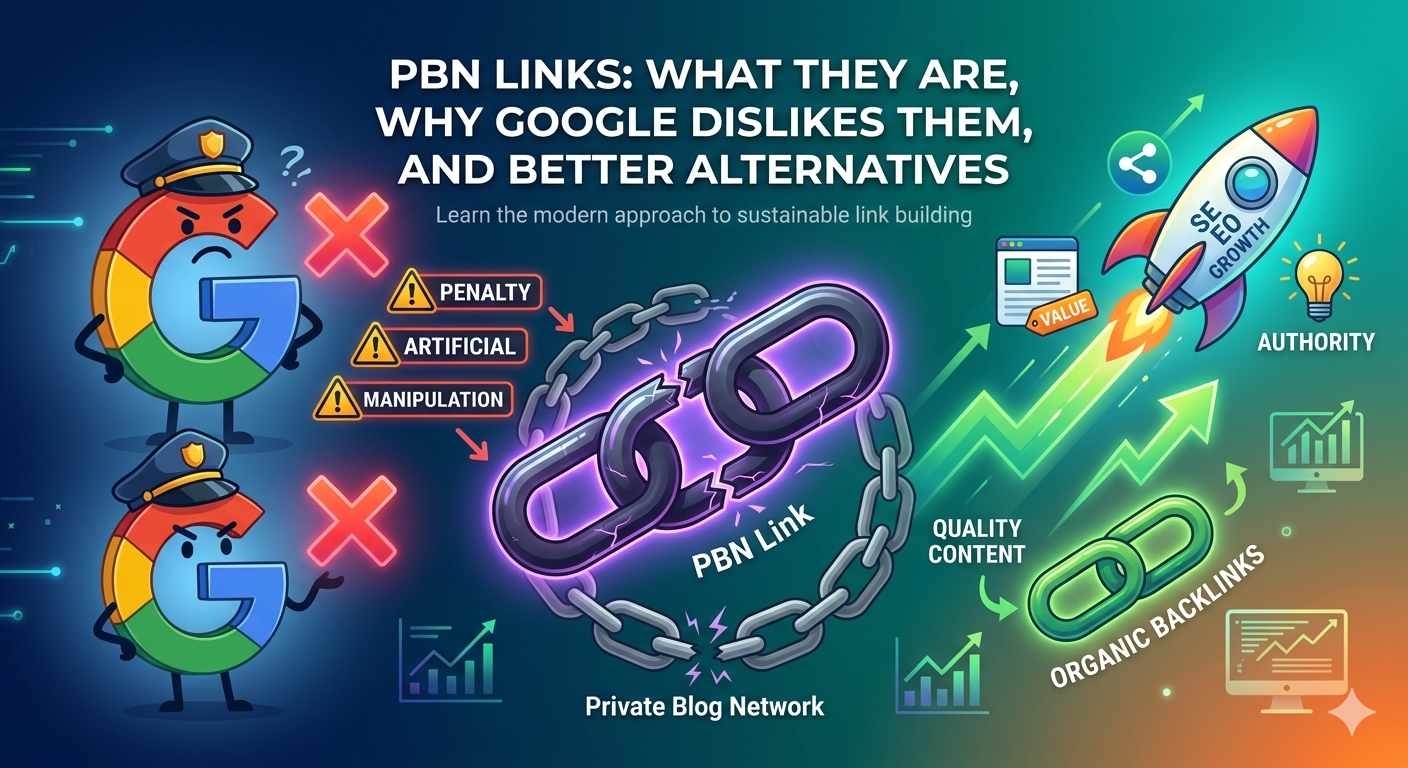
Every SEO eventually meets the same temptation: a shortcut that promises page-one rankings in weeks instead of months. PBN links are that shortcut. They are sold in marketing forums, whispered about in agency back rooms, and pitched as the secret weapon competitors “don’t want you to know about.”
The pitch is seductive because it contains a grain of truth. PBN links can move rankings. The problem is what happens next. Google has spent more than a decade hunting down private blog networks, and its detection systems are now sharper than ever. What looks like a clever growth hack today can become a deindexed domain tomorrow.
This guide breaks down exactly what PBN links are, the mechanics behind them, why Google treats them as a violation, and the white-hat alternatives that build authority without putting your business at risk.
TL;DR
- PBN links come from a private blog network: a group of sites one person controls purely to pass link equity to a “money site.”
- They are a black-hat tactic that directly violates Google’s link spam policies.
- PBN risks include manual penalties, algorithmic devaluation, and full deindexing of your site.
- Google’s AI-driven detection (SpamBrain) now analyzes networks at scale, making footprints far easier to expose.
- A single google penalty can erase years of traffic overnight, and recovery is slow and uncertain.
- White hat link building (digital PR, HARO, real guest posts, linkable assets) delivers slower but durable, penalty-proof results.
- For lasting growth, earn authority backlinks instead of buying them through a network.
What Are PBN Links?
PBN links are backlinks that come from a private blog network, a collection of websites a single person or agency owns and controls for one purpose: to artificially boost the rankings of a target site. That target is commonly called the “money site.”
Each site in the network exists to pass authority. The operator builds or buys several domains, fills them with basic content, and points dofollow links toward the money site using carefully chosen anchor text. Because the operator controls everything, which page gets linked, what the anchor says, and when the link goes live, pbn backlinks offer total control that natural links never do.
That control is exactly what makes them attractive and exactly what makes them dangerous. According to Google Search Central’s spam policies, any practice that manipulates links “with the intent of manipulating ranking in Google Search” qualifies as link spam. PBN links sit squarely inside that definition.
How a Private Blog Network Actually Works
Most PBNs follow the same blueprint:
- Acquire expired domains. Operators hunt for dropped domains that already carry authority and existing backlinks. Buying an aged domain is like buying a used car that still has mileage, the old link equity does not reset when ownership changes.
- Rebuild the site. They install WordPress, add generic articles, and make the site look like an independent blog.
- Plant the links. Within that filler content, they insert dofollow links to the money site using keyword-rich anchors.
- Hide the footprint. Sophisticated operators spread sites across different hosts, IPs, and registrars to disguise the fact that one entity owns them all.
On paper it looks like a self-made backlink machine. In practice, every step leaves a trace that Google’s systems are trained to find.
Why Marketers Still Use PBN Backlinks
If PBNs are so risky, why do they persist? The honest answer is speed and control.
Backlinks remain a core ranking signal. Patrick Stox’s Ahrefs study of one million keywords confirmed that links still correlate strongly with rankings, and Backlinko’s research found that 94% of all online content earns zero external links while only 2.2% attracts links from multiple sites. In a world where links are scarce and valuable, the promise of instant, controllable authority is tempting.
Pbn seo also appeals to anyone working in hyper-competitive niches, affiliate marketing, gambling, supplements, where earning editorial links organically is genuinely hard. Vendors lean on this frustration, marketing PBN links as a fast track past months of outreach. For a short-term affiliate site built to be flipped or abandoned, the risk-reward math can look acceptable. For a real brand, it almost never does, because the rankings PBN links buy can disappear the moment Google notices.
This is also where the shortcut mindset collides with reality. The same data that proves links matter is the reason quality matters more: 93.8% of experienced link builders now prioritize link quality over raw quantity. If you want to do this the safe way, it pays to study the best white-hat link building services before handing money to anyone promising a network of “high-DA” placements.
Why Google Dislikes PBNs
Google’s objection is philosophical and practical at once. PageRank was designed so that a link represents a genuine editorial endorsement, one site vouching for another. Pbn link building fakes that endorsement at scale, which corrupts the entire signal Google relies on.
Google’s spam policies, updated most recently in December 2025, are explicit: buying or selling links, automated link placements, and large-scale link schemes are all violations. PBNs check every box.
Detection has also evolved dramatically. Google’s SpamBrain system, significantly upgraded through the August 2025 spam update, applies machine learning to evaluate links at the network level. Instead of judging one link at a time, it maps relationships between linking domains, anchor-text distribution, topic clusters, and the historical behavior of every domain involved. This shift reflects a broader change in the industry, the ongoing debate around AI SEO vs Traditional SEO, where pattern-based AI systems now catch manipulation that simple rule-based filters once missed.
The result: footprints that operators thought they had hidden, shared analytics IDs, duplicate themes, overlapping author bios, similar backlink profiles, are now trivial for Google to connect.
The Real PBN Risks
The danger of pbn risks is not theoretical. Google can respond two ways, and both are bad.
A manual action happens when a human reviewer inspects your link profile and issues a penalty for “unnatural links.” You receive a notice in Google Search Console, and your rankings can collapse overnight or your site can vanish from search entirely. Algorithmic devaluation is quieter but just as costly: Google’s systems simply ignore the links, wasting every dollar and hour you invested.
History is full of cautionary tales. The 2011 J.C. Penney link scheme, exposed by The New York Times, showed how even a major retailer could be demoted for manipulative links. In 2014, Google’s webspam team launched a sweeping PBN crackdown that deindexed countless network sites; some owners reported traffic drops of up to 90% over a single weekend. The pattern has never stopped, it has only become more automated.
| PBN Risk | What Happens | How Likely | Recovery Difficulty |
| Algorithmic devaluation | Links ignored, no ranking benefit | Very high | N/A (just wasted spend) |
| Manual penalty | Rankings drop, GSC warning issued | High | Hard, months of cleanup |
| Full deindexing | Site removed from Google entirely | Possible | Severe, often permanent |
| Collateral damage | Owner’s other sites also flagged | Documented | Severe |
| Lost investment | Money spent on domains and content evaporates | Certain if caught | N/A |
Even worse, a google penalty rarely stays contained. Reviewers who flag a money site frequently inspect the owner’s other properties, meaning one bad bet can take down an entire portfolio.
PBN Links vs White Hat Link Building
The clearest way to weigh your options is side by side.
| Factor | PBN Links | White Hat Link Building |
| Speed | Fast (weeks) | Slower (2–6 months) |
| Control | Total | Limited |
| Google compliance | Violation | Fully compliant |
| Penalty risk | High | None |
| Link longevity | Fragile, dies with the network | Durable, compounds over time |
| Cost over time | Domains + hosting + content + risk | Outreach + content investment |
| Brand value | None | Real referral traffic and credibility |
| Best for | Disposable affiliate sites | Long-term businesses and brands |
The takeaway is simple. PBN links optimize for a sprint you may not finish. White-hat tactics optimize for a marathon you can actually win.
Better Alternatives: White Hat Link Building That Lasts
The good news is that earning authority backlinks the right way is more achievable than ever. Unlike PBN links, these methods comply with Google’s guidelines and build assets no algorithm update can wipe out.
Digital PR. Create newsworthy content, original data, surveys, expert commentary, and pitch it to journalists. It is now one of the most favored tactics among professional link builders precisely because it produces links from publications Google already trusts.
HARO and expert sourcing. Platforms like HARO and Qwoted connect reporters with credible sources. Answer relevant queries quickly and concisely, and you can earn editorial links from high-authority news sites without ever building a single private blog.
Authentic guest posting. Write genuinely useful articles for real, traffic-earning sites in your niche. The key difference from PBNs is intent: you are contributing value to a live audience, not planting a link on a dead domain.
Linkable assets. Build tools, calculators, guides, and studies that people want to reference. Long-form content over 3,000 words consistently earns more backlinks than short posts, giving you a natural magnet for links.
Broken link building and resource outreach. Find dead links on relevant pages, offer your content as the replacement, and pitch resource pages that already curate links in your space.
These tactics take effort, but they convert link building from a liability into a durable asset. If you are deciding whether to handle this in-house or outsource it, this white-label link building pricing guide breaks down what realistic, penalty-free campaigns actually cost.
How to Build Authority Backlinks Safely
A few principles keep your link profile clean and resilient:
- Prioritize relevance. Links from sites in your niche carry far more weight than links from unrelated domains. Relevance is now the single most-cited quality factor among SEOs.
- Vary your anchors. Over-optimized, exact-match anchor text is a classic spam signal. Keep it natural.
- Diversify your tactics. Relying on any single method, even a white-hat one, leaves you exposed. A mix of PR, guest posts, and linkable assets reads as authentic.
- Audit regularly. Use Google Search Console to monitor for manual actions and disavow any toxic links you didn’t earn.
The ask itself is the test. If you would be comfortable showing a link to a Google reviewer, it is white hat. If you would have to explain it away, it isn’t.
Final Verdict
PBN links are a bet against a house that keeps getting better at catching cheaters. They can deliver a rush of rankings, but the downside, a manual penalty, lost investment, even a deindexed domain, is severe and increasingly likely as Google’s AI detection matures. The cruel irony is that the more effective your PBN links appear in the short term, the more dependent your rankings become on assets you could lose in a single update.
For a disposable site you don’t mind losing, the gamble is yours to take. For a real business with a brand to protect, the math is clear: skip the PBN links, invest in white hat link building, earn authority backlinks that compound, and build something no algorithm update can take away. The slow road is the only one that actually reaches the destination.
Frequently Asked Questions
Are PBN links illegal?
No, they are not illegal, but they violate Google’s spam policies. Using them risks penalties that can remove your site from search results.
Do PBN links still work in 2025 and beyond?
They can produce short-term ranking gains, but Google’s network-level detection makes them high-risk and increasingly easy to catch and devalue.
What is the safest alternative to PBN backlinks?
Digital PR, HARO sourcing, authentic guest posting, and creating linkable assets are the most reliable ways to earn authority backlinks safely.
How long does it take to recover from a PBN penalty?
Recovery from a manual action can take months and is not guaranteed. Deindexed sites frequently never return to their previous rankings.