

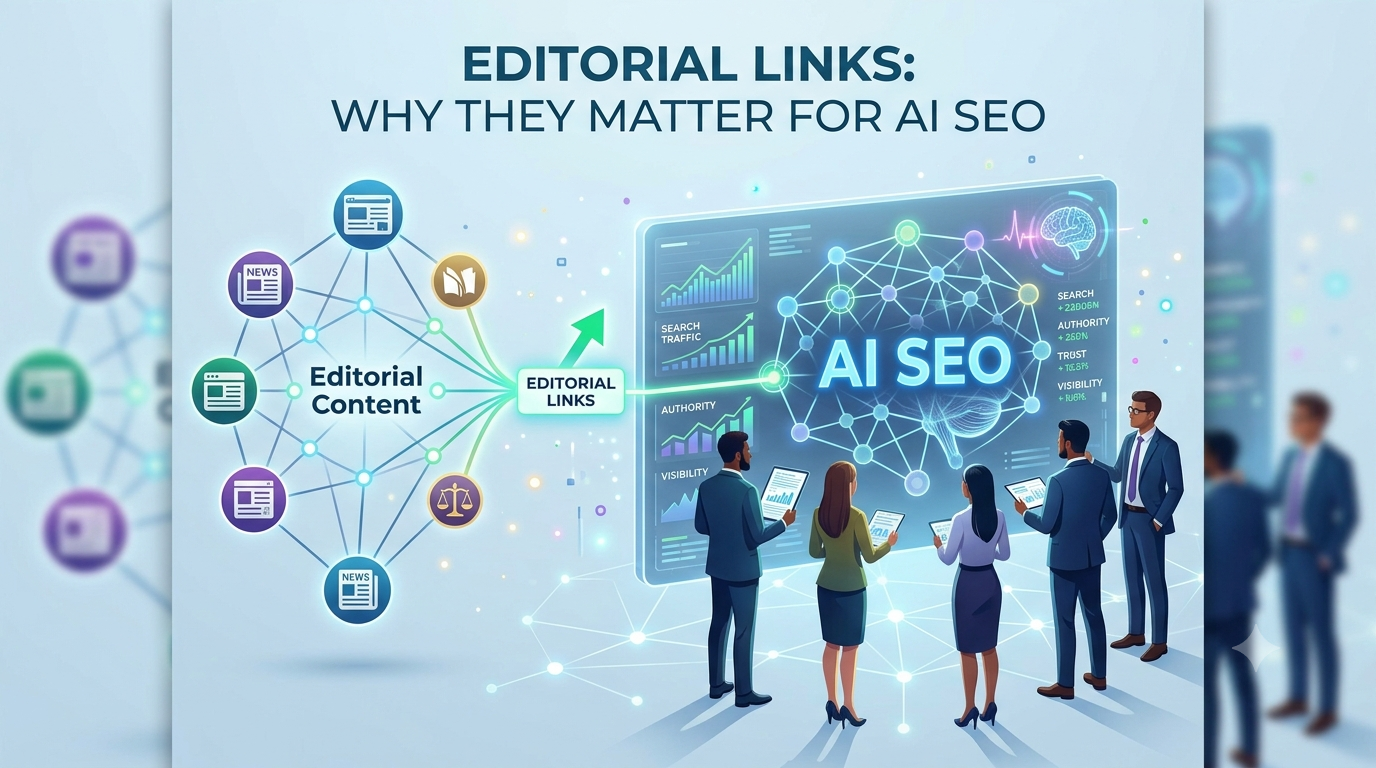
Search has changed faster in the last 18 months than in the previous decade. Google’s AI Overviews, ChatGPT Search, Perplexity, and Gemini now answer questions directly, and a shrinking share of users ever clicks through to a website. In that environment, the question is no longer just “How do I rank?” It’s “How do I become the source the AI trusts enough to cite?”
That single shift has pushed one asset to the center of modern strategy: editorial links. These are the unpaid, contextual references that writers, journalists, and editors add when your content genuinely earns the mention. They were always the gold standard in link building. But in the AI era, they’ve quietly become something bigger, the primary signal that answer engines use to decide which brands are credible enough to repeat. If your name isn’t showing up in the editorial coverage that AI systems read, you’re not showing up in the answers they generate.
This guide breaks down what editorial links are, why they carry so much weight for AI SEO, and how to actually earn them in 2026.
TL;DR
- Editorial links are unpaid, naturally placed backlinks added by writers and editors because your content adds real value, not because you bought, traded, or requested the placement.
- AI search engines lean heavily on earned editorial coverage: Muck Rack’s 2026 analysis of more than 25 million AI citations found earned media drives 84% of all citations, while paid and advertorial content accounts for just 0.3%.
- As AI Overviews suppress clicks, Ahrefs measured a 58% drop in click-through rate for the #1 result, being cited inside the answer matters more than ranking below it.
- These placements now double as brand mentions, helping AI models understand your brand as a trusted “entity” in your niche.
- They strengthen E-E-A-T, support Generative Engine Optimization (GEO), and are far harder for competitors to fake than bulk or paid links.
- Earning them takes original data, linkable assets, digital PR, and genuine outreach, not link farms or private blog networks.
- Quality and topical relevance now beat raw volume; one strong placement from a relevant, authoritative publisher outperforms dozens of generic links.
What Are Editorial Links?
An editorial link is a backlink that a publisher adds on its own initiative because your page is worth referencing. Nobody paid for it. Nobody traded for it. A writer was working on an article, needed to point readers to a credible source, and chose you.
That origin story is exactly what makes them so valuable. They’re a clean, organic vote of confidence, the kind a search engine or an AI model can read as genuine endorsement rather than manipulation. When a journalist cites your original study or an industry blog links to your guide, they’re vouching for your expertise in public.
This is the opposite of acquired links, which are paid for, swapped, or explicitly requested. The distinction isn’t academic. It changes how rankings respond, how AI systems treat the reference, and how much risk the link carries. Paid placements and link schemes are exactly what Google’s spam policies target, while a true editorial mention looks identical to any other organic citation a publication makes, because that’s what it is.
If you want to go deeper on how to source these placements at scale, this breakdown of the best editorial link building services in 2026 is a useful starting point for evaluating providers on real publisher relationships rather than marketing claims.
Editorial Links vs. Other Link Types
Not every backlink behaves the same way. The table below shows how editorial links stack up against the most common alternatives across the metrics that matter in 2026.
| Link Type | How It’s Obtained | AI Citation Value | Penalty Risk | Long-Term SEO Value |
| Editorial links | Earned naturally; publisher chooses to link | Very high | Very low | Excellent |
| Guest posts (for links) | Written and placed by you or an agency | Low to moderate | Moderate | Moderate |
| Paid / sponsored links | Purchased placement | Negligible | High | Poor |
| Directory / niche edits | Inserted into existing pages | Low | Moderate to high | Weak |
| PBN links | Private network you control | Near zero | Very high | Damaging |
The pattern is clear: the less transactional a link looks, the more trust it earns from both Google and AI models. Editorial links sit at the top precisely because there’s no commercial fingerprint for an algorithm, or a human reviewer, to detect.
Why AI Search Rewrote the Rules
To understand why editorial links matter so much now, you have to understand what AI search did to traffic.
When an AI Overview sits above the traditional blue links, it absorbs the click. According to Ahrefs’ analysis, the organic click-through rate for the number one result drops by 58% when an AI Overview appears. The Pew Research Center, in a controlled study of 68,000 queries, found that users are nearly 47% less likely to click a result when an AI summary is present, and only about 8% of those searches end in a click to any website at all.
The takeaway is uncomfortable but simple: ranking first no longer guarantees the visit. Increasingly, the win condition is being named and linked inside the AI answer itself. And that’s where editorial links become decisive, because AI systems don’t pull their citations out of thin air, they pull them from the editorial web they’ve learned to trust.
7 Reasons Editorial Links Matter for AI SEO
1. AI Models Cite Earned Media Far More Than Paid Content
This is the headline finding of the era. Muck Rack’s What Is AI Reading? Study, which analyzed more than 25 million links cited by ChatGPT, Claude, and Gemini across 17 industries, found that earned media accounts for 84% of all AI citations, while paid and advertorial content makes up a rounding error at 0.3%. Journalism alone supplies roughly 27% of cited sources. Those numbers have held steady across three editions of the study going back to mid-2025, which tells you it’s a structural pattern, not a temporary quirk.
In plain terms: AI systems overwhelmingly cite the kind of coverage that editorial links create, and almost completely ignore the kind that paid links represent.
2. They Double as Brand Mentions
The old wall between “a backlink” and “a brand mention” has collapsed. An editorial link is both at once. It passes the authority of a high-quality backlink and functions as a contextual mention that AI systems use to understand your brand as an entity. Every time a credible publisher references you by name with a link, you’re reinforcing the association between your brand and your topic in the data these models learn from.
3. They Build Topical Authority, Not Just “Link Juice”
Editorial links tend to come from contextually relevant pages, a fintech publication linking to your fintech research, for example. That relevance teaches search engines and AI models which topics you own. In a world where SEO is about becoming the leading source for an entire subject rather than ranking for one keyword, topically aligned coverage is how you signal genuine subject-matter authority.
4. They’re Hard to Fake, Which Makes Them Trustworthy
Editorial links are scarce by design. You can’t mass-produce them without doing the underlying work of being worth citing. That scarcity is exactly why they carry so much weight. Bulk links, link exchanges, and PBN-style placements leave detectable patterns; genuine editorial coverage doesn’t, because there’s no transaction to detect. The harder a signal is to game, the more both Google and AI models lean on it.
5. They Strengthen E-E-A-T and Author Trust
Experience, Expertise, Authoritativeness, and Trust (E-E-A-T) is now a core lens for evaluating content, especially in YMYL niches like health and finance. When authoritative publishers consistently cite your work, you accumulate the external validation that E-E-A-T rewards. Editorial links are the third-party proof that you’re not just claiming expertise, others recognize it.
6. They Power Generative Engine Optimization (GEO)
GEO, optimizing to be cited and described accurately inside AI-generated answers, depends on AI systems “reading” trustworthy references to your brand. Since earned editorial coverage is the dominant input into those answers, editorial link building has become a core GEO tactic rather than a traditional-SEO afterthought. If you’re evaluating partners for this kind of work, this roundup of the best AI SEO agencies in 2026 is a helpful reference for understanding which firms specialize in GEO, AEO, and citation-level visibility.
7. They Capture High-Intent, Surviving Clicks
Even with click-through rates compressed, the clicks that survive are higher-intent, users who consumed the AI summary and still want depth. Seer Interactive’s study found that brands cited inside AI Overviews earn roughly 35% more organic clicks than non-cited brands on the same results page. Editorial links increase your odds of being one of those cited sources.
Editorial Links vs. Brand Mentions in AI SEO
Because the two now overlap, it helps to see exactly how they compare and where they reinforce each other.
| Factor | Editorial Link | Unlinked Brand Mention |
| Passes ranking authority | Yes | No (or limited) |
| Helps AI entity recognition | Yes | Yes |
| Drives referral clicks | Yes | Rarely |
| Counts toward backlink profile | Yes | No |
| Influences AI citations | Strongly | Moderately |
The smartest 2026 strategy treats them as a single goal: earn coverage that mentions your brand and links to it. You get the SEO authority and the AI-entity signal in one placement.
How to Earn Editorial Links
Editorial links can’t be ordered like office supplies, but you can dramatically increase how often you earn them. The approaches below consistently produce results.
Publish original data and research. Statistics, surveys, and studies are link magnets because writers need credible numbers to cite. Original research is the single most reliable way to attract editorial links from journalists.
Build genuine linkable assets. Comprehensive guides, free tools, calculators, and definitive resources give publishers a reason to reference you instead of a competitor.
Invest in digital PR. Connecting your data and expertise to current conversations gets you quoted in the news coverage that AI systems read most heavily. Muck Rack’s research also noted that AI citation rates are highest within the first seven days of publication, so timely, newsworthy angles compound the benefit.
Pursue expert commentary and roundups. Contributing genuine insight to expert features earns contextual links while positioning you as a credible voice.
Do real outreach, not spam. Thoughtful, relevant pitches to writers covering your space turn good assets into placements. The goal is to make linking to you the obvious choice, not to beg for a favor.
What to Avoid
Some shortcuts now cause more harm than the links are worth:
- Buying links at scale. Paid placements are nearly invisible to AI citation systems and expose you to Google penalties.
- PBNs and link networks. High risk, near-zero AI value, and easily detected.
- Obsessing over Domain Rating alone. Relevance and real traffic now matter as much as raw authority metrics.
- Chasing volume over quality. One relevant editorial link beats a dozen unrelated ones every time.
How to Measure the Impact
Traditional metrics only tell half the story now. Track these alongside rankings and referral traffic:
| Metric | What It Tells You |
| AI citations / mentions | Whether AI platforms are surfacing your brand |
| Share of voice in AI answers | How you compare to competitors inside LLM responses |
| Referring domains (editorial) | Growth in genuine, earned coverage |
| Organic conversions | The bottom-line result, not just visibility |
As LinkedIn publicly noted in early 2026, awareness-driven organic traffic can fall sharply even when rankings hold steady, which is why leading teams now measure visibility through mentions and citations, not clicks alone.
Frequently Asked Questions
Are editorial links still worth it in 2026?
Yes, more than ever. They combine SEO authority, referral traffic, brand trust, and AI visibility in a single placement, and they’re the link type AI systems cite most.
What’s the difference between editorial links and guest posts?
An editorial link is earned naturally because a publisher chose to reference you. Guest posts are content you create and place yourself, often to obtain a link, which carries more risk and far less AI citation value.
Do editorial links help with ChatGPT and Perplexity, not just Google?
Yes. Studies analyzing ChatGPT, Claude, and Gemini show earned editorial coverage is the dominant source of their citations, so they support visibility across all major answer engines.
How many editorial links do I need? There’s no fixed number.
A small set of relevant, authoritative placements from sites in your niche will outperform a large volume of generic or paid links.
The Bottom Line
The economics of search have flipped. When AI answers replace clicks, the brands that win are the ones AI chooses to cite, and AI overwhelmingly cites earned, editorial coverage over anything paid. That makes them the highest-leverage asset in a modern SEO and GEO strategy. They build authority, reinforce your brand as a trusted entity, satisfy E-E-A-T, and put your name inside the answers users actually read.
Earning them is slower than buying links, but that difficulty is the point. The work that makes you worth citing, original data, genuine expertise, real relationships, is exactly what AI search rewards. In 2026, editorial links aren’t an optional add-on. They’re the foundation of staying visible as search becomes a conversation.