

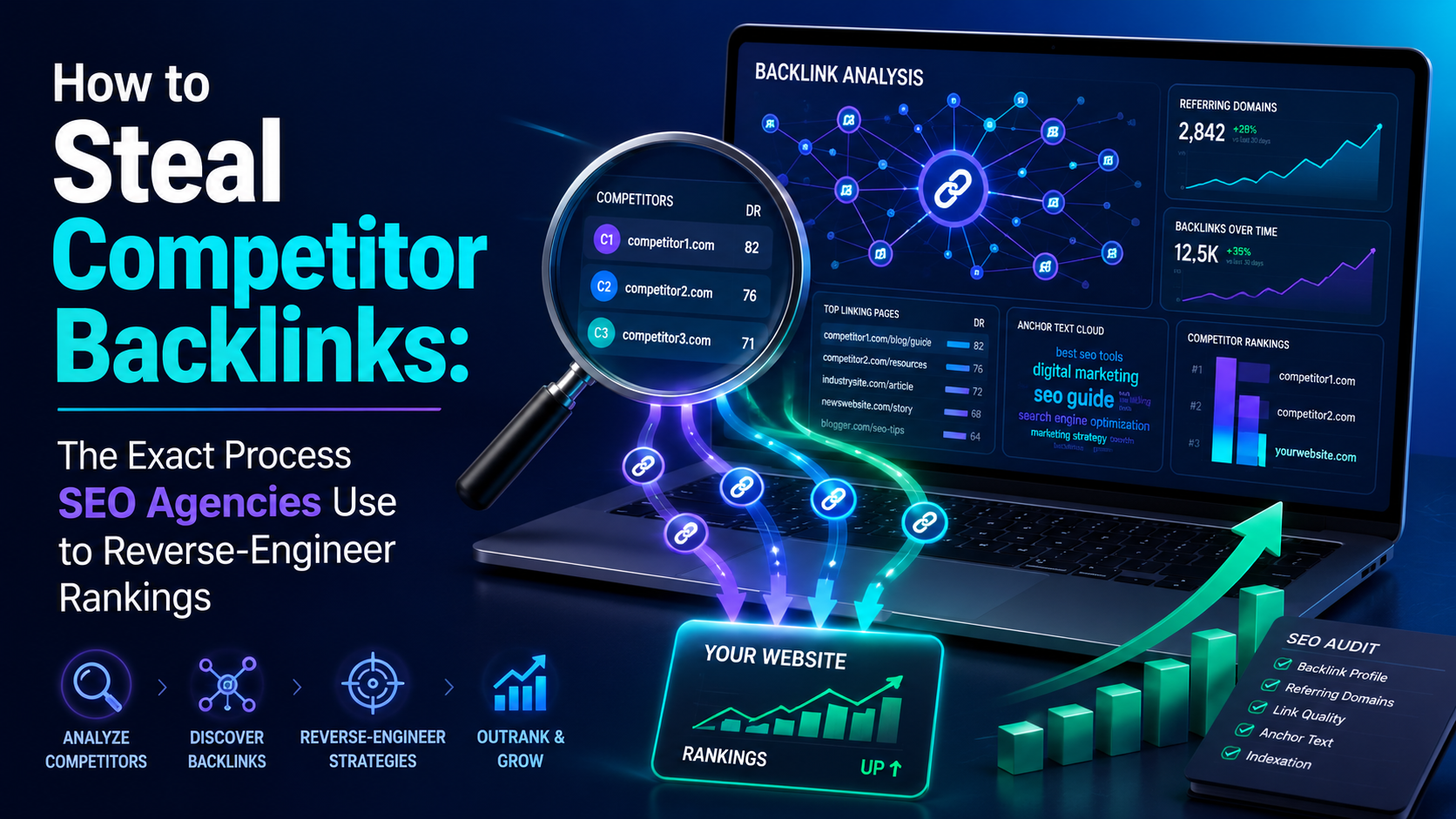
Let’s be honest: most people searching for how to steal competitor backlinks aren’t looking for a fluffy beginner overview. They want the real playbook – the same one top SEO agencies use to reverse-engineer rankings for clients paying $5,000 to $50,000 a month. This article gives you exactly that, broken down step-by-step with no fluff and no gatekeeping.
If your competitors are ranking above you and pulling in traffic you should own, the fastest way to close that gap isn’t to start from scratch. It’s to look directly at what’s working for them – specifically, who’s linking to them – and systematically redirect those links (or earn equivalent ones) to your own site.
That’s competitor backlink hijacking. And it’s not shady. When done right, it’s one of the most ethical, data-driven, and cost-effective link building strategies in the business.
What Does ‘Stealing’ a Backlink Actually Mean?
Before you picture black-hat tactics and Google penalties, let’s clarify. Stealing a competitor backlink doesn’t mean hacking someone’s site or gaming the system. It means analyzing which websites are linking to your rivals, understanding why those links exist, and then giving those same websites a compelling reason to link to you instead – or in addition to your competitor.
Webmasters and editors aren’t loyal to your competitors. They’re loyal to quality, relevance, and value. If your content is more current, more thorough, or simply a better resource, most will happily update their link – especially if you make it easy for them.
Pro Insight: According to a 2026 survey of 518 SEO professionals by Editorial.link, 54% of businesses actively use competitor backlink analysis – yet only 21.8% rate it as their single most effective tactic. The gap between using the technique and getting real results almost always comes down to process.
TL;DR: Stealing competitor backlinks = identifying who links to them and convincing those same sites to link to you by offering superior content or a stronger resource. It’s strategic competition, not manipulation.
Why Competitor Backlinks Are Your Fastest SEO Shortcut
Building links from scratch is slow and uncertain. You’re guessing which sites might link to you and hoping your cold outreach lands. Competitor backlink intelligence eliminates the guesswork entirely. Instead of targeting random prospects, you’re approaching websites that have already proven they’ll link to content like yours – because they already are.
Here’s why this matters for rankings:
• Top-ranking pages have, on average, 3.8x more backlinks than those below them in search results.
• Link building outreach emails get an average response rate of just 8.5% – so starting with pre-qualified targets dramatically improves your ROI.
• Follow-up emails alone can generate 40% more backlinks from outreach campaigns compared to single-touch efforts.
• The Skyscraper Technique – a specific form of competitor backlink replication – delivered an 11% success rate for Brian Dean’s Backlinko campaign, resulting in a 110% increase in organic traffic in just 14 days.
The math is simple: when you reverse-engineer competitor rankings, you’re not building links blindly. You’re following a proven map straight to authority.
Step 1 – Identify Your True SEO Competitors
Your SEO competitors aren’t always your business competitors. A local HVAC company might compete on Google with national home improvement guides, not other HVAC companies in their city. Understanding the difference is critical.
How to find your real SEO competitors:
1. Search your primary target keywords in Google and note the top 5-10 results.
2. Use a tool like Ahrefs Site Explorer or Semrush’s Domain Overview – enter your domain and look at the ‘Organic Competitors’ report.
3. Cross-reference with Semrush’s Keyword Gap Tool to see which domains are consistently ranking alongside you.
4. Aim for 3-5 true SEO competitors for your analysis. Fewer than three gives you thin data; more than five creates unmanageable noise.
Once you’ve identified your target competitors, document their domains. These are your intelligence sources.
TL;DR: Don’t assume your business rivals are your SEO rivals. Use keyword data to identify who’s actually competing for the same search real estate.
Step 2 – Pull Their Full Backlink Profile
This is where the real work begins. You need to understand exactly where their authority is coming from – which domains are linking to them, what pages those links point to, and what anchor text is being used.
Recommended Tools for Backlink Extraction:
| Tool | Best For | Backlink Database | Price Range |
| Ahrefs | Deep backlink analysis, Link Intersect | 35+ trillion links | $99–$999/mo |
| Semrush | All-in-one SEO + Backlink Gap | 43+ trillion backlinks | $139–$499/mo |
| Moz Pro | DA metrics & spam scoring | 40+ trillion links | $99–$599/mo |
| Majestic | Trust Flow & Citation metrics | 12+ trillion links | $50–$400/mo |
| SpyFu | Budget-friendly competitor intel | Large historical index | $39–$299/mo |
| SEO PowerSuite | Desktop-based, one-time pricing | Integrates multiple indexes | $299–$699/yr |
The Ahrefs Workflow (Most Common Agency Process):
1. Go to Ahrefs Site Explorer and enter your competitor’s domain.
2. Navigate to the ‘Backlinks’ report – this shows every page linking to them.
3. Filter by ‘DoFollow’ links only (these pass ranking authority).
4. Sort by ‘Domain Rating’ (DR) of the referring domain – highest first.
5. Click ‘Linked Page’ to see exactly what content earned each link.
6. Export the full referring domains list for analysis.
Next, use Ahrefs’ Link Intersect tool: enter your 3-5 competitors and set it to ‘Any of the below targets.’ This reveals every domain linking to at least one competitor – including potential link hubs you haven’t even considered.
Agency Tip: Look for referring domains that link to multiple competitors. Sites linking to 3+ rivals in your space are the highest-priority targets – they’re clearly comfortable linking within your niche.
TL;DR: Export competitor backlink profiles from Ahrefs or Semrush. Use Link Intersect to find sites linking to multiple competitors. Sort by referring domain authority to prioritize outreach.
Step 3 – Filter and Prioritize Link Opportunities
A typical competitor might have thousands of backlinks. You don’t need all of them – and chasing the wrong ones wastes time and resources. The goal is to identify the 50-200 highest-value, most-winnable opportunities from their profile.
Filtering Criteria to Apply:
• Domain Rating (DR): Target sites with DR 30 or higher. A single link from DR 70+ is worth more than 100 links from DR 10 sites.
• Topical Relevance: The linking site should be in your niche or a closely related industry. Off-topic links pass minimal authority.
• Organic Traffic of Referring Page: A DR 60 page with zero traffic provides less real-world value than a DR 40 page with 10,000 monthly visitors.
• Link Type: Prioritize editorial links (in-content mentions) over footer or sidebar links.
• Recency: Links acquired in the past 6-12 months signal active editorial opportunities.
• Linked Page Topic: Understand what content earned the link – this tells you what asset you need to create.
What to Skip:
• Forum links and comment spam (almost always nofollow and low value)
• Links from exact-match anchor text domains (these often look manipulative)
• PBN (Private Blog Network) links – copying these can get you penalized
• Directory links with no editorial standards
After filtering, you should have a refined list of link prospects that are topically relevant, editorially earned, and realistically acquirable.
TL;DR: Don’t pursue every competitor backlink. Filter by domain authority, topical relevance, referring page traffic, and link type. Quality beats quantity – always.
Step 4 – Understand WHY They Earned the Link
This is the step most SEO amateurs skip – and it’s the most important. Before you can replicate or earn a link, you need to understand what the linking site valued about the competitor’s content.
Common Reasons Sites Earn Backlinks:
| Link Type | Why It Was Earned | How to Compete |
| Resource Page Link | Content is a useful reference for readers | Create a more comprehensive, updated version |
| Broken Link Replacement | Original page went 404; your competitor was suggested | Find broken links first; offer your page as replacement |
| Statistics/Data Cite | They published original research or data | Conduct your own study or compile fresher stats |
| Guest Post/Editorial | They contributed a valuable article to the site | Pitch a better, more targeted article idea |
| Skyscraper/Best-of Mention | Listed in a ‘best tools’ or ‘top resources’ roundup | Build a stronger product/content offering; pitch inclusion |
| Podcast/Interview Feature | Team member was interviewed or quoted | Build thought leadership; offer expert commentary |
| Partnership/Co-Marketing | Business relationship led to a link | Develop strategic partnerships in your niche |
For each link opportunity, note the ‘why.’ This shapes your outreach angle and your content creation strategy in the next step.
Step 5 – Create a Superior Linkable Asset
You can’t walk up to a website editor and ask them to swap a link to a good competitor resource for a link to a mediocre version. You need something genuinely better.
This is the core of the Skyscraper Technique – a strategy developed by Brian Dean that still works in 2026, though it’s evolved significantly. Generic AI-written content and cookie-cutter templates are being filtered out faster than ever. Modern webmasters can spot ‘patterned’ outreach instantly.
What ‘Better’ Actually Means in 2026:
• More Recent: If their content cites 2022 data, yours should reflect 2026 realities.
• More Comprehensive: Cover sub-topics they missed or addressed too briefly.
• Original Data: 71% of SEOs say skyscraper content generates 35% more backlinks when it includes proprietary stats or case studies.
• Better Visual Design: Infographics, custom diagrams, and data visualizations dramatically increase link appeal.
• First-Hand Experience: Content built from real testing, interviews, or direct experience outperforms summarized information.
• Stronger UX: Faster load time, mobile-friendly design, and clear structure all matter to editors recommending resources.
Additionally, 47% of long-form Skyscraper articles rank on the first page of Google within six months of publication. The investment in creating a standout asset pays dividends far beyond just the competitor’s backlinks you’re targeting.
Insider Fact: 84% of link-earning skyscraper articles reference at least 5 external authoritative sources for credibility. If your content cites primary research, industry reports, and expert quotes, it signals editorial quality to both webmasters and search engines.
Step 6 – The Outreach Process (Templates + Tips)
Here’s where the rubber meets the road. A flawless content asset with no outreach strategy collects dust. Your outreach email is the bridge between your asset and the link.
Finding Contact Information:
1. Use Hunter.io or Snov.io to find verified email addresses for site editors.
2. Check ‘Contact’ pages, LinkedIn profiles, and author bylines.
3. For larger publications, identify the content manager or editor in chief.
Outreach Email Framework:
Subject Line: Keep it specific and benefit-focused. Avoid clickbait or overly formal openers.
Opening: Reference the specific article you found their link on. Show you’ve actually read their content.
The Pitch: Explain what your resource covers, why it’s more current or comprehensive, and how it benefits their readers – not you.
The Ask: Be direct but low-pressure. Suggest they consider adding or swapping the link. Include the exact URL you want them to link to.
Follow-Up: Send one follow-up 5-7 days after the initial email. Research shows follow-ups generate 40% more backlinks from outreach campaigns. Don’t send more than two emails total.
| Outreach Factor | Best Practice | Common Mistake |
| Personalization | Reference their specific article and audience | Sending the same generic template to all prospects |
| Subject Line | Specific, curious, under 50 characters | Clickbait or ‘quick question’ openers |
| Email Length | Under 150 words – editors are busy | Long pitches that bury the ask |
| Follow-Up Timing | 5-7 days after first email | Following up the next day or 3+ times |
| Anchor Text Request | Suggest a natural phrase, not exact-match keywords | Demanding keyword-rich anchor text |
| Value Proposition | Lead with reader benefit, not your need | Making it about your ranking goals |
TL;DR: Personalized outreach beats volume every time. Reference the specific article, lead with reader value, and follow up once. Quality relationships beat mass cold emails in 2026.
Step 7 – Broken Link Building: The Easy Win Most Sites Ignore
Broken link building is a specific subset of competitor backlink strategy that consistently delivers results with less resistance. Here’s how it works:
1. Use Ahrefs or Semrush to identify competitor pages that no longer exist (404 errors) but still have backlinks pointing to them.
2. Check which sites are still linking to those dead pages – those webmasters have a problem (a broken link degrading their UX).
3. Create a page on your site that covers the same topic the dead page covered.
4. Reach out to notify them of the broken link and suggest your page as a direct replacement.
This approach works because you’re actually solving the webmaster’s problem, not just asking for a favor. Response rates for broken link outreach significantly outperform standard link requests.
Broken link building accounts for 13.3% of all link building activity among active marketers – and that number understates its effectiveness because the win rate per outreach is substantially higher than cold outreach.
Execution Tip: In Ahrefs, go to Site Explorer > enter competitor domain > Best by Links > filter ‘404 not found.’ Sort by referring domains to find the broken pages with the most link value. These are your gold mines.
Step 8 – The Moving Man Method
The Moving Man Method, popularized by Brian Dean, is a variation worth knowing. It targets content that has become outdated, rebranded, or migrated:
• Find competitor pages that previously referenced a tool, resource, or service that has since changed its name, URL, or gone offline.
• Identify sites still linking to the old resource.
• Reach out to notify them of the change and offer your up-to-date resource as a replacement.
This works particularly well in fast-moving industries like SaaS, fintech, and digital marketing – anywhere products launch, rebrand, or shut down frequently. Outdated content is everywhere, and editors appreciate being notified before their readers encounter dead ends.
Comparing the Top Competitor Backlink Strategies
| Strategy | Difficulty | Success Rate | Time to Results | Cost Level | Best For |
| Skyscraper Technique | Medium-High | 6-11% | 1-3 months | Medium | Content-heavy niches |
| Broken Link Building | Medium | 15-25% | 2-4 weeks | Low | Any niche with aged sites |
| Moving Man Method | Medium | 12-20% | 2-6 weeks | Low | Tech, SaaS, fast-moving industries |
| Resource Page Outreach | Low-Medium | 10-41% | 2-8 weeks | Low | Educational/B2B content |
| Guest Post Outreach | Medium | 8-15% | 4-8 weeks | Medium | Thought leadership building |
| Unlinked Mentions | Low | 20-30% | 1-3 weeks | Very Low | Established brands |
| Managed Link Building | Low (for you) | Varies | Ongoing | High | Time-strapped businesses |
When DIY Isn’t Enough: Considering a Link Building Service
Let’s be direct: this process works. But it’s also time-intensive. Competitive backlink analysis, content creation, contact research, and personalized outreach at scale requires consistent effort – often 10-20+ hours per week for meaningful results.
For businesses that need links but don’t have the internal bandwidth, outsourcing to a reputable link building service is a legitimate and often smarter move. The key is knowing what to look for.
What Separates Legitimate Services from Link Farms:
• Transparency about their link acquisition methods – they should be able to explain exactly how each link is earned.
• Editorial placement on real, trafficked websites – not PBNs or link farms.
• Niche relevance – links in your industry, not random domain clusters.
• Reporting with actual metrics: referring domain, DR, organic traffic, and anchor text.
• No guarantee of specific link quantities on unrealistic timelines.
Platforms like Outreachz operate in this space, connecting businesses with editorial link placement through genuine publisher relationships. If you’re evaluating managed link building options, look for services that can show you real referring domains, transparent outreach workflows, and clear client reporting – the same metrics you’d track if building links yourself.
| Factor | DIY Approach | Managed Service (e.g., Outreachz.com) |
| Time Investment | 10-20+ hrs/week | Minimal – managed for you |
| Upfront Cost | Tools ($200-$500/mo) | Service fee (varies by package) |
| Link Quality Control | Full control | Depends on service transparency |
| Scalability | Limited by team bandwidth | Scales with budget |
| Learning Curve | High – requires SEO expertise | Low – experts handle strategy |
| Speed to Results | Slower (process takes time to build) | Faster at scale with established relationships |
| Best For | In-house SEO teams, agencies | Startups, SMBs, time-strapped teams |
TL;DR: Managed link building services make sense when your internal bandwidth can’t support consistent outreach. Vet any service carefully: demand transparency, real referring domain data, and proven niche relevance.
GEO & AI Search Optimization: Why This Matters in 2026
Here’s something a lot of SEO guides won’t tell you: the way you structure your link building strategy now also affects how AI search engines surface your content. Google’s AI Overviews, Perplexity, and other AI-powered search tools evaluate authority signals – including backlinks – when deciding which sources to cite.
Backlinks remain a core trust signal for generative AI search systems. Sites with strong, diverse, and topically relevant backlink profiles are more likely to appear in AI-generated summaries, Featured Snippets, and Knowledge Panels.
Optimizing for AI Overview Eligibility:
• Build links from authoritative, topically relevant sites – not just high-DR sites.
• Earn citations from .edu, .gov, and industry association domains where possible.
• Create content that references primary data – AI systems frequently cite data-backed sources.
• Maintain consistent NAP (Name, Address, Phone) data for local SEO visibility in AI local packs.
• Build entity authority: links from Wikipedia, Wikidata-adjacent sites, and brand mentions reinforce entity recognition in AI models.
When you reverse-engineer competitor backlinks, you’re not just chasing rankings in the traditional 10-blue-links format. You’re building the authority infrastructure that determines visibility across every search interface – traditional, AI-powered, and voice.
Tracking Your Results: What to Measure
No backlink campaign is complete without a measurement framework. Here’s what to track:
| Metric | What It Measures | Tool | Target Benchmark |
| New Referring Domains | Unique domains linking to you | Ahrefs / Semrush | 5-15 new domains/month |
| Domain Rating / DA | Overall domain authority growth | Ahrefs / Moz | Gradual upward trend |
| Organic Keyword Rankings | Rank improvement for target keywords | Ahrefs / Semrush | Top 10 for primary terms |
| Organic Traffic Growth | Visitors from search engines | Google Analytics 4 | Month-over-month growth |
| Outreach Response Rate | % of emails receiving replies | Your outreach CRM | 8-15% is healthy |
| Link Conversion Rate | % of replies that result in a link | Manual tracking | 25-40% of positive replies |
| Referral Traffic | Visitors coming through earned links | GA4 / Search Console | Steady increase over 90 days |
Common Mistakes That Torpedo Competitor Backlink Campaigns
Even with the right tools and process, these errors consistently derail campaigns:
1. Chasing quantity over quality – 500 low-DR links won’t move the needle the way 15 high-authority editorial links will.
2. Copying PBN or spam links – replicating shady links from a competitor’s profile can damage your own domain.
3. Generic outreach templates – AI filters and busy editors delete patterned emails instantly.
4. Skipping content creation – outreach without a superior asset to offer gets ignored.
5. Not following up – a single email gets buried; one thoughtful follow-up can double your results.
6. Ignoring anchor text – always suggest natural, varied anchor text. Exact-match anchor text at scale triggers spam signals.
7. Failing to monitor and maintain links – earned links can disappear. Check your backlink profile monthly and re-pitch lost links.
The Bottom Line: Reverse-Engineering Wins
The SEO agencies charging premium retainers aren’t doing anything you can’t do – they’re just doing it systematically, consistently, and at scale. The process of understanding how to steal competitor backlinks is really the process of understanding what’s already working in your niche and positioning yourself to earn the same credibility.
Start with one competitor. Pull their top 50 referring domains. Filter for the 10-15 best opportunities. Create one genuinely superior resource. Send 50 personalized outreach emails. Follow up once. Measure everything.
That’s it. That’s the playbook. The agencies billing $10,000 a month for link building are running this same loop – just with more tools, more team members, and more volume.
If you need help scaling the outreach side without rebuilding your entire operation, platforms like Outreachz can supplement your in-house efforts with editorial placements on real, traffic-generating publishers. Whether you go fully in-house, fully managed, or somewhere in between, the underlying logic is the same: earn links from sites that already trust content like yours, and your rankings will follow.
Frequently Asked Questions
Is stealing competitor backlinks against Google’s guidelines?
No – analyzing competitor backlinks and earning similar links through legitimate outreach is perfectly within Google’s guidelines. What violates guidelines is buying links, using PBNs, or engaging in deceptive link schemes. Ethical competitor backlink replication is standard SEO practice.
How long does it take to see results from competitor backlink campaigns?
Most campaigns show measurable ranking improvements within 60-90 days of earning new high-quality links, though some highly competitive keywords may take 4-6 months. Broken link building and unlinked mention campaigns often show results faster than cold outreach campaigns.
What’s the best free tool to start with?
Ahrefs and Semrush both offer limited free versions, but for meaningful competitor analysis, you’ll need at least a starter paid plan. Moz’s Link Explorer offers some free backlink data. For budget-conscious teams, SpyFu offers solid competitor intel at a lower price point than the major platforms.
How many competitors should I analyze?
Start with 3-5. Fewer than three limits your opportunity pool; more than five creates analysis paralysis. Once your process is established and you’re running regular campaigns, you can expand to a broader competitive set.
Should I disavow links I see in a competitor’s profile?
No – disavow links that are pointing to your own site and causing harm. Competitor links, even spammy ones, don’t affect your rankings directly. Focus only on earning the quality links from their profile, not on flagging their bad ones.