

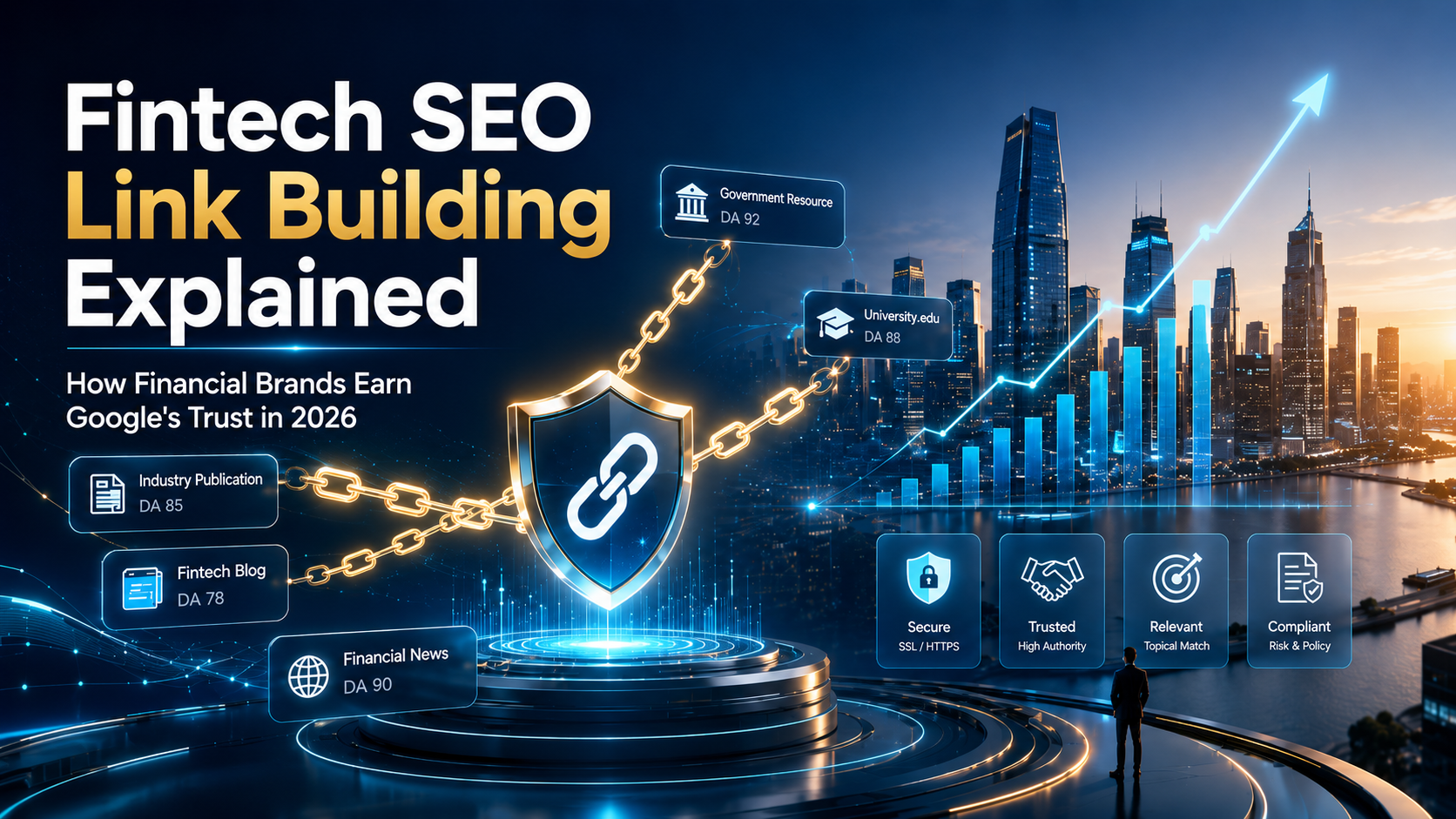
If you run a fintech brand – a neobank, a lending platform, a payments startup, a crypto exchange – you already know that getting found on Google is not simply a matter of publishing helpful content and waiting. The financial technology space is one of the most brutally competitive environments in organic search, and the rules Google uses to judge your website are stricter than nearly any other industry.
That is because Google classifies fintech websites as YMYL – Your Money or Your Life – content. Anything that touches a person’s financial decisions, their savings, their investments, or their debt carries real-world consequences. Google’s quality raters and core algorithms apply a far higher bar to these sites. And at the center of that bar is one concept: trust.
Trust, in Google’s world, is not something you self-declare. It is something other credible voices on the web confer upon you through backlinks. That is why fintech SEO link building has become one of the most strategically important – and most misunderstood – disciplines in digital marketing in 2026.
This guide cuts through the confusion. We will explain exactly what fintech link building is, why it works differently from generic SEO outreach, how Google and AI search engines evaluate your backlink profile, and which strategies – and services – are actually producing results for financial brands this year.
What Is Fintech SEO Link Building (And Why Is It So Different)?
TL;DR: Fintech link building is the practice of earning editorial backlinks from authoritative finance and technology publications. Unlike general SEO, every link must pass YMYL scrutiny – one low-quality placement can damage rankings more than no link at all.
At its simplest, link building is the process of getting other websites to link back to yours. Search engines like Google use these inbound links as votes of confidence – signals that your content is credible, useful, and worth ranking. The more authoritative the sites linking to you, and the more relevant those sites are to your topic, the stronger the trust signal.
But fintech link building is not the same as general link building. Here’s why:
• YMYL scrutiny means that a backlink from a low-authority or topically irrelevant site does not just fail to help you – it can actively hurt your rankings by signaling that your site is not a carefully maintained, high-trust resource.
• Financial content demands editorial standards that most publishers cannot meet. A link placement must come from a site whose own content is accurate, well-sourced, and compliant with applicable financial regulations.
• E-E-A-T (Experience, Expertise, Authoritativeness, and Trustworthiness) is the overarching framework Google uses to evaluate financial content. Your backlink profile is one of the primary ways you demonstrate authoritativeness and trustworthiness in Google’s eyes.
• AI search engines like Google’s AI Overviews, ChatGPT Search, and Perplexity now synthesize answers from the most cited and trusted sources on the web. Being cited repeatedly across authoritative publications is how you get recommended by these systems – not just ranked by traditional algorithms.
The global fintech market is projected to reach $460 billion by the close of 2026. More capital flowing into the space means more competitors fighting for the same high-intent search queries. In that environment, a weak backlink profile is not a minor disadvantage – it is an existential one.
Google’s YMYL & E-E-A-T Framework: The Trust Calculus for Financial Brands
TL;DR: Google’s YMYL classification applies the strictest algorithmic scrutiny to fintech sites. E-E-A-T – Experience, Expertise, Authoritativeness, and Trustworthiness – is not a direct ranking factor but is the underlying quality standard your link profile, content, and site structure must reflect.
Before diving into tactics, it helps to understand precisely how Google evaluates a fintech website. The YMYL (Your Money or Your Life) designation means that Google’s quality evaluation system treats incorrect or untrustworthy financial information as a potential real-world harm – the same standard applied to medical advice.
Under this lens, E-E-A-T becomes the operating framework:
| Signal | What It Means | How Link Building Contributes |
| Experience | First-hand, lived knowledge of the subject matter | Links from practitioner-authored content on niche financial publications validate real-world authority |
| Expertise | Demonstrated depth of knowledge in the topic | Editorial mentions in respected finance journals, think-tank reports, or regulatory commentary signal subject-matter expertise |
| Authoritativeness | Recognition by peers and trusted institutions | High-DR backlinks from established financial media (Forbes, Bloomberg Businessweek, Investopedia) are the gold standard |
| Trustworthiness | Accuracy, transparency, and safety of the site and its content | Consistent editorial placements on vetted, compliance-conscious publishers signal that other editors trust your brand’s accuracy |
The key insight is this: you cannot fake E-E-A-T. You cannot buy it with a bulk link package. You earn it by producing genuinely accurate content and by getting the publications that already have credibility to link to you – editorially, in context, and for the right reasons.
The Rise of GEO: Why AI Search Changes the Link Building Equation
TL;DR: Generative Engine Optimization (GEO) is the emerging discipline of ensuring your brand is cited by AI search engines. In fintech, being recommended by ChatGPT or Google’s AI Overviews is rapidly becoming as valuable as a first-page Google ranking – and the same link building principles that build Google trust also drive AI citation.
Search in 2026 is no longer just about ten blue links. According to recent data, 54% of Americans now turn to AI-powered tools like ChatGPT for financial research. Google’s AI Overviews appear at the top of results for many high-intent fintech queries, displacing organic click traffic for the brands ranked just below them.
For fintech brands, this creates both a threat and a massive opportunity. When a user asks an AI system, “What is the best payment gateway for a small business?” – the AI does not simply return a list of links. It generates a synthesized, authoritative-sounding answer pulled from the most trusted and frequently cited sources across the web. If your brand is consistently mentioned in those sources, the AI recommends you. If it is not, you are invisible at the exact moment when a prospect is ready to decide.
This is what the SEO industry is calling Generative Engine Optimization (GEO). And the core requirement for GEO visibility in fintech is identical to the core requirement for Google rankings: contextual, authoritative links from trusted financial publishers that mention your brand with natural, semantically rich language.
In practical terms, GEO-optimized fintech link building means:
• Ensuring your brand name appears consistently across multiple authoritative financial publications, not just in one or two isolated placements.
• Using natural, conversational anchor text and surrounding context that AI language models can extract meaning from – not just keyword-stuffed anchor links.
• Building brand entity strength so that AI systems can confidently associate your brand name with specific financial services, capabilities, and trust attributes.
• Prioritizing publications that AI systems actively crawl and cite – established financial media, regulatory commentary sites, and recognized industry blogs.
6 Proven Fintech SEO Link Building Strategies That Actually Work in 2026
The fundamentals of fintech link building have not changed – quality over quantity, relevance over reach, editorial integrity over paid schemes. But the specific tactics that produce results have sharpened considerably. Here are the six approaches that are generating measurable gains for financial brands right now.
1. Original Research & Data-Driven Content
Nothing attracts editorial backlinks in the fintech space more reliably than proprietary data. When you publish an original survey, benchmark report, or dataset that journalists, analysts, and other bloggers cannot get anywhere else, you create a naturally linkable asset that generates inbound citations for months or years.
Effective formats include annual industry benchmark reports (e.g., “State of Digital Lending 2026”), consumer sentiment surveys on financial behavior, API-powered dashboards that refresh with live market data, and statistical compilations on fintech adoption trends by region or demographic.
When a Forbes contributor or a Bankrate journalist cites your data, they link to it. That is editorial link building at its most powerful – and it is fully compliant with every quality guideline Google and AI systems apply.
2. Digital PR & Financial Media Outreach
Digital PR is the practice of proactively pitching newsworthy stories, expert commentary, and data findings to financial journalists and editors at high-authority publications. Done well, it earns brand mentions and backlinks from exactly the kinds of sites Google and AI systems consider gold-standard sources: Bloomberg, Business Insider, The Financial Brand, Bankrate, NerdWallet, and similar outlets.
The most effective fintech PR outreach in 2026 focuses on building genuine relationships with specific editors over time – not spray-and-pray mass pitching. A single consistent source relationship with a Financial Times contributor is worth more than fifty low-quality guest post placements.
Respond quickly to journalist requests via services like HARO (now Connectively) and Qwoted. Offer genuine data-backed expertise rather than promotional language. Over time, you become the source an editor reaches out to first – and the links follow naturally.
3. Strategic Guest Posting on Finance & Tech Publications
Guest posting remains a valuable fintech link building strategy when executed with editorial rigor. The key distinctions that separate effective guest posts from low-quality link schemes are topical relevance (the publication must genuinely serve a financial audience), editorial independence (the editor controls what gets published, not the brand), and content quality (the article must provide standalone value to the publisher’s audience).
Target publications with domain ratings above 50, authentic readership in the financial services space, and editorial processes that include fact-checking. Avoid any network or platform that offers guaranteed placements without editorial review – these are precisely the signals that trigger Google’s YMYL quality filters.
4. Regulatory & Compliance-Driven Content
This strategy is uniquely powerful in fintech – and almost completely ignored by generic SEO agencies. Every time a major regulation changes (think PSD3 in Europe, evolving SEC crypto guidance in the US, new CFPB rules on lending), there is a surge in journalistic and blogger demand for accurate explanatory content.
Fintech brands that publish fast, accurate, compliance-reviewed explainers of regulatory changes position themselves as go-to sources for journalists covering those beats. The result is high-authority editorial links from news sites, legal publications, and industry trade press that almost no competitor has the infrastructure to earn.
As one practitioner noted, the regulatory complexity that makes fintech content difficult to create is also what gives compliant brands a durable competitive moat in search and AI citation.
5. Broken Link Building & Competitor Gap Analysis
Broken link building involves identifying links on authoritative financial websites that point to dead or outdated pages, then reaching out to those site owners with a replacement resource – yours. It is a white-hat technique that provides genuine value to the publisher (fixing a dead link) while earning you a contextually relevant placement.
Complement this with competitor backlink gap analysis using tools like Ahrefs or Semrush to identify high-authority sites that link to your competitors but not to you. Reverse-engineer why those links were earned and create content designed to earn similar or better placements.
6. Thought Leadership & Podcast / Event Citations
Fintech founders, CMOs, and product leaders who regularly appear on industry podcasts, contribute to conference proceedings, or publish expert commentary in trade publications generate significant entity authority – the kind of recognized expertise that Google’s quality raters look for in YMYL content authors.
Each podcast appearance, conference citation, or byline in a recognized trade journal creates additional brand entity signals that strengthen your overall E-E-A-T profile. These mentions often convert into backlinks when hosts share show notes, conference organizers publish speaker pages, or trade journals maintain online archives.
What Makes a Good Fintech Backlink? The Quality Checklist
TL;DR: Not all backlinks are created equal. In the YMYL fintech space, the quality of each individual link matters far more than total link volume. A single placement on Investopedia is worth more than 200 placements on low-authority blogs.
| Quality Signal | What to Look For | Red Flags to Avoid |
| Domain Authority / Rating | DR 50+ preferred; DR 70+ for top-tier placements | Sites with inflated DA from spammy link profiles |
| Topical Relevance | Finance, fintech, banking, or technology editorial focus | General lifestyle, unrelated industry, or PBN content |
| Editorial Standards | Fact-checked content, named authors, editorial process | Anonymous content, paid placement labels, no editorial review |
| Organic Traffic | Site receives genuine search traffic (verify in Ahrefs/Semrush) | Zero traffic sites, even with high theoretical DR |
| Anchor Text Context | Natural language, contextually embedded in relevant content | Exact-match keyword-stuffed anchors, out-of-context links |
| Compliance Awareness | Publisher understands financial content standards | Sites with gambling, unregulated crypto, or pharma spam |
Top Fintech Link Building Services Compared (2026)
If you are considering outsourcing your fintech SEO link building, vendor selection is critical. The wrong agency – one that uses generic outreach templates or places links on non-compliant publishers – can trigger Google penalties in a YMYL vertical that take months to recover from. The table below compares the leading services based on their focus, pricing structure, and best use case.
| Service | Best For | Starting Price | Avg. Delivery | Standout Strength |
| OutreachZ | Scalable, flexible campaigns for growing fintech brands | ~$60–$80 per link | 1–2 weeks | Client-friendly flexibility + competitive pricing |
| uSERP | Enterprise fintech and high-end PR-grade placements | $5,000/month | 3–4 weeks | Premium editorial placements in top-tier financial media |
| Editorial.Link | Risk-free, fully vetted finance placements | $350 per link | 2–3 weeks | Guaranteed editorial review on all placements |
| RankZ | Personalized strategy-led campaigns | $150 per link | 3–6 weeks | Deep campaign personalization for niche fintech verticals |
| Page One Power | Custom resource-based link building | $600 per link | 3–5 weeks | Manual outreach with full campaign transparency |
| FatJoe | Agency outsourcing and scalable volume | $79 per link | 2–4 weeks | Affordable entry point for smaller fintech brands |
| Siege Media | Content-led, linkable asset creation | Custom pricing | 4–8 weeks | Best for data-driven infographic and tool-based campaigns |
Spotlight: OutreachZ for Fintech Link Building
Among the services listed above, OutreachZ stands out as a particularly practical option for fintech brands that need flexibility without sacrificing link quality. Their model allows brands to acquire high-authority editorial placements on a per-link basis starting around $60–$80, with average turnaround times of just one to two weeks – significantly faster than many competitors who quote four to six week windows.
For growth-stage fintech companies that need to scale their backlink profile incrementally – without committing to a $5,000/month retainer – this kind of per-link flexibility is genuinely valuable. OutreachZ also positions its service around editorial quality, ensuring placements come from vetted publishers rather than content farms or private blog networks.
That said, as with any link building service, the most important due diligence step is requesting sample placements and verifying publisher quality independently using Ahrefs or Semrush before committing to a campaign.
Link Building Pitfalls That Can Destroy a Fintech Brand’s Rankings
TL;DR: In the YMYL space, the wrong links can be more damaging than no links at all. Fintech brands face unique risks from link schemes, unchecked publisher selection, and over-aggressive anchor text strategies that trigger manual penalties.
The stakes in fintech link building are unusually high. A manual penalty from Google in the YMYL space can collapse organic traffic for months, and the recovery process is slow and painful. Here are the most common mistakes that damage financial brands:
• Bulk link packages from link farms or private blog networks (PBNs). These look impressive in volume reports but violate Google’s quality guidelines and often trigger algorithmic or manual penalties.
• Paying for links that are disclosed as sponsored or paid without a no-follow tag. Google’s guidelines require that paid links either carry a rel=”nofollow” or rel=”sponsored” attribute, or that they are not passed as PageRank at all. Undisclosed paid placements in the fintech space carry elevated risk given Google’s scrutiny of YMYL content.
• Over-optimized exact-match anchor text. Using your target keyword phrase (e.g., “fintech payment processing solutions”) as the anchor text repeatedly across placements is a well-known spam signal that triggers Penguin-era filters.
• Publishing on sites with no legitimate editorial standards or sites that also link to gambling, unregulated crypto schemes, or pharmaceutical spam. The outbound link neighborhood of a publisher matters as much as its domain authority.
• Ignoring toxic backlink monitoring. Fintech is a high-spam vertical. Competitors sometimes conduct negative SEO campaigns by building spammy links to rivals. Monthly monitoring and prompt disavow submissions are non-negotiable maintenance tasks.
Fintech Link Building Strategies: Side-by-Side Impact Analysis
| Strategy | E-E-A-T Impact | GEO Impact | Difficulty | Best Use Case |
| Original Research / Data Reports | Very High | Very High | High | Brands with access to proprietary data, survey budgets, or API integrations |
| Digital PR & Media Outreach | Very High | Very High | High | Established brands with newsworthy stories, data, or expert spokespeople |
| Guest Posts (Vetted Publishers) | High | Medium | Medium | Consistent authority building across mid-tier to high-tier financial publications |
| Regulatory Content | High | High | Medium-High | Fintech brands with compliance infrastructure and legal review capacity |
| Broken Link Building | Medium | Low-Medium | Medium | All fintech brands; good supplement to proactive strategies |
| Thought Leadership / Podcasts | High | Medium-High | Low-Medium | Founders, executives, and subject-matter experts in specific fintech verticals |
How Much Should a Fintech Brand Budget for Link Building in 2026?
One of the most common questions from fintech marketing leaders is how to set a realistic link building budget. The honest answer is that the fintech space commands a premium – both because of the editorial rigor required and because the demand for placements on authoritative financial publishers is extremely high.
Here is a practical framework for thinking about fintech link building investment levels:
| Investment Level | Monthly Budget Range | Expected Link Volume | Appropriate For |
| Entry Level | $500 – $1,500/month | 4–12 links/month | Early-stage startups building initial domain authority |
| Growth Stage | $2,000 – $5,000/month | 15–35 links/month | Series A/B fintech companies competing in mid-tier keyword categories |
| Competitive | $5,000 – $15,000/month | 35–80 links/month | Established fintech brands targeting high-competition terms against incumbent banks |
| Enterprise | $15,000+/month | 80+ links/month (mixed tier) | Neobanks, large lending platforms, or payment processors at scale |
Note that raw link volume is rarely the right metric. A single placement in a Forbes Finance contributor piece or a Bankrate editorial roundup delivers more trust signal than dozens of mid-tier guest posts. Focus budget conversations on the quality and authority distribution of your target placements, not just monthly link counts.
How to Measure Fintech Link Building Success
One of the persistent challenges in fintech SEO is connecting link building activity to business outcomes that executives and investors care about. Vanity metrics like total backlinks or domain authority scores are directionally useful but often disconnected from revenue impact.
The metrics that matter most for fintech link building in 2026 are:
• Domain Rating / Domain Authority Trend – Track the trajectory of your overall domain authority over 6–12 month rolling windows, not week-to-week.
• Share of Voice in High-Intent Queries – Are you gaining visibility for the specific queries that drive qualified demos, signups, or funded accounts?
• Referring Domain Growth (Quality-Filtered) – Focus on net new referring domains with DR 40+ rather than total backlink counts, which are easily inflated by irrelevant links.
• AI Citation Share – Use brand monitoring tools to track how frequently your brand appears in AI-generated answers for your target query categories. This is the GEO equivalent of ranking position.
• Organic Traffic to High-Commercial-Intent Pages – Revenue-linked pages (pricing, demo request, product landing pages) receiving organic traffic growth is the closest proxy to SEO-driven pipeline.
• Multi-Touch Attribution from Organic – For longer B2B fintech sales cycles, organic search commonly appears as an early touchpoint. Multi-touch attribution models help quantify SEO’s contribution even when it is not the last click before conversion.
Choosing the Right Fintech Link Building Service: Questions to Ask
Whether you are evaluating OutreachZ, a boutique PR firm, or a full-service SEO agency, the due diligence process for fintech link building vendors should be thorough. The wrong partner in a YMYL vertical is not just a wasted budget – it is a brand risk.
Here are the questions every fintech marketing leader should ask before signing:
• Can you show me example placements from financial industry publishers? Ask for live URLs, verify domain ratings independently, and review the editorial quality of the surrounding content.
• How do you handle YMYL compliance in your editorial outreach? Legitimate fintech link building services will have a documented process for vetting publishers against financial content standards.
• What is your anchor text strategy, and how do you avoid over-optimization? Any service that promises exact-match keyword anchors across all placements is a red flag.
• Do you provide monthly reporting on referring domain quality, not just raw link counts? Quality-conscious agencies track metrics that reflect actual trust signal value.
• How are you adapting to AI search and GEO? In 2026, any fintech link building service that focuses exclusively on traditional Google rankings and ignores AI citation visibility is already operating with an outdated playbook.
• What is your link monitoring and disavow process? For fintech brands in a high-spam vertical, ongoing monitoring and swift disavow submissions when toxic links appear are non-negotiable.
The Bottom Line: Trust Is the Product
In the fintech industry, trust is not just a brand value – it is the functional prerequisite for growth. Users do not hand over their banking credentials, investment portfolios, or payment details to brands they do not trust. And they consistently find the brands they do trust through organic search, financial media, and increasingly, AI-generated recommendations.
Fintech SEO link building is the systematic process of building that digital trust in the eyes of Google, AI search systems, and the human editors whose publications both audiences rely on. It is not about accumulating link counts. It is about earning recognition from the voices in your space that already have credibility – one high-quality, editorially rigorous, contextually relevant placement at a time.
The brands that invest seriously in that process in 2026 – with the right strategies, the right partners, and the right quality standards – are the ones that will dominate organic search and AI recommendation in 2027 and beyond. The brands that cut corners in a YMYL space will eventually discover that Google’s trust, once lost, is extraordinarily difficult to win back.
Your link building is your reputation in the search ecosystem. Treat it accordingly.