

TL;DR – Quick Summary
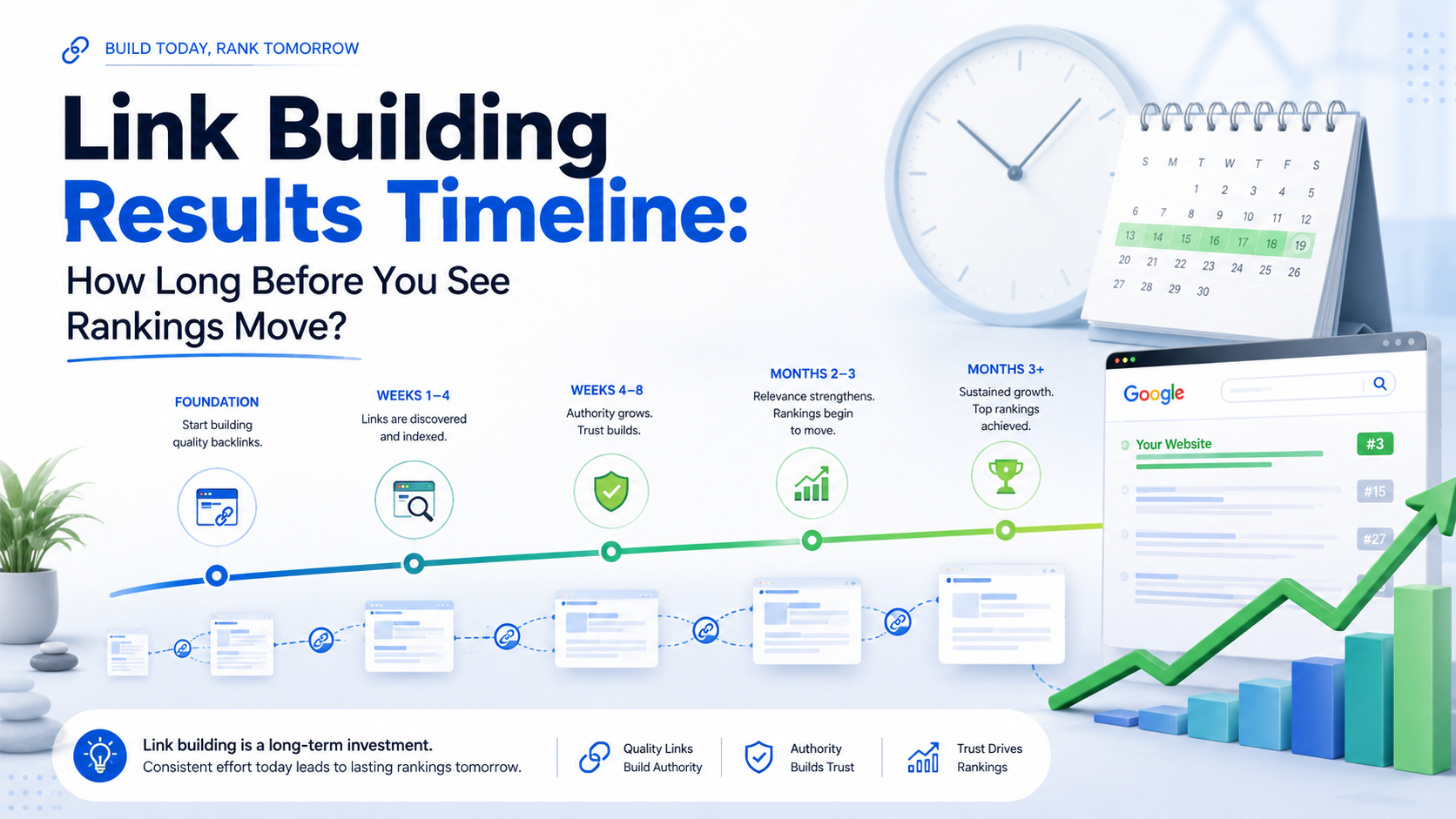
• Most link building campaigns produce measurable ranking improvements within 2–6 months.
• The average backlink takes roughly 10 weeks to visibly influence rankings.
• 89.2% of link builders see results within 1–6 months, per industry survey data.
• Quality, relevance, and consistency of links matter far more than raw volume.
• Domain authority, on-page SEO, and content quality all directly affect how fast link building results appear.
• Campaigns that run consistently for 6–12+ months produce compounding, long-term gains.
Introduction: The Question Every Site Owner Is Asking
You’ve read the playbooks. You’ve hired the agency. You’ve watched your competitor climb the rankings. And now you’re staring at Google Search Console wondering the same thing everybody wonders: “When does this actually start working?”
That skepticism is completely valid. Link building is one of the most discussed – and most misunderstood – strategies in search engine optimization. The internet is full of promises: “get to page one in 30 days,” “buy 500 links and rank overnight.” And then reality sets in. Real link building results don’t happen overnight, and the timeline is rarely linear.
This guide cuts through the noise. Using the latest survey data, real-world case studies, and current SEO research, we’re going to map out exactly what to expect – month by month – when you invest in a link building campaign. More importantly, we’ll show you what separates the campaigns that see rapid results from the ones that stall.
Bottom line: link building results are real, measurable, and worth the wait – but only if you understand the timeline and commit to seeing it through.
Why Don’t Link Building Results Happen Immediately?
This is the first thing any honest SEO professional will tell you: there is always a lag between earning a backlink and seeing your rankings move. Understanding why that lag exists is the key to setting realistic expectations and not pulling the plug too early.
The Three-Stage Discovery Delay
When a new backlink goes live on another website, Google doesn’t instantly apply its full value to your rankings. Three sequential processes must complete before that link moves the needle:
1. Crawling – Google’s bots must first discover the new page or updated content that contains the link. High-authority sites with frequent crawl budgets can be picked up in hours; low-authority or infrequently updated sites may take weeks.
2. Indexing & Evaluation – Once crawled, Google evaluates the link’s context, anchor text, the authority of the linking domain, and the relevance of the content surrounding the link. This evaluation is what determines how much weight the link carries.
3. Re-ranking & Validation – After evaluation, Google adjusts your page’s position. But it doesn’t stop there – Google continues to monitor user behavior (click-through rates, dwell time, pogo-sticking) to validate whether the new ranking deserves to stick.
Each of these stages adds time to the clock. And because they’re happening simultaneously across thousands of pages on your site and hundreds of linking domains, the cumulative timeline is rarely predictable down to the week.
| Key Stat Industry research from Editorial.link analyzed hundreds of domains across industries and found that a single quality backlink takes approximately 10 weeks on average to improve rankings. (Source: Editorial.link, 2024) |
The Indexing vs. Ranking Gap
One of the most common misconceptions in link building is equating indexing with ranking impact. Google indexing a link and that link actually changing your position are two entirely separate events, often separated by weeks or even months.
If you check Google Search Console and see that a link has been indexed, that’s a good sign – but it doesn’t mean rankings will move tomorrow. The full weight of a backlink is distributed gradually as Google tests different ranking positions and monitors user response.
The Month-by-Month Link Building Results Timeline
| TL;DR Months 1–2 are for foundation-building. Months 3–4 bring volatility and early signals. Months 5–6 deliver real traffic movement. Months 7–12 produce compounding gains. |
Months 1–2: The Setup Phase
During the first two months of any link building campaign, the work happening behind the scenes is crucial – but you won’t see much in your rankings. This is the period when your link building partner is:
• Conducting a backlink audit of your existing profile
• Identifying high-value, relevant targets for outreach
• Creating or optimizing the content pages that will receive links
• Beginning outreach to publishers, journalists, and site owners
• Securing the first placements and getting them live
During this period, Google is discovering and beginning to evaluate your earliest links. You may notice a slight uptick in keyword impressions in Search Console – that’s your first signal. Traffic, however, will likely remain flat.
What to track in months 1–2: Number of live links secured, Domain Rating (DR) of linking sites, crawl status of new links in Search Console.
Months 3–4: Volatility Onset and Early Signals
This is statistically the most dangerous phase of any link building campaign – not because things are going wrong, but because things are going right in ways that look alarming. Luca Tagliaferro’s SEO timeline research identifies months 3–4 as a volatility onset period: Google crawls and indexes your link profile, rankings begin to fluctuate, and pages that previously sat at stable positions may bounce up and down.
This is normal algorithm behavior. Google is stress-testing your new positioning. Many businesses make the fatal mistake of canceling their link building program right at this moment, just before the compounding effect kicks in.
| Warning According to research from DiscoveredLabs (2026), link building programs frequently fail not because the strategy is wrong, but because teams cancel in month 3, right before compounding results begin. |
What to track in months 3–4: Keyword ranking volatility, AI citation rate (a leading indicator for AI search visibility), impressions growth in Search Console, domain authority progression.
Months 5–6: The Compounding Effect Begins
If you’ve been consistent – building quality links steadily rather than in sporadic bursts – months 5 and 6 are typically when the needle starts visibly moving. Pages that were sitting on page 2 or 3 begin climbing to page 1. Traffic starts to follow.
Research from Reporter Outreach (2026) across five separate campaigns found that meaningful ranking improvements emerged within 6 months for SaaS clients with solid on-page SEO foundations. Their fastest case study showed 2,203% traffic growth in 6 months for a SaaS company that had strong existing content but minimal authority – link building was the missing piece.
What to track in months 5–6: Page-1 keyword gains, organic traffic sessions month-over-month, pages ranking for new keyword variations, conversions attributed to organic traffic.
Months 7–12: Long-Term Compounding and Authority Building
This is where link building campaigns earn their real ROI. The authority accumulated in the first six months doesn’t just hold – it compounds. Every new piece of content you publish benefits from the baseline trust Google has now assigned to your domain. Every new link you earn carries more weight because it’s being added to an already-authoritative profile.
Campaigns that run consistently for 12+ months often see exponential gains, not linear ones. A site that earned 10,000 monthly organic visits at month 6 might be at 40,000 by month 12, not because they doubled their link volume, but because the authority from earlier links is now elevating newer pages.
What to track in months 7–12: Total referring domains, site-wide traffic growth, ranking improvements across the full content library (not just targeted pages), revenue and conversion attribution from organic.
Month-by-Month Link Building Results at a Glance:
| Phase | Timeline | Ranking Impact | What to Monitor |
| Foundation | Months 1–2 | Minimal / Impressions only | Links live, DR of placements, Search Console impressions |
| Volatility Onset | Months 3–4 | Fluctuation begins, early gains possible | Keyword volatility, AI citation rate, ranking shifts |
| Compounding Begins | Months 5–6 | Page-1 gains, traffic lift visible | Traffic sessions, page-1 keywords, conversions |
| Authority Compounds | Months 7–12 | Exponential, site-wide gains | Total referring domains, revenue attribution, full-site traffic |
| Long-Term Dominance | 12+ Months | Compounding grows with each new link/content piece | Domain Rating growth, industry share of voice, AI visibility |
Key Factors That Determine How Fast You See Link Building Results
TL;DR
Your starting domain authority, content quality, link quality, competition level, and campaign consistency are the five biggest variables controlling your results timeline.
No two link building campaigns produce results on the same timetable. The speed at which you see rankings move depends on a cluster of variables – some within your control, some not. Here’s a deep dive into each one.
1. Your Starting Domain Authority
This is the single biggest predictor of how quickly link building results will appear. A site with a Domain Rating (DR) of 40 and 200 existing referring domains will respond to new links much faster than a site with a DR of 10 and 15 referring domains – even when both run the same campaign.
Why? Google already trusts higher-authority domains. New backlinks push that site past ranking thresholds faster because the baseline trust is already established. For newer or lower-authority sites, expect the first 3–6 months to build that foundation before the compounding effect kicks in.
2. Quality and Authority of the Links You’re Earning
Not all backlinks are created equal – and the gap between a high-authority editorial link and a low-quality directory submission has never been wider. A single editorial placement from a DR 75+ publication can move rankings faster than a dozen links from DR 20 sites.
According to Reporter Outreach’s 2026 survey, 62% of SEOs now prioritize quality over quantity, and 52% require a minimum DR of 50+ for any link placement. Their campaign benchmarks show that targeting DR 77–83+ per placement produces faster timelines than what most agencies report.
3. On-Page SEO and Content Quality
Links amplify what’s already on your site – they don’t compensate for what’s missing. If the destination pages receiving backlinks are thin, poorly structured, or misaligned with search intent, even the best backlinks won’t produce ranking movement.
Google’s Helpful Content System evaluates whether content genuinely serves users. Pages that pass this filter – with clear structure, original insight, proper keyword usage, and schema markup – will see link-driven ranking gains far faster than pages that don’t.
4. Competition Level of Your Target Keywords
The more competitive a keyword, the longer it takes for link building results to materialize. A local plumber targeting “emergency plumber in Columbus” will see faster movement than a SaaS startup targeting “CRM software” – simply because the latter keyword has well-funded competitors with years of authority.
Focusing on lower-competition, long-tail keyword variations during the early months of a campaign is a strategic way to generate early wins while building toward the higher-competition terms.
5. Link Building Consistency
Sporadic link building – acquiring 30 links in month one and then stopping – is less effective than a steady, consistent cadence. Google rewards natural-looking authority growth. A sudden spike followed by silence can raise flags, while a consistent monthly build looks organic and produces compounding gains.
6. Technical SEO Foundation
Backlinks remain among the strongest ranking signals, but they don’t work well in isolation from other aspects of site health. Crawlability issues, slow page speed, poor Core Web Vitals scores, or missing structured data can all throttle the impact of even excellent backlinks.
Factors That Speed Up vs. Slow Down Link Building Results:
| Factor | Speeds Up Results | Slows Down Results |
| Domain Authority | DR 40+ with 200+ referring domains | DR under 15, few referring domains |
| Link Quality | DR 60–80+ editorial placements | Low DR, irrelevant, or spammy links |
| Content Quality | In-depth, E-E-A-T optimized pages | Thin, duplicated, or unfocused content |
| Keyword Competition | Long-tail, low-competition targets | High-competition head terms only |
| Campaign Consistency | Steady monthly link acquisition | Burst-and-pause link building |
| Technical SEO | Fast load, clean crawl, schema markup | Crawl errors, slow speed, poor UX |
| Anchor Text Mix | Natural, varied, topically relevant | Over-optimized exact-match anchors |
| On-Page Optimization | Title tags, headers, internal links aligned | Misaligned content with target keywords |
Quality vs. Quantity: What the Data Actually Says
For years, SEO practitioners debated whether link building was a numbers game. The data from 2024 and 2026 is conclusive: quality has decisively won the argument.
According to a 2024 industry survey:
• 93.8% of link builders now prioritize link quality and acquire links from reputable, relevant websites
• 65.4% of SEO professionals believe domain authority is more influential than raw link count
• The top-rated page on Google typically has 3.8x more backlinks than pages in positions 2–10 – but those backlinks are overwhelmingly from authoritative sources
• Semrush’s 2024 ranking factors study found that the average DR/DA score of the top 10 pages for competitive queries is 67.42 out of 100
Perhaps most telling: John Mueller of Google has explicitly stated that the relevance and quality of links is far more important than volume. A handful of contextually relevant, editorially-placed links from trusted publications will consistently outperform bulk link schemes.
High-Quality vs. Low-Quality Link Building: Side-by-Side Comparison
| Metric | High-Quality Link Building | Low-Quality Link Building |
| Link Sources | Editorial placements on DR 60–80+ sites | PBNs, link farms, spammy directories |
| Relevance | Topically aligned with your niche | Random or unrelated websites |
| Anchor Text | Natural, varied, brand + contextual | Over-optimized exact-match only |
| Google Risk | Minimal – rewards quality signals | High – may trigger manual penalties |
| Timeline to Results | 2–6 months for measurable gains | Short-term spike, then drop or penalty |
| Long-Term Value | Compounding gains over 12+ months | Diminishing returns, often negative |
| Cost Efficiency | Higher upfront, stronger long-term ROI | Cheap short-term, expensive long-term |
| AI Search Visibility | Builds authority for AI citations too | No AI-citation benefit; can harm it |
Link Building Results by Industry and Niche
TL;DR
Results timelines vary significantly by industry. SaaS and tech companies with strong content often see results faster. E-commerce and local businesses face unique competitive dynamics.
One of the most important – and least discussed – factors in link building timelines is industry vertical. The competitive landscape, average content quality, and existing authority levels differ dramatically across sectors.
| Industry | Typical Timeline to Results | Key Challenges | Speed Factors |
| B2B SaaS | 3–6 months | High competition for software keywords | Strong existing content, digital PR opportunities |
| E-Commerce | 6–10 months | Competing against major retailers with massive authority | Product-focused editorial links, lifestyle publications |
| Local Business | 2–4 months | Lower competition, geo-targeted keywords | Local citations, geo-specific editorial placements |
| Healthcare / Legal | 6–12 months | E-E-A-T requirements are intense; strict editorial standards | Expert authorship signals, high-DR niche publications |
| Finance / Fintech | 8–14 months | Highly competitive; extensive regulatory content requirements | Authoritative financial media placements, thought leadership |
| News / Media | 1–3 months | Fast-indexing environment, social amplification | High-DR editorial links, brand mentions |
| Education / EdTech | 4–7 months | .edu link opportunities, high trust requirements | Research-based content, academic outreach |
Link Building and AI Search: The New Visibility Layer
If your link building strategy is purely focused on Google’s traditional organic rankings, you may be missing a rapidly expanding opportunity. AI-powered search interfaces – including Google’s AI Overviews, Perplexity, ChatGPT Search, and others – are fundamentally changing how authority signals translate into visibility.
The brands and pages that AI search engines cite are overwhelmingly those with strong backlink profiles from authoritative, editorially trusted sources. This is because AI systems are trained to prioritize credibility signals – exactly the same signals that high-quality link building produces.
Digital PR links are uniquely valuable in this context: they generate both a backlink and an editorial brand mention, which means they build authority for traditional SEO and AI search visibility simultaneously. According to a 2026 survey by Reporter Outreach, AI citation rate is now emerging as a leading indicator of link building success – particularly in months 1–3 when traditional ranking signals are still warming up.
GEO Optimization: Showing Up in AI-Generated Answers
Generative Engine Optimization (GEO) is the practice of optimizing content and authority signals to appear in AI-generated responses. The principles of link building that improve traditional rankings also improve AI visibility:
• Authoritative backlinks from trusted publishers signal credibility to AI systems
• Consistent brand mentions across reputable sources increase AI citation likelihood
• Content that is well-structured, fact-dense, and cites verifiable sources is more likely to be extracted by AI
• Schema markup and clean HTML improve machine readability for AI crawlers
In practical terms, this means a well-executed link building campaign in 2026 delivers a double dividend: higher traditional rankings AND greater presence in AI-generated answers.
Warning Signs That Your Link Building Isn’t Working
Not all link building campaigns are created equal. Here are the red flags that suggest your campaign may be heading in the wrong direction – and what to do about them:
You’re Building Links But Seeing Zero Movement After 6 Months
If you’ve consistently built quality links for six months and seen zero ranking movement, the issue is usually one of three things: (1) the links aren’t actually high quality, (2) your on-page SEO is suppressing the impact, or (3) there’s a technical issue preventing Google from properly evaluating your content.
Your Rankings Spike and Then Drop Sharply
This pattern often indicates low-quality link building. Google initially rewards new links, then re-evaluates. If the links came from PBNs, link farms, or irrelevant sources, the initial spike will be followed by a correction – sometimes a penalty.
You’re Getting Links From Irrelevant Sources
A backlink from a cooking blog pointing to a cybersecurity SaaS company carries almost zero value. Topical relevance is a critical quality signal. If your link profile is filled with off-topic placements, the cumulative authority impact will be minimal regardless of the DR scores involved.
Your Anchor Text Is Unnatural
Over-optimized exact-match anchor text – where every backlink uses the precise keyword you’re targeting – is a long-standing red flag for Google’s Penguin algorithm. A natural backlink profile includes a variety of anchor types: branded, naked URL, partial-match, and generic.
How to Choose the Right Link Building Partner
Given that link building results depend so heavily on the quality of the links themselves, choosing the right service or agency is arguably the most important decision in your SEO strategy. Here’s what to look for – and how to evaluate your options objectively.
What to Look For in a Link Building Service
• Transparency in publisher vetting – can they show you the DR, traffic, and relevance of placements before you commit?
• Editorial placement approach – are links earned through genuine content and outreach, or purchased from link networks?
• Minimum DR standards – reputable services typically maintain minimum DR thresholds of 50+ per placement
• Niche relevance – does the service build links within your specific industry and topic area?
• Reporting and attribution – can they show you the direct link between their work and your ranking changes?
• Proven case studies with measurable data – traffic numbers, ranking shifts, timeline documentation
Link Building Service Comparison: What Separates the Best from the Rest
The table below compares key attributes you should evaluate when choosing a link building partner:
| Attribute | Best-in-Class Services | Average Services | Red Flags |
| Link Quality | DR 60–80+, editorial placements | DR 30–50, mixed placement methods | Guaranteed links, PBN placements |
| Transparency | Full publisher preview before purchase | Summary reports post-delivery | No reporting or vague metrics |
| Topical Relevance | Strict niche alignment standards | Broad relevance criteria | Links from any available domain |
| Pricing Model | Clear deliverable-based or retainer pricing | Tiered packages with variable quality | Suspiciously cheap bulk offers |
| Timeline Setting | Honest 2–6 month expectations | Vague or optimistic promises | “Guaranteed rankings in 30 days” |
| Case Studies | Specific, verifiable with traffic data | Generic success claims | No evidence of past results |
| AI Search Impact | Digital PR for dual SEO + GEO benefit | SEO-only focus | No consideration of AI search |
Consider Outreachz.com for Scalable, Quality-First Link Building
When evaluating your options, Outreachz.com is worth adding to your shortlist. The platform connects businesses with real editorial placements across a curated network of high-authority publishers – emphasizing topical relevance and transparent reporting over volume-for-volume’s sake. For brands that want consistent, predictable link building results without the guesswork of cold outreach campaigns, a platform like Outreachz provides a structured, accountable approach to growing your backlink profile in line with Google’s quality standards.
Whether you opt for a managed service, an agency retainer, or a platform like Outreachz, the same principles apply: prioritize quality, maintain consistency, and measure results against realistic timelines.
Realistic Expectations: What “Success” Actually Looks Like
One of the most valuable things any link building guide can offer is an honest calibration of expectations. Here’s what success genuinely looks like at each stage – based on real campaign data, not best-case scenarios.
| Campaign Stage | Realistic Success Metric | Unrealistic Expectation |
| Month 1–2 | 3–8 live links from DR 50+ sources; +15–30% impressions in Search Console | Page 1 rankings, traffic spikes |
| Month 3–4 | Ranking volatility with upward trend; early keyword gains on long-tail terms | Stable top-10 placements |
| Month 5–6 | 10–25% organic traffic lift; page-1 appearance for target keywords | Full campaign ROI, dramatic revenue impact |
| Month 7–12 | Compounding traffic gains (25–100%+); site-wide authority elevation | Linear growth matching monthly spend |
| 12+ Months | Exponential gains; new content ranks faster; authority advantage grows | Plateau – good campaigns don’t plateau |
Real-World Reference Point
A SaaS company with solid existing content but minimal organic traffic achieved 2,203% traffic growth within 6 months of consistent digital PR.
The key: strong on-page SEO was already in place – link building was the authority signal Google needed to promote content it had previously overlooked. An e-commerce brand competing against major retailers saw meaningful ranking movement at month 10, with editorial placements in lifestyle and gift publications building credibility over time. A relocation company built links steadily over 6 months and grew from near-zero to 40,000 monthly organic sessions.
Frequently Asked Questions: Link Building Results Timeline
How long does link building take to show results?
Most campaigns see measurable ranking improvements within 2–6 months, with the first visible signals (impression growth, early ranking shifts) typically appearing in weeks 6–10. Significant traffic movement usually follows in months 5–7. The exact timeline depends on your domain authority, content quality, link quality, and competition level.
Can I speed up link building results?
Yes – to a degree. Building from a higher domain authority baseline, targeting lower-competition keywords initially, ensuring your on-page SEO is solid before building links, and focusing exclusively on high-DR, topically relevant placements all compress the timeline. However, there is no legitimate shortcut past Google’s crawl-evaluate-rerank cycle.
Why are my rankings dropping after getting new links?
Ranking volatility – including temporary drops – is normal in months 3–4 as Google tests your new positions. If drops persist beyond month 5 or 6 and are severe, investigate the quality of the links being built. PBN-sourced or irrelevant links can trigger algorithm corrections. Also check for concurrent technical SEO issues or Google core updates that may have coincided with your campaign.
How many backlinks do I need to rank on page 1?
There’s no universal number. The top-ranking pages on Google average 3.8x more backlinks than pages in positions 2–10, but the DR and relevance of those links matter far more than quantity. Ahrefs data shows a correlation of 0.68 between backlink count and rankings – strong, but not absolute. Focus on matching the authority profile of your top competitors, not hitting an arbitrary link count.
Is link building still worth it in 2026?
Absolutely. 79.7% of SEO experts report that link building is an essential part of their optimization strategy, and 80% predict links will remain a ranking factor for at least the next decade. The strategy has evolved – quality, relevance, and editorial integrity now dominate – but the fundamental principle that authoritative links signal trustworthy content remains central to how Google ranks the web.
Do links help with AI search results (Perplexity, ChatGPT, Google AI Overviews)?
Increasingly, yes. AI search systems prioritize credible, authoritative sources for their citations, and the same editorial backlinks that improve traditional rankings also increase your likelihood of appearing in AI-generated answers. Digital PR placements – which generate both backlinks and brand mentions – are particularly effective for building both traditional SEO authority and AI search visibility simultaneously.
Conclusion: Patience, Consistency, and the Right Strategy
The biggest mistake brands make with link building is treating it like a short-term tactic. The data is clear: link building results require a 2–6 month minimum investment before meaningful ranking improvements appear, and the campaigns that deliver the highest long-term ROI are the ones that run consistently for 12 months or more.
Understanding this timeline isn’t just about managing expectations – it’s about making smarter decisions. Every month you cancel a link building campaign too early, you’re leaving compounding gains on the table. Every low-quality link you accept to save money today may cost you a penalty correction tomorrow.
The formula for link building success in 2026 and beyond is straightforward:
• Earn high-quality, editorially placed backlinks from relevant, authoritative publishers
• Build consistently – not in bursts – to produce natural-looking authority growth
• Ensure your on-page SEO and technical foundation can amplify the links you earn
• Track the right metrics at each stage, not just traffic and rankings
• Commit to the full 6–12 month timeline before evaluating campaign success
Whether you’re running an in-house SEO program, working with an agency, or using a platform like Outreachz.com to manage outreach and placements, the principles don’t change. Quality, consistency, and patience are the three pillars of durable link building results – and they’re the only path to rankings that compound over time rather than evaporating overnight.
Ready to Start Measuring Real Link Building Results?
Before launching or scaling a link building campaign, ensure you have:
✓ A clear domain authority baseline (use Ahrefs, Moz, or Semrush)
✓ Target pages with solid on-page SEO and genuine content depth
✓ A vetted link building partner with transparent reporting and quality standards
✓ Realistic timeline expectations: 2–6 months for early signals, 6–12 months for meaningful gains
✓ Tracking in place: Search Console, GA4, and your preferred rank tracker Set the right foundation, choose quality over shortcuts, and link building results will follow.