

Introduction
Every few years, someone declares guest posting dead. Every few years, they’re wrong.
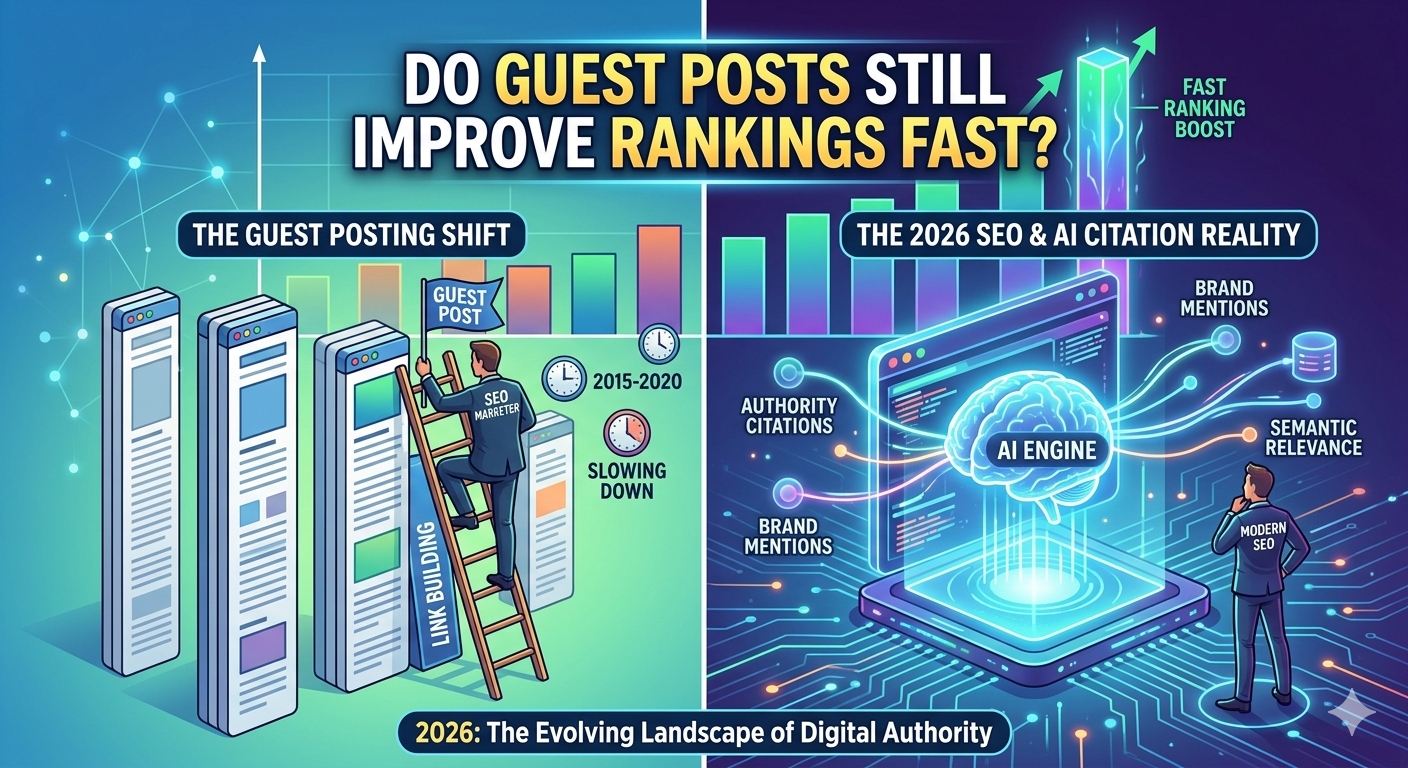
But in 2026, the conversation has evolved. It’s no longer just about whether guest posts still improve rankings, it’s about how they improve rankings, which platforms they influence, and whether your content is getting cited by AI engines that are now reshaping how people discover information online.
The SEO landscape has shifted dramatically. Google’s AI Overviews now appear in an estimated 30–40% of all search queries. ChatGPT serves over 900 million weekly users. Perplexity processes hundreds of millions of queries monthly. The real question isn’t whether guest posting works. it’s whether your guest posting strategy is built for this new reality.
This article cuts through the noise and gives you the full picture: what the data says, where guest posting fits in modern SEO, and what white hat guest posting looks like in a world where AI engines are the new gatekeepers.
TL;DR
- Yes, guest posts still improve rankings, but quality, relevance, and editorial context now matter far more than volume.
- Low-quality or spammy guest posts not only fail to move rankings, they can actively trigger Google penalties.
- A single high-authority, niche-relevant backlink consistently outperforms dozens of weak placements.
- Guest posting now plays a dual role: building traditional SEO signals and earning AI citations in platforms like ChatGPT, Perplexity, and Google AI Overviews.
- Generative Engine Optimization (GEO) is the new layer on top of SEO, and guest posts on authoritative domains are a core strategy for earning AI visibility.The AI Citation Reality: Guest Posting Meets GEO
- White hat guest posting in 2026 means editorial quality, topical alignment, and natural link placement, not mass outreach.
- Expect results in 4–12 weeks depending on backlink quality, competition level, and publishing frequency.
What’s Actually Changed With Guest Posting in 2026
Guest posting as a tactic hasn’t changed. Guest posting as a strategy has changed completely.
Back in the early 2010s, the playbook was simple: publish as many guest posts as possible, stuff in keyword-rich anchor text, and watch rankings climb. Google got wise to that fast. Penguin, manual penalties, and a series of algorithm overhauls systematically crushed low-quality link schemes.
In 2026, the shift isn’t about doing less guest posting. It’s about doing it with intention.
Search engines now evaluate backlinks on a matrix of signals: domain authority, topical relevance, real organic traffic on the host site, editorial quality of the content, natural anchor text variation, and whether the link placement actually makes contextual sense. A guest post on a relevant, active blog with genuine readership sends a completely different signal than a paid placement on a link farm disguised as a blog.
The bottom line: guest posts still improve rankings when they come from real websites with real audiences and real editorial standards. The tactic works, the execution requirements are simply higher.
Do Guest Posts Still Work? What the Data Says
The skepticism around guest posting usually stems from one of two things: people doing it wrong, or people comparing 2012 results to 2026 expectations. Here’s what the current data actually tells us:
- Google’s ranking system still weights contextual backlinks as one of its strongest trust signals. High-authority editorial links from niche-relevant websites continue to move keyword rankings, particularly in competitive SERPs.
- Quality over quantity is no longer optional. A single contextual backlink from a DR 60+ domain in your niche can deliver more ranking impact than 50 links from low-quality guest post farms.
- Generic or AI-spun guest posts are effectively dead. Google’s quality evaluation is sophisticated enough to identify thin, mass-produced content, and such posts now provide negligible SEO value while increasing risk.
- Guest posting for SEO 2026 is increasingly a GEO strategy. Because AI platforms pull from high-authority, frequently-cited content, getting published on trusted industry blogs is now a pathway to AI citation visibility as well as traditional rankings.
The answer to “do guest posts still work” is unambiguously yes, provided the execution is right.
How Guest Posts Improve Rankings: The Core Mechanism
Understanding why guest posts still improve rankings helps you execute the strategy more effectively. There are five primary mechanisms at play:
1. Contextual Backlink Signals When a high-authority domain links to your site within relevant, well-written content, search engines treat it as an editorial endorsement. These editorial links carry significant PageRank value and improve your domain’s overall authority score.
2. Topical Authority Building Consistently publishing on niche-specific platforms builds topical relevance. If your site covers digital marketing and your guest posts appear on respected marketing blogs, search engines begin associating your domain with that subject area, improving rankings for related keyword clusters.
3. Indexation & Crawl Velocity Links from active, frequently crawled websites help search engine bots discover and index your pages faster. For newer sites or fresh content, this can meaningfully accelerate ranking timelines.
4. Referral Traffic & Engagement Signals Guest posts that attract real readers send positive behavioral signals back to search engines. When users click through, engage with your content, and explore additional pages, it tells Google your site delivers genuine value.
5. Brand Entity Strengthening Repeated mentions of your brand name across authoritative domains reinforce your entity in Google’s Knowledge Graph. This matters for both traditional rankings and AI citation likelihood.
Guest Posting for SEO 2026 vs. Previous Years: A Direct Comparison
| Factor | Guest Posting Pre-2019 | Guest Posting in 2026 |
| Volume vs. Quality | Volume-driven, 50+ posts/month | Quality-driven, 5–15 strategic posts/month |
| Anchor Text | Exact match keywords preferred | Natural, branded, and varied anchors required |
| Host Site Standards | Any DA 20+ site accepted | Active traffic, real audience, editorial gatekeeping required |
| Content Depth | 500–800 word articles standard | 1,000–2,000+ words with genuine expertise expected |
| Link Placement | Often forced into bio or footer | Contextual in-body placement only (1–2 per post) |
| Risk Level | Low (Google less sophisticated) | Higher penalties for spammy patterns |
| AI Visibility | Not applicable | Critical, guest posts now feed AI citation models |
| Results Timeline | 2–4 weeks sometimes | 4–12 weeks for quality placements |
| Primary Goal | Rankings only | Rankings + Brand authority + AI citations |
The AI Citation Reality: Guest Posting Meets GEO
This is the dimension of guest posting that most SEOs are still sleeping on.
In 2026, generative engine optimization (GEO), the practice of optimizing content to be cited inside AI-generated answers, has become a legitimate strategic priority. AI Overviews appear on 30–40% of Google searches. ChatGPT has over 900 million weekly users. Perplexity processes hundreds of millions of citation-forward queries each month. According to recent GEO research, AI referral traffic jumped 527% year-over-year in 2025, and platforms like ChatGPT now serve over 900 million weekly users, making AI citation visibility as strategically important as traditional rankings.
Here’s the connection to guest posting: AI platforms preferentially cite content from authoritative, frequently-referenced domains. When your brand earns a guest post placement on a respected industry publication, two things happen. First, you gain a traditional SEO backlink. Second, your brand and content get associated with a domain that AI engines already trust and cite. That association strengthens your chances of appearing in AI-generated answers.
Research from Princeton, Georgia Tech, and The Allen Institute of AI found that comparison articles account for 32.5% of AI citations, while opinion and thought leadership pieces drive another 10%. These are exactly the content formats that perform best as guest posts.
It’s also worth noting that 47% of brands currently have no deliberate GEO strategy, creating a significant competitive window for those who start building AI citation pathways now through strategic guest posting.
What Makes a Guest Post AI-Citation-Ready?
| Content Element | SEO Value | GEO / AI Citation Value |
| Specific statistics with sources | Medium | Very High |
| Expert quotes with attribution | Medium | Very High |
| Comparison tables or structured data | Low-Medium | High |
| Clear, direct answer in first 200 words | High | Very High |
| Schema markup on host site | Medium | High |
| FAQ sections with question-format headers | High | Very High |
| Long-form, comprehensive guides (1,500+ words) | High | High |
| Thin, generic content (under 600 words) | Low | None |
White Hat Guest Posting: What It Looks Like in 2026
White hat guest posting isn’t a separate category of tactics, it’s the only kind of guest posting that works in 2026. Here’s what separates legitimate strategy from practices that will get you penalized:
What white hat guest posting looks like:
- Contributing original, expert-level content to sites where your perspective genuinely adds value
- Selecting host sites based on topical relevance and real audience engagement, not just DR or DA scores
- Using natural anchor text that includes brand variations, partial match phrases, and URL formats
- Placing links where they logically belong within the content, not forcing them into irrelevant contexts
- Building genuine relationships with editors and site owners for long-term publishing opportunities
- Publishing at a measured velocity (5–15 high-quality posts per month) rather than mass-producing low-effort content
What gets you penalized:
- Using content mills or AI spinners to produce low-quality articles at scale
- Targeting sites that clearly exist only to sell links, with no real readership
- Over-optimizing anchor text with exact-match keywords across multiple placements
- Placing more than two links in a single post, especially to unrelated pages
- Paying for guaranteed placements on sites with inflated traffic metrics but no real engagement
How to Identify the Right Guest Posting Opportunities
Finding legitimate, high-value guest posting opportunities is time-intensive but essential. Here’s a practical framework:
Evaluate host sites on these criteria before outreach:
| Metric | Minimum Threshold | Strong Target |
| Domain Rating (DR) | DR 40+ | DR 60+ |
| Organic Monthly Traffic | 5,000+ visits | 20,000+ visits |
| Topical Relevance | Same broad niche | Same specific sub-niche |
| Content Freshness | Posts within 60 days | Posts weekly |
| Editorial Standards | Has guidelines, reviews submissions | Has named editors, editorial team |
| Outbound Link Ratio | Under 5 external links per post | Under 3 external links per post |
If manually finding and vetting sites sounds overwhelming, working with vetted platforms is a practical alternative. The best guest posting services handle outreach, vetting, and placement logistics, letting your team focus on content quality and strategy rather than prospecting.
Common Guest Posting Mistakes That Kill Rankings (and AI Visibility)
Even experienced SEOs make these mistakes consistently:
1. Prioritizing metrics over relevance. A DR 80 site in a completely unrelated industry delivers almost no topical authority benefit, and increasingly limited AI citation value.
2. Writing for the link, not the reader. Guest content that reads like a thinly disguised advertisement signals low editorial quality to both Google and AI crawlers.
3. Ignoring anchor text diversity. A backlink profile where every guest post links with the same exact-match keyword phrase is a manipulation signal that Google actively monitors.
4. Treating guest posting as a standalone tactic. Guest posts still improve rankings most effectively when combined with a strong technical SEO foundation, solid on-page optimization, and a broader content strategy.
5. Neglecting GEO alignment. Writing guest posts without structured data, statistics, and direct-answer formatting misses the AI citation opportunity entirely.
High-Quality vs. Low-Quality Guest Posts: The Full Breakdown
| Attribute | High-Quality Guest Post | Low-Quality Guest Post |
| Content Depth | 1,200–2,000+ words, expert insight | Under 600 words, generic advice |
| Host Site Traffic | Real organic visitors, engaged audience | Inflated metrics, bot traffic |
| Editorial Review | Human editor reviews and edits submission | Auto-published or rubber-stamped |
| Niche Alignment | Directly relevant to your site’s topic | Loosely related or unrelated |
| Link Placement | Contextual, in-body, natural | Stuffed in bio, footer, or unrelated paragraph |
| Anchor Text | Natural brand or partial-match variation | Forced exact-match keyword |
| SEO Impact | Positive ranking signal, topical authority | Minimal to none, potential penalty |
| AI Citation Value | Increases likelihood of AI brand mentions | No contribution to GEO |
| Long-term Value | Compounding, ages well | Diminishing, may be devalued |
How Long Before Guest Posts Impact Rankings?
This is the question every client asks, and the honest answer is: it depends on execution quality.
For high-authority placements (DR 60+) on topically relevant domains with real traffic, ranking movement is typically visible within 4–8 weeks. For mid-tier placements (DR 40–60), expect 8–12 weeks for measurable impact. Results compound, a consistent strategy of 6–10 quality placements per month builds a backlink profile that delivers accelerating returns over time.
AI citation visibility can appear faster. Because platforms like Perplexity use real-time web search and update frequently, a well-structured guest post on an indexed, authoritative domain can begin influencing AI-generated responses within days to weeks of publication.
The Bottom Line: Do Guest Posts Still Improve Rankings in 2026?
Absolutely, but the bar is meaningfully higher than it was five years ago.
Guest posts still improve rankings when they originate from real, editorially-controlled websites in your niche, when they contain genuinely valuable content written for readers first, and when link placement is natural and contextually relevant. The volume-over-quality playbook is dead. The strategic, relationship-driven approach is thriving.
Beyond traditional rankings, guest posting has evolved into a dual-purpose strategy. Done right, it earns backlinks that move Google rankings and builds the brand authority and citation signals that get you mentioned in AI-generated answers across ChatGPT, Perplexity, and Google AI Overviews.
The brands winning in 2026 are not necessarily publishing the most guest posts. They’re publishing the right guest posts, on the right sites, with the right content, positioned for both traditional search and AI citation engines. That’s the standard to aim for.
Frequently Asked Questions
Is guest posting safe for SEO in 2026?
Yes, when done with editorial quality, topical relevance, and natural link placement. What’s unsafe is mass-producing low-quality guest posts on link farm sites, which can trigger algorithmic or manual penalties.
How many guest posts per month is ideal?
Quality is the determining factor, not volume. For most sites, 5–15 high-quality placements per month is a sustainable and effective cadence that avoids over-velocity signals.
Can guest posts help with Google AI Overviews?
Yes. Guest posts on authoritative domains increase your brand’s citation likelihood in Google AI Overviews, especially when the content uses statistics, expert insights, FAQ formatting, and direct-answer structure.
Do guest posts work for local SEO?
Yes, particularly when placed on locally relevant publications or regional industry blogs. Local citations combined with quality backlinks reinforce geographic relevance signals.
Is guest posting still white hat?
Guest posting is white hat when it follows editorial guidelines, provides genuine value to the host site’s readers, and uses natural link placement. It becomes gray or black hat when placements are paid without disclosure, links are forced, or content is spun.