


TL;DR
Short tail keywords (1-2 word phrases) have massive search volume but brutal competition. You won’t rank for them overnight but you also can’t ignore them. This guide shows you exactly how to use short tail SEO as the backbone of a scalable keyword strategy that compounds over time.
What Is Short Tail SEO? (And Why Most Marketers Get It Wrong)
Let me be direct with you.
Most SEO advice out there tells you to ignore short tail keywords and go straight for long tail. “Too competitive,” they say. “Not worth your time.”
That advice is incomplete and following it blindly is leaving serious traffic on the table.
Short tail SEO refers to the practice of optimizing your website content and pages around short, broad, high-volume search terms typically one to two words. Think “shoes,” “CRM software,” “digital marketing,” or “laptops.” These are the kinds of queries that tens of thousands, sometimes millions of people type into Google every single month.
Here’s the thing: the keyword “cars” alone pulls over 1.2 million searches per month and returns roughly 6.6 billion search results. That’s not a niche, that’s a universe. Tapping even a fraction of that traffic can transform your business.
But the bigger picture is this: short tail SEO isn’t just about ranking for one or two big keywords. It’s about building the kind of topical authority and domain credibility that makes every keyword on your site easier to rank for over time. That’s the strategy most people miss entirely.
Short Tail vs. Long Tail Keywords: Understanding the Spectrum
Before you can master short tail SEO, you need to understand where it sits within the full keyword landscape.
The keyword ecosystem breaks down into three tiers:
the Head (short-tail) – broad, high-volume terms like “shoes” or “coffee” with extremely competitive rankings and often vague search intent
the Body (medium-tail) – slightly more specific terms like “men’s running shoes” or “organic coffee beans” where intent is clearer but competition remains high
the Long Tail – highly specific queries like “best organic coffee beans for cold brew” where each unique query has low volume but together they dominate the search landscape.
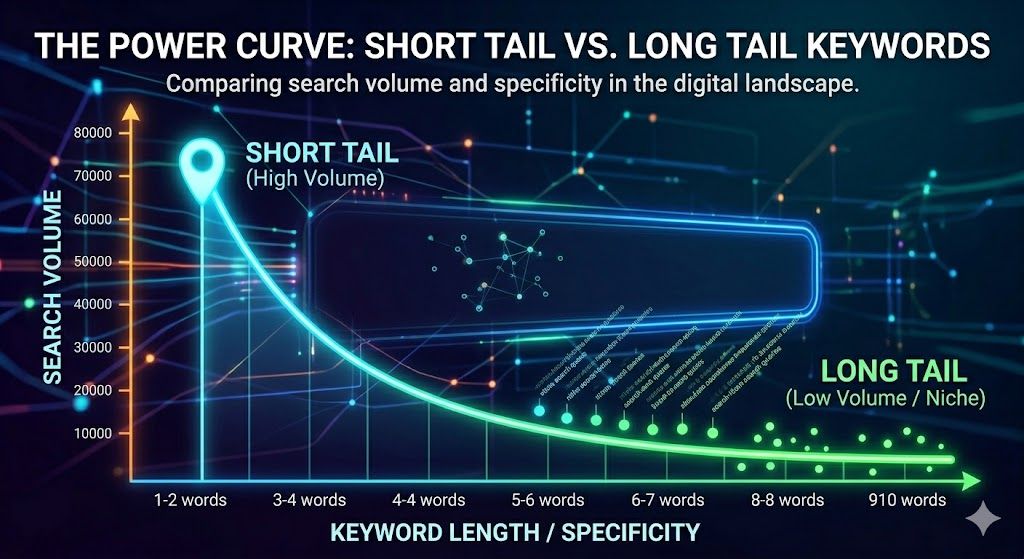
Here’s a comparison to make this crystal clear:
| Attribute | Short Tail Keywords | Long Tail Keywords |
| Word Count | 1-2 words | 3+ words |
| Monthly Search Volume | Very High (10K-1M+) | Low (10-1,000) |
| Keyword Competition | Extremely High | Low to Moderate |
| Search Intent Clarity | Vague / Broad | Specific / Clear |
| Conversion Rate | Lower | Higher (up to 2.5x) |
| Time to Rank | Months to Years | Weeks to Months |
| Best For | Brand Awareness, Authority | Qualified Traffic, Conversions |
| Domain Authority Needed | High | Low to Medium |
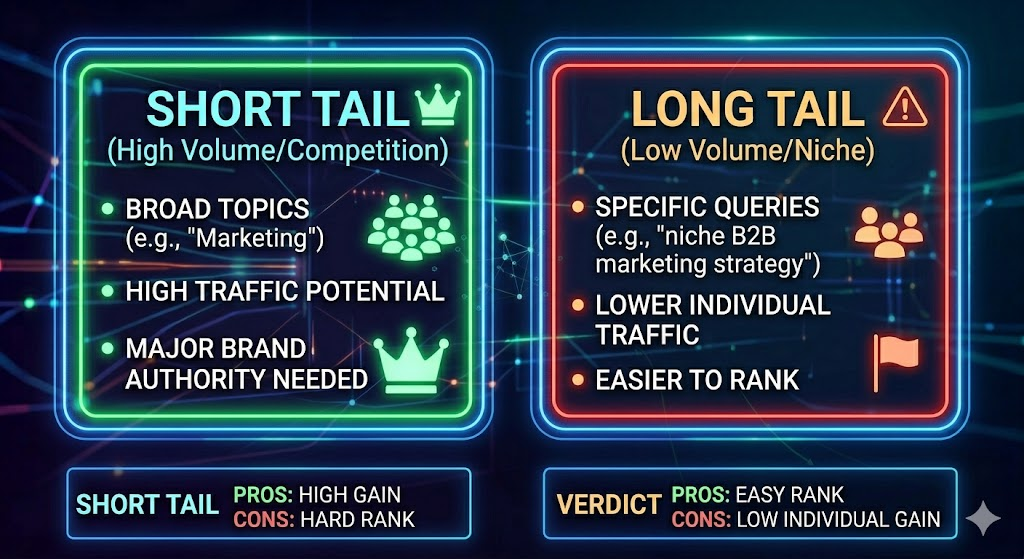
Research shows that 91.8% of all searches are long tail, and they convert at 2.5 times the rate of short tail terms. So why bother with short tail at all?
Because the remaining 8.2% of short tail searches still represents an enormous absolute volume of traffic. And because building authority around head terms fundamentally strengthens your entire keyword portfolio.
Why Short Tail SEO Still Matters in 2026
I’ve been watching search trends for years. And one thing I know for certain: the brands that dominate short tail keywords are the brands that own their industry.
Here’s why short tail SEO deserves a serious place in your strategy:
1. It Builds Massive Brand Visibility
Short tail keywords serve as the main entry points to your website. When users start with broad searches, it’s these keywords that introduce them to your brand and offerings, setting the stage for deeper engagement. If someone searches “CRM” and your brand appears on page one, you’ve planted a flag. You’re now in the consideration set before the user even knows what they specifically want.
2. It Signals Topical Authority to Google
Google’s algorithm rewards sites that demonstrate comprehensive expertise on a subject. When you target short tail terms and build topic clusters around them, you’re signaling to Google that your site is the authoritative source on that subject, not just a page that mentions it once.
3. It Anchors Your Content Architecture
Short tail keywords help identify the pillar pages on your website, the foundational pages that form the core of your content strategy. These pages often target broad, short tail keywords and while they might not always rank immediately, they’re critical for your site structure and user navigation.
Think of your pillar pages like the homepage of a topic. Every supporting article, guide, or comparison page radiates outward from that anchor.
4. It Fuels Your Long Tail Strategy
Here’s a counterintuitive truth: if you optimize your content for long tail keywords, it will help you also rank for the short, broad keywords over time. But the reverse is also true, when you build authority around a head term, all related long tail keywords in that cluster become dramatically easier to rank for.
They feed each other. That’s the flywheel.
The Real Challenge With Short Tail SEO
Let me be honest with you, short tail SEO is hard. I’m not going to sugarcoat it.
Short tail keywords come from the beginning of the search curve, are one to two words, and are full of general, broad search terms. While they might generate a great deal of traffic and interest, they are often highly competitive and far too generic to immediately result in conversions.
Here are the core challenges you’re up against:
Unclear Search Intent: When someone types “coffee,” are they looking to buy it, learn about it, find a coffee shop, or read a recipe? You have no idea. That ambiguity makes it nearly impossible to craft a single page that satisfies every visitor.
Sky-High Competition: For almost every short tail keyword, you’re competing with household-name brands, Wikipedia, major media outlets, and industry giants who have been building domain authority for a decade or more.
Lower Conversion Rates: Because the intent is vague, most visitors landing from short tail keywords are in the research or awareness phase, not the buying phase. Your conversion rates will naturally be lower than long tail traffic.
Longer Time to Results: Ranking for short tail keywords doesn’t happen in a week or a month. For most sites, it’s a multi-year effort that requires sustained content production, backlink building, and technical SEO work.
Does that mean you should avoid them? Absolutely not. It means you need a smarter game plan.
How to Build a Winning Short Tail SEO Strategy
This is where most guides stop at theory. I’m going to give you the actual playbook.
Step 1: Use Short Tail Keywords as Seed Keywords
The first practical application of short tail keywords isn’t to rank for them immediately, it’s to use them as research starting points.
Leveraging tools such as Google Keyword Planner or SEMrush can offer a goldmine of relevant keywords. They not only suggest terms but also provide insights into competition and search volume. Start by entering your broad head terms, then mine the data for long tail variations, related queries, and content ideas.
A single short tail keyword like “project management” can generate hundreds of long tail variations, “project management tools for remote teams,” “project management certification online,” “project management best practices for startups”, each representing a real traffic opportunity.
Step 2: Build Topic Clusters Around Head Terms
Think of topic clusters like building a kingdom. Your pillar page (short tail keyword) is the castle, and cluster content (long tail keywords) are the surrounding villages, all connected by roads (internal links).
Here’s how this looks in practice:
- Pillar Page: “Email Marketing” (targets the short tail term)
- Cluster Content:
- “Email marketing for e-commerce beginners”
- “Best email marketing platforms compared”
- “How to write email subject lines that get opened”
- “Email marketing automation workflows”
- “Email list segmentation strategies”
Each cluster article links back to the pillar page. The pillar page links out to each cluster article. Over time, Google sees your site as the definitive resource on “email marketing” and your short tail ranking climbs naturally.
Step 3: Optimize Pillar Pages for E-E-A-T
If you want to compete for short tail keywords, your pillar pages need to be exceptional. Not good. Not decent. Exceptional.
Following Google’s people-first, E-E-A-T guidelines on Expertise, Experience, Authoritativeness, and Trust is the strategic foundation for gradually moving up the rankings for short tail terms.
For a pillar page targeting a short tail keyword, this means:
- In-depth, comprehensive coverage of the topic (2,000+ words minimum)
- Original data, case studies, or expert perspectives
- Clear author credentials and bylines
- Authoritative backlinks from industry publications
- Fast page load speeds and mobile optimization
- Structured data markup where applicable
Step 4: Map Short Tail Keywords to the Top of Your Funnel
Short tail keywords align well with top-of-funnel (ToFu) content, content that aims to educate and engage a broad audience. This is where brand awareness lives. Your goal at this stage isn’t to convert; it’s to capture attention, build trust, and guide users toward more specific content where conversion happens.
Use short tail keywords for:
- Category landing pages
- Educational hub pages / resource centers
- Brand-defining blog posts
- Comprehensive guide content (“The Ultimate Guide to X”)
Step 5: Earn Your Way Up with Backlinks
There’s no shortcut here. Short tail keywords are highly competitive, but ranking for them can significantly increase your visibility. If your website manages to secure a top spot for a high-volume keyword, your brand will be exposed to a massive audience, which can help boost your overall brand recognition.
The path to getting there runs through backlinks. Build relationships with industry publications, contribute guest posts to authoritative sites, create link-worthy assets like original research reports or free tools, and leverage digital PR.
Every authoritative backlink you earn is a vote of confidence that lifts your short tail rankings incrementally over time.
Short Tail SEO + AI Search: What’s Changing in 2026
Here’s something most guides aren’t talking about yet but they should be.
Short tail keywords can still be valuable for awareness and category leadership, but they come with tradeoffs: more competition, higher volatility, and search intent that is hard to satisfy with a single page. With AI-driven search experiences surfacing direct answers, broad informational queries often get summarized before a user clicks.
What does this mean for short tail SEO? It means that thin, generic content optimized for head terms is getting squeezed out of the click economy by AI Overviews and generative search answers.
The winners in 2026 are sites that:
- Go deeper than surface level: AI can summarize basic information. Your content needs to offer analysis, original perspective, and firsthand expertise that AI can’t replicate.
- Structure content for AI extraction: Answer the core query directly in the first paragraph. Use clear H2/H3 headings. Include FAQ sections that mirror how users phrase questions.
- Demonstrate real E-E-A-T signals: Author credentials, original research, and expert quotes give Google and AI systems a reason to feature your content as a source.
Think of AI Overviews not as a threat but as a distribution opportunity. If your content gets cited in an AI Overview for a high-volume short tail keyword, you’re getting brand exposure at the very top of the search experience even without a traditional click.
Short Tail SEO Tools You Should Be Using
Winning at short tail SEO requires the right data. Here are the tools that give you a competitive edge:
| Tool | Best For | Cost |
| Semrush | Keyword research, competitor analysis, topic clusters | Paid (Free trial available) |
| Ahrefs | Backlink analysis, keyword difficulty scoring | Paid |
| Google Keyword Planner | Search volume data, CPC estimates | Free (Google Ads account) |
| Google Search Console | Tracking existing rankings, CTR optimization | Free |
| Moz Keyword Explorer | Keyword difficulty, SERP analysis | Freemium |
| Surfer SEO | On-page optimization for pillar content | Paid |
The data these tools provide, especially keyword difficulty scores, search volume trends, and competitor gap analysis is non-negotiable if you’re going to compete intelligently for short tail terms.
A Framework for Knowing When to Target Short Tail Keywords
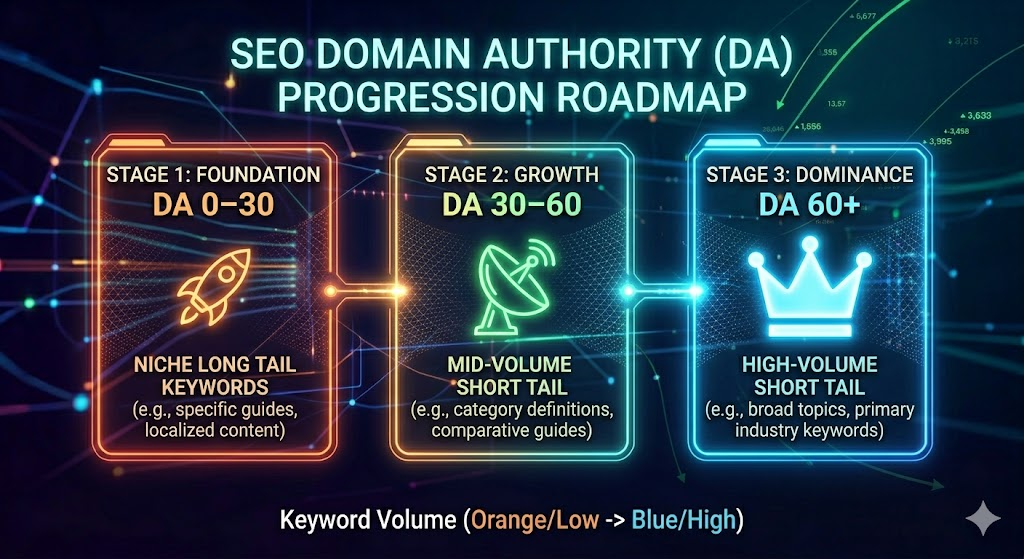
Not every site should prioritize short tail keywords at the same time. Here’s how to know where you are and what to focus on:
New Site / Low Domain Authority (DA 0-30): Don’t chase head terms yet. Focus entirely on long tail keywords to build early rankings and domain authority. Every win you get here compounds into short tail progress down the road.
Growing Site / Medium Domain Authority (DA 30-60): Start building topic cluster pillar pages around strategic head terms. You may not rank page one for the short tail term yet, but your cluster content is pulling in long tail traffic while the pillar page builds authority.
Established Site / High Domain Authority (DA 60+): Now you can aggressively pursue short tail terms. Your backlink profile, content depth, and topical authority have positioned you to compete. Focus on winning featured snippets, AI Overview citations, and page one placements.
Real-World Short Tail SEO Examples
Let me show you how this looks across different industries:
E-commerce Example: A short tail keyword like “running shoes” has millions of monthly searches. A new e-commerce store shouldn’t target it directly. Instead, they build content around “best trail running shoes for beginners,” “how to choose running shoes for flat feet,” and “running shoe size guide.” As their domain authority grows and they earn backlinks, their category page for “running shoes” gradually climbs.
B2B SaaS Example: A project management software company targets the short tail keyword “project management” as a pillar page. They create 20+ cluster articles around subtopics. Over 18 months, the pillar page begins ranking on page two, then page one, not because they stuffed the keyword, but because they built an ecosystem of topical authority.
Content Site Example: A personal finance blog uses “investing” as a seed keyword to generate their entire content strategy. Every long tail article, “how to start investing with $500,” “index funds vs ETFs for beginners,” “best brokerage accounts 2026”, feeds authority back to the core topic.
Common Short Tail SEO Mistakes to Avoid
I see these errors repeatedly. Don’t make them.
Mistake #1: Targeting head terms too early. If your site is new, you’ll burn time and resources trying to rank for terms your domain authority can’t support yet. Build from the long tail inward.
Mistake #2: Treating short tail keywords as standalone pages. One page targeting “digital marketing” with no supporting cluster content is a dead end. Build the ecosystem, not just the pillar.
Mistake #3: Ignoring search intent. Broader keywords have higher search volume, but are also more competitive. The competition makes short tail keywords cost more to rank and comes with lower conversion rates, partly because someone searching “running shoes” may want to learn about them or buy them. They may also want to look up a picture of shoes for a school project or for their own website. Understand who your visitor actually is and design your content around their most likely intent.
Mistake #4: Keyword stuffing. The age-old tactic of keyword stuffing is not just frowned upon but can actively harm rankings. Your short tail keyword should appear naturally throughout the content, in the title, H1, first paragraph, a few subheadings, and organically within the body text. That’s it.
Mistake #5: Neglecting technical SEO. Pillar pages targeting high-competition keywords need to be technically flawless. Core Web Vitals, mobile responsiveness, structured data, and clean crawlability are table stakes at this level of competition.
The Bottom Line: Short Tail SEO Is a Long Game Worth Playing
Here’s my take after years of studying and implementing keyword strategies across hundreds of sites:
Short tail SEO isn’t for the impatient. It’s for the strategic.
Despite the drawbacks, short tail keywords are still a core part of any SEO strategy. Few other types of optimization offer the kind of high visibility and traffic that short tail keywords can. Given their broad search intent and the high levels of competition around them, short tail keywords work best as stepping stones to more targeted, long tail keyword content.
The brands that win at short tail SEO don’t win by accident. They win by building the machine: topic clusters, E-E-A-T content, authoritative backlinks, technical excellence, and the patience to let domain authority compound over time.
Treat short tail keywords like a long-term investment. You don’t expect a stock to 10x in a week. You build a diversified portfolio, hold your position, and let the compounding effect do its work.
Start with the long tail. Build topical authority. Target your pillar pages. Earn your rankings.
That’s how you do short tail SEO right.
Frequently Asked Questions About Short Tail SEO
What is a short tail keyword in SEO?
A short tail keyword is a broad, 1-2 word search term with high monthly search volume and high competition. Examples include “laptops,” “SEO,” or “running shoes.”
Are short tail keywords worth targeting?
Yes, but strategically. They build brand authority and massive traffic potential, but require high domain authority and a supporting content ecosystem to rank effectively.
How long does it take to rank for short tail keywords?
Typically 12-36 months for competitive head terms, depending on your domain authority, content quality, backlink profile, and consistency of execution.
What’s the difference between short tail and long tail SEO?
Short tail targets broad, high-volume, high-competition terms for brand awareness. Long tail targets specific, lower-volume, lower-competition terms for conversions and qualified traffic. Both serve different purposes in a complete SEO strategy.
Should I use short tail or long tail keywords first?
Start with long tail keywords to build early rankings and authority. As your domain authority grows, graduate to targeting short tail terms through pillar content and topic clusters.