

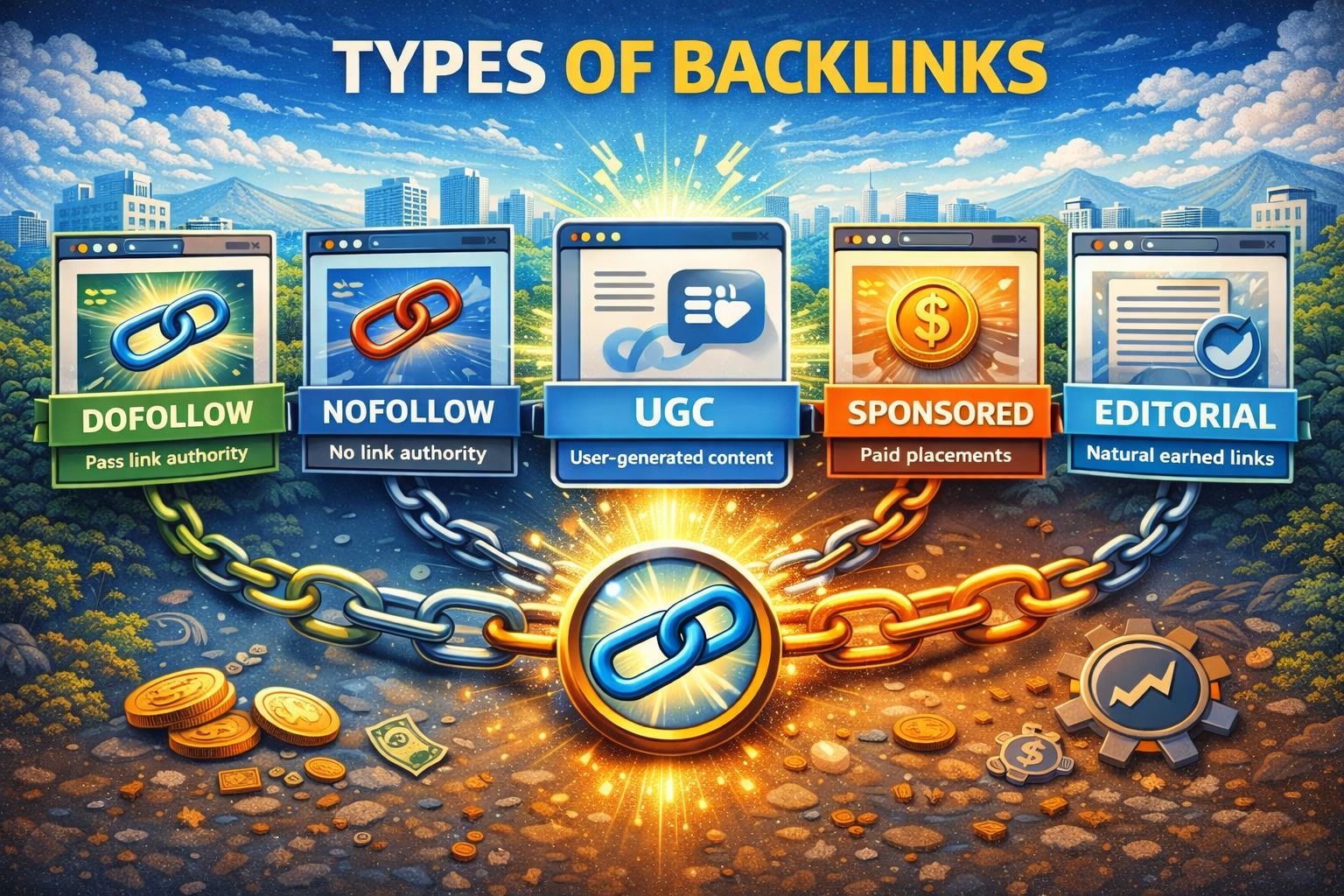
Backlinks are still one of the clearest ways search engines discover pages, understand topical relationships, and estimate whether a page has earned attention from other sites. Google explicitly says it uses links to discover pages and as a relevance signal, while also warning that manipulative link practices can trigger spam systems or ranking loss.
But not all backlinks are equal.
Some backlinks strengthen authority, trust, and discoverability. Some are neutral. Some are misused. And some are the exact kinds of links Google’s spam policies are designed to devalue or penalize. That is why understanding the Types of Backlinks matters more than simply chasing a bigger link count.
This guide breaks down the major types of backlinks in a practical way: by link attribute, by source, by placement, and by SEO value. You will also see which backlink types are worth pursuing, which should be handled carefully, and which should usually be avoided.
What Are Backlinks?
A backlink is a hyperlink from one website to another. In SEO, backlinks are often called inbound links or incoming links. Search engines use them to find new pages and to understand how pages relate to each other. Quality backlinks can support visibility, while low-quality or manipulative backlinks can become a liability.
In simple terms, a backlink acts like a citation on the web. When a relevant site links to your page because your content adds value, that backlink can carry much more weight than a random link placed in a low-quality directory or spammy comment section. Google’s guidance also makes clear that context matters, especially when links are commercial, user-generated, or created at scale to manipulate rankings.
Why the Type of Backlink Matters
Many site owners still ask, “Are backlinks good or bad?” The better question is, “What kind of backlink is it?”
A backlink’s value depends on several factors, including relevance, editorial intent, placement, anchor text clarity, crawlability, and whether the link reflects a real recommendation versus a manufactured signal. Google’s documentation also distinguishes between normal links, paid links, and user-generated links by recommending different rel attributes such as sponsored, ugc, and nofollow.
TL;DR
The best backlinks are relevant, editorially placed, and naturally useful to readers. The riskiest backlinks are paid links passing ranking value, scaled link placements, spammy user-generated links, or manipulative schemes.
The Main Types of Backlinks by Link Attribute
One of the clearest ways to classify backlinks is by attribute. These attributes help search engines understand the nature of a link.
1. Follow Links
A standard link with no qualifying rel attribute is commonly called a “follow” link in SEO. Google’s documentation explains that for regular links you do not need to add a special rel value. These are the links most SEOs usually mean when they talk about earning backlinks.
These links are typically the most desirable when they are:
- placed editorially
- topically relevant
- on crawlable pages
- surrounded by useful context
A follow link from a trusted industry publication, niche blog, university resource page, or well-maintained business partner page is generally far more valuable than dozens of irrelevant links from weak sites.
2. Nofollow Backlinks
Google introduced nofollow as a way to signal that a link should not necessarily pass traditional ranking credit. Later, Google said nofollow, sponsored, and ugc are treated as hints rather than absolute directives. That means a nofollow backlink may still have discovery, referral, branding, and indirect SEO value, even if it is not the same as a standard editorial follow link.
Nofollow backlinks often appear on:
- comments
- forums
- some news sites
- sponsored placements
- social platforms
- user profile links
They should not be dismissed completely. A nofollow link on a highly visible site can still send qualified referral traffic and improve brand discovery.
3. Sponsored Backlinks
Google recommends using rel=”sponsored” for links that are advertisements, sponsorships, or other paid arrangements. This is one of the most important distinctions in modern link building. If money, product, services, or compensation influenced the placement, Google wants that relationship qualified properly.
A sponsored backlink is not inherently bad. The problem is using paid links to manipulate rankings while disguising them as natural editorial endorsements. That crosses into link spam territory.
4. UGC Backlinks
rel=”ugc” is meant for user-generated content, such as forum posts, reviews, community content, and comments. Google explicitly recommends ugc or nofollow for links users can add on your site.
UGC backlinks are common on:
- forum threads
- blog comments
- Q&A platforms
- community profiles
- discussion boards
These links can be valuable for visibility and traffic if they are natural, relevant, and helpful to users. They become risky when they are mass-posted for link manipulation.
Comparison Table: Link Attributes
| Backlink Type | Typical rel Value | Main Use Case | SEO Value | Risk Level |
| Follow backlink | none | Editorial citation or natural recommendation | Usually strongest when relevant | Low |
| Nofollow backlink | nofollow | General non-endorsed or cautious linking | Mixed but still useful | Low |
| Sponsored backlink | sponsored | Paid placements, sponsorships, advertising | Limited for ranking when qualified | Medium if misused |
| UGC backlink | ugc | Comments, forums, reviews, community content | Usually secondary SEO value | Medium if spammed |
The takeaway is simple: attributes do not make a link “good” or “bad” on their own. They clarify the relationship behind the link. The real issue is whether the link exists primarily to help users or to manipulate rankings.
Types of Backlinks by Source
This is the classification most marketers care about because it connects directly to link building strategy.
5. Editorial Backlinks
Editorial backlinks are links placed naturally by publishers, journalists, bloggers, or site owners because your content deserves citation. These are widely considered the gold standard because they are based on merit and editorial choice rather than payment or forced placement. Industry guides from Ahrefs, Semrush, and Backlinko consistently emphasize editorial, relevant, naturally placed links as the most valuable type.
Examples include:
- a reporter citing your original research
- a blogger referencing your guide
- a niche site linking to your tool
- a publisher quoting your expert insight
These backlinks tend to be durable, context-rich, and aligned with how search engines want the web to work.
6. Guest Post Backlinks
Guest post backlinks come from content you contribute to another website. Semrush notes that guest posting can help with reach and backlinks, but Google’s stance is clear: if guest posting is done at scale with the main purpose of manipulating links, it becomes spammy.
That means guest post backlinks sit in a middle zone:
- strong when used selectively on relevant, quality sites
- weak or risky when done at scale on low-quality sites
- problematic when anchor text is over-optimized or links are bought
A thoughtful guest article on a respected site can still be worthwhile. A mass-produced campaign across thin sites is exactly the kind of footprint modern spam systems are built to catch.
7. Digital PR Backlinks
Digital PR backlinks come from media coverage, expert commentary, data studies, trend reports, and story-led outreach. They are often editorial in nature and can be among the strongest backlinks because they usually come from trusted publications with real audiences. Ahrefs specifically highlights editorial and digital PR-style link acquisition as effective forms of link building.
This type of backlink is especially strong when your site publishes:
- original data
- expert commentary
- newsworthy research
- industry benchmarks
- reactive insights on timely topics
8. Resource Page Backlinks
Resource page backlinks come from curated pages that list helpful tools, guides, vendors, definitions, or references around a topic. These can work well when the page is maintained, relevant, and genuinely curated. They tend to perform better when your content is clearly useful rather than promotional. Industry guides commonly classify resource links as worthwhile when they are contextually justified.
9. Directory Backlinks
Directory backlinks are links from business directories, local citation platforms, industry directories, or catalog-style listings. These are not all equal.
A legitimate local business directory, chamber of commerce listing, or credible niche association can be helpful for trust and discoverability. A low-quality directory built only to sell links is much weaker and can become part of a manipulative pattern. Google has long warned that paid links and link schemes violate policy when they are designed to pass ranking value.
10. Forum and Community Backlinks
Forum backlinks come from community discussions, niche forums, product communities, and Q&A sites. These usually fall under user-generated content. They are best used for audience participation and referral traffic, not as a scalable SEO shortcut. Google’s anti-spam guidance for user-generated content and forum abuse makes that distinction very clear.
11. Comment Backlinks
Comment backlinks are links dropped in blog comments or comment-enabled platforms. In most cases, these are low value for SEO and often marked nofollow or ugc. Excessive comment link building is a classic spam tactic and should not be a meaningful part of a modern strategy.
12. Profile Backlinks
Profile backlinks come from business profiles, community accounts, member pages, software listings, or author bios. They may have branding value, but most carry limited SEO weight unless the profile itself is authoritative and relevant. Used naturally, they can support discoverability. Used in bulk, they often become noise.
13. Image Backlinks
Image backlinks happen when another site uses your original image, chart, infographic, or graphic and credits your site with a link. These can be excellent because they are often earned through original assets. They also create reclaim opportunities when your visuals are used without attribution. High-quality visual assets often attract editorial references over time.
14. Partnership Backlinks
Partnership backlinks come from suppliers, vendors, clients, integrations, events, associations, or business relationships. Semrush notes that existing professional relationships can be a realistic source of backlinks when the relationship is genuine and contextually relevant.
These are usually most effective on:
- partner pages
- integration pages
- client success stories
- vendor listings
- association member pages
Types of Backlinks by Placement
Placement changes value. A link inside a strong piece of relevant content is usually more meaningful than a link buried in a footer.
15. Contextual Backlinks
Contextual backlinks appear within the main body content of a page, surrounded by relevant text. Industry guidance consistently treats these as especially valuable because they fit naturally into the topic and are more likely to help users.
16. Author Bio Backlinks
Author bio backlinks are common in guest posts and contributor pages. These can still be useful, but they are typically weaker than a strong contextual editorial mention inside the article itself. Their value depends on page quality, relevance, and how heavily the site relies on contributor content.
17. Footer and Sidebar Backlinks
Footer and sidebar backlinks are sitewide or semi-sitewide links that appear across many pages. These used to be common, but they are often much less valuable today and can look manipulative when overused, especially if keyword-rich anchor text is repeated across an entire site. Google’s spam policies focus on manipulative link practices, and sitewide commercial link patterns can fall into risky territory.
The Best Types of Backlinks for SEO
Not every backlink type deserves equal effort. In 2026, the strongest backlinks usually share the same traits:
- Editorially placed
- Topically relevant
- Contextual within content
- On crawlable, real pages
- On sites with real audiences and standards
That is why the most desirable backlink types are usually:
- editorial backlinks
- digital PR backlinks
- strong contextual guest post backlinks
- earned image backlinks
- relevant resource page backlinks
- real partnership backlinks
These align with how Google describes useful links and how major SEO publishers describe high-quality backlinks.
TL;DR
If a backlink exists because somebody genuinely wanted to reference your content, it is usually the right kind of backlink to pursue.
Backlink Types That Need Caution
Some backlink categories are not automatically bad, but they require restraint and good judgment.
Guest Post Backlinks at Scale
Useful in moderation. Risky when mass-produced. Google explicitly warns against large-scale article campaigns primarily intended to manipulate rankings.
Directory Backlinks
Helpful when they come from legitimate business or industry directories. Weak when they come from low-quality SEO directories.
UGC and Forum Backlinks
Fine when they are natural and genuinely helpful. Problematic when automated, repeated, or dropped across irrelevant threads.
Sponsored Backlinks
Acceptable when properly disclosed with rel=”sponsored”. Risky when paid links are disguised as editorial endorsements.
Backlink Types to Avoid
Google’s spam policies remain the clearest benchmark here. Avoid backlink tactics that exist mainly to manipulate ranking signals rather than help users.
These usually include:
- paid links intended to pass ranking value
- link exchanges done excessively
- mass guest posting solely for links
- automated forum and comment spam
- private blog network style placements
- low-quality directory submissions at scale
- hidden or deceptive links
- site reputation abuse tied to manipulative publishing models
Google’s March 2024 spam policy updates also added sharper focus on large-scale abuse patterns, including site reputation abuse and scaled content abuse. That matters because poor-quality pages created mainly to host links or borrowed authority can fit into broader manipulation patterns.
Table: Good vs Risky vs Harmful Backlink Types
| Category | Examples | Likely SEO Impact | Notes |
| Strong | Editorial, digital PR, contextual resource links, earned image credits | High | Best when relevant and naturally placed |
| Moderate | Guest posts, partner links, niche directories, author bios | Mixed | Works best with real relevance and restraint |
| Low Value | Generic profiles, random forum signatures, most comment links | Low | More branding than ranking value |
| Harmful or Risky | Paid links passing value, spam directories, automated UGC, manipulative sitewide links | Negative to risky | Can trigger devaluation or policy issues |
How to Evaluate Any Backlink Type
When reviewing a backlink, ask these questions:
1. Is the linking site relevant?
Topical relevance remains one of the most cited quality markers in modern SEO guidance. A link from a related site typically makes more sense than one from an unrelated page.
2. Was the link editorially chosen?
Editorial choice is a strong proxy for trust. A link someone chose to add because it improves their content is better than a link inserted as part of a transaction or template.
3. Is the link in the main content?
Contextual links generally outperform links in sidebars, footers, or thin profile pages.
4. Is the link crawlable?
Google recommends using standard crawlable links and sensible anchor text so Search can understand and follow them.
5. Does the link make sense for readers?
This is the simplest and often best filter. If the link helps the reader, it is usually aligned with search engine expectations. If it feels forced, it probably is.
TL;DR
The best backlink audit question is not “Does this link exist?” It is “Would this link still make sense if Google did not count it at all?”
Final Thoughts
The smartest way to think about Types of Backlinks is not as a giant list of link sources, but as a hierarchy of trust.
At the top are backlinks earned because your content deserved to be cited: editorial mentions, digital PR links, strong contextual references, and useful resource inclusions. In the middle are backlinks that can be helpful if used carefully: guest posts, partner links, niche directories, and selected community mentions. At the bottom are backlink types that are usually ignored, devalued, or risky when scaled: spam comments, bulk profile links, manipulative sitewide placements, and paid links designed to pass authority.
In 2026, the winning approach is straightforward: build things worth citing, promote them to relevant audiences, qualify commercial links correctly, and stay far away from shortcuts that exist only to game rankings. That approach is more durable, more brand-safe, and more aligned with how Google says Search works.
Quick FAQ
What are the most valuable types of backlinks?
Usually editorial backlinks, digital PR backlinks, contextual links from relevant content, and earned mentions from trusted sites. These tend to align best with relevance, editorial choice, and genuine user value.
Are nofollow backlinks useless?
No. Google treats nofollow as a hint, and nofollow links can still help with discovery, referral traffic, visibility, and brand signals.
Are guest post backlinks still good?
They can be, if they are selective, relevant, and written for real audiences. Large-scale guest posting campaigns for SEO manipulation are risky.
What backlink types should I avoid?
Avoid paid links that pass ranking value, automated comment spam, manipulative link exchanges, spammy directories, and any large-scale link scheme.
Does Google still care about backlinks?
Yes. Google says it uses links to discover pages and as a relevance signal, while also using spam systems to reduce the impact of manipulative linking.