

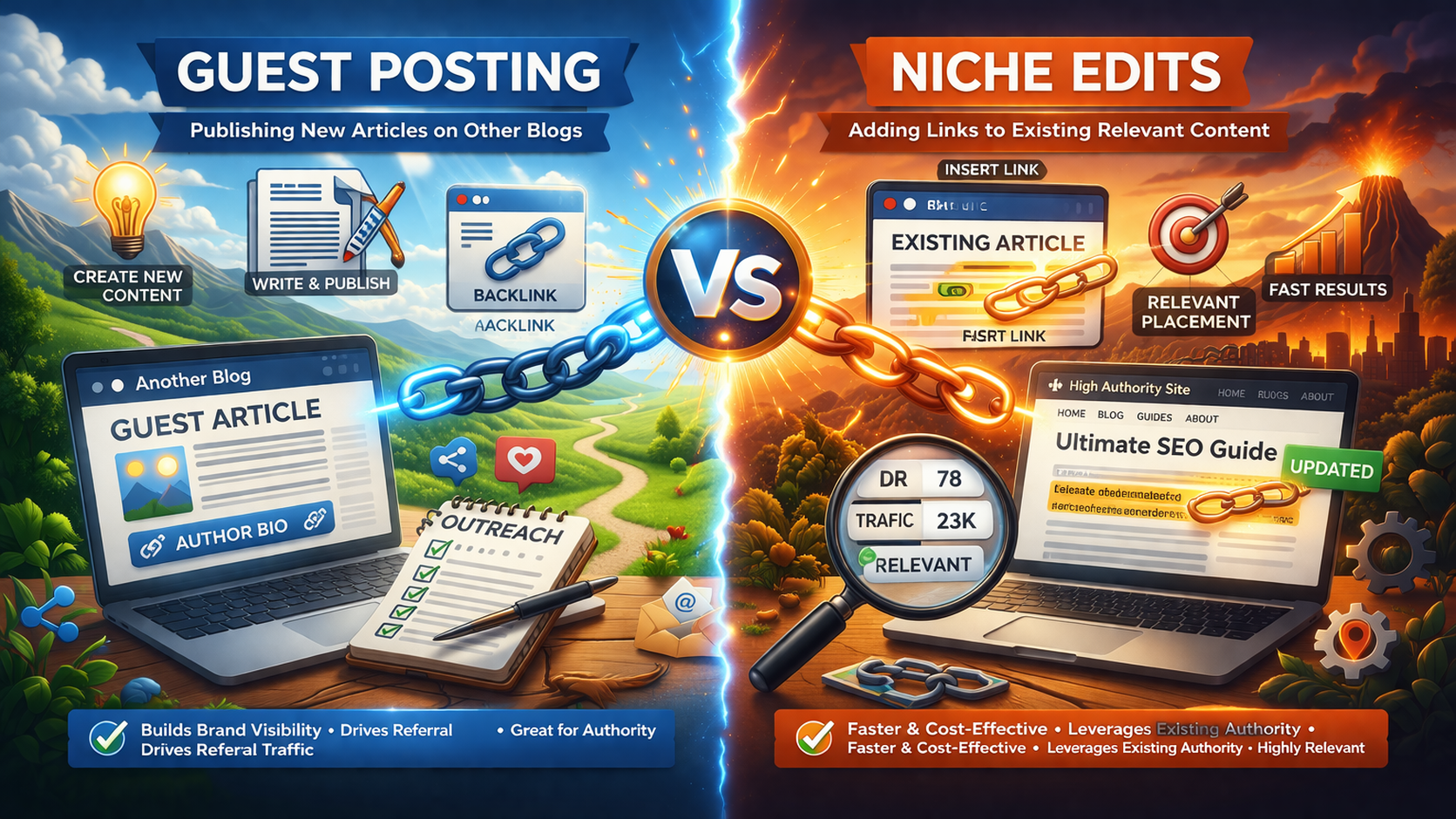
Quick Summary
Guest posting builds brand authority through original content on third-party sites. Niche edits (link insertions) place your link inside already-indexed, high-authority content. Neither is universally better — the right choice depends on your timeline, budget, and goals. This guide breaks down every angle so you can make the smartest move for your site.
Introduction: Why the Guest Posting vs Niche Edits Debate Still Matters in 2026
If you’ve spent any time in the world of SEO, you’ve probably heard the age-old argument: guest posting vs niche edits — which one actually moves the needle? And the truth is, this debate isn’t going away anytime soon, because both tactics genuinely work. The question is understanding when, why, and how to deploy each one.
The link building landscape shifted hard in late 2025. Google’s September 2025 core update cracked down on low-quality backlink networks and guest post farms, forcing the entire industry to pivot from volume-based link acquisition to a relevance-first model. SEO agencies worldwide had to recalibrate their strategies almost overnight. That makes this comparison more timely and consequential than ever.
Whether you’re an in-house SEO manager, a content marketer, a small business owner, or a digital marketing agency running campaigns for multiple clients, this guide gives you the full picture. We’ll dissect both strategies across every relevant dimension — cost, speed, SEO impact, risk, content control, E-E-A-T alignment, and long-term ROI — so you can build a link profile that doesn’t just look good on paper, but actually ranks.
What Is Guest Posting? A Clear Definition
Guest posting — also called guest blogging — is the practice of writing and publishing original content on another website in exchange for one or more backlinks pointing back to your site. It’s one of the oldest and most widely recognized off-page SEO strategies in existence, and it remains highly effective when done right.
The typical guest posting workflow looks like this: you identify a reputable website within your niche, pitch a content idea to the site owner or editor, produce a high-quality article once approved, and in return receive a byline, author bio, and at least one contextual backlink within the body of the post. The host website gains fresh content; you gain a backlink and brand exposure.
Key Benefits of Guest Posting
Brand Authority and Thought Leadership: Publishing on recognized industry sites positions you as a credible voice in your field. When your byline appears on respected publications, both humans and search engines take notice. For YMYL (Your Money or Your Life) niches — finance, health, legal — this kind of editorial association is nearly irreplaceable.
Full Content Control: You write the article from scratch. That means you control the narrative, the anchor text strategy, the internal linking structure, and the messaging around your backlink. For brand-sensitive campaigns, this level of control is invaluable.
Referral Traffic Potential: A well-placed guest post on a high-traffic site can send qualified, niche-specific visitors to your website for years. Unlike niche edits, guest posts create a new indexed page that can rank independently and compound traffic over time.
Relationship Building: The outreach process for guest posting creates genuine publisher relationships that open doors to future collaborations, co-marketing opportunities, and social amplification.
E-E-A-T Signals: Google’s E-E-A-T (Experience, Expertise, Authoritativeness, Trustworthiness) framework rewards authorship signals. A guest post with a named author bio on a trusted domain sends powerful trust signals that a naked link insertion simply cannot replicate.
Drawbacks of Guest Posting
Time-Intensive Process: From prospecting to pitching, writing, revisions, and publication, a single guest post can take anywhere from 8 to 16 hours of total effort. At $50/hour, that’s $400–$800 per link before any paid placement fees.
Indexation Risk: One often-overlooked vulnerability of guest posting is that the host site controls the fate of your backlink. A study examining 203 guest posts published in January 2024 found that by early 2025, only 126 were still indexed — roughly a 38% disappearance rate — effectively doubling the true cost per retained link from $154 to approximately $249.
Competitive Outreach: High-authority sites with strict editorial standards receive hundreds of pitches every month. Securing placements on the best domains requires genuine relationship effort and often premium pricing.
Delayed Results: A freshly published guest post needs time to get indexed and accumulate its own authority. You won’t see immediate ranking improvements the way you can with niche edits on aged, high-traffic pages.
TL;DR: Guest posting is ideal for building long-term brand authority, E-E-A-T signals, and referral traffic. It’s resource-heavy but delivers high editorial value when executed on legitimate, quality sites.
What Are Niche Edits? Breaking Down Link Insertions
Niche edits — also known as link insertions, curated links, or contextual link placements — are backlinks added to existing, already-published content on third-party websites. Instead of creating a new article, you’re inserting your link into a page that Google has already crawled, indexed, and in many cases already ranked for relevant keywords.
The process involves identifying high-authority content in your niche, reaching out to the site owner (or working through a link building service), and negotiating a placement within the existing article. Sometimes a small passage of content accompanies the link; other times the anchor text is woven naturally into the existing copy.
Key Benefits of Niche Edits
Faster Link Equity Transfer: Because niche edits live on pages that are already indexed and have established URL ratings, the link equity flows faster. You’re not waiting for a new page to build authority from scratch — you’re tapping into existing authority immediately.
Lower Cost: Niche edits eliminate content creation costs. Pricing typically runs $50–$365 per placement (averaging $141–$361 for DR 40+ sites), which is generally 20–30% less than comparable guest post placements when you factor in writing fees.
Predictable Quality Assessment: Before you commit to a niche edit, you can audit every key metric of the target page — its Domain Rating, URL Rating, organic traffic, keyword rankings, and index status. With guest posts, the page doesn’t exist yet, so you’re making projections.
Less Content Overhead: No keyword research, no 1,500-word article, no editorial revisions. The operational lift is dramatically lower, which makes niche edits easier to scale, especially for agencies managing multiple client campaigns simultaneously.
White-Hat When Done Right: Ethical niche edits — secured through genuine outreach on high-quality, editorially rigorous sites — are a completely legitimate link building tactic. The key is vetting your target pages carefully with tools like Ahrefs or Moz.
Drawbacks of Niche Edits
No Content Control: You don’t control the surrounding context. The existing article sets the narrative, and your link must fit naturally within it. If the surrounding content is outdated, off-message, or low quality, the placement loses value.
Limited Brand Building: A link insertion doesn’t carry your name, voice, or brand story. There’s no byline, no author bio, and no thought leadership signal. For early-stage brands trying to establish credibility, this is a notable gap.
Gray Area Risk: The niche edit market has a murkier reputation than guest posting because some vendors operate by adding links to sites without the owner’s knowledge, or by using networks of compromised sites. Vetting your provider’s methodology is non-negotiable.
E-E-A-T Gap for YMYL Niches: For finance, health, and legal content, Google’s quality evaluators heavily scrutinize the expertise signals around linked content. A niche edit, no matter how authoritative the host domain, doesn’t provide the authorship and expert-association signals that a properly crafted guest post delivers.
TL;DR: Niche edits are your best bet for fast, cost-efficient authority transfer from established pages. They’re ideal for commercial campaigns that need quick ranking momentum but require careful vetting of both the page and the provider.
Guest Posting vs Niche Edits: Head-to-Head Comparison
The table below offers a structured, at-a-glance breakdown of how these two strategies stack up across every major evaluation dimension.
| Factor | Guest Posting | Niche Edits | Edge |
| Definition | Original article published on a third-party site with your backlink | Your link inserted into existing, indexed content on a third-party site | — |
| Turnaround Time | 3–8 weeks (pitch, write, edit, publish) | 1–3 weeks (outreach + insertion) | Niche Edits |
| Average Cost (DR 40+) | $150–$800+ (incl. writing fees) | $50–$365 per placement | Niche Edits |
| Content Creation Required | Yes — 750 to 2,000+ words typically | No — link added to existing content | Niche Edits |
| Content Control | Full — you write the entire piece | None — existing article sets context | Guest Posts |
| Indexation Reliability | Variable — new pages can be deindexed | High — page is already indexed | Niche Edits |
| Speed of Results | Slower — new pages need time to build authority | Faster — existing page authority transfers immediately | Niche Edits |
| Brand Building Value | High — byline, author bio, thought leadership signals | Low — no authorship or brand narrative | Guest Posts |
| E-E-A-T Signal Strength | Strong — especially for YMYL niches | Moderate — relies on page relevance | Guest Posts |
| Referral Traffic Potential | High — post can rank and send traffic long-term | Low to moderate — depends on page traffic | Guest Posts |
| Scalability | Moderate — content bottleneck limits volume | High — no content required, easier to scale | Niche Edits |
| Risk Level | Lower — editorial standards provide cover | Moderate — varies heavily by provider quality | Guest Posts |
| Link Permanence | Good — but dependent on host maintaining the page | Good — embedded in existing content structure | Tie |
| Best For | Brand authority, YMYL niches, long-term SEO | Quick wins, commercial pages, budget efficiency | — |
| Relationship Building | Strong — opens ongoing publisher partnerships | Minimal — typically transactional | Guest Posts |
| ROI (Short-Term) | Lower — delayed results, higher upfront cost | Higher — faster equity transfer, lower cost | Niche Edits |
| ROI (Long-Term) | Higher — compounds through referral traffic + brand | Moderate — limited compounding effect | Guest Posts |
Cost Breakdown: What You Actually Pay in 2026
Pricing for both guest posting and niche edits has evolved significantly, particularly following the September 2025 quality update that pushed the market away from cheap, high-volume placements toward fewer, higher-quality links.
Guest Post Pricing Tiers (2026 Market Data)
| Domain Rating (DR) | Estimated Cost Per Placement | Notes |
| DR 10–20 | $70–$150 | Entry-level blogs; lower authority but useful for diversification |
| DR 20–40 | $100–$300 | Mid-range sites; good for supporting long-tail keyword strategies |
| DR 40–60 | $250–$600 | Solid authority placements; recommended baseline for competitive niches |
| DR 60–80 | $500–$1,200 | High-authority editorial sites; significant brand exposure |
| DR 80+ | $800–$3,000+ | Major publications (Forbes, Healthline, Investopedia, etc.) |
Note: Writing fees ($50–$200+ per article depending on length and expertise required) are often not included in the placement price above. Factor these into your total cost-per-link calculation.
Niche Edit Pricing Tiers (2026 Market Data)
| Domain Rating (DR) | Estimated Cost Per Insertion | Notes |
| DR 20–40 | $50–$140 | Good for tier-2 support or niche-specific content clusters |
| DR 40–60 | $141–$250 | Core workhorse tier for most commercial campaigns |
| DR 60–75 | $250–$365 | Premium insertions on established editorial sites |
| DR 75+ | $365–$600+ | Reserved for high-authority aged content; rare but high-impact |
Key Insight: Niche edits are generally 20–30% cheaper than equivalent guest posts when accounting for writing costs. However, guest posts can deliver 2–4x more long-term compounding value through referral traffic and brand recognition, making ROI comparisons timeline-dependent.
SEO Impact: Which Strategy Delivers Better Rankings?
This is the question every SEO wants answered in black and white. The honest answer is: it depends on your specific situation. But research and practitioner data from 2025–2026 gives us a much clearer picture than ever before.
Domain Authority and Link Equity
Niche edits placed on aged, high-traffic pages often transfer link equity faster than fresh guest posts because the host page already has established URL Rating (UR) and accumulated backlinks of its own. Google evaluates a page’s existing authority — not just the domain — when determining how much weight a given link carries. A niche edit on a 3-year-old article with 50 referring domains pointing to it will almost always outperform a brand-new guest post on a DR 50 site that was published last week.
Indexation and Stability
One of the most practical arguments in favor of niche edits is indexation certainty. Data from an SEO campaign tracking 203 guest posts found that roughly 38% disappeared from Google’s index within a year — primarily due to webmaster negligence, site restructuring, or domain abandonment. Every lost guest post is a wasted investment. Niche edits, by contrast, live on pages that are already indexed and actively maintained, providing a much more stable foundation for your link profile.
Speed of Ranking Impact
If you need to move a target page up the rankings within 30–90 days, niche edits have a structural advantage. The link equity flows immediately from an established, trusted page. Guest posts require Google to crawl the new page, index it, assess its authority, and then factor that into your backlink profile — a process that can take weeks to months.
E-E-A-T and Content Quality Signals
Google’s E-E-A-T framework has become an increasingly dominant ranking signal, particularly after the 2023–2025 Helpful Content updates. For YMYL content — anything touching money, health, safety, or legal matters — Google’s quality raters look explicitly for author expertise signals. A guest post byline from a named expert on an authoritative publication carries E-E-A-T weight that no link insertion can replicate. This makes guest posting the non-negotiable choice for finance, medical, and legal sector campaigns.
TL;DR: For pure ranking speed and cost efficiency, niche edits win in the short term. For brand-heavy campaigns, YMYL niches, and long-term authority compounding, guest posts deliver superior results. The winning play in 2026 is a calibrated mix of both.
When to Use Guest Posting vs Niche Edits: Decision Framework
The most successful SEO practitioners in 2026 don’t treat this as an either/or debate — they treat it as a toolkit question. Here’s a practical decision framework to guide your choice.
Choose Guest Posting When…
| Scenario | Why Guest Posting Fits |
| You’re in a YMYL niche (finance, health, legal) | E-E-A-T authorship signals are critical; editorial placements on trusted sites carry algorithmic weight |
| You’re building a new brand or repositioning an existing one | Guest posts provide bylines, author bios, and thought leadership exposure that niche edits cannot offer |
| You need long-term referral traffic | A high-quality guest post on a popular site can send targeted visitors for years after publication |
| Your link profile looks unnatural or thin | Fresh, editorially justified content adds diversity and legitimacy to your backlink profile |
| You’re targeting top-tier publications (DR 70+) | Premium publications rarely accept niche edits; guest contributions are the primary access point |
| Budget is long-term oriented | Guest posting’s compounding ROI through traffic and brand compounds over time |
Choose Niche Edits When…
| Scenario | Why Niche Edits Fit |
| You need fast ranking improvements (30–90 day window) | Established pages pass link equity immediately; no waiting for new content to build authority |
| Budget is tight or campaign is high-volume | Lower cost per link allows more placements per dollar; 20–30% savings vs. guest posts |
| You’ve identified a perfect high-authority page in your niche | Tapping into an existing DR 60+ page that ranks for related keywords is highly efficient |
| You’re supporting pillar content with topic cluster links | Niche edits from topically adjacent content reinforce topic authority signals |
| Your existing link profile is heavy on guest posts | Diversifying with link insertions creates a more natural, mixed link acquisition pattern |
| You’re managing multiple client campaigns at scale | Lower content overhead makes niche edits far more scalable across a large portfolio |
The Hybrid Strategy: How Smart SEOs Combine Both in 2026
The smartest link building strategy in 2026 isn’t a binary choice — it’s a blended model that leverages the complementary strengths of guest posting and niche edits. Leading SEO agencies have converged on a hybrid approach that consistently outperforms siloed tactics.
Industry data shows that agencies combining niche edits (for short-term velocity) with guest posts (for sustained authority) report 1.5–2x ROI compared to campaigns relying exclusively on one tactic.
Recommended Hybrid Budget Allocation
| Campaign Phase | Guest Posting % | Niche Edits % | Rationale |
| New Site Launch (0–6 months) | 30% | 70% | Prioritize fast authority transfer to overcome sandbox effect |
| Growth Phase (6–18 months) | 50% | 50% | Balance brand building with continued ranking momentum |
| Mature Site Maintenance | 60% | 40% | Emphasize long-term authority compounding and brand equity |
| Competitive Campaign Sprint | 20% | 80% | Maximize link velocity for rapid SERP movement on target pages |
| YMYL Niche (all phases) | 80% | 20% | E-E-A-T requirements demand editorial authorship signals |
Tiered Targeting Framework
Tier 1 (Brand & Authority): Reserve premium guest post placements (DR 70+, major industry publications) for brand-level campaigns and YMYL topics where editorial association matters most.
Tier 2 (Core Link Building): Use a 50/50 mix of guest posts and niche edits on DR 40–70 sites for your primary money pages and competitive keyword targets.
Tier 3 (Support & Diversification): Use mid-tier niche edits (DR 30–50) for supporting long-tail keyword clusters, topic cluster reinforcement, and link profile diversification.
How to Vet Sites for Guest Posts and Niche Edits
Quality control is the single biggest factor determining whether your link building campaign succeeds or backfires. The September 2025 update made it absolutely clear: Google is getting better at identifying paid link schemes, and low-quality placements don’t just fail to help — they can actively hurt your rankings.
Key Metrics to Evaluate for Any Placement
| Metric | What to Look For | Tool |
| Domain Rating (DR) | Target DR 40+ for competitive niches; DR 30+ for niche-specific long-tail | Ahrefs, Moz |
| URL Rating (UR) | UR of the specific page matters more than DR for niche edits; aim for UR 20+ | Ahrefs |
| Organic Traffic | Minimum 500–1,000 monthly organic visitors; sites with zero traffic are red flags | Ahrefs, SEMrush |
| Traffic Trend | Stable or growing traffic; avoid sites that show sharp recent drops | Google Search Console (if accessible) |
| Spam Score | Below 5% is ideal; above 10% requires caution | Moz Link Explorer |
| Topical Relevance | Content on the site should be clearly related to your niche | Manual review |
| Index Status | Verify the specific page is indexed via Google Search | Google Site: search |
| Outbound Link Profile | Avoid sites with excessive outbound links on single pages (link farm signal) | Ahrefs |
| ‘Write for Us’ Pages | Sites openly advertising paid guest posts carry higher algorithmic scrutiny risk | Manual check |
Red Flag Alert: Avoid any site that openly advertises ‘sponsored posts,’ ‘paid link insertions,’ or ‘write for us’ at scale. Google’s quality guidelines explicitly flag these as link scheme indicators, and placements on such sites carry elevated devaluation risk.
Common Mistakes to Avoid in Guest Posting and Niche Edit Campaigns
1. Prioritizing DR Over Topical Relevance: A DR 80 link from a cooking blog does almost nothing for a SaaS company’s rankings. Topical alignment is the most underrated factor in link building quality.
2. Over-Optimized Anchor Text: Stuffing exact-match keywords into every anchor text is one of the clearest manual penalty triggers. Aim for a natural mix of branded, partial-match, and generic anchors.
3. Ignoring Link Velocity: Acquiring 50 links in a single week after months of inactivity sends an unnatural signal. Maintain consistent, gradual link acquisition that mirrors organic growth patterns.
4. Using Low-Quality Link Services: Some niche edit vendors insert links across thousands of sites without webmaster consent. These gray-hat or black-hat tactics can result in manual penalties that are difficult and time-consuming to recover from.
5. Not Tracking Link Retention: Links disappear. Sites go down, articles get deleted, and webmasters restructure content. Audit your backlink profile quarterly using Ahrefs or SEMrush to catch and replace lost links before they erode your authority.
6. Neglecting Content Quality in Guest Posts: A poorly written guest post not only fails to rank independently — it can damage your brand reputation and result in the host site removing your placement entirely. Treat every guest post as if it were content for your own site.
The Future of Link Building: Where Guest Posts and Niche Edits Are Headed
Google’s direction is unmistakably clear: quality, relevance, and genuine editorial justification are the currency of sustainable link building. The September 2025 algorithm update was a watershed moment, and 2026 continues to reward the same core principles.
Both guest posting and niche edits have a strong future — but only for practitioners who prioritize quality over volume. Guest post farms, PBNs, and link insertion networks operating without editorial oversight are being systematically devalued. What thrives is authentic, topically relevant link placement on sites with real traffic, genuine audiences, and editorial standards.
The rise of AI-generated content has also raised the bar for what constitutes a high-quality guest post. Editors and site owners are now far more selective because they’re inundated with AI-produced pitches. Human expertise, original research, and genuine industry perspective are what secure placements on the sites that actually move rankings in 2026.
Looking ahead, expect to see greater integration of brand signals into link evaluation — publisher authority, author credentials, and site associations will continue to grow in algorithmic importance. This trend further validates the long-term value of guest posting as a brand-building vehicle, while niche edits remain the tactical precision tool for campaign acceleration.
TL;DR: Both tactics will remain viable through 2026 and beyond, but only when executed on high-quality, topically relevant sites. The volume-first era of link building is definitively over. Quality, relevance, and authenticity are the new non-negotiables.
Frequently Asked Questions: Guest Posting vs Niche Edits
Is guest posting or niche edits better for new websites?
For new websites, niche edits offer faster authority transfer because you’re tapping into already-indexed, established pages. However, a mixed approach works best: use niche edits to build initial authority quickly, then layer in guest posts to develop brand credibility and E-E-A-T signals over the following months.
Are niche edits safe in 2026?
Yes, when executed correctly. The key is working with reputable providers who secure placements through genuine outreach on editorially rigorous sites. Avoid any service that can’t explain how it secures its placements or that offers suspiciously low prices at high volumes — these are hallmarks of gray-hat networks.
How many links should I build per month?
Link velocity should match your site’s size, age, and competitive landscape. A new site building 5–15 links per month is reasonable. An established site in a competitive niche might safely acquire 20–50 per month. The critical factor is maintaining a natural growth curve — sudden spikes trigger scrutiny.
Can I use both guest posting and niche edits at the same time?
Absolutely, and you should. Running simultaneous campaigns allows you to capture the fast-acting authority transfer of niche edits while building the longer-term brand equity that guest posts deliver. Most successful agencies allocate budget to both tactics concurrently and adjust the ratio based on client goals and campaign phase.
Do niche edits pass as much link juice as guest posts?
In many cases, a well-placed niche edit on a high-UR, high-traffic aged page passes more immediate link equity than a fresh guest post on a comparable DR site. The existing page authority and established crawl frequency give niche edits a structural advantage in short-term equity transfer.
What’s the ideal anchor text strategy for each?
For guest posts, use your full content and context to build a natural anchor mix: 50–60% branded or partial-match, 20–30% topical or generic, and 10–20% exact-match at most. For niche edits, you have less flexibility — the anchor must fit naturally within the existing text. Work with the context the page provides and don’t force exact-match anchors where they read awkwardly.
Final Verdict: Guest Posting vs Niche Edits — Which Should You Choose?
After dissecting every angle of this debate, here’s the unambiguous takeaway: neither guest posting nor niche edits is inherently superior. They’re complementary tools that serve different strategic purposes, and the highest-performing link building campaigns in 2026 deploy both with deliberate intention.
If you’re running an established site in a competitive, non-YMYL niche and need to move rankings within the next 60–90 days, lean heavily on niche edits. They’re faster, cheaper, and more predictable in the short term. If you’re building a brand, establishing authority in a YMYL niche, or thinking in multi-year timelines, guest posting deserves the lion’s share of your link building budget.
The smartest play — backed by real campaign data — is the hybrid model: allocate roughly 60% of your link building budget to guest posting for sustained authority development, and 40% to niche edits for tactical ranking acceleration and budget efficiency. Adjust that ratio based on your timeline, competitive pressure, and specific page goals.
What hasn’t changed and won’t change is this: quality always wins. Whether you’re writing a guest post or securing a niche edit, the fundamentals are identical — topically relevant, editorially justified, placed on sites with real traffic and genuine audiences. Build links like that, and both tactics will serve you well.